Form a C Corporation in District of Columbia for Free
To start a C Corporation in the District of Columbia (Washington, D.C.), you file Articles of Incorporation (Form DBU-1) with the DC Department of Licensing and Consumer Protection (DLCP), Corporations Division. Swyft Filings prepares and files that paperwork for a $0 service fee, so you only pay the required fee, which starts at $99 and increases if you authorize more than $100,000 in capital. You can also upgrade your package to receive help with bylaws, stock setup, shareholder records, multiple share classes, EIN, registered agent, and other Washington, D.C. Corporation formation services.
Starting a DC C Corp begins with choosing a name that clears DLCP's records, then appointing a registered agent to accept legal mail on your behalf. From there, you'll decide your share structure, file your Articles of Incorporation, put your bylaws in writing, and hold your first organizational meeting. Lastly, you will close things out by getting an EIN from the IRS.
If you find the paperwork complex and time-consuming, Swyft Filings can form your Washington, D.C. C Corp for you at no service cost. You only cover the official filing fee. If you want to know the complete Washington, D.C. C Corporation filing process, here's the full breakdown of each step.
Step 1: Choose a Business Name for Your Washington, D.C. C Corp
Filing a C Corporation requires making your information public. The first thing you share in the filing document, bank papers, or any other filing is your business name. The moment DLCP approves your Articles, your name goes public on the entity record along with other information.
Many filings are rejected only because their name was too similar to an existing one or didn’t fulfill the Corporation naming requirements in the District of Columbia.
Let's go through the DC naming rules for a C Corp:
Your business name must be distinguishable on DLCP's records from every other domestic or foreign entity already on file, under DC Code § 29-103.01.
The name must contain a corporate designator, "corporation," "incorporated," "company," or "limited," or an abbreviation such as "Corp.," "Inc.," "Co.," or "Ltd.," under DC Code § 29-103.02.
The name can't include language reserved for another entity type, so no "LLC" or "limited liability company" in a corporation's name.
Words like "bank," "insurance," or "trust" require prior approval before you can use them.
If you haven't settled on a name, run it through our free Business Name Generator for creative name options. Once you like a name, don’t finalize it. First, search it against DLCP's business name records through CorpOnline (now called BOSS) to confirm it's available before you file.
No. You can go straight to filing your Articles without ever reserving a name first. Reservation is only useful if you're not ready to file yet but want to lock the name down while you handle other formation details. If you reserve, file a Name Reservation Registration & Transfer (Form GN-3) with DLCP under DC Code § 29-103.03. Once you pay the $50 fee, you can hold the name exclusively for 120 days.
DC requires you to register a trade name before using it, under DC Code § 47-2855.02. Operating under an unregistered trade name means you're conducting business under a name the District has no record of. This can complicate opening a bank account, signing contracts, or enforcing agreements under that name, since the name isn't officially tied to your corporation. So rather than guessing, it's best to register a trade name through DLCP's Trade Name Registration Application, if you are using one. It can be filed either online or by mail. Read our complete guide to getting a DBA in DC for the full filing walkthrough.
No. DLCP doesn't require or reference a domain name anywhere on the Articles of Incorporation. It's a practical step for your brand, not a legal one. Online registrars let you check and register a domain for usually $10 to $20 a year. If you choose our ‘Standard’ or ‘Premium’ package, your first year of domain registration and a done-for-you website are included at no extra cost.
No. Filing your Articles of Incorporation only clears your name against other entities on DLCP's records. It doesn't stop another business from using a similar name for its products or services, and DC doesn't run a separate trademark registry the way some states do. For actual trademark protection, you either build common law rights through consistent use, or you file for a trademark with the USPTO for nationwide protection.
Step 2: Appoint a Washington, D.C. Registered Agent
Under DC Code § 29-104.04, every DC corporation must continuously maintain a registered agent. To appoint a registered agent, choose an eligible agent, get their consent, then list their name and DC street address in your Articles of Incorporation when you file.
This isn't something you can leave blank and fill in later. The agent's name and DC address go directly on your Articles of Incorporation, so you need this settled before you file.
A registered agent in DC must meet the following:
A physical street address in DC. A P.O. box doesn't satisfy this requirement.
If you're naming an individual, they must be available at that address during regular business hours to accept service of process and official mail.
If you're naming a business as your agent, it must be a commercial registered agent already authorized to act in that role, or the entity must otherwise be recognized under DC law.
The agent's consent to serve is required. Under the statute, designating an agent on your Articles is treated as your affirmation that the agent has already agreed to the role.
No. A registered agent is a role, not an ownership position. The registered agent's only job is to accept legal documents and state correspondence at a physical DC address during business hours. An LLC owner (a member) can absolutely also serve as that LLC's registered agent if they meet the address and availability requirements, but the two roles are legally distinct. The same logic applies to a corporation: a director, officer, or shareholder can serve as the registered agent, but "owner" and "registered agent" aren't interchangeable terms.
Search the company's name through DLCP's business entity lookup on the DC BOSS portal. Every registered corporation's filed Articles of Incorporation list its current registered agent's name and DC address, and this is public record. If the search doesn't turn up the entity, the business may be registered under a slightly different legal name, or it may not be registered with DC at all.
Yes. The main trade-off is privacy. Your name and DC address become part of DLCP's permanent public record, and that information can end up on data broker sites. You're also required to be personally available at that address during normal business hours to accept legal documents, including service of process if your corporation is ever sued, which limits your flexibility if you travel or work irregular hours. If you miss a delivery because you weren't available, you risk missing a legal deadline. A professional registered agent service keeps your personal address off the public record and forwards documents to you securely instead.
Step 3: Configure Your Share Structure
Your corporation's share structure determines how ownership is divided among shareholders and how much stock your company can issue. Setting it up properly from the start makes it easier to allocate founder ownership, bring in investors, and provide equity to employees as your business grows. District of Columbia doesn't require you to state your authorized share count in the Articles of Incorporation, since DC treats this as flexible, but including it keeps your formation documents consistent with the structure you intend to use.
Work through these before you file:
Choose your stock type: Most corporations use common stock for founders and employees. You may also establish preferred stock if you expect to raise outside investment or need to provide investors with different rights or preferences.
Consider multiple classes: If needed, your corporation can have different classes or series of stock with different voting, dividend, or other rights. The appropriate structure depends on your ownership and financing plans.
Consider voting rights: Decide whether different classes of shares will have different voting rights. For example, one class may have full voting rights while another may have limited or no voting rights.
Plan for future financing: If you expect to seek venture capital or other outside investment, consider how future financing rounds could affect your authorized shares and ownership percentages.
Authorized shares are the total number your corporation is legally permitted to issue, as stated on your Articles of Incorporation. Issued shares are the portion of that total you've actually distributed to shareholders. A corporation can authorize far more shares than it initially issues, holding the rest in reserve for future employees or investors, without needing to amend its Articles every time it grants new stock.
Yes, but it isn't free. Increasing your authorized shares later requires filing an amendment to your Articles of Incorporation with DLCP, which carries its own filing fee and processing time. There's no legal penalty for starting low, but the practical cost is the extra paperwork and delay if you need more shares in the middle of closing an investment round. Most founders authorize more shares than they plan to issue right away specifically to avoid this.
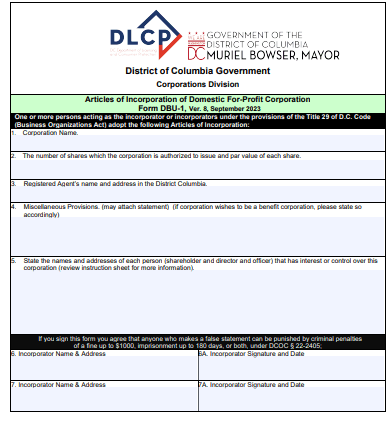
Step 4: File Your DC Articles of Incorporation (Form DBU-1)
Form DBU-1 is the document that legally creates your Corporation, filed with DLCP's Corporations Division. The filing fee starts at $99 for authorized capital up to $100,000, and increases based on the number and value of the shares you authorize above that threshold.
Filing methods:
Online: File through DLCP's BOSS portal (formerly CorpOnline) at corponline.dlcp.dc.gov. This is the fastest method, and payments are made by credit card.
By mail: Complete Form DBU-1 and mail it with payment to DLCP's Corporations Division.
In person: Submit your completed Articles as a walk-in filing at DLCP's Business License Center. Walk-in filings are treated as expedited and are billed accordingly.
What information is required to be added in the Articles of Incorporation:
Corporation name: Must include "Corporation," "Incorporated," "Company," or "Limited," or an abbreviation such as "Corp.," "Inc.," "Co.," or "Ltd."
Number of authorized shares and par value: State how many shares your corporation is authorized to issue and the par value of each share. If you don't list a par value, DLCP values each share at $1 for calculating your filing fee. The fee itself scales with your authorized share count.
Registered agent name and address: List your registered agent's name and their physical address in the District of Columbia.
Miscellaneous provisions: Use this section to note if you're forming a benefit corporation. You can also include optional items here, such as your corporate purpose, share class terms, limits on director liability, or indemnification provisions, though none of these are required.
Ownership and control disclosure: List the name, residence, and business address of every shareholder, director, and officer whose direct or indirect ownership interest exceeds 10 percent, or who holds 10 percent or less but still controls the corporation's financial or operational decisions or day-to-day operations.
Incorporator information: Include the name and address of each incorporator. Every incorporator must sign and date the Articles.
Yes, expediting is available. Standard processing runs around 15 business days. If that's too slow, DLCP offers 3-day expedited service for $50 or same-day service for $100, both charged in addition to the base filing fee, not instead of it.
You can amend your Articles of Incorporation online through DLCP's BOSS portal, the same system used for the original filing. Mail filing is also available if you prefer paper. Both methods require the applicable amendment filing fee.
Yes. DC doesn't require the incorporator to be an individual. A business entity can serve as the incorporator on your Articles of Incorporation, and the incorporator doesn't need to be a director, officer, or shareholder of the corporation being formed. Their only role is signing and submitting the Articles to DLCP.
Step 5: Create Corporate Bylaws
DC doesn't require you to file bylaws, but you need them in place before your organizational meeting, since adopting them is typically the first item on that meeting's agenda. Bylaws should cover:
Board and officer roles, including who has signing authority
Shareholder voting rights and meeting procedures
Stock classes and their attached rights
The vote threshold required for major decisions
The process for transferring or selling shares
Your corporation's dissolution process
Write your own using this list as a checklist, or use a corporate bylaws service, which tailors your bylaws to your actual share structure instead of handing you a generic template.
Without adopted bylaws, your corporation has no written record of how decisions get made, who has authority to sign on the company's behalf, or how disputes between shareholders get resolved. If your corporation is ever sued, this gap can support an argument that the business wasn't run as a genuinely separate legal entity from its owners, which puts your personal liability protection at risk.
Bylaws don't need to be filed with DLCP, but they should be formally adopted by your initial directors or incorporator, usually documented through a signed resolution or the minutes of your organizational meeting. That signed adoption record is what you keep with your corporate files as proof the bylaws were actually put in place.
Bylaws are internal documents, not filed with DLCP, so there's no state office that keeps a copy for you. Your corporation keeps its own adopted copy with its corporate records, alongside meeting minutes and resolutions. If you've lost yours, check with your registered agent, your corporate attorney, or whoever handled your formation, since a formation service often retains a copy on file.
Step 6: Hold an Organizational Meeting
Once your Articles of Incorporation are approved, your initial directors or incorporator hold the corporation's first official meeting. At it, you'll typically:
Adopt the corporate bylaws
Elect officers (president, secretary, treasurer)
Issue the initial shares of stock
Set your fiscal year
Authorize opening a corporate bank account
Keep formal minutes of this meeting and every meeting after it. Minutes aren't filed with DLCP, but they're one of the clearest pieces of evidence that your corporation is following proper formalities, which matters if your liability protection is ever challenged.
No. Meeting minutes are an internal corporate record, not a filed document, so notarization isn't required. What matters is that the minutes are accurate, dated, and signed or approved by the directors present, then kept with your corporate records.
The organizational meeting happens once, right after your corporation is formed, and it's where you adopt bylaws, elect your first officers, and issue your initial stock. An annual shareholder meeting is a recurring meeting held every year after that, where shareholders vote on matters like electing directors and approving major corporate decisions. One kicks the corporation off; the other keeps it running on an ongoing basis.
Step 7: File for an EIN
Once DLCP approves your Articles of Incorporation, apply for an Employer Identification Number (EIN). It's a nine-digit federal tax ID the IRS uses to identify your corporation, separate from your own Social Security number.
Here's why your DC C Corp needs an EIN:
Opening a business bank account
Hiring employees in DC or any other state
Filing your federal tax return and registering with the DC Office of Tax and Revenue
Applying for a business credit card or loan
Keeping your personal Social Security number off business contracts
You can apply for an EIN through the IRS website at no cost, and it takes about 15 minutes. If you can't apply online, you can apply using IRS Form SS-4 instead.
Yes. A non-U.S. resident can obtain an EIN for their DC C Corp. Since the IRS's online application requires a valid SSN or ITIN, most non-U.S. residents apply instead by completing Form SS-4 and submitting it by mail or fax.
Call the IRS Business & Specialty Tax Line to request a replacement confirmation, called a 147C letter. You'll need to verify your identity and your relationship to the business before they'll release the number. You can also often find your EIN on a prior year's tax return or on paperwork from the bank where you opened your business account.
What Are the Post-Formation Requirements for a DC C Corp?
Open a Business Bank Account
Once your EIN confirmation letter arrives, head to the bank. Bring:
Your stamped Articles of Incorporation
Your adopted corporate bylaws
Your EIN confirmation letter
Use this account exclusively for business expenses, and keep it completely separate from your personal finances. This separation is one of the most important habits for protecting your limited liability. Commingling personal and business funds is one of the fastest ways courts pierce the corporate veil, so open this account before you make your first business transaction.
File Your Biennial Report
DC corporations must file a biennial report every two years with the DC Department of Licensing and Consumer Protection (DLCP) to maintain good standing. The biennial report confirms or updates important company information, including the registered agent, principal office address, officers, and directors.
The filing fee for a DC corporation's biennial report is $300. Failure to file the required report on time may result in the corporation losing good standing, facing penalties, or being administratively dissolved.
Obtain Business Licenses and Permits
Nearly every DC C Corp needs a Basic Business License (BBL) to legally operate, regardless of industry. Beyond the BBL, many regulated fields require an additional professional or occupational license, including healthcare providers, construction and contracting, and real estate and property management.
Business license and permit requirements vary widely by industry and take a lot of research. Our business license research service can identify exactly which federal, state, and local licenses your corporation needs and how to apply for them.
Pay DC Corporate Franchise Tax
DC taxes corporate net income at 8.25% under DC Code § 47-1807.02. C Corps must file Form D-20 annually with the DC Office of Tax and Revenue.
A minimum tax applies even during low-profit years:
$250 if DC gross receipts are $1 million or less
$1,000 if DC gross receipts exceed $1 million
Missing this filing, even at zero profit, can trigger penalties and interest, so mark this deadline alongside your biennial report.
How Much Does It Cost to Incorporate a C Corp in DC?
Item
Cost
Articles of Incorporation (Form DBU-1)
$99+ (based on authorized capital)
Name Reservation (Form GN-3, optional)
$50
Trade Name / DBA Registration
$55
Expedited Filing (3-day)
$50
Expedited Filing (same-day)
$100
Biennial Report (every 2 years)
$300
EIN (IRS)
$0
Need Help With Your C Corp Formation in DC?
Starting a DC C Corp involves paperwork and ongoing requirements that can quickly become complicated, from setting up your share structure to keeping up with DLCP's biennial reporting. Swyft Filings has helped businesses with corporation formation and compliance since 2015. Our team understands DLCP's requirements and can help you prepare and file your C Corp paperwork fast and accurately.
*Disclaimer: This guide offers general information about forming a C Corp in Washington, DC, and is not a substitute for legal, tax, or financial advice.*
Check C Corp Formation Guides for Other States
C Corp rules, filing costs, and corporate tax structures vary by jurisdiction. Select any state below to view its specific C Corp laws.
Starting a Washington, D.C. C Corp means filing Articles of Incorporation, appointing a registered agent, and staying current with the biennial report. Swyft Filings has been helping businesses form and stay compliant since 2015. Our team knows the DC DLCP requirements and can file your C Corp quickly, accurately, and in full compliance.
There's no maximum number of shareholders for a DC corporation. Authorize enough to cover your founders, leave room for an employee option pool, and account for at least one future investor round, since authorizing too few now often means an amendment later.
It's optional at that point, but worth drafting anyway if you plan to bring on co-founders, employees, or investors later. It's easier to set the rules before more people hold shares than to negotiate them afterward.
Most C Corp owners take a salary if they work in the business, taxed as ordinary income, or dividends as a shareholder, which get taxed twice: once at the corporate level and again on the owner's personal return. Most owners rely on salary and distribute dividends only from whatever profit is left over.
Our free service covers preparing and filing your Articles of Incorporation, the document that legally creates your corporation. It doesn't cover everything else that goes into running one. You'll also need bylaws, a registered agent, and a Basic Business License. Handle those yourself, or upgrade to a paid package and we'll take care of them for you.
Yes. DC allows a domestic LLC to convert to a corporation by filing the appropriate conversion documents with DLCP. This creates a new corporate entity governed by DC's corporation statutes, so it's worth planning the conversion around your tax year and any existing contracts.
You file Articles of Dissolution with DLCP. Before doing so, settle any outstanding franchise tax and biennial report obligations with DC, since an unresolved balance can complicate or delay the dissolution. Learn more through Swyft Filings' business dissolution service.