
Initial Setup
Compliance
Changes & Filings
Resolve
Protect & Legal
Learn
Excellent
7,984 reviews

Florida routes all C Corp filings through the Department of State's Sunbiz portal. Forming a C Corp in Florida involves choosing a Florida C Corporation business name, appointing a registered agent, filing Articles of Incorporation, establishing your share structure and bylaws, and obtaining an EIN. Here’s a step-by-step guide to forming your Florida C Corp from start to finish.
Under Florida Statute section 607.0401, you must choose a name for your Florida C Corporation that meets Florida’s Corporate naming rules.
1. Use a Corporate Designator
Your Florida corporation’s name must include Corporation, Company, or Incorporated, or an abbreviation such as Corp., Inc., or Co. The designator must clearly indicate that the business is a corporation rather than an individual, partnership, or other type of business entity.
2. Match the Corporation’s Purpose
Your Florida C Corporation name cannot state or imply that the corporation is organized for a purpose that is not permitted under Florida law or its Articles of Incorporation.
3. Avoid Government Implications
The name cannot suggest that your Florida C corporation is affiliated with or connected to a state or federal government agency or a corporation chartered under U.S. law.
4. Choose a Distinguishable Name
Your Florida corporation’s name must be distinguishable from other entities and filings already on record with the Florida Division of Corporations, subject to certain statutory exceptions.
*NOTE: Simply changing a suffix, article (definite and indefinite), “and” to “&,” singular/plural or possessive form, recognized abbreviation, punctuation mark, or symbol generally will not make an otherwise identical name distinguishable.*
If you have selected a name for your Florida C Corporation, it’s a good idea to keep 2–3 backup names in case your first choice is unavailable. If you need more ideas, you can use Swyft Filings’ free business name generator to create several options. Next, search the official SunBiz Corporate Search database to check whether your preferred Florida C Corporation name is available.
You can check your proposed C Corporation name through the Florida Division of Corporations’ SunBiz records search. Enter the name without the corporate suffix, such as “Inc.” or “Corp.” because Florida does not consider different corporate suffixes enough to make names distinguishable.
Review existing entities and their status to determine availability. ACTIVE/ACT or INACTIVE/UA names are generally not available, while an INACTIVE/INACT name is generally available for use.
To file a DBA, known as a fictitious name in Florida, register the name with the Florida Department of State before conducting business under it. You can file online or by mail. The application requires your fictitious name, business information, and owner details. The current registration fee is $50.
Florida also requires the fictitious name to be advertised at least once in a newspaper in the county of the corporation’s principal place of business, although proof of publication is not required. If you need a certified copy of your fictitious name registration, an additional $30 fee applies. A certificate of status for a fictitious name registration costs an additional $10.
When forming a C Corporation in Florida, you must designate a registered agent to receive legal documents and official correspondence on behalf of your corporation. The agent can be an eligible individual resident of Florida or an authorized business entity with a physical street address in the state.
Make sure that your registered agent meets the following Florida corporation requirements listed below:
Physical Address: The agent must maintain a physical street address in Florida. A P.O. Box cannot be used as the registered office address.
Age Eligibility: A person who lives in Florida and is at least 18 years old.
Availability: The agent must be available at the registered office during regular business hours to receive service of process and other official documents.
Formal Consent: Must have formal written or electronic consent/acceptance to serve as your Florida Registered Agent for your C Corporation.
Whether you choose to serve as your own Florida registered agent or hire a professional registered agent service, the appointment process generally involves these steps:
1. Select a Registered Agent: Choose an eligible individual, such as yourself or another trusted person who meets Florida’s corporation requirements, or hire a professional registered agent service.
2. Obtain the Agent’s Consent: The Florida registered agent must accept the appointment as required by Florida law.
3. Provide the Information When Filing Articles of Incorporation: Include the registered agent’s name, Florida street address, and required acceptance information in your corporation’s Articles of Incorporation when filing with the Florida Division of Corporations.
The cost of a registered agent for your Florida C Corp depends on whether you act as your own registered agent or hire a professional registered agent service. Florida charges a $35 fee to designate a registered agent when you form a corporation. This is a state filing fee, not the cost of hiring a professional registered agent.
If you choose to serve as your own Florida registered agent and meet Florida's requirements, you generally only pay the $35 state registered-agent designation fee as part of the corporation formation process. You do not have to pay a separate annual registered-agent service fee. However, if you hire a professional registered agent, you'll pay the Florida state fee plus the provider's service fee. For example, Swyft Filings' registered agent service costs $149 per quarter. That's approximately $49.67 per month when averaged over the quarter.
You need to determine your corporation’s share structure before filing the Articles of Incorporation, as the authorized shares and related details must be included in the formation documents.
Your corporation's share structure determines how ownership is divided among shareholders and how much stock your company can issue. Setting it up properly from the beginning can make it easier to allocate founder ownership, bring in investors, and provide equity to employees as your business grows.
When setting up your Florida C Corp's share structure, consider the following:
Determine authorized shares: Decide the total number of shares your C corporation is authorized to issue. Florida requires this number to be stated in the Articles of Incorporation. You can authorize more shares than you initially plan to issue.
Choose your stock type: Most corporations use common stock for founders and employees. You may also establish preferred stock if you expect to raise outside investment or need to provide investors with different rights or preferences.
Consider multiple classes: If needed, your corporation can have different classes or series of stock with different voting, dividend, or other rights. The appropriate structure depends on your ownership and financing plans.
Consider voting rights: Decide whether different classes of shares will have different voting rights. For example, one class may have full voting rights while another may have limited or no voting rights.
Plan for future financing: If you expect to seek venture capital or other outside investment, consider how future financing rounds could affect your authorized shares and ownership percentages.
Specify the structure in your Articles: Include the required authorized-share information in your Florida Articles of Incorporation when forming the corporation. Keep the formation documents consistent with the share structure you intend to establish.
For example, a startup might authorize 10 million common shares but initially plan to issue only a portion of those shares to its founders. The remaining authorized shares would remain unissued and could potentially be used for future employees or investors. Because your share structure can affect ownership, voting rights, and future fundraising, consider your company's long-term plans before finalizing it.
After choosing a name for your Florida corporation business and deciding who will serve as its registered agent, the next step is to officially form your corporation with the State of Florida. You do this by filing Articles of Incorporation with the Florida Division of Corporations, commonly known as Sunbiz.
To operate as a C corporation, you will need to file the state's Articles of Incorporation for a profit corporation. "C corporation" refers primarily to how the corporation is taxed at the federal level. Florida does not have a separate Articles of Incorporation form specifically for a C corporation. You can file your Articles of Incorporation online through Sunbiz or submit a paper filing by mail or in-person. Choose Swyft Filings’ basic package to start your Florida C Corp for free.
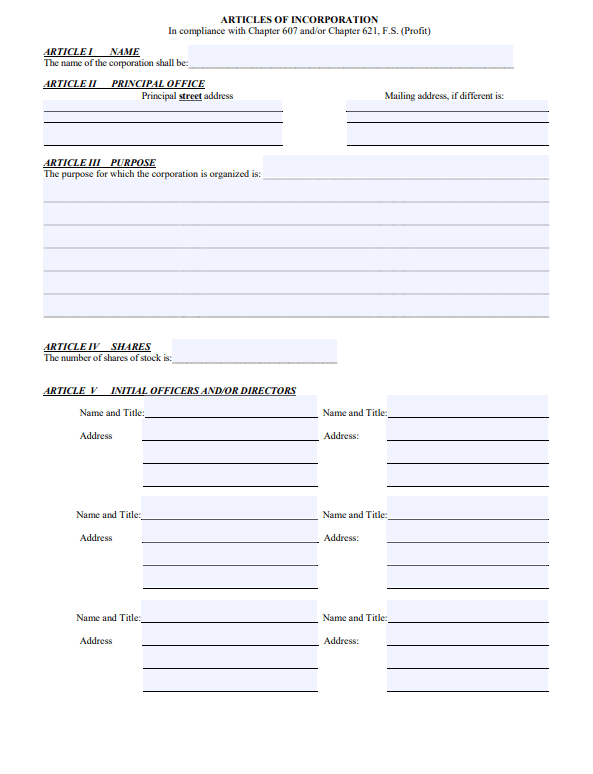
Let’s discuss each in brief:
Option 1: File online
Online filing of Articles of Incorporation through Sunbiz is generally the most convenient option for a new corporation. You will need to enter your corporation's information electronically, provide the registered agent information, identify the incorporator, specify the authorized shares, and provide the other required details.
You'll then review the information before submitting the filing and pay the applicable $70 state fees (Articles of Incorporation filing fee $35.00 + Designation of Registered Agent filing fee $35.00).
Option 2: File by mail
If you prefer not to file online, you can complete the appropriate Florida Articles of Incorporation form and mail it to the Division of Corporations along with the required payment. When filing by mail, make sure the form is complete and properly signed before sending it to the address:
New Filing Section
Department of State
Division of Corporations
P.O. Box 6327 Tallahassee, FL 32314
(850) 245-6052
Option 3: File in person
File your Florida Articles of Incorporation in person by submitting your completed documents as a walk-in filing at the Florida Division of Corporations. The address where you can submit is
New Filing Section
Division of Corporations,
Department of State
The Centre of Tallahassee, 2415 N.
Monroe Street, Suite 810, Tallahassee, FL 32303
NOTE: Florida charges $35 to file the Articles of Incorporation and an additional $35 to designate a registered agent, for a required total of $70. A certified copy costs $8.75, plus $1 per page over eight pages (up to $52.50), and a Certificate of Status costs $8.75. Optional services are not included in the $70 formation fee, so you'll pay additional fees for them if you choose to add any.
To file Florida Articles of Incorporation, you will need:
Florida charges a $70 state fee to form a for-profit corporation. The basic required fees include:
Florida also offers optional items, including a certified copy of the filed document ($8.75, plus $1 per page over eight pages (up to $52.50) and a Certificate of Status, for an additional $8.75 fee. These are Florida state filing fees. They are separate from any fees you may pay to a formation service, registered-agent service, or other.
After you submit your Florida Articles of Incorporation and the required fees, the Florida Division of Corporations processes your filing. If the filing meets Florida's requirements, the state will file the Articles and create a record for your C corporation. Your corporation will receive important identifying information, including its Florida document number.
If you file online, a filing confirmation is generally sent electronically to the email address provided during filing. Once the corporation appears in Florida's business records, you can use the state's records to verify the corporation's status and access filed documents.
Not by itself. When you file Articles of Incorporation in Florida, you are creating a Florida profit corporation. The corporation's federal tax classification is a separate matter.
A corporation is generally taxed as a C corporation by default for federal income tax purposes unless it makes a valid election to be treated differently, such as an S corporation election if it qualifies.
Therefore, if you are following a guide on how to form a C corporation in Florida, the state formation step is to create the Florida profit corporation by filing Articles of Incorporation. You then handle the corporation's federal tax and other compliance requirements separately.
Corporate bylaws are the internal rules that govern how your Florida C Corp is managed and operated. Unlike the Articles of Incorporation, which are filed with the state to legally form the corporation, bylaws are generally kept with the corporation's internal records.
Your bylaws can establish procedures for making decisions, holding meetings, electing directors and officers, and managing the corporation's affairs.
When creating your corporate bylaws for your Florida C corp, consider including:
Board of directors: Define the number of directors, their roles, terms, and how vacancies or replacements are handled.
Shareholder meetings: Establish when and how shareholder meetings will be held and how shareholders will receive notice.
Board meetings: Set rules for calling board meetings, providing notice, establishing a quorum, and voting on corporate decisions.
Officers: Identify the corporation's officers, such as the president, secretary, and treasurer, and outline their responsibilities.
Voting procedures: Explain how shareholders and directors vote and how corporate decisions are approved.
Committees: Establish rules for creating and managing board committees, if needed.
Corporate records: Specify how important corporate documents, meeting minutes, and other records will be maintained.
Amendments: Establish the process for changing the bylaws as the corporation grows.
After the bylaws are prepared, the corporation's initial directors or incorporator should follow the applicable organizational procedures to adopt them and keep the approved bylaws with the company's corporate records.
Need help drafting your Corporate Bylaws? Swyft Filings can simplify the process by preparing and drafting customized Corporate Bylaws. Start by completing a short questionnaire about your corporation's structure, shareholders, and management. Our specialists then draft your Corporate Bylaws and, if needed, a Shareholders' Agreement. You’ll receive your completed documents ready for review and adoption as part of your corporation’s organizational process.
Corporate bylaws should focus on the corporation’s internal governance rather than information that belongs in other documents. Generally, avoid including:
Keep the bylaws for your Florida C Corporation focused on who has authority, how decisions are made, how meetings are conducted, and how the corporation is governed.
After filing your Articles of Incorporation for your Florida C Corp, Florida law requires you to hold an initial organizational meeting where your incorporator or initial directors formally start the business. At this meeting, you will typically:
Keep formal minutes from this meeting and every meeting after it. Minutes are not filed with the state, but they are one of the clearest pieces of evidence that your corporation is following proper formalities, which matters if your liability protection is ever challenged.
After forming your Florida C Corp, apply for an Employer Identification Number (EIN). An EIN is a federal tax identification number used to identify your corporation for tax and other business purposes. Wondering why your Florida C Corp needs an EIN?
Here are the top reasons:
You can apply for an EIN directly on the IRS website at no cost, or have Swyft Filings file it for you as part of your Florida C Corporation formation package.
Filing your Articles of Incorporation creates your Florida C corporation, but you must meet several ongoing requirements to keep it in good standing and maintain its liability protection.
This is the single most important recurring filing for any Florida corporation. Unlike some states, Florida doesn't ask new corporations to file a separate "initial report"; your very first annual report becomes due the calendar year after your Articles of Incorporation are approved.
From there, the rule is the same for every corporation regardless of formation date:
Filing deadline: May 1 each year
Where: Online only, through Sunbiz.org (Florida does not accept mailed or walk-in annual reports)
Fee: $150 for a Florida profit corporation when filed by May 1
Late fee: $400 for reports filed after May 1, and Florida law does not allow this fee to be waived or reduced
What it does: Confirms or updates your registered agent, principal address, mailing address, officer/director names, and FEIN on the state's public record
If you skip it for too long, the state can administratively dissolve the corporation, which can strip away its active status and require a reinstatement filing, along with back fees, to fix it. So, you can consider a professional service like Swyft Filings to file the annual report on your behalf. Our specialists prepare and file the required annual report, and you receive confirmation once the filing is complete.
Unlike an LLC or S Corp, a Florida C Corp pays tax at the entity level. Florida taxes corporate net income at a 5.5% rate. C corporations generally report and pay this tax annually to the Florida Department of Revenue using Form F-1120. This is separate from, and in addition to, the federal corporate income tax.
Florida corporate income tax returns are generally due in the month following the federal due date, and most corporations are required to make estimated tax payments throughout the year if their expected liability exceeds a set threshold. Because this is a corporate-level tax, it applies whether or not the corporation distributes profits to shareholders; dividends are then taxed again at the shareholder level, the "double taxation" C Corps are known for.
Open a dedicated business bank account for a Florida C Corp as soon as your EIN is issued. Mixing personal and business funds, known as commingling, is one of the fastest ways to weaken the liability protection a C Corp is supposed to provide. Banks commonly request documents such as your Articles of Incorporation, EIN confirmation letter, and a corporate resolution or authorization identifying who is authorized to open the account.
Florida doesn't issue a single statewide business license. These requirements vary by location and industry. Depending on where you operate, you may need a Local Business Tax Receipt from your county or municipality. This is renewed annually and carries fines for operating without one. If you are in a regulated field like construction, cosmetology, real estate, food service, or healthcare, you will also need a state license from the DBPR or another agency.
What applies to your Florida C corp depends entirely on your industry and where you are physically operating. It's worth checking with your county tax collector's office directly, or using Swyft Filings business license research service to sort out what's actually required for your specific business and where and how you can apply for them.
If your C corporation sells taxable goods or services, you generally need to register with the Florida Department of Revenue for sales tax before making taxable sales. Florida's state sales tax rate is 6%, and most counties impose a local discretionary surtax.
If you plan to hire employees, you'll also need to register separately for Florida reemployment tax (the state's version of unemployment insurance), which is distinct from the sales tax registration.
The cost of forming a C Corp in Florida depends on the required state filing fees and any additional services you choose. Here’s a quick breakdown of the main costs you may encounter:
| Cost | Fee |
|---|---|
| Articles of Incorporation | \$35 |
| Registered Agent Designation | \$35 |
| Total required formation cost | \$70 |
| Name Reservation (optional, 120 days) | \$35 |
| Certificate of Status (optional) | \$8.75 |
| Certified Copy (optional) | \$8.75 |
| Florida Corporation Annual Report Fee | \$150/year |
| Annual Report Late Fee (after May 1) | \$400 |
Starting a Florida C Corp involves paperwork and ongoing requirements that can quickly become complicated, from setting up your share structure to keeping up with state filings. Swyft Filings has helped businesses form corporations in Florida for free since 2015. Our team understands Florida Division of Corporations requirements and can help you prepare and file your C Corp paperwork accurately and efficiently.
$0 + State Filing Fees
*Disclaimer: This guide provides general information about forming a C Corp in Florida and is not a substitute for legal, tax, or financial advice.*
C Corp rules, filing costs, and corporate tax structures vary by jurisdiction. Select any state below to view its specific C Corp laws.