
Initial Setup
Compliance
Changes & Filings
Resolve
Protect & Legal
Learn
Excellent
7,984 reviews

Start a C Corp in Texas by choosing a unique business name for your corporation, then appoint a registered agent to act as your point of contact with the state. Next, file your Certificate of Formation and configure your share structure. From there, draft your corporate bylaws, hold your organizational meeting, and obtain an EIN.
If you don’t want to handle the paperwork yourself or want to avoid filing errors, Swyft Filings can handle the entire process of forming a C Corp in Texas for you. Here's a step-by-step breakdown of each step below.
Your corporation's name becomes public the moment you file. It appears on your Certificate of Formation and on every document you file afterward, and it's what customers will see in your ads and on your signage once you start marketing. Choose something easy to read and say out loud, and something that actually connects with the customers you're trying to reach.
Here are the rules every Texas C Corp name must follow:
It must be distinguishable from every other entity already on file with the Texas Secretary of State, under Texas Business Organizations Code § 5.053.
It must include a corporate designator, such as "Corporation," "Incorporated," "Company," "Corp.," "Inc.," or "Co.," under Texas Business Organizations Code § 5.054.
It cannot falsely suggest affiliation or connection to a state or federal government agency, under Texas Business Organizations Code § 5.064.
Certain restricted words require prior approval before you can use them. "Bank" or "Trust" needs a no-objection letter from the Texas Banking Commissioner under Texas Finance Code § 31.005, and "College" or "University" needs approval from the Texas Higher Education Coordinating Board under Texas Education Code § 61.313.
If you haven't landed on a name yet, run it through our free Business Name Generator to get unique naming options. Once you have a potential name, run it through the Texas Secretary of State's SOSDirect business name search at $1 per search to confirm no one else has it. Read our complete guide to business entity search in Texas for a step-by-step name checking breakdown.
Before you file anything, name someone to receive legal documents and state correspondence on your corporation's behalf. This must be in place when you submit your Certificate of Formation, since the agent's name and Texas address go directly on that form. A registered agent in Texas should meet the following requirements:
An individual registered agent must be at least 18 years old and reside in Texas.
They should have a physical street address in Texas. P.O. box addresses are not allowed for registered agent purposes.
They must be available at the address during normal business hours to receive state or legal papers.
They must provide written or electronic consent to serve as the registered agent.
If your registered agent is an organization, it must be based in Texas and registered or authorized to do business in Texas.
Registered agent appointment includes the following steps:
You need to state the number of shares in your Certificate of Formation, along with other ownership details.
Consider the following things when setting up share structure for a Texas C Corp:
Choose Your Share Types: Founders and early employees typically hold ordinary (common) shares. You can also create preferred shares, which carry priority on payments, meaning preferred holders get paid before common holders if the company is sold or liquidated. Investors typically require these.
Set Up Multiple Share Classes: Many corporations split their stock into Class A and Class B, with one class carrying more votes per share, letting founders raise capital without giving up board control.
Assign Voting Rights and Board Appointments: Your share class determines how much voting power a shareholder has, and whether their shares include the right to appoint or remove a board member. Decide this for each class before you issue any stock.
Restrict Share Transfers: Most shareholder agreements include a right of first refusal, meaning a shareholder who wants to sell must offer the shares to existing shareholders or the corporation first, before selling to an outside buyer.
Plan for Future Financing: If you expect to seek venture capital or other outside investment, consider how future financing rounds could affect your authorized shares and ownership percentages.
Understand Dilution: Existing shareholders' ownership percentage can shrink whenever the corporation issues new shares, unless a preemptive right or anti-dilution provision in the shareholder agreement limits it.
Offer Equity Compensation to Employees: Instead of paying cash for the full salary, you can grant employees stock or stock options as part of their compensation. Most corporations set aside an option pool, commonly 10% to 20% of authorized shares, specifically for this purpose, and grant options from that pool on the same vesting schedule as founder shares. This is a common way to attract talent early on, when cash is limited.
Set a Vesting Schedule: A vesting schedule sets the timeline over which an employee or founder earns full ownership of their granted shares. The standard structure is 4 years with a 1-year cliff, meaning no shares vest until the employee has been with the company for a full year, after which vesting continues monthly or quarterly.
What Happens to Shares If a Shareholder Dies: Your shareholder agreement should specify this in advance with a buy-sell provision, whether the corporation buys the shares back, offers them to remaining shareholders, or lets them pass to the deceased shareholder's estate.
Once your structure is decided, the actual issuance involves:
Put all of the above into one document. This becomes your shareholder agreement. It is one of the reference documents your corporation and its shareholders will actually use.
This is the document that legally creates your corporation. It's Form 201, filed with the Texas Secretary of State.
How do you file your Texas Certificate of Formation?
Online: Go to SOSDirect, the Texas Secretary of State's online filing portal, create an account, and submit Form 201 with the $300 filing fee.
By mail: Send Form 201 and a $300 check to the Secretary of State, P.O. Box 13697, Austin, TX 78711-3697.
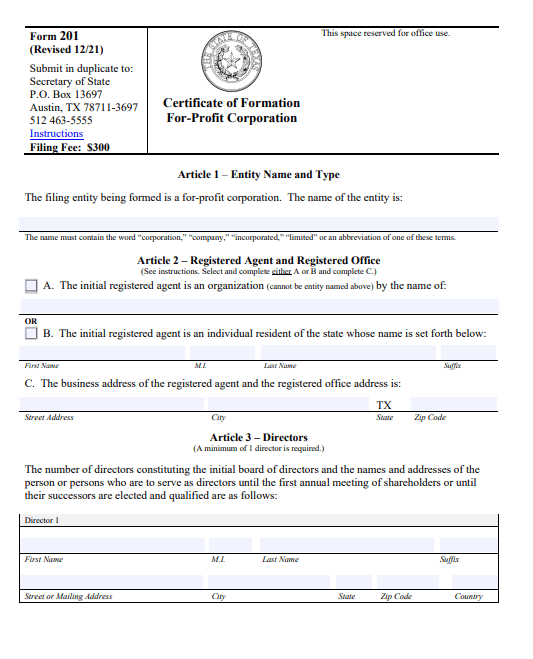
In person: File at the James Earl Rudder Office Building, 1019 Brazos Street, Austin, TX 78701.
To complete your Texas C Corporation formation, you’ll need basic business and organizer details, including:
Standard online filings through SOSDirect typically take 5 to 7 business days to process. If you need it faster, Texas offers three expedited tiers under its Texas Express program, all available for Certificate of Formation filings:
Standard Expedited: $50 per document, processed in about 2 to 3 business days.
Next-Day Service: $500 per document. Filings received by 12:00 p.m. are processed by the close of business the next business day.
Same-Day Service: $750 per document. Filings received by 12:00 p.m. are processed by the close of business that same day. This tier must be requested in person or by email to [email protected], rather than through the standard SOSDirect checkout.
Note: Expedited filing charges don’t include the filing fee. $300 fee to file Form 201 still applies.
Bylaws are your corporation's internal rulebook. Texas doesn't require you to file them with the state, but you need them in place before your organizational meeting, since the meeting's first order of business is adopting them.
What must be included in bylaws?
Write your own using the requirements above as a checklist, or use a template. Our corporate bylaws service builds a set tailored to your share structure and share classes rather than a generic template.
After the bylaws are prepared, the corporation's initial directors or incorporator should follow the applicable organizational procedures to adopt them and keep the approved bylaws with the company's corporate records.
This is your first official meeting as a corporation. At it, you and your initial directors will:
Record formal minutes of this meeting and keep them with your corporate records. Texas law requires corporations to keep meeting minutes.
Minutes are not filed with the state, but they are one of the clearest pieces of evidence that your corporation is following proper formalities, which matters if your liability protection is ever challenged.
Once the state approves your Texas Certificate of Formation, you can apply for an Employer Identification Number (EIN). It is a nine-digit federal tax ID the IRS uses to identify your corporation, separate from your own Social Security number, for tax filings and everyday business transactions.
Here's why your Texas C Corp needs one:
You can apply for an EIN via the IRS website at no cost; it takes about 15 minutes. The application requires the following details:
If you cannot apply online, you may apply for an EIN using IRS Form SS-4.
Bring your Certificate of Formation, your adopted bylaws, and your EIN confirmation letter to the bank when you open the account. Keeping business funds completely separate from personal accounts is one of the things that helps to maintain your liability protection.
Most Texas C Corps need at least one of the following, depending on what you sell: a Sales Tax Permit if your business includes selling taxable goods or services, a professional or occupational license if you're in a regulated field like healthcare, real estate, or construction, and a local health permit if you're opening a restaurant or handling food.
Apply for the Sales Tax Permit directly through the Comptroller's Texas Online Tax Registration Application; you'll need your corporation's SOS file number and each officer or director's Social Security number to complete it.
For anything industry-specific or local, your city or county clerk's office issues those directly, and the Texas Business Permit Office can confirm exactly which ones apply to you before you file.
Register your corporation with the Texas Comptroller of Public Accounts and set up a Webfile account to file and pay online. Currently, your corporation owes franchise tax at 0.75% of taxable margin (0.375% if you're primarily retail or wholesale), but you owe nothing if your annualized revenue is at or below the no-tax-due threshold of $2.65 million. File through the Comptroller's Webfile system every year by May 15.
This is separate from the tax report itself, and it's required every year even if you owe zero franchise tax. It keeps the state's record of your officers, directors, and registered agent current, and it's also due by May 15. Missing this filing, not just missing a tax payment, is what actually puts your corporation at risk of losing good standing with the state.
| Item | Cost |
|---|---|
| Certificate of Formation (Form 201) | $300 |
| Name Reservation (Form 501) | $40 |
| Assumed Name Certificate / DBA (Form 503) | $25 |
| Registered Agent (professional service) | Swyft offers at $149/quarter |
| EIN (IRS) | $0 |
Starting a Texas C Corp involves paperwork and ongoing requirements that can quickly become complicated, from setting up your share structure to keeping up with state filings. Swyft Filings has helped businesses with corporation formation in Texas and compliance since 2015. Our team understands Texas Secretary of State requirements and can help you prepare and file your C Corp paperwork accurately and efficiently.
$0 + State Filing Fees
*Disclaimer: This guide offers general information about forming a C Corp in Texas and is not a substitute for any kind of legal, tax, or financial advice.*
C Corp rules, filing costs, and corporate tax structures vary by jurisdiction. Select any state below to view its specific C Corp laws.