
Initial Setup
Compliance
Changes & Filings
Resolve
Protect & Legal
Learn
Excellent
7,984 reviews

Forming a C Corp in New York follows a familiar process, but there is one important difference to note up front. The New York Secretary of State automatically serves as the registered agent for every domestic corporation.
You cannot replace the state as the agent, although you can appoint an additional private registered agent. Once that is clear, the New York C Corp formation process is straightforward. Choose a compliant business name, set up your registered agent, establish your share structure, file the Certificate of Incorporation, adopt bylaws, hold an organizational meeting, and apply for an EIN.
Your corporation's name is one of the first decisions you'll make, and New York has specific rules for what names a corporation can use. Before filing your Certificate of Incorporation, make sure your preferred New York C Corporation name meets the state's requirements.
Keep these points in mind:
Use an approved corporate designator: Your name must end with “Corporation,” “Incorporated,” or “Limited,” or an approved abbreviation such as “Corp.,” “Inc.,” or “Ltd.”
Don't rely on minor changes: Changing only the corporate designator, punctuation, spacing, or similar formatting generally won't make an otherwise identical name distinguishable.
Avoid restricted terms: Certain words may require approval or consent from a state or other government agency before use.
Avoid misleading names: Your corporation's name should not falsely suggest a government affiliation or imply that the business provides services it is not authorized to provide.
New York requires corporate names to be distinguishable from existing corporations, LLCs, and limited partnerships on file with the Department of State.
If you are still exploring options, use Swyft Filings' free business name generator to come up with additional ideas. After choosing a name, you can check its availability and, if needed, reserve it before moving forward with your C Corporation formation in New York.
Yes. You can reserve a New York C Corp name while preparing your formation documents. To do so, complete and file an Application for Reservation of Name with the New York Department of State, along with the $20 filing fee. Send the completed application and fee to:
NYS Department of State
Division of Corporations
One Commerce Plaza
99 Washington Avenue
Albany, NY 12231
The name is reserved for 60 days. You can renew the reservation up to two times, with each extension costing an additional $20.
This is where New York genuinely differs from most other states. The Secretary of State automatically acts as the primary registered agent for all registered business entities, ensuring that they receive important legal notices promptly and efficiently. This isn't optional, and you can't file without it.
The Secretary of State forwards legal papers to whatever address you list in your formation documents, typically by mail, which can add a few days of delay compared to a dedicated registered agent.
You may also appoint your own private registered agent as an additional party who can be served, on top of the Secretary of State. This agent must be a New York resident individual (at least 18 years old) or a domestic or foreign entity authorized to do business in New York.
Keeping your forwarding address current matters enormously here, since a lawsuit is still considered properly served once it reaches the Secretary of State, whether or not it ever reaches you.
Your Certificate of Incorporation must state the number of shares the corporation is authorized to issue. Before filing, decide how many shares to authorize, whether you'll have one or multiple classes of stock, and what rights each class will have.
Consider these points when setting up your New York C Corp share structure:
Authorized shares: Decide the maximum number of shares your corporation can issue.
Issued shares: Determine how many of those authorized shares you'll actually issue to founders or other shareholders.
Stock classes: You can structure your corporation with common stock and, when appropriate, additional classes or series with different rights.
Ownership percentages: Decide how the issued shares will be divided among the shareholders.
Voting rights: Establish which shares carry voting rights and how much voting power each shareholder has.
Future financing: Consider whether you'll need additional shares available for investors, employees, or future fundraising.
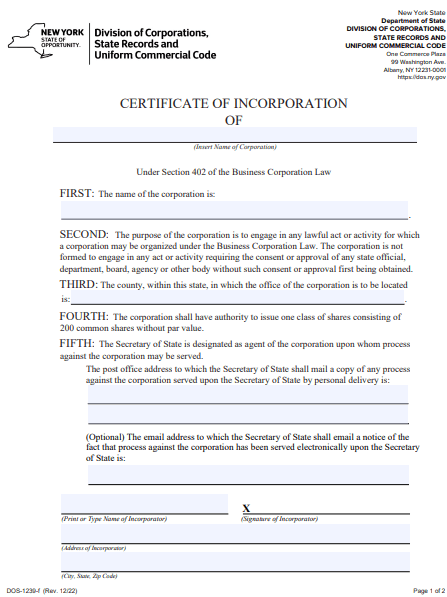
You can file your Certificate of Incorporation with the New York Department of State. Filing this document officially creates your C Corporation once the state accepts it. The filing fee for a domestic business corporation is $125. You can submit the Certificate of Incorporation online or send the completed form by mail to the Division of Corporations.
Filing methods for New York Certificate of Incorporation:
1. Online filing: You can submit your Certificate of Incorporation electronically through the New York Department of State's online filing system. You can choose between two options:
Make sure to sign in or create a NY.gov account. After the filing, you can also log in to check your application status. Also, once the filing is accepted, you'll receive an email acknowledgment with your filing receipt attached as a PDF.
You can also request additional documents, such as a certified copy for $10, along with expedited handling for an additional fee ranging from $25 to $150, depending on the processing speed you select.
2. Mail filing: You can complete the state's Certificate of Incorporation form and mail it with the required filing fee to:
New York State Department of State
Division of Corporations
One Commerce Plaza
99 Washington Avenue
Albany, NY 12231
The state also accepts filings submitted directly to the Division of Corporations during its business hours. Once the Department of State accepts and files your Certificate of Incorporation, your New York C Corp officially comes into existence. The state issues an official filing receipt confirming that the document was filed.
Once your Certificate of Incorporation is filed, the next step is to create corporate bylaws. Typical provisions cover:
New York law does not require you to file your bylaws with the Department of State. Swyft Filings can prepare customized Corporate Bylaws for your New York C Corp as part of a premium package.
Once your New York C Corp has been formed and its bylaws are in place, hold an organizational meeting to establish the corporation's operations formally. The initial directors and incorporator(s) use this meeting to approve key decisions and document how the corporation will operate.
During the organizational meeting, you can:
Adopt the bylaws: Formally approve the corporation's bylaws.
Appoint officers: Elect or appoint the president, secretary, treasurer, and other officers.
Approve stock issuance: Authorize the issuance of shares to the founders or other shareholders.
Approve banking arrangements: Authorize the corporation to open a business bank account.
Approve initial resolutions: Document important startup decisions made by the directors.
Set the fiscal year: Establish the corporation's accounting or fiscal year.
Authorize contracts: Approve important agreements the corporation needs to operate.
You don't generally file the meeting minutes with the New York Department of State. Keep the minutes, resolutions, and other organizational documents with your corporation's internal records.
Your New York C Corp is now formed, but you’ll still need a federal tax ID to handle many of its day-to-day business activities. That ID is called an Employer Identification Number (EIN). Apply for the EIN directly with the IRS. There is no fee to obtain one.
Once you have your EIN, you can use it to:
New York C Corp compliance involves several recurring responsibilities, including filing your Biennial Statement, managing corporate taxes, and keeping your business information up to date. Staying on top of these requirements can help you avoid missed filings, penalties, and other compliance issues.
New York corporations must file a Biennial Statement with the New York Department of State every two years. The filing is due during the corporation's anniversary month.
To stay on track:
New York C Corps are generally subject to the state's Article 9-A franchise tax, which uses multiple tax bases rather than a single calculation. Depending on the corporation's circumstances, tax may be calculated using the business income base, business capital base, or fixed dollar minimum.
When preparing your tax filings:
Confirm current rates and thresholds with the New York Department of Taxation and Finance before your first return is due, since this is one of the more complex state corporate tax structures in the country.
New York does not have a single universal business license that covers every C Corp. Your licensing requirements may depend on your industry, business activities, and location. New York City and other local governments may have additional requirements beyond state-level registrations.
Before operating your business:
Swyft Filings' business license research service can help identify licenses that may apply to your business and provide direct application guidance through which you can apply for them.
Open a separate business bank account for your New York C Corp and use it for the corporation's financial activities. Keeping corporate and personal funds separate helps maintain clear financial records and reinforces the distinction between you and the corporation.
Use the account for:
Avoid using personal accounts for routine corporate expenses. Maintaining separate finances also makes bookkeeping, tax preparation, and financial reporting easier as your business grows.
The cost of forming a C Corp in New York depends on more than the state's filing fee. Your total startup costs may include the Certificate of Incorporation, name reservation, registered agent services, and other optional business services.
| Cost | Fee |
|---|---|
| Certificate of Incorporation | $125 |
| Name Availability Search (per name) | $5 |
| Private registered agent service | Varies |
| Name Reservation (60 days) | $20 |
| EIN | $0 |
Start your free New York C Corp with Swyft Filings' Basic package for a $0 service fee + New York state fees. Get help with your business name search, preparation and filing of your formation documents, and support from a formation specialist throughout the process. For additional support, choose our premium packages.
$0 + State Filing Fees
*Disclaimer: This guide offers general information about forming a C Corporation in New York and isn't a substitute for legal, tax, or financial advice.*
C Corp rules, filing costs, and corporate tax structures vary by jurisdiction. Select any state below to view its specific C Corp laws.