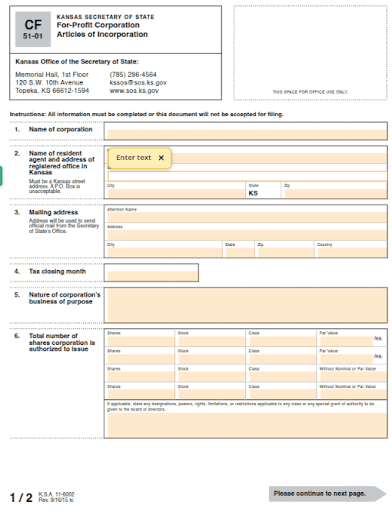
Forming a Kansas C Corporation starts with preparing and filing your Articles of Incorporation. Choose the Swyft Filings Basic Kansas C Corporation formation package, starting at a $0 service fee + $85 state filing fee for online filing or $90 for paper filing. It includes a name availability check, preparation and filing of your Articles, and ongoing support from a formation specialist.You can also choose a paid package for additional corporate setup services, including customized bylaws, initial resolutions, EIN assistance, stock authorization, multiple stock classes, and other corporate setup support. Our formation options can help simplify the filing process while giving you the flexibility to choose the support your business needs.
To form a C Corporation in Kansas, choose a compliant C Corporation name, appoint a Kansas resident agent, decide how your shares will be structured, file Articles of Incorporation, adopt corporate bylaws, complete the corporation's organizational meeting, and obtain an EIN.
Kansas also requires for-profit corporations to submit a Business Entity Information Report every two years, rather than an annual report. That requirement is covered later in the guide. Let’s first discuss all steps to start a C Corporation in Kansas in detail:
Step 1: Choose a Name for Your Kansas C Corporation
Kansas requires a domestic corporation, including a C Corporation, to use an approved word of formation in its legal name.
1. Use Designator:Kan. Stat. § 17-6002 spells out the rules for what you can and can’t name your business. Your name can contain terms such as:
Corporation
Incorporated
Company
Limited
Association
Foundation
Institute
Society
Corp.
Inc.
Co.
Ltd.
2. Distinguishable Name: The corporation’s name must be distinguishable from the names of other corporations, LLCs, and limited partnerships organized, reserved, or registered with the Kansas Secretary of State. A written consent from an existing entity may allow an otherwise similar name. Kansas law also permits several other statutory corporate words and equivalent terms in other languages written in Roman characters.
3. Restricted Words: Using restricted terms such as “bank,” “trust,” or “insurance,” or words that imply an affiliation with a government agency, may require additional approval, licensing, or authorization under Kansas law.
Keeping these things in mind, shortlist some relevant names for your C Corp in Kansas. You can also use Swyft Filings' free Business Name Generator to create potential names before checking their availability. Then use the State of Kansas name availability search tool to check availability for your preferred name. You can use this tool easily by typing the exact business name into the search bar.
All the relevant results will appear, where you can easily check if another company already uses that name. If you need more details on existing companies, use the Kansas Business Entity Search Station (BESS).
Use the Kansas Secretary of State's business name availability search. The current Articles instructions specifically direct filers to check whether the proposed corporation name is already in use before submitting the formation filing. If a conflicting name already exists, Kansas may allow use in certain circumstances when the existing business provides a written Consent to Use of Similar Business Name.
Yes. Kansas allows an available entity name to be reserved for 120 days. Name reservation is useful if you have selected the Kansas C Corporation name but are not yet ready to submit the Articles of Incorporation. The fee is $30 for online filing or $35 for paper filing by mail. Name reservations cannot be renewed.
No. You can proceed directly to filing your Articles of Incorporation if the C Corp name appears available and you are ready to form the corporation. A reservation is mainly useful when you want to hold the name while finalizing other formation decisions.
Step 2: Appoint a Kansas Resident Agent
Kansas uses the term "resident agent," which is commonly called a "registered agent" in other states. Every Kansas corporation must maintain a registered office in the state and list its resident agent and registered office in the Articles of Incorporation.
Your Kansas C Corp’s resident agent can be:
An individual who is at least 18 years old
A business entity authorized to conduct business in Kansas
The corporation itself
The resident agent must consent to serve in this role and maintain a physical street address in Kansas. P.O. boxes cannot be used as the registered office. The agent should also be available at the registered office during regular business hours to receive service of process and other official documents.
The registered office must be an address in Kansas where the resident agent can be regularly present. The Secretary of State requires a physical address such as a street, rural route, or highway address. A P.O. box alone is not acceptable.
Yes. An individual can serve as resident agent if they meet Kansas requirements and can reliably receive legal and official documents at the registered office. Consider whether you will consistently be available at that location before choosing yourself. If you think you can’t due to business growth demand, then choose Swyft Filings Professional registered agent service.
Yes. The Kansas Articles of Incorporation allow the business itself to be named as the resident agent. Some founders instead use a professional registered agent service so official correspondence is handled at a dedicated address.
Submit a Certificate of Amendment for a change of resident agent and/or registered office. The current Secretary of State form lists:
$30 for online filing
$35 for paper filing
The new registered office still must be a qualifying Kansas physical address. Swyft Filings' change of registered agent service can also assist if you prefer not to manage the resident-agent responsibility yourself.
The C Corporation should promptly appoint a replacement. Keeping an active resident agent and valid registered office is an ongoing requirement. Allowing that information to become invalid can affect the corporation's state status and its ability to receive legal documents.
Step 3: Set Your Kansas C Corp Share Structure
Kansas requires corporations that issue stock to provide detailed share information in the Articles of Incorporation. If your C Corporation will have one stock class, the Articles must state:
The total number of authorized shares.
The par value of each share, or that the shares have no par value.
If your C Corporation will have more than one class, the Articles must identify:
Total authorized shares.
Number of shares in each class.
Which classes have par value.
Which classes have no par value.
Applicable rights, preferences, powers, qualifications, limitations, and restrictions.
No. Kansas allows corporations to issue shares with or without par value according to the Kansas Office of the Revisor of Statutes. The Articles of Incorporation must specify the par value of each applicable class or state that the shares are without par value.
Issued shares are the shares a Kansas C Corp has actually issued to its shareholders. A corporation can issue fewer shares than the total number authorized in its Articles of Incorporation, leaving additional shares available for future issuance. A Kansas C Corp should maintain accurate stock records showing:
Shareholder’s name
Number of shares issued
Share class
Date of issuance
Consideration paid for the shares
Applicable vesting or transfer terms
Yes. Kansas corporations can establish multiple classes and series of stock with different economic and governance rights. For example, common stock might be used to grant founders and employees equity, while preferred stock could provide investors with different dividend, voting, conversion, or liquidation rights. The Articles should properly describe those rights where required.
Kansas does not establish a single share count that applies to every C Corp. A small, owner-operated corporation may choose a simple structure. A startup planning to raise capital may authorize a larger pool to allow room for future equity issuances.
Consider the corporation's:
Founder ownership.
Future financing.
Employee equity plans.
Investor expectations.
Voting arrangements.
Step 4: File Your Kansas Articles of Incorporation
Your Kansas corporation is formally created at the state level by filing Articles of Incorporation. You can file online or submit a paper filing. Before filing, prepare the required information such as:
Select the option to form a for-profit corporation.
Enter the required corporation and incorporator information.
Provide your registered office and resident agent details.
Enter your authorized share information and any applicable stock provisions.
Review the filing and submit it with the required filing fee.
Paper filing: Complete the applicable Articles of Incorporation form, sign it, and submit it with the required filing fee to the Kansas Secretary of State, Docking State Office, Building 915 SW Harrison Street, Topeka, KS 66612.
Use the Kansas Secretary of State's online business registration system. The basic process is:
Access the Kansas business registration portal.
Choose the domestic corporation formation option.
Enter the corporation's legal name.
Provide the resident agent.
Enter the Kansas registered-office address.
State the corporation's purpose.
Enter the authorized stock information.
Provide incorporator information.
Add initial directors if applicable.
Review and submit the filing.
Pay the $85 online filing fee.
The Secretary of State states that online formation processing takes minutes, and the certified copy can be printed online after processing.
Yes. The current paper filing fee is $90. Mail the completed filing to: Kansas Secretary of State Docking State Office Building 915 SW Harrison Street Topeka, KS 66612 The current state form accepts checks and credit or debit card payment methods.
Not always. The current Kansas Articles form states that director names and addresses are required if the incorporators' authority will terminate upon filing of the Articles. Otherwise, the director section may be left blank.
Yes. A Kansas corporation can have one or more incorporators, and its board may consist of one or more natural persons. That makes a single-founder corporation possible, provided all other corporate requirements are satisfied.
Step 5: Adopt Bylaws for Your Kansas C Corp
After incorporation, establish the internal rules that govern your corporation. Kansas law permits corporate bylaws to address matters relating to the corporation's business and affairs, and to the rights and powers of shareholders, directors, officers, and employees, provided that such provisions do not conflict with Kansas law or the Articles.
Your bylaws can cover:
Number of directors.
Director elections and vacancies.
Officer titles and responsibilities.
Shareholder meetings.
Board meetings.
Notice rules.
Voting procedures.
Quorum.
Share administration.
Committees.
Corporate records.
Bylaw amendment procedures.
Swyft Filings can prepare customized Corporate Bylaws as part of our premium Kansas C Corp formation package.
The answer depends on how the corporation is organized. The incorporators may adopt the original bylaws unless the Articles named initial directors. Kansas law also permits the board to adopt bylaws in applicable circumstances before stock has been paid for.
No routine Secretary of State filing is required for corporate bylaws. Keep them with your corporation's internal records.
Yes. Kansas provides procedures for incorporators, directors, and shareholders to adopt, amend, or repeal bylaws depending on the corporation's stage and governing documents. Document every amendment so your records clearly show the current version.
Step 6: Hold Your Organizational Meeting
Kansas requires an organizational meeting after filing the Articles unless the permitted action-without-meeting procedure is used. The meeting can take place inside or outside Kansas. The initial meeting can be used to:
Adopt bylaws.
Elect directors if the incorporators are meeting.
Elect officers if directors are meeting.
Approve stock issuances.
Authorize the corporate bank account.
Approve founder agreements.
Establish accounting procedures.
Approve contracts.
Complete other organizational actions.
Kansas requires at least two days' written or electronic notice of the organizational meeting to the applicable incorporators or directors unless the statutory alternative process applies.
Yes. Kansas law provides a method for completing organization without holding a physical meeting when the required written or electronic consent is obtained. This can be useful for a small corporation in which all incorporators or initial directors agree on startup decisions.
The board must contain one or more natural persons. The bylaws normally determine the number of directors unless the Articles themselves fix the board size. Directors do not have to be stockholders unless the Articles or bylaws require share ownership.
Keep a written record of the actions approved at the organization meeting. Useful records include:
Meeting date and participants.
Bylaw approval.
Director elections.
Officer appointments.
Stock issuances.
Banking authority.
Contracts and resolutions.
Maintaining these records helps demonstrate who was authorized to act for the corporation.
Step 7: Apply for Your EIN
The IRS advises business owners who are creating a legal entity to complete state formation before applying for an EIN. A Kansas C Corp commonly needs an EIN to:
File federal corporate tax returns.
Register for Kansas taxes.
Open a corporate bank account.
Hire employees.
Process payroll.
Apply for business permits.
Establish business credit.
Swyft Filings professionals apply for an EIN on your behalf as part of its paid Kansas C Corp formation service.
The IRS issues EINs directly for $0. Eligible applicants with a U.S. principal place of business can generally use the IRS online EIN application.
Yes. Operating as a corporation is itself one of the situations in which an EIN is generally needed.
Yes. EIN filing assistance is available through applicable Swyft Filings paid Kansas C Corp formation packages.
What Are the Post-Formation Requirements for a Kansas C Corp?
Getting the Articles approved establishes the corporation, but several state and federal responsibilities continue after formation. Kansas corporations should pay particular attention to the state's biennial Information Report, tax registration, corporate income tax, resident-agent information, and internal corporate records.
1. File Your Kansas Information Report Every Two Years
Kansas no longer uses a standard annual-report cycle for most businesses. A Kansas for-profit corporation files a Business Entity Information Report every two years.
The reporting year depends on the year the business was formed:
A corporation formed in an even-numbered year files in succeeding even-numbered years.
A corporation formed in an odd-numbered year files in succeeding odd-numbered years.
The biennial Information Report fee for a for-profit C corporation in Kansas is $90 when filed online or $110 when filed on paper.
For-profit business reports are due April 15 of the applicable reporting year.
Kansas gives businesses a three-month delinquency period after the due date. If that period expires without filing, the business can enter forfeited status and may be unable to make other filings with the Secretary of State until it is reinstated.
2. Budget for Kansas Corporate Income Tax
A Kansas C Corp may owe state corporate income tax on income subject to Kansas taxation. The amount you owe depends on your Kansas taxable income, applicable tax rates, deductions, credits, and whether your corporation has income connected to other states.
Keep these points in mind:
Track your corporation’s taxable income throughout the year.
Maintain records of deductible business expenses and supporting documentation.
File the appropriate Kansas corporate income tax return.
File your federal corporate income tax return with the IRS.
Determine whether your corporation must make estimated tax payments.
Keep records of income and expenses if your corporation does business in multiple states.
Review Kansas Department of Revenue requirements each tax year, as tax rates, thresholds, filing requirements, and payment rules can change.
NOTE: Kansas corporate income tax rates, surtaxes, estimated-payment thresholds, and other requirements may change from year to year. Check the current Kansas Department of Revenue guidance for the tax year in which your C Corp operates.
3. Do Not Confuse the Information Report With a Franchise Tax
Kansas does not currently impose the old corporate franchise tax. The Kansas Department of Revenue states that the Kansas franchise tax expired for tax years beginning after December 31, 2010.
That means:
The biennial Information Report fee is not a franchise tax.
Your corporation may still owe Kansas corporate income tax.
Other activity-specific state taxes can still apply.
Old articles discussing a current Kansas franchise tax may be outdated.
This distinction is useful when budgeting ongoing Kansas C Corp costs.
4. Register for Kansas Sales Tax and Employer Withholding When Applicable
A Kansas C Corp may need additional tax accounts depending on the business's activities. Kansas Department of Revenue registration can include:
Retailers' Sales Tax.
Compensating Use Tax.
Withholding Tax.
Corporate Income Tax.
Other activity-specific tax accounts.
Kansas currently charges no general business tax registration fee, although certain regulated licenses have their own charges. If your business makes taxable retail sales, register for the appropriate sales-tax account.
If you hire employees, Kansas generally requires employers subject to withholding rules to register for state withholding.
When hiring employees:
Register for Kansas withholding when required.
Collect federal Form W-4.
Collect Kansas Form K-4 where applicable.
Set up unemployment insurance responsibilities.
File payroll reports.
Maintain employment records.
5. Check Kansas Business Licenses and Local Permits
Formation of the corporation does not automatically authorize every type of business activity. Licensing depends on what your corporation does and where it operates.
Check whether you need:
Professional licensing.
Occupational licenses.
Industry permits.
Local business registrations.
Zoning approval.
Building or occupancy permits.
Feeling unsure about which licenses apply? Swyft Filings' business license research service can review your business details against applicable federal, state, and local requirements and identify any relevant licenses or permits.
6. Open a Dedicated Business Bank Account
Opening a corporate bank account helps keep Kansas C Corp's finances separate from shareholders' or officers' finances.
A dedicated account also makes it easier to manage:
Revenue.
Expenses.
Payroll.
Tax payments.
Capital contributions.
Vendor payments.
How Much Does It Cost to Incorporate a C Corp in Kansas?
Kansas filing costs vary depending on whether you file online or by paper and whether you choose optional filings.
Cost
Current Fee
Articles of Incorporation
$85 (online) and $90 (mail)
Name reservation
$30 (online) and $35 (mail)
Resident Agent/Registered Office Change
$30 (online) and $35 (mail)
Biennial Information Report
$90 (online) and $110 (mail)
Ready to Start Your Free Kansas C Corp?
Swyft Filings' Basic Kansas C Corporation formation package helps you start your corporation with a $0 service fee + Kansas' $85 online state filing fee. Paid packages are also available and provide additional assistance with corporate bylaws, stock authorization documents, EIN filing, corporate resolutions, and other business setup needs.
Disclaimer: This guide provides general information about forming and maintaining a C Corporation in Kansas. It is not a substitute for legal, tax, accounting, or financial advice.
Check C Corp Formation Guides for Other States
C Corp rules, filing costs, and corporate tax structures vary by jurisdiction. Select any state below to view its specific C Corp laws.
Starting a Kansas C Corp means filing Articles of Incorporation, appointing a registered agent, and staying current with the biennial information report. Swyft Filings has been helping businesses form and stay compliant since 2015. Our team knows the Kansas Secretary of State requirements and can file your C Corp quickly, accurately, and in full compliance.
No. Kansas law does not require directors of a corporation to be shareholders unless the corporation's Articles of Incorporation or bylaws impose that requirement.
Yes, potentially. An eligible Kansas corporation can elect S Corporation tax treatment by filing IRS Form 2553 and meeting the federal eligibility requirements. The election changes the federal tax treatment of the existing corporation; it does not create a new Kansas business entity.
Generally, no. Kansas' standard Articles of Incorporation request incorporator information and certain director information, but they do not require a general shareholder list. The standard Information Report requires information about officers and directors rather than a complete list of shareholders. Certain special agricultural reporting requirements may require additional stockholder-related information. The corporation should maintain its own internal stock ledger showing its actual shareholders.
Yes, but incorporating in Kansas does not automatically authorize a corporation to conduct business in every other state. If the corporation has sufficient activity in another state, such as employees, offices, stores, or another ongoing business presence, that state may require foreign qualification. Registration, registered-agent, tax, and reporting requirements vary by state.
Kansas provides a three-month delinquency period after a corporation's Information Report due date. During delinquency, the business may be limited in the other documents it can file. If the report remains unfiled after the three-month period, the corporation can enter forfeited status. A forfeited corporation generally must submit its past-due reports and complete the reinstatement process before it can resume normal Kansas Secretary of State filings.