
Initial Setup
Compliance
Changes & Filings
Resolve
Protect & Legal
Learn
Excellent
7,984 reviews

Starting a Missouri C Corp begins with locking down a business name. It has to be distinguishable from other names already registered with the Secretary of State. Next, you name a registered agent. This is the person or company that receives legal mail on your corporation's behalf.
Once those two things are settled, you work out your share structure. Missouri actually calculates your filing fee based on this. Then you file your Articles of Incorporation. This is the step that legally creates your corporation.
After that, you write your bylaws. These are the internal rules your corporation runs on. Then you hold your organizational meeting. This is where your bylaws, your shares, and your officers all get put into place. And last, you close things out with an EIN from the IRS. This is your corporation's federal tax ID.
If you'd rather not fill the forms yourself, Swyft Filings will form your Missouri C Corp at no service cost. You still pay the state filing fee, but the paperwork is on us. Here's what each step actually involves.
The name on your Articles becomes public record the moment the state approves your filing. From there, it's on your bank documents, every contract you sign, and whatever signage or marketing you put in front of customers. Pick something that reads clean out loud and gives customers a real sense of what the business does.
Missouri naming rules for a C Corp:
Still stuck on a name? Our free business name generator can hand you a working list in a couple of minutes. Once you've got a potential name, run it through the Missouri Secretary of State's business entity search before you file. A near-miss on spacing or an abbreviation the system reads as identical to an existing name is enough to get your Articles rejected, so checking first saves you a second filing fee.
Once your Articles are approved, your name is protected in Missouri as a corporate entity name, but that's not the same thing as trademark protection over how you use that name in commerce. If your corporation plans to sell outside Missouri or expects people to search for the brand nationally, filing a federal trademark can provide nationwide rights and important legal protections for the registered mark. Most founders wait until the corporation is formed and the business has some traction before spending money on either one.
Tip: Make sure to search your business name in a trademark database along with a business entity search before filing.
Missouri requires every corporation to keep a registered agent and registered office on file at all times, under RSMo § 351.370. This is the person or business that legally accepts lawsuits, state notices, and other official correspondence on your corporation's behalf. It's a required field on your Articles of Incorporation, so it needs to be settled before you file, not after.
What a Missouri registered agent has to be:
Appointing one comes down to three things:
You can serve personally, as long as you're a Missouri resident with a physical address in the state and you're available during business hours to receive documents.
What you can't do is have the corporation itself act as its own registered agent; the entity can't name itself, though an individual officer or director tied to the company can serve in a personal capacity.
The tradeoff to serving yourself is that your registered agent’s address becomes a searchable public record. A professional registered agent service helps to keep your personal address off that record and forwards official documents straight to you.
Under §351.484(5)–(6), failure to maintain a registered agent or registered office can lead to administrative dissolution. If the corporation is administratively dissolved, it no longer has the same active status and may need to be reinstated before continuing its business activities as an active corporation.
In practice, this usually surfaces when mail to your registered office starts bouncing back undelivered, or your agent resigns, and nobody files a replacement.
once dissolution goes through, your corporation loses its legal standing to operate, though missouri does allow reinstatement. Filing a change of registered agent when you notice a gap is a lot cheaper than waiting for the state to catch it.
Yes, as long as that business entity is itself authorized to transact business in Missouri and maintains a physical Missouri office matching the registered office address on file.
Plenty of small corporations name a business-formation company or a law firm as their agent instead of an individual, mainly because it keeps the appointment stable even if officers or directors change over the years.
Missouri wants your authorized share count and par value listed directly on your Articles of Incorporation, and unlike most states, that number also determines your filing fee. Getting this settled before you file isn't just good planning here; it directly changes what you pay the state.
Steps to set up your share structure:
Choose Your Share Types:
Founders and early team members commonly hold common stock. Preferred stock is built for outside investors and carries a payout advantage: Preferred stock often gives investors preferential rights to distributions or liquidation proceeds, depending on the terms of the shares. Venture capital and other institutional investors often request preferred stock because it can provide specific economic and voting rights.
Set Up Multiple Share Classes:
Splitting stock into Class A and Class B, where one class carries more votes per share, lets a founder bring in outside capital without giving up a majority say in company decisions. Not every corporation needs this on day one, but building it in from the start beats restructuring after shares are already out the door.
Assign Voting Rights and Board Appointments:
Owning shares doesn't automatically come with a board seat or a vote on every matter. Spell out what each share class actually controls before you issue a single share, since renegotiating this after shareholders are already on the cap table is a much harder conversation.
Restrict Share Transfers:
A right of first refusal can be included in a shareholder agreement or other governing agreement to allow the corporation or current shareholders to buy shares before they are offered to another party.
Plan for Future Financing:
If venture capital or other outside investment is part of the plan, think through how a future funding round dilutes today's ownership percentages before locking in your authorized share count. Authorizing too few shares now usually means amending your Articles later, often at an inconvenient moment.
Understand Dilution:
When a corporation issues new shares to other investors, existing shareholders can be diluted unless they participate in the issuance or have applicable preemptive or anti-dilution rights.
Offer Equity Compensation to Employees:
Rather than stretching payroll to compete on salary alone, some corporations reserve a portion of their shares for employee stock options or other equity compensation, depending on their hiring and financing plans. This is often how early-stage corporations attract talent when cash is tight.
Set a Vesting Schedule:
A common vesting schedule for startup equity is four years with a one-year cliff. Nobody's shares start vesting until they've put in a full year with the company, and after that, vesting continues monthly or quarterly for the remaining three years.
Plan for a Shareholder's Death:
A buy-sell provision in your shareholder agreement should spell this out in advance, whether the corporation buys the shares back, offers them to remaining shareholders first, or lets them pass to the deceased shareholder's estate. It's a far easier conversation to have on paper now than during an actual loss.
Issue Stock to Your Shareholders:
Once your structure is decided, put it into action:
Draft a Shareholder Agreement:
Pull every decision above into a single document. This becomes the reference your corporation and its shareholders actually turn to when a question comes up later, so it should come last, once the decisions it documents have actually been made.
Your Articles of Incorporation are the documents that legally create your corporation. The required content is set out in RSMo § 351.055, and the filing fee starts at $58 and rises based on your authorized shares, as covered in Step 3.
Note: “C corporation” generally describes a corporation's federal tax treatment. Missouri forms a corporation under its state corporate law; the corporation is generally taxed as a C corporation unless it makes an S corporation election.
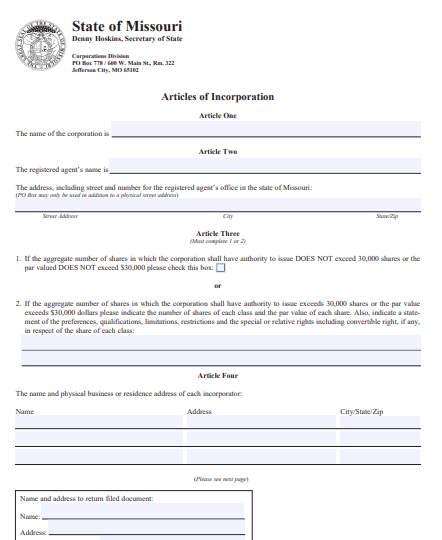
Filing methods:
Online: Create an online account on the Missouri Secretary of State's online business filing portal for online filing. This is by far the faster route; most online filings process within one to two business days.
By mail: Send your completed Articles of Incorporation to the following address:
Mailing: PO Box 778, Jefferson City, MO 65102
Physical delivery: 600 W. Main St., Jefferson City, MO 65101
Missouri doesn't run a separate paid expedite program the way some states do. Filing online is already the fast lane; the state simply processes online submissions ahead of paper ones.
What information does Missouri require on your Articles of Incorporation?
Missouri doesn't require corporations to file bylaws with the state, and RSMo § 351.290 doesn't force you to have them at all. What it does say is that if you adopt bylaws, the power to make, alter, or repeal them sits with shareholders unless the Articles hand that power to the board, though the original set can be adopted by the directors themselves.
In practice, nearly every functioning corporation has them, since they're what your organizational meeting formally adopts as its first order of business.
What your bylaws should cover:
Draft your own using the list above as a starting checklist, or use Swyft Filings' Corporate Bylaws service, which builds a set around your actual share structure instead of handing you a generic template.
Yes, and treating them as optional is a mistake most founders only regret later. Bylaws help document how your corporation is governed and can provide important evidence that the corporation maintains appropriate internal formalities.
If a creditor ever argues your corporation is just a shell and asks a court to pierce the corporate veil, having adopted bylaws and actually following them is part of what demonstrates you kept things properly separate. Skipping them saves no filing fee, since they're never submitted to the state anyway, so there's no upside to leaving them out.
Once the state approves your Articles of Incorporation, your initial directors hold the corporation's first official meeting. This is where the structure you've been building on paper actually gets put into motion.
Typical business handled at this meeting:
So, write formal meeting minutes and keep them with your corporate records. You won't file these with the state, but they're often the clearest piece of evidence that your corporation follows real formalities rather than existing only on paper, which matters a great deal if your liability protection is ever tested down the line.
Once your Articles of Incorporation are approved, apply for an Employer Identification Number, a nine-digit federal tax ID that identifies your corporation separately from you as an individual.
Why your Missouri C Corp will generally need an EIN:
You apply directly through the IRS website at no cost, and the online application usually takes about 15 minutes. You'll need information about the corporation, its responsible party, business address, and the reason you're applying. If you don't have a Social Security number, you can still apply by mailing or faxing Form SS-4 instead of using the online path.
To open a business bank account in Missouri, bring your Articles of Incorporation, your adopted bylaws, and your EIN confirmation letter. Keep business funds strictly separate from personal money from day one; mixing the two is one of the fastest ways to break the liability protection a corporation is meant to provide.
Missouri doesn't issue one universal business license that covers every corporation. Most businesses end up needing a local license from the city or county where they operate, plus anything industry-specific, a contractor's license for construction, a health permit for food service, or a professional license in a regulated field like healthcare or accounting. If your business includes selling taxable goods or services, register for a Retail Sales License through the Missouri Department of Revenue before your first sale.
Swyft Filings can help you with business license research, which covers the name and filing requirements of the licenses and permits that apply to your corporation.
Missouri taxes corporate net income at a flat 4% rate under RSMo § 143.071, which is on the lower end nationally and notably lower than several neighboring states. You'll register with the Missouri Department of Revenue and file Form MO-1120 for your state return, generally due on the same schedule as your federal corporate return. Missouri does not currently impose a separate corporate franchise tax, so corporate net income is the main state-level income tax line item you're budgeting for.
This is a completely separate filing from your corporate income tax return, and owing no tax doesn't mean nothing's due here. The registration report keeps the state's record of your officers, directors, and registered agent current. For corporations formed after July 1, 2003, the Corporate Registration Report is due within 30 days after incorporation. After that, the report is generally due by the end of your corporation's incorporation month each year, unless you change the filing month or elect biennial reporting.
The standard annual fee is \$20 online or \$45 by paper filing. Missouri also allows eligible corporations to file a biennial registration report instead of filing annually. Corporations incorporated or qualified in an even-numbered year file in even-numbered years, while those incorporated or qualified in an odd-numbered year file in odd-numbered years. The biennial fee is \$40 online or \$90 by paper filing.
| Item | Cost |
|---|---|
| Articles of Incorporation (authorized capital $30,000 or less) | $58 |
| Each additional $10,000 (or fraction) of authorized capital | +$5 |
| Name Reservation (optional, 60 days) | $25 |
| Fictitious Name / DBA Registration (optional, 5 years) | $7 |
| Statement of Change of Registered Agent | $10 |
| Certificate of Authority (foreign corporation registering in Missouri) | $155 |
| Corporate Registration Report (annual) | $20 online / $45 paper |
| Registered agent | $149/quarter (Swyft Filings) |
| EIN (IRS) | $0 |
The one fee you genuinely can't avoid is the Articles of Incorporation filing itself. Everything else on this list depends on choices you make along the way: name reservation, a DBA, or how you set up your share structure.
Forming a C Corp in Missouri means getting your Articles right, naming a registered agent, settling on a director count that actually matches state law, and keeping up with a filing fee that moves based on your share structure instead of sitting at a flat number. Swyft Filings has helped over 600,000 businesses get formed correctly since 2015. Our team knows what the Missouri Secretary of State expects on a filing, so your paperwork goes fast, and you can get to running the business confidently.
$0 + State Filing Fees
*Disclaimer: This guide shares general information about forming a C Corp in Missouri and is not any kind of legal, tax, or financial advice.*
C Corp rules, filing costs, and corporate tax structures vary by jurisdiction. Select any state below to view its specific C Corp laws.