
Initial Setup
Compliance
Changes & Filings
Resolve
Protect & Legal
Learn
Excellent
7,984 reviews

Wyoming is one of the simplest states in the country to incorporate in. There's no newspaper publication requirement, no state corporate income tax, and no franchise tax; the process runs in a straight line. Just pick a compliant C Corp name, line up a registered agent, decide your share structure, file your Wyoming Articles of Incorporation, adopt bylaws, hold an organizational meeting, and finish with an EIN.
Here's what each step involves:
Wyoming's corporate naming rules are set forth in W.S. § 17-16-401, and they're noticeably looser than those in most states.
No mandatory designator: Unlike an LLC, a Wyoming corporation does not have to end in "Corporation," "Incorporated," "Inc.," or "Corp." You may add one for clarity or branding, but the state won't reject a filing that omits it.
Distinguishable in the state's records: Your Wyoming C Corporation name must stand apart from every other domestic and foreign entity already on file with the Secretary of State, including corporations, LLCs, limited partnerships, and statutory trusts.
No implied unauthorized purpose: The Wyoming C Corporation name can't suggest your corporation exists for something outside what your Articles allow.
Restricted words: Terms like "Bank," "Trust," or wording implying a government affiliation need separate approval before you can use them.
Once you have settled on a name, run it through the Wyoming Secretary of State's WyoBiz business entity search to confirm its name is available before you file.
If you have a name that appears available, still consider keeping one or two alternatives in case the Wyoming Secretary of State determines that your preferred name is not distinguishable when you file. You can use Swyft Filings' free business name generator to shortlist some more options.
File an Application for Reservation of Corporate Name with the Secretary of State's Business Division, either online through WyoBiz or by mail. The filing fee is $60. The reservation holds your name for 120 days and is nonrenewable, so file it close to when you actually plan to incorporate. Remember, mail processing time is up to 15 business days following the date of receipt, and you need to mail it to the address:
Herschler Building East, Suite 101
122 W 25th Street
Cheyenne, WY 82002-0020
Every Wyoming corporation must continuously maintain a registered agent with a physical street address in the state (no P.O. boxes).
Physical Wyoming address: The registered office has to be a real street address where the agent can be reached.
Availability during business hours: The agent needs to be present to accept legal and state documents as they arrive.
Individual or entity: The agent can be a Wyoming resident, or a domestic or foreign business entity authorized to operate in the state, so an out-of-state commercial registered agent company is fine, as long as it's registered in Wyoming.
Ongoing duty: This isn't a one-time formation step; the corporation must keep a valid agent on file at all times or risk falling out of compliance.
The cost of a professional registered agent service varies by provider, but price is only one factor to consider. For example, Swyft Filings charges $149+ per quarter for its registered agent service. The service includes a dedicated registered office address, secure handling and digital delivery of official state and legal notices, and a secure online dashboard for viewing, storing, and downloading received documents.
Therefore, when comparing registered agent services, don't focus only on finding the lowest price. Consider what you are getting for the fee. A service with more useful features and support may offer better value even if its price is higher.
Wyoming's flat $100 filing fee doesn't scale with your authorized share count, so there's no cost penalty for authorizing a large number of shares up front.
Consider your current ownership plans and future investors before choosing your structure, since changing it later may require additional corporate steps.
Decide how many shares to authorize. You can authorize an unlimited number of shares if you state that in your Articles, or set a specific number — most startups authorize a round number like 10,000 or more so they don't need to amend later.
Choose your stock classes. Common and preferred stock can carry different voting, dividend, and liquidation rights.
Document founder ownership in your corporate records once share allocations are agreed.
Know the difference between authorized and issued shares; authorized is the ceiling, and issued is what's actually distributed.
Leave room for investors and employees, since every future share issuance dilutes existing holders.
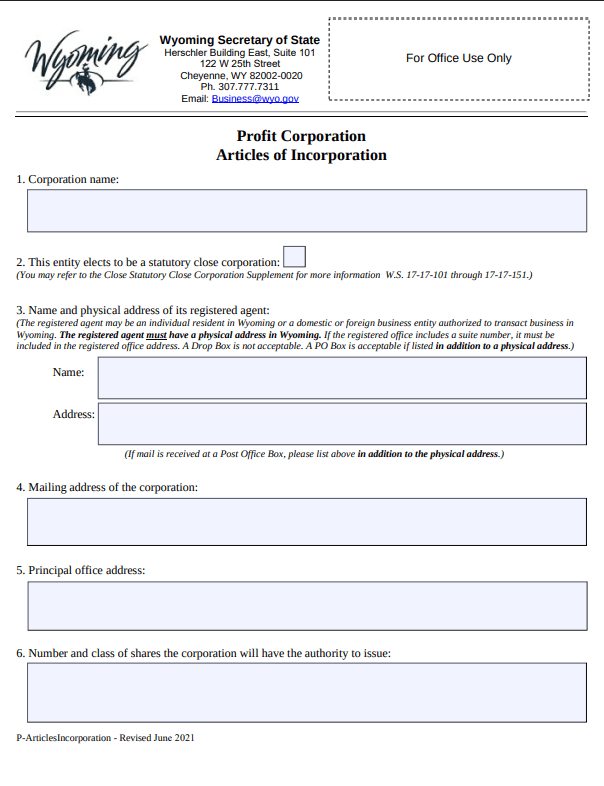
Once you have chosen your C Corporation's name, registered agent, and share structure, the next step is to officially create your Wyoming C Corp by filing its Articles of Incorporation with the Wyoming Secretary of State. When preparing the Articles, pay close attention to the information you provide.
Option 1: File Online
You can file your Wyoming C Corp Articles of Incorporation online through the Wyoming Secretary of State's WyoBiz portal. The current filing fee for a Wyoming profit corporation is $100, and online filings can be paid by Visa or Mastercard.
Complete the online application. The portal will guide you through sections such as:
Business Entity Name
Review all the information carefully before submitting. Wyoming's filing instructions specifically advise reviewing the form before submission because incomplete filings cannot be processed.
Pay the $100 state filing fee online. The Wyoming Secretary of State lists Visa and Mastercard as payment options for online filings.
After submitting the filing, keep your confirmation and a copy of the filed Articles of Incorporation with your corporate records.
*NOTE: The Wyoming Secretary of State refers to the C Corp entity type as a "Profit Corporation" in its online filing system. A C Corporation is a federal tax classification, so forming the Wyoming profit corporation is the state formation step; your federal tax treatment is handled separately.*
Option 2: File by Mail
Complete a paper Wyoming Articles of Incorporation form using black ink, mail it with a check or money order for $100 to:
Wyoming Secretary of State
Herschler Building East, Suite 101
122 W 25th Street
Cheyenne, WY 82002-0020
Processing time of Wyoming Articles of Incorporation is up to 15 business days.
Under W.S. 17-16-202, Wyoming requires the Articles of Incorporation for a for-profit corporation to include four main pieces of information:
Corporate name: The corporation's name must meet Wyoming's naming requirements under W.S. 17-16-401.
Authorized shares: State the number of shares the corporation is authorized to issue. Wyoming also allows the Articles to state that the corporation may issue an unlimited number of shares.
Registered office and agent: Provide the street address of the corporation's initial registered office and the name of its initial registered agent at that address.
Incorporator information: Include the name and address of each person acting as an incorporator.
You can also include additional provisions, such as the names and addresses of initial directors, the corporation's purpose, rules governing the corporation's affairs, the par value of shares, and certain director liability provisions. These additional provisions are generally optional unless required for your particular corporate structure.
After filing your Articles of Incorporation, the next step is to establish the internal rules your Wyoming C Corp will follow. These rules are called corporate bylaws. Wyoming law requires the incorporators or the board of directors to adopt the corporation's initial bylaws.
Your bylaws typically explain how the corporation will be governed and how important corporate decisions will be handled. They can cover matters such as:
Board of directors: Set out the number of directors, how directors are elected or replaced, and how the board conducts its business.
Shareholders' meetings: Establish rules for annual and special shareholder meetings, including notice and voting procedures.
Board meetings: Explain how board meetings are called, what constitutes a quorum, and how directors vote on corporate matters.
Corporate officers: Identify the corporation's officers, such as the president, secretary, and treasurer, and describe their responsibilities.
Shares and stock records: Include procedures for issuing shares, maintaining ownership records, and handling stock certificates if the corporation uses them.
Committees: If appropriate, establish rules for creating and operating board committees.
Corporate records: Set out how important business and corporate records will be maintained.
Amendments: Explain how the bylaws can be changed in the future.
Use Swyft Filings' Corporate Bylaws service. We create the bylaws based on your actual share structure, rather than providing a generic template that doesn't reflect the classes or vesting terms you've established.
The incorporators or board of directors can adopt the corporation's initial bylaws. If the Articles of Incorporation already name the initial directors, those directors can hold an organizational meeting to complete the corporation's organization, including adopting the bylaws and appointing officers.
If the Articles do not name initial directors, the incorporators can first elect the directors or authorize the board to complete the corporation's organization.
After filing your Articles of Incorporation with the Wyoming Secretary of State, hold an organizational meeting to officially set up your corporation's internal structure.
During the meeting, your Wyoming C Corp initial directors generally:
Wyoming law permits directors to take certain corporate actions through written consent instead of holding a physical meeting, provided the statutory requirements are met. Keeping accurate corporate records is important because the organizational meeting establishes the initial governance and ownership decisions of your Wyoming C Corp.
The IRS generally requires corporations to have an EIN, even if they do not currently have employees. You should form your Wyoming corporation before applying for an EIN. The IRS allows you to apply online for free if your principal place of business is in the United States or its territories.
If approved, you can receive your EIN immediately online. If you choose Swyft Filings’ Premium Wyoming C Corporation formation package, our professionals will apply for an EIN on your behalf at no additional cost as part of the package.
Getting your Articles approved is only the start. To stay in good standing, keep up with the following:
Due date: The first day of the anniversary month of your Wyoming C Corporation formation date.
Fee: A minimum of $60, or $0.0002 per dollar of Wyoming-located assets if those assets exceed $300,000.
Missed deadline: Falling behind risks losing good standing and eventual administrative dissolution.
Stay compliant with Wyoming’s annual filing requirements with Swyft Filings’ Annual Report service. Our professionals can prepare and file your Wyoming C Corp Annual Report on your behalf, helping you avoid missed deadlines. It’s a convenient way to keep your corporation in good standing while you focus on running your business.
After forming your Wyoming C Corp, open a separate business bank account to keep corporate and personal finances apart. Banks commonly request your Articles of Incorporation, EIN confirmation letter, and corporate documents showing who is authorized to manage the account. Keeping finances separate also helps maintain the corporation's separate legal identity.
If you sell taxable goods or services, register with the Wyoming Department of Revenue to collect sales tax. If you hire employees, register for unemployment insurance with the Wyoming Department of Workforce Services. Wyoming has no state income tax withholding, since it has no individual income tax.
Wyoming does not have a general statewide business license requirement for every C Corp. However, your business may need specific state, county, or city licenses and permits depending on its location, industry, and activities. Check with the appropriate local and state authorities before starting operations to determine which licenses apply to your Wyoming C Corp.
You can also use Swyft Filings professional business license research service to identify the licenses your Wyoming C Corp may need, understand the application requirements, and get guidance on how and where to apply.
The cost to incorporate a C Corp in Wyoming starts with the state’s filing fee, but your total startup and ongoing costs depend on the services and business requirements you choose.
| Cost | Fee |
|---|---|
| Wyoming Articles of Incorporation | $100 |
| Wyoming Registered Agent Service | Varies |
| Name Reservation (optional, 120 days) | $60 |
| Annual Report (minimum) | $60/year |
| EIN | $0 |
With Swyft Filings, you can get started with our Basic Wyoming C Corporation formation service package for a $0 service fee plus the applicable Wyoming state fees. We can help you prepare and file your formation documents, so you can focus on getting your business up and running. If you need additional support, you can choose a premium package with services such as EIN assistance, bylaws, and other corporate formation needs.
$0 + State Filing Fees
*Disclaimer: This guide provides general information about forming a C Corporation in Wyoming and is not a substitute for legal, tax, or financial advice.*
C Corp rules, filing costs, and corporate tax structures vary by jurisdiction. Select any state below to view its specific C Corp laws.