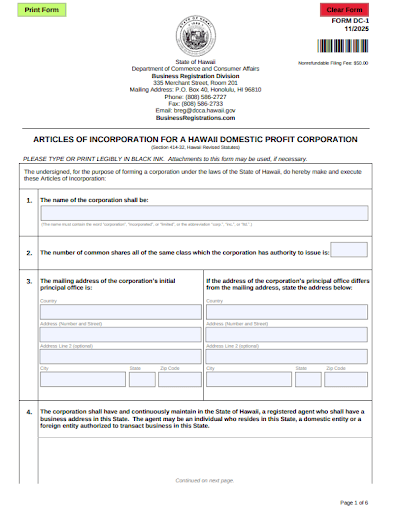
To form a C Corporation in Hawaii, you file Articles of Incorporation (Form DC-1) with the Hawaii Department of Commerce and Consumer Affairs (DCCA), Business Registration Division. Swyft Filings prepares and submits that paperwork at a $0 service fee, so you only pay the $50 state filing fee. Upgrade to our premium package, and we'll also draft your bylaws, set up your stock authorization, connect you with a business attorney for consultation, and provide a registered agent as an add-on.
Starting a Hawaii C Corp means choosing a name that is available in the state's database. Next, you appoint a registered agent who can legally accept mail on the company's behalf. From there, you decide your share structure. You submit your Articles of Incorporation. You put your corporate bylaws in writing. You run your first organizational meeting. Then you finish by getting an EIN from the IRS.
Once everything is in place, you begin your post-formation steps. This includes applying for a business license. It also includes opening a business bank account.
If you don't feel comfortable handling all the paperwork yourself, Swyft Filings will form your Hawaii C Corp for you at no service cost. You only cover the state's fee.
Step 1: Choose a Business Name for Your Hawaii C Corp
The name you pick goes on public record the moment your Articles are approved. It's what shows up on your bank paperwork, your contracts, and eventually your storefront or website, so it's worth getting right the first time rather than filing amendments later.
Hawaii naming rules for a C Corp:
The name must contain the word "corporation," "incorporated," or "limited," or the abbreviation "corp.," "inc.," or "ltd."
Alphabet restrictions: All the letters of your business name should come from the English alphabet.
The name may not state or imply that the corporation is organized for a purpose other than what's allowed under its Articles of Incorporation.
The name can't be the same as, or substantially identical to, any entity already registered in Hawaii, a name currently reserved, or a fictitious name adopted by a foreign corporation.
Certain words, including "bank," "trust," and "credit union," require approval from the state's Commissioner of Financial Institutions before you can use them.
If you're still stuck on a name, our free business name generator can get you a shortlist in a couple of minutes. Once you've settled on something, run a Hawaii business name search to know whether the name you have chosen is not taken by someone else.
You can reserve it by filing an Application for Reservation of Name with the DCCA, which holds your chosen name for 120 days for a $10 fee. You can file online through Hawaii Business Express or by mail. Reservations aren't renewable, so if you're still not ready to incorporate when the 120 days run out, you'll need to submit a fresh application and pay the fee again.
Yes. Hawaii calls this a trade name rather than a DBA, and unlike most states, registering one here is optional. You can operate under a different name than the one on your Articles without filing anything. Registering it anyway, using Form T-1, gives you statewide constructive notice that you're claiming the name, which is worth having if you plan on building a brand around it. The fee is $50, the registration lasts five years, and renewal costs another $50. If you'd rather have it handled for you, our DBA service in Hawaii covers the filing.
Filing your Articles only protects your corporate name from being used by another Hawaii entity. It doesn't stop someone from using a similar name for a different product or service, and it doesn't protect your logo or slogan. A Hawaii state trademark, filed with the DCCA for $50, protects a mark only within the state. If you plan to sell outside Hawaii or expect your brand to get real recognition, a federal trademark through the USPTO covers all 50 states.
As soon as you've picked a name and confirmed it's available with the state and before you spend money on signage, business cards, or marketing. Domain registrars typically charge $10 to $20 a year, and most social platforms let you reserve a handle for free the moment you create an account. If you choose our ‘Standard’ or ‘Premium’ package, your first year of domain registration is included.
Step 2: Appoint a Hawaii Registered Agent
Hawaii requires every corporation to keep a registered agent on file at all times. Your agent can be an individual who resides in Hawaii, or a domestic or foreign entity already authorized to transact business in the state, and they must maintain a business address in Hawaii. This isn't something you can leave blank and fill in later. The agent's name and address are required fields on your Articles of Incorporation.
What Hawaii requires of a registered agent:
A real business address inside Hawaii; a P.O. box alone won't satisfy this requirement
Presence at that address during normal business hours, so documents can be handed over in person
If you're naming a business as your agent, that business must already be authorized to transact business in Hawaii
You can serve as your own agent if you meet the address and availability rules above. The tradeoff is that your name and Hawaii address become part of the state's public record. A professional registered agent service keeps your personal address off that record and forwards your official mail to you securely. Plus, you do not need to be available at the registered address to attend to your business meetings or trips.
A commercial registered agent has filed a listing statement with the DCCA, which lets businesses appoint them by name alone on formation paperwork. A noncommercial agent, like a friend, a business partner, or a professional service that hasn't filed that listing, still needs their full Hawaii address listed on your Articles. Either type can legally serve your corporation as long as they meet the residency and address requirements.
They can be the same address, and plenty of small Hawaii corporations run it that way. Just know that your registered office is only where legal mail gets delivered. Your principal place of business is wherever you actually run day-to-day operations. There's no requirement that the two match, so if you'd rather keep your home address private, using a separate registered agent address is worth considering.
Your agent has to file a signed statement of resignation with the DCCA and mail you a copy of it. That resignation takes effect 31 days after it's filed, or sooner if you appoint a replacement first. If you let that window close without naming a new agent, your corporation can eventually become subject to administrative dissolution for failing to maintain an agent for service of process. Once you notice the gap, file a change of registered agent right away rather than waiting for a notice from the state.
Step 3: Configure Your Share Structure
You need to state your authorized share count on your Articles of Incorporation, which means the ownership decisions have to happen before you file. Getting this right early saves you an amendment later if your structure turns out too small for the investors or employees you eventually bring on.
Know the following when setting up share structure for a Hawaii C Corp:
Common stock goes to founders and early team members. It's the default share type most people picture when they think of owning part of a company.
Preferred stock is built for investors, not founders. It comes with a payout advantage: if the company is sold or shut down, preferred shareholders get paid before anyone holding common stock sees a dollar.
Splitting stock into classes protects control, not just ownership. A common setup is Class A shares carrying more votes per share than Class B, letting a founder raise outside money without also handing over a majority say in company decisions.
Voting rights and board seats aren't automatic. Spell out each share class's voting rights and board seats before issuing stock, since changing these rules later means renegotiating with existing shareholders.
Transfer restrictions keep your cap table from filling up with strangers. A right of first refusal clause means a shareholder who wants out has to offer their shares back to the company or other shareholders first.
Future fundraising changes the math on what you authorize today. If venture capital is part of the plan, think through how a Series A or later round dilutes today's ownership percentages before locking in your initial authorized share count.
An option pool is how most corporations pay in equity instead of cash. Corporations typically carve out 10% to 20% of authorized shares as an option pool for employees.
Vesting protects the company if someone leaves early. The standard structure nationwide is four years with a one-year cliff.
A buy-sell provision in your shareholder agreement should say what happens to a shareholder's stake if they pass away, whether the corporation buys the shares back, offers them to remaining shareholders, or lets them pass to the estate.
There's no state minimum or maximum. A reasonable starting point covers your founders, leaves room for an employee option pool, and accounts for at least one future investor round, since authorizing too few shares now usually means amending your Articles later.
Once your structure is decided, follow the following steps: Prepare formal stock certificates for each shareholder Log every transaction in your corporate stock transfer ledger Confirm your offering qualifies for an exemption from SEC registration Pull all of these decisions into a shareholder agreement, the document your corporation and its shareholders will actually turn to when a question comes up later.
Most small corporations rely on a federal exemption instead of registering. If you're relying on the Rule 506(b) exemption, you'll need to file Form D with the SEC within 15 days of your first share sale.
Step 4: File Your Hawaii Articles of Incorporation
Hawaii's formation document is the Articles of Incorporation, filed on Form DC-1 with the DCCA Business Registration Division. The filing fee is $50.
By mail, email, or fax to the Business Registration Division, P.O. Box 40, Honolulu, HI 96810
In person, at 335 Merchant Street, Room 201, Honolulu, HI 96813
Standard processing generally takes a few weeks. If you need it faster, Hawaii offers expedited review for an additional $25 on top of the base filing fee.
What information does Hawaii require on your Articles of Incorporation?
Your corporation's name, matching the naming rules above
Your registered agent's name and Hawaii business address
The number of shares you're authorizing
The mailing address of your initial principal office
The name and address of each incorporator
Hawaii lets you correct a filed document by submitting Articles of Correction, or file Articles of Amendment if you need to change something more substantive, like your authorized share count or your corporate name. Both go through the DCCA the same way your original Articles did. If you don’t have any paperwork experience, taking help from a business formation specialist can help to reduce the chances of mistakes to a minimum.
Hawaii requires only one director, so a single founder can legally serve as the entire initial board. There's no maximum, and directors don't need to be Hawaii residents. One person can also hold multiple officer titles at once, so a solo founder can be president, secretary, and treasurer if that's how the company is structured early on.
If your corporation was formed in another state and you want to legally operate in Hawaii too, you don't refile your Articles. Instead, you submit an Application for Certificate of Authority (Form FC-1) to the DCCA, along with a certificate of good standing from your home state dated within 60 days of filing. The filing fee for a profit corporation is $50, and the application must include your directors' and officers' names and addresses. Our foreign qualification service handles this filing if you want the registration to go smoother without any mistakes.
Step 5: Create Corporate Bylaws
Hawaii doesn't require corporations to file bylaws with the state, but you need them written and adopted before your organizational meeting, since adopting the bylaws is typically the first item on that meeting's agenda.
What your bylaws should spell out:
When, where, and how shareholder and director meetings happen
What counts as a quorum and how voting actually works
Director qualifications, compensation, and term length
Officer titles, their duties, and their compensation
How the corporation determines who's officially a shareholder of record
The process for amending the bylaws themselves down the road
You can draft these yourself using the list above as a starting checklist, or use a Corporate Bylaws Service. We draft the bylaws around your actual share structure instead of handing you a generic template.
No, and this applies even if you're the only person involved. Bylaws are an internal document, kept with your corporate records rather than filed with the state, but nothing checks whether you have them when you file your Articles. The gap might show up later, if your corporation's legitimacy is ever questioned by a bank, an investor, or a court.
Meetings lack structure, decisions get made informally, and nobody can point to a clear process when a disagreement comes up. The bigger risk might surface if your corporation is ever sued and a creditor argues the business wasn't really run as a separate legal entity from its owners. Courts call this piercing the corporate veil, and when it succeeds, shareholders can be held personally responsible for the corporation's debts, the exact outcome forming a corporation is supposed to prevent.
They need to be consistent with your Articles, not identical to them. Your Articles are the public-facing document filed with the state; your bylaws are the internal rulebook covering day-to-day governance. If your bylaws ever conflict with something stated in your Articles, like your share structure, your Articles always rule.
Anytime something material changes, like adding a share class, bringing on outside directors, or changing how officers are compensated. There's no set schedule, but reviewing them whenever you amend your Articles or bring on new investors is a reasonable habit.
Step 6: Hold an Organizational Meeting
Once the state approves your Articles of Incorporation, your initial directors, or the incorporators if directors weren't named on the Articles, get together for the corporation's first official meeting. This is where the paperwork you've been preparing actually gets put into motion.
Typical business handled at this meeting:
Formally adopting the bylaws you drafted in Step 5
Electing officers; most Hawaii corporations settle on a president, secretary, and treasurer at minimum
Issuing the initial shares of stock based on the structure you configured in Step 3
Setting the corporation's fiscal year
Authorizing whoever will open the corporate bank account to actually do so
Yes, even as a solo founder. It's a quick, formal step, and it's the moment your bylaws, officer titles, and initial stock issuance become official rather than assumed. If you're the only person involved, you can generally document the required organizational actions through the procedures permitted by Hawaii law and your corporate documents.
The same liability risk that comes with skipping bylaws. Without a documented organizational meeting, there's no formal record of when officers were elected, when stock was issued, or when your bylaws were adopted. That gap can work against you if your corporation's separateness from its owners is ever challenged in court.
Hawaii doesn't require it to happen in person. As long as your bylaws don't say otherwise, the meeting can happen over video call, by phone, or even through written consent signed by all initial directors instead of holding a live meeting at all.
Keep the meeting minutes with your other corporate records. You won't file them with the state, and nobody's checking that they exist, but they're often the single strongest piece of documentation showing your corporation follows real formalities rather than existing only on paper.
Step 7: File for an EIN
With your Articles of Incorporation approved, the next move is applying for an Employer Identification Number. Think of it as a Social Security number for your corporation, a nine-digit federal ID that identifies your business separately from you as an individual.
Reasons your Hawaii C Corp needs one:
Opening a business bank account, since most banks won't open a corporate account without it
Hiring employees, in Hawaii or anywhere else
Filing your federal tax return and registering with the Hawaii Department of Taxation
Applying for a business credit card or a business loan
You apply directly through the IRS website. The IRS doesn't charge a fee for an EIN, and the online application usually takes about 15 minutes. If you choose standard and premium C Corp formation packages, Swyft handles EIN filing for you.
You can start preparing, but most of the practical next steps like opening a bank account, registering for the General Excise Tax, and hiring your first employee all require the EIN first. Most founders treat getting the EIN as the very next task after their Articles are approved.
Your EIN is a federal number from the IRS. Hawaii issues its own separate Hawaii Tax ID when you register for the General Excise Tax through the Hawaii Department of Taxation. You'll need your EIN on hand to complete that state registration, but the two numbers serve different agencies and never substitute for each other.
Yes, if this is a new legal entity. An EIN is tied to one specific business. If you're incorporating a business that used to run as a sole proprietorship or a different entity type, you'll need to apply for a new EIN for the corporation, even if you're keeping the same name and the same bank.
Minor errors, like a typo in your address, can usually be corrected by calling the IRS Business & Specialty Tax Line directly. If you made a more significant error, like applying under the wrong entity type, you may need to write to the IRS to request a correction, or in some cases apply for a new EIN.
What Are the Post-Formation Requirements for a C Corp in Hawaii?
Open a Business Bank Account
Bring your Articles of Incorporation, your adopted bylaws, and your EIN confirmation letter to the bank when you set it up. Once you successfully open a business bank account, keep it strictly separate from your personal finances. Mixing the two is one of the fastest ways to undermine the liability protection a corporation is supposed to provide.
Obtain the Business Licenses and Permits You Need
Hawaii doesn't issue a single general business license that covers everyone. Every corporation doing business in Hawaii does need a General Excise Tax (GET) license from the Department of Taxation, since Hawaii taxes business activity itself rather than collecting a traditional sales tax.
Register with Form BB-1 through Hawaii Tax Online for a one-time $20 fee. Depending on your industry, you may also need a local business license from your county or an industry-specific license, such as a contractor's license or a health permit. Our guide on how to apply for a business license in Hawaii walks through what applies to your industry.
Register for Hawaii Corporate Income Tax
Hawaii taxes corporate net income at 4.4% on the first $25,000, 5.4% on income between $25,000 and $100,000, and 6.4% on income above $100,000. This is separate from, and in addition to, whatever you owe the IRS federally. You'll file Form N-30 with the Hawaii Department of Taxation, generally due the 20th day of the fourth month after your tax year ends.
Collect the General Excise Tax
Once you have your GET license, you may owe GET on your gross business receipts. The base rate for many business activities is 4%, and an applicable county surcharge can increase the combined rate. The rate depends on the type of business activity and where the business operates.
File Your Hawaii Annual Report Every Year
Every Hawaii corporation must file an annual report with the DCCA during the calendar quarter that contains its registration anniversary. Filing online costs $12.50 and filing by mail costs $15. This keeps the state's record of your officers, directors, and registered agent current.
Miss it for two years running, and your corporation can be delinquent. Annual reports can incur a $10 late fee per year delinquent, and failure to file can also result in a penalty of up to $100 for each 30-day period of delinquency. One of the easiest ways to remember the date and file on time is to hire a professional annual report filing service. They can handle this filing for you for a little fee.
How Much Does It Cost to Incorporate a C Corp in Hawaii?
Item
Cost
Articles of Incorporation (Form DC-1)
$50
Expedited Review (optional)
$25
Name Reservation (optional, 120 days)
$10
Trade Name Registration (optional, 5-year term)
$50
State Trademark (Form T-2)
$50
Certificate of Authority for a Foreign Corporation
$50
Annual Report (every year, online)
$12.50
EIN (IRS)
$0
Ready to Start a Free C Corp in Hawaii?
Forming a C Corp in Hawaii means getting the Articles of Incorporation right, appointing a registered agent, and staying on top of state requirements. Swyft Filings has helped 600,000+ businesses get formed correctly since 2015. Our team knows Hawaii DCCA requirements inside and out, so your paperwork gets filed right the first time, and you can focus on running your business confidently.
Starting a Hawaii C Corp means filing Articles of Incorporation, appointing a registered agent, and staying current with the annual report. Swyft Filings has been helping businesses form and stay compliant since 2015. Our team knows the Hawaii DCCA requirements and can file your C Corp quickly, accurately, and in full compliance.
A corporation is taxed as a C Corp by default unless it elects S Corp status with the IRS. Filing IRS Form 2553 elects S Corp status, which passes income through to shareholders' personal tax returns instead of taxing it at the corporate level first.
The tradeoff is that S Corps are limited to 100 shareholders, shareholders must meet specific eligibility requirements, including restrictions on nonresident alien shareholders, and the corporation can generally have only one class of stock.
Most owners who actively work in a C Corp take a salary, which is taxed like employee income. Any additional profit distributed as dividends is generally taxed twice: first at the corporate level and again on the shareholder's personal tax return.
Yes. Hawaii does not set a minimum shareholder count for a corporation, so a single founder can own 100% of the corporation's authorized shares. No additional shareholders are required to form or legally operate the corporation.
Swyft Filings' free service covers preparing and filing the Articles of Incorporation, which is the document that legally brings your corporation into existence. It does not cover every requirement that comes after formation.
You'll still need items such as corporate bylaws and a registered agent, and you may want a business attorney to review your formation documents. You can handle these requirements yourself or choose a paid package that includes additional formation services.