Excellent
7,984 reviews

Starting a C Corp in Arizona involves more than filing your formation documents. You will need to choose a name for your corporation, appoint a statutory agent, set your share structure, file with the Arizona Corporation Commission, handle publication if applicable, adopt bylaws, hold an organizational meeting, and obtain your EIN.
Here's what each step involves:
Your Arizona C Corporation name must include an approved corporate designator and be distinguishable from other business names on file with the Arizona Corporation Commission (ACC).
Arizona applies a minimal standard for name distinguishability, meaning your corporation’s name generally must differ from existing business names on record. However, minor changes, such as punctuation or the corporate designator, may not be enough to make the name distinguishable.
What are the rules for naming a C corporation in Arizona?
Use an approved designator: Include terms such as “Corporation,” “Incorporated,” “Company,” “Limited,” or “Association,” or their accepted abbreviations.
Make the name distinguishable: Check the ACC records to ensure your name is sufficiently distinct from existing corporations, LLCs, trade names, and limited partnerships.
Avoid LLC terms: Your corporation’s name cannot include terms or abbreviations that indicate it is an LLC, such as “LLC,” “L.L.C.,” “LC,” or “L.C.”
Check restricted words: Terms related to financial institutions, such as “bank,” “deposit,” “credit union,” “trust,” or “trust company,” may require written approval from the appropriate state regulatory agency.
Avoid unlawful purposes: The name cannot suggest that your corporation is organized for an illegal purpose or for a purpose that falls outside the purposes stated in its Articles of Incorporation.
You can check your preferred business name online using the Arizona Business Center (ABC) business search to see whether the name is already registered. In case your first choice does not meet the state's naming requirements, use Swyft Filings' free business name generator.
Arizona uses the term "statutory agent" rather than "registered agent," but the role is the same: a person or entity available at a physical Arizona address to accept legal and state documents on your corporation's behalf.
Here are the basic Arizona statutory agent requirements for corporations:
Individual: Must be at least 18 years old and a resident of Arizona.
Business entity: Can be a domestic or foreign corporation or LLC authorized to conduct business in Arizona.
Physical address: Must maintain a physical street address in Arizona. A P.O. Box cannot be used as the statutory agent's address.
Availability: Must be available during normal business hours to receive legal documents.
Written consent: The agent must accept the appointment by signing the required Arizona statutory agent acceptance form, which is submitted with (or shortly after) your Articles. For online filings, the agent accepts by email through the Arizona Business Center, and the ACC rejects the filing if the agent doesn't accept within 72 hours.
State records: The statutory agent's name and address must be kept on file with the Arizona Corporation Commission.
NOTE: A corporation cannot serve as its own statutory agent, but an owner, officer, or other eligible individual can serve as the agent personally if they meet Arizona's requirements.
Before filing your Arizona C Corp formation documents, decide how ownership of the corporation will be divided into shares. Your Articles of Incorporation should state the number of shares the corporation is authorized to issue and, if applicable, identify different classes or series of shares and their rights. Most small C corporations start with a single class of common stock, while businesses planning to raise outside funding may choose a more flexible structure.
Consider these points when setting it up:
Choose the number of authorized shares: Decide how many shares the corporation can issue.
Choose the share class: Common stock is often used for basic ownership, while preferred stock may be appropriate when raising investment.
Define voting rights: Determine which shares have voting rights and how those rights work.
Allocate founder ownership: Decide how many shares each founder will receive.
Leave room for future ownership: Consider reserving authorized shares for future investors, employees, or other shareholders.
Document the structure: Include the required share information in your formation documents and corporate records.
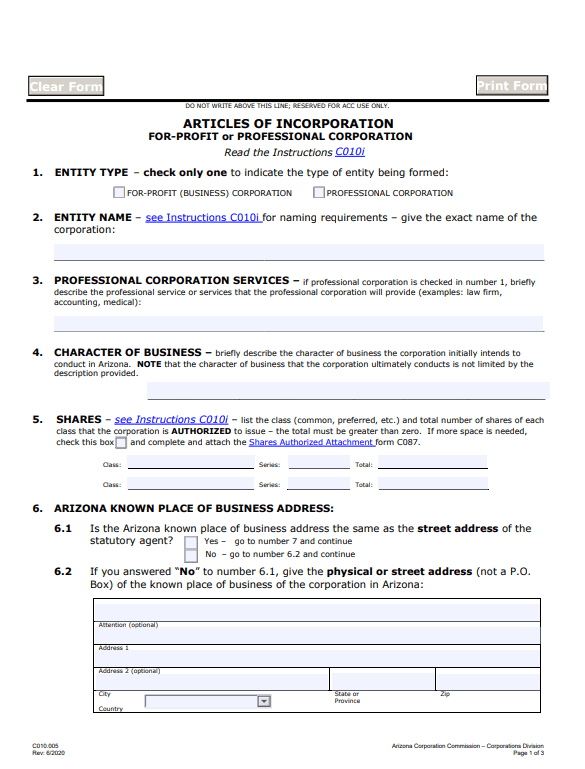
When forming an Arizona corporation, you generally need to submit two documents to the Arizona Corporation Commission (ACC):
Articles of Incorporation: This document officially establishes the corporation and includes key information such as the corporation's name, authorized shares, and statutory agent.
Certificate of Disclosure: This form provides information about certain individuals connected to the corporation. It asks whether specified officers, directors, and shareholders who own 10% or more of the corporation have certain criminal, securities-law, or bankruptcy history covered by Arizona's disclosure requirements.
The Certificate of Disclosure is separate from the Articles of Incorporation. Its purpose is to provide the ACC with required background information about certain people involved with the corporation. Both documents should be completed accurately and submitted as required for the corporation's formation.
Here are the two ways through which you file:
Option 1: File Online
Create an account on the Arizona Business Center (ABC), the ACC's online filing portal (formerly eCorp)..
Select "Start a New Business" and choose Domestic Profit Corporation.
Enter your corporation's name, statutory agent, share structure, and incorporator/director information.
Complete the Certificate of Disclosure questions.
Pay the $60 base filing fee.
Option 2: File by Mail/In-person
Mail or submit your completed Articles of Incorporation, Certificate of Disclosure, Statutory Agent Acceptance, and a cover sheet, with a check or money order for $60, to the address:
Arizona Corporation Commission's Corporations Division
Examination Section,
1300 W. Washington St., Phoenix, Arizona 85007
Standard processing currently runs about 9–11 business days. Expedited processing adds $35; same-day service is available for a higher fee.
Under A.R.S. § 10-203(D), a newly approved corporation must publish a copy of its Articles of Incorporation in a newspaper.
Who's exempt: Corporations whose known place of business is in Maricopa County (Phoenix metro) or Pima County (Tucson metro). Arizona law exempts corporations based in counties with more than 800,000 people, and the ACC posts the filing in its online database instead.
Who has to publish: Every other corporation that is not exempt must publish a notice in a newspaper of general circulation in the county where its known place of business is located.
Deadline: Within 60 days of ACC approval.
How long it runs: Three consecutive publications, usually completed within one to two weeks.
Cost: Roughly \$30–\$150, paid directly to the newspaper, not bundled into your Articles filing fee.
After forming your Arizona C Corp, the incorporators or initial board should adopt the corporation’s initial bylaws. Bylaws are the internal rules that explain how the corporation will operate and how decisions will be made. Arizona law allows bylaws to include provisions for managing the corporation, provided they do not conflict with state law or the Articles of Incorporation. Swyft Filings can simplify the process by preparing and drafting customized Corporate Bylaws for your Arizona C Corp.
Your bylaws can cover important areas such as:
Board of directors: Explain how directors are elected, removed, and replaced.
Officers: Identify officer positions and outline their responsibilities.
Meetings: Set rules for board and shareholder meetings, including notice requirements.
Voting: Explain voting procedures and the number of votes needed for different decisions.
Quorum: Establish the minimum number of directors or shareholders needed to conduct business.
Shareholder matters: Set procedures for shareholder meetings and voting.
Corporate records: Establish how meeting minutes and other corporate records will be maintained.
Once your Articles and Certificate of Disclosure are approved (and publication is satisfied, if it applies to you), hold an organizational meeting. The incorporator or initial directors typically:
You should form your corporation with the Arizona Corporation Commission before applying for an EIN. The ACC does not issue EINs. The IRS handles the application and issuance process.
You can apply for an EIN online through the IRS at no cost. If your application is approved online, the IRS provides the EIN immediately. You will need information about your corporation and its responsible party, generally the principal officer who controls or manages the corporation.
Unlike an Arizona LLC, forming a C corporation comes with a real, recurring compliance calendar; this is one of the few areas where Arizona doesn't stay hands-off.
Arizona C corporations must file an Annual Report and Certificate of Disclosure with the Arizona Corporation Commission every year, under A.R.S. § 10-1622. If a new officer, director, or 10% shareholder joins between reports, file a supplemental Certificate of Disclosure within 60 days.
Due date: Your corporation's anniversary date, as assigned by the ACC.
Notification: The ACC sends a notice roughly 90 days ahead of your due date, which falls in your corporation's assigned anniversary month rather than a fixed calendar date.
Filing window: You can file up to 90 days before your due date, which falls in your corporation's anniversary month. The ACC sends email reminders only if you sign up for them in the Arizona Business Center, so add the date to your own calendar.
Fee: \$45 for regular processing or \$80 for expedited processing.
Late penalty: \$9 per month delinquent; the ACC can move toward administrative dissolution after about 60 days of non-filing.
You can consider a professional service to file the annual report on your behalf. A service will prepare and file your report on your behalf, and you will receive confirmation once the filing is complete.
Arizona taxes C Corp income at a flat rate, applied to the corporation's Arizona taxable income, with a modest flat-dollar minimum tax that applies even to corporations with little or no taxable income.
Because these figures can change with each legislative session, confirm the current rate and minimum on the Arizona Department of Revenue's corporate tax page before filing your return.
If your Arizona C Corp sells taxable goods or provides services subject to Arizona's Transaction Privilege Tax (TPT), you may need to obtain a TPT license through the Arizona Department of Revenue. Some cities and towns also impose local TPT requirements or business licensing rules. Check the requirements for each location where your corporation conducts business.
Arizona does not have one general statewide business license that applies to every corporation. Instead, licensing requirements can depend on your location, industry, and business activities.
Check with your city or county for local licenses and permits, and determine whether your industry requires additional state licensing. Businesses in fields such as healthcare, contracting, and real estate may have specific professional or occupational requirements. Swyft Filings’ Business License Research service can help identify the licenses and permits that may apply to your business. You’ll receive a customized report with relevant application links and renewal requirements.
Set up a separate bank account for your Arizona C Corp to keep corporate and personal finances separate. This makes it easier to manage business transactions and maintain accurate financial records. Depending on the bank, you may need to provide your Articles of Incorporation, EIN confirmation, corporate bylaws, corporate resolution, and identification for authorized signers.
The cost to incorporate a C Corp in Arizona includes the state filing fee and any additional services you choose during the C Corp formation process in Arizona. Here is the rough breakdown of the cost to incorporate a C Corp in Arizona:
| Cost | Fee |
|---|---|
| Arizona Articles of Incorporation + Certificate of Disclosure | $60 |
| Newspaper Publication (if outside Maricopa/Pima County) | \~$30–$150 |
| Arizona Statutory Agent Service | Varies |
| Name Reservation (optional, 120 days) | $10 |
| Annual Report Filing Fee | $45/year |
| EIN | $0 |
Between the Certificate of Disclosure, share structure decisions, and the county-dependent publication requirement, forming an Arizona C Corp involves a few more steps than simply filing your Articles of Incorporation. If you want help managing these requirements, choose the desired Swyft Filings' Arizona C Corp formation package and get the support you need.
$0 + State Filing Fees
*Disclaimer: This guide provides general information about forming a C Corp in Arizona and is not a substitute for legal, tax, or financial advice.*
C Corp rules, filing costs, and corporate tax structures vary by jurisdiction. Select any state below to view its specific C Corp laws.
