
A dissolved, inactive, or suspended business can stop you from getting a loan, signing a contract, or proving your company’s good standing. Here's how to fix it.
To reinstate an LLC, start by checking your business status with the Secretary of State or state business registry. Then fix the issue that caused the problem. That may mean filing missed annual reports, paying late fees, updating your registered agent, clearing state tax issues, or requesting a tax clearance letter. Keep reading to know the reinstatement process in detail, step by step.
Key Takeaways:
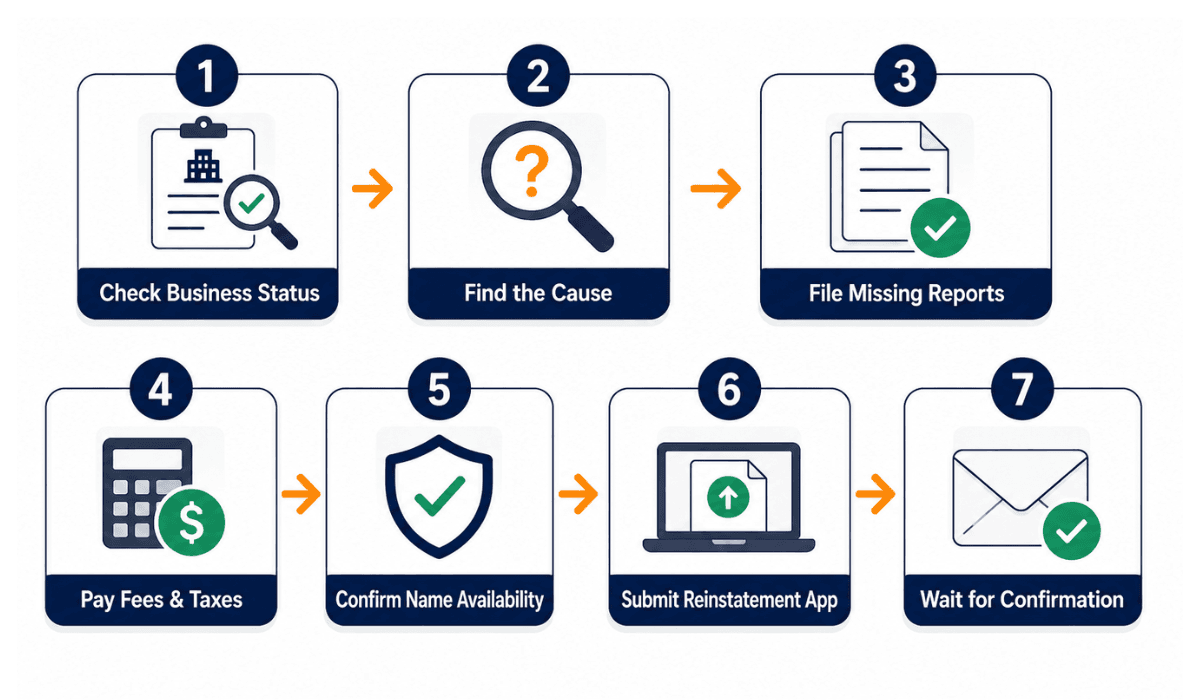
Most LLC reinstatement processes follow these steps:
Search your business in the state business database.
Confirm why your LLC is inactive, dissolved, suspended, revoked, or forfeited.
File all missing reports or statements.
Pay state fees, penalties, interest, and taxes.
Check whether your business name is still available.
Submit the reinstatement application.
Wait for confirmation before making major business moves.
The state may issue a certificate of reinstatement, certificate of revival, or updated active status once your filing is accepted.
What Is Business Reinstatement?
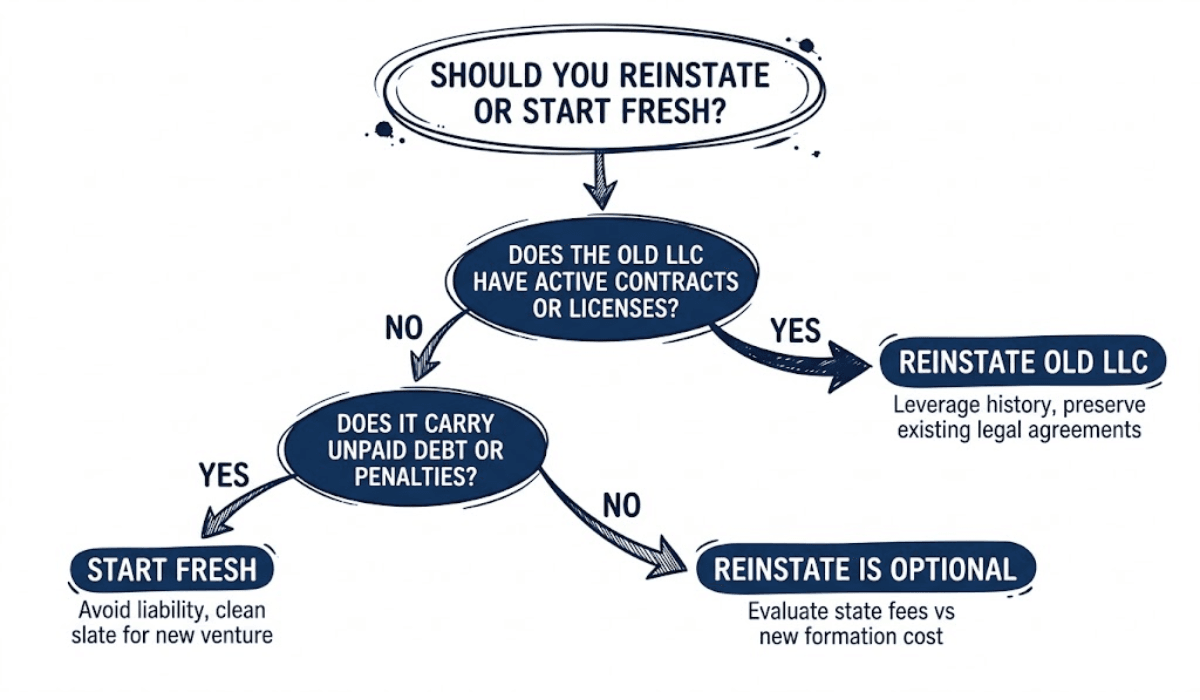
Reinstatement is the process of bringing an existing business entity back to active status after it has fallen out of compliance. The exact steps depend on your state, entity type, tax history, and the reason your business was dissolved or suspended.
A business can lose good standing when it does not meet state requirements. Common terms include:
- Administrative dissolution: The state ended the entity's active status because it missed a required filing or payment.
- Suspended: The business lost certain rights or privileges, often because of tax or state filing issues.
- Forfeited: The business lost rights to operate or defend itself in that state because of noncompliance.
- Revoked: The state canceled the authority of a domestic or foreign entity to do business.
- Inactive: The business is not currently active in state records.
- Good standing: The business is current with required state filings and fees.
Business Reinstatement Requirements at a Glance
Business reinstatement is not one form in every state. It is usually a group of tasks that bring your company back into compliance.
Requirement | What It Means | Where to Check |
Business status | Your company may be active, inactive, dissolved, revoked, suspended, or forfeited | Secretary of State or state business registry |
Reason for noncompliance | The state needs to know what caused the loss of good standing | State notice, business search, tax agency account |
Past-due filings | Missed annual reports, statements of information, or franchise tax reports may need to be filed | Secretary of State or the tax department |
Payments | Late fees, penalties, interest, taxes, and filing fees may be due | State agency fee schedule |
Reinstatement form | The official application that asks the state to restore your entity | Secretary of State or filing office |
Name availability | Your old business name may need to be available before reinstatement | State name search |
Registered agent | Your agent information may need to be current | State business registry |
Why Was My LLC or Company Dissolved?
Most businesses fall out of good standing because of missed administrative tasks, not because the owner intentionally shut the company down.
Common reasons include:
- Missing an annual report
- Missing a statement of information
- Not paying state franchise taxes
- Not paying state fees, penalties, or interest
- Letting the registered agent resign without replacing them
- Not updating the registered office address
- Missing nonprofit annual filings
- Ignoring a state notice
- Failing to maintain a foreign qualification in another state
A foreign-qualified business can also lose authority in a state where it is registered to do business outside its home state. For example, a Delaware LLC registered in Texas or Florida may need to fix filings in those states even if the Delaware entity is still active.
What Happens If You Do Not Reinstate Your LLC?
An inactive or dissolved LLC can create practical problems. It may not stop every business activity in every state, but it can limit what your company can do and how others view it.
You may run into issues when you try to:
- Get a certificate of good standing
- Open or update a business bank account
- Apply for financing
- Sign a lease or vendor contract
- Renew a license
- Sell the business
- Defend the business in court
- Close the business properly
- Keep the same business name
California gives a clear example of how serious this can become. The California Franchise Tax Board states that a suspended or forfeited business is not in good standing and loses its rights, powers, and privileges to do business in California. [1]
A suspended business loses important rights, including the ability to do business, defend itself in court, or preserve its business name.
The lesson is not to panic but to act in the right order.
First, confirm the problem. Then fix the missed filings, taxes, agent issues, or name issues before you submit reinstatement paperwork.
How to Reinstate Your LLC or Company, Step by Step
Step 1: Check Your Business Status
Start with your state's business search tool. This is usually run by the Secretary of State, Division of Corporations, Corporation Commission, or similar filing office.
Search using:
- Legal business name
- State entity ID number
- Filing number
- Document number
- Registered agent name
- Officer or organizer name, if the state allows it
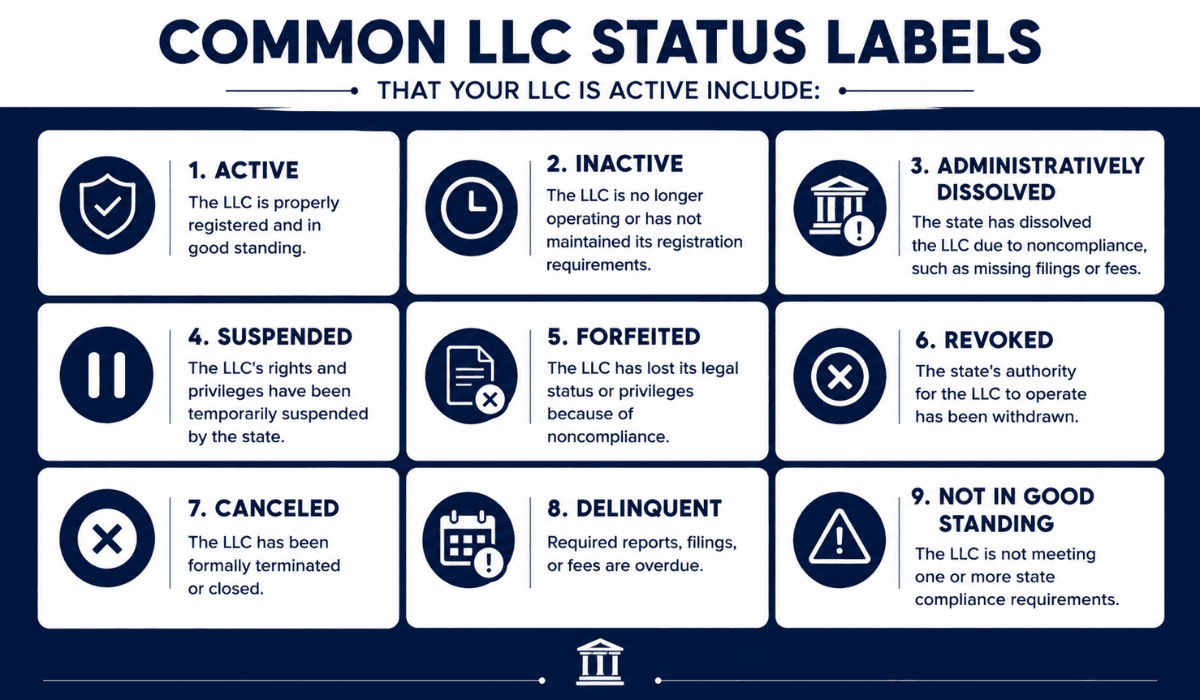
Write down the exact status shown in the database. Do not rely on old emails or letters alone. Your status may have changed since the last notice. This status tells you what problem you need to solve next.
Step 2: Find Out Why Your Business Fell Out of Good Standing
The state does not reinstate a business just because the owner asks. You need to cure the deficiency. That means you must fix the issue that caused the status problem.
Look for:
- Missed annual reports
- Missing tax returns
- Unpaid franchise taxes
- Late fees, penalties, and interest
- Registered agent resignation
- Missing statement of information
- Name conflict
- Missing tax clearance letter
Some states show the reason in the business search. Others require you to log in, call the agency, check a tax account, or review mailed notices.
Also Read: What Is a Certificate of Good Standing?
Step 3: File Missing Reports and Statements
Many reinstatement cases begin with missed annual reports or information statements.
An annual report is usually not a financial statement. It often confirms or updates basic company information, such as:
- Principal office address
- Mailing address
- Registered agent
- Managers, members, officers, or directors
- Federal employer identification number
- Contact email
Florida's Division of Corporations states that an annual report must be filed each year to maintain active status. Entities that do not file by the required September deadline may be administratively dissolved or revoked, and reinstatement requires a reinstatement application plus associated fees.
Your state may call this filing an annual report, biennial report, periodic report, public information report, or statement of information. [2]
Step 4: Pay State Fees, Penalties, Interest, and Taxes
Reinstatement usually costs more than one filing fee. The total cost depends on your state, how long the business has been inactive, and what caused the issue.
Possible costs include:
- Reinstatement application fee
- Missed annual report fees
- Late filing fees
- Franchise taxes and interest
- Penalties
- Registered agent change fees
- Name amendment fees
- Tax clearance request fees
Do not guess your total cost. Check the state fee schedule, your tax account, and any state notices before you file.
Step 5: Confirm Your Business Name Is Still Available
A dissolved or inactive business may lose the exclusive right to its name in some states. If another business has taken your name, the state may require you to amend the name before reinstatement.
Before filing, search the state database for your exact business name. Check for exact matches, similar names, plural or singular versions, punctuation changes, and entity designators like LLC, L.L.C., Inc., Co., or Company.
If your name is not available, you may need a name amendment. You can also use a business name checker to brainstorm alternatives before checking your state database.
Step 6: Submit the Reinstatement Application
Once the missing filings and payments are ready, submit the reinstatement paperwork to the right agency.
Common form names include:
- Application for Reinstatement
- Application for Certificate of Reinstatement
- Certificate of Reinstatement
- Application for Certificate of Revivor
- Certificate of Revival
- Reinstatement Application
- Tax Clearance Letter Request for Reinstatement
Some states let you file online. Others require mailed forms, tax clearance, or agency review before the Secretary of State can accept the reinstatement.
Texas is one example where the tax agency and the Secretary of State may both be involved.
The Texas Comptroller states that Texas-formed and out-of-state entities registered with the Texas Secretary of State must satisfy state tax filing requirements before they can be reinstated.
For franchise tax reinstatement, the entity must file outstanding franchise tax and public information reports, pay tax, penalty, and interest, request a tax clearance letter, and then submit that letter along with Secretary of State reinstatement forms and filing fees. [3]
Step 7: Wait for Confirmation Before Resuming Major Business Actions
Processing time depends on the state, filing method, tax clearance requirements, and whether your paperwork is complete.
Online filings may update quickly in some states. Mailed filings, tax review, name conflicts, and missing reports can slow the process.
Before you sign a major contract, apply for financing, or tell a bank your company is active again, confirm the business status in the state database. Save the approval notice, receipt, certificate, or state confirmation for your records.
How Much Does Business Reinstatement Cost?
Business reinstatement costs vary by state and by problem. A company that missed one annual report may pay much less than a company that missed several years of reports and taxes.
Cost Category | Why It Matters |
Reinstatement application fee | Most states charge a fee to process the reinstatement |
Missed annual report fees | You may need to file every overdue report |
Late penalties | Some states add penalties after specific deadlines |
Taxes and interest | Tax-related suspensions can require payment before reinstatement |
Registered agent update | A missing or resigned agent can block good standing |
Name amendment | You may need this if your old name is no longer available |
Here are approximate fee ranges for some of the most-searched states. These are for general reference only; fees change and vary by entity type.
State | Estimated Reinstatement Fee | Late Annual Report Fee | Notes |
Florida | $100 (LLC) | $400 (after May deadline) | Automatic dissolution occurs every September. |
Texas | $75 (LLC) | Varies | Franchise tax + SOS fees both apply |
California | $0 SOS fee (LLC revivor) | Varies | FTB back taxes and penalties are the main cost |
Illinois | $200 (LLC) | $300 per missed year | Articles of Reinstatement required |
Georgia | $50 | $25 per missed report | Online filing available |
Note: Always verify current amounts at your state's official filing office before submitting.
How Long Does Reinstatement Take?
Reinstatement can take anywhere from a quick online update to several weeks or longer. The timeline depends on the state and the problem.
Reinstatement may take longer if:
- You missed several years of filings
- The state needs tax clearance
- Your business name is no longer available
- You must coordinate with more than one agency
- You mail forms instead of filing online
- Your filing has errors or missing information
- State processing volume is high
Some states offer expedited handling. Expedited processing can help, but it does not fix missing reports, unpaid taxes, or incorrect forms. Complete paperwork matters more than speed.
What Documents Do You Need to Reinstate an LLC?
Gather your records before you start. This helps avoid filing delays.
You may need:
- Legal business name and state entity ID number
- EIN and formation date
- Principal office address and mailing address
- Registered agent name and address
- Missed annual reports and franchise tax reports
- Tax account information and state notices
- Reinstatement application form
- Tax clearance letter, if required
- Name amendment, if required
- Payment method
- Owner, member, manager, officer, or director information
State-Based Scenarios: How Reinstatement Can Look in Real Life
Scenario 1: Texas LLC Forfeited Because of Franchise Tax Reports
The likely path:
- File all outstanding franchise tax and public information reports.
- Pay any tax, penalty, and interest due.
- Request a tax clearance letter from the Texas Comptroller.
- Submit the tax clearance letter, reinstatement forms, and filing fees to the Texas Secretary of State.
- Confirm the LLC is active before signing the catering contract.
This is a good example of why business reinstatement often involves more than the Secretary of State. Tax clearance is part of the process in Texas, and skipping it means the SOS will not process the reinstatement.
Scenario 2: California LLC Suspended During a Bank Loan Review
The likely path:
- Check whether the issue is with the Franchise Tax Board, the Secretary of State, or both.
- File all past-due tax returns with the FTB.
- Pay past-due tax balances, penalties, fees, and interest.
- File the correct revivor request form for an LLC with the FTB.
- Fix any Statement of Information issue with the Secretary of State.
- Confirm the LLC is back in good standing before the loan review continues.
California's process shows why timing matters. A suspended or forfeited business faces real limits on legal rights, contracts, and business activity until every issue is resolved, not just one.
Scenario 3: Illinois LLC Dissolved for Missed Annual Reports
The likely path:
- File all overdue annual reports with the Illinois Secretary of State.
- Pay the filing fees and any applicable late penalties.
- Submit Form LLC-35.40 (Articles of Reinstatement) to the Illinois Secretary of State.
- Confirm the LLC is showing as active in the state database.
- Provide the certificate of good standing to the client.
This scenario is common for business owners who move without updating their registered agent or registered office address. State notices go to the address on file, not where you actually are.
Reinstating an LLC vs. Starting a New LLC: Which Is Better?
Some owners wonder if it is easier to start a new LLC instead of reinstating the old one. The right choice depends on your business history, debt, contracts, licenses, taxes, name, and state rules.
Reinstatement May Make Sense If | Starting a New LLC May Make Sense If |
You need the same business history | The old LLC was never used |
You need the same EIN for accounts or contracts | The old entity has too many unpaid fees |
You have bank accounts tied to the old LLC | You do not need the old business name |
You have licenses tied to the entity | The old name is no longer available |
You need to preserve contracts or vendor history | The business model has changed significantly |
You need to dissolve the old LLC properly first | State rules make reinstatement unavailable or impractical |
Note: Forming a new LLC does not erase what the old one owed. State penalties, taxes, and creditor claims can follow the owners personally if the old entity was never properly closed. If you are unsure, speak with a business formation specialist before deciding.
Can You Reinstate a Dissolved LLC Online?
Many states require online reinstatement via their digital portals, but not all reinstatement cases can be completed online.
Online reinstatement may be available when:
- The issue is only the missed annual reports
- The state accepts online payments
- No tax clearance is required
- The business name is still available
- Registered agent information is current
Mail or agency review may be required when:
- Tax clearance is needed
- The business name has been taken
- Several years of reports are overdue
- A signature or original form is required
- A nonprofit needs IRS reinstatement
- The state needs additional documentation
Search your state filing office for “reinstatement,” “revivor,” “revival,” or “administrative dissolution.” Use the official state website whenever possible.
How to Fix Registered Agent Problems During Reinstatement
A registered agent receives legal and state notices for your business. If your registered agent resigns or your registered office address is invalid, the state may treat your company as noncompliant.
To fix this issue:
- Choose a valid registered agent with a physical address in the state.
- Update the registered agent information with the state.
- Pay any required change fee.
- Keep proof of the update with your company records.
A reliable registered agent helps prevent missed notices going forward. Missing a single state notice can restart the same compliance problem.
Can You Dissolve a Business That Is Not in Good Standing?
Sometimes an owner does not want to reinstate the business. They want to close it. That can still require cleanup first.
Some states require a business to fix tax or filing issues before it can legally dissolve, withdraw, or terminate.
Texas requires entities to satisfy state tax filing requirements before they can terminate, merge, convert, or reinstate.
California also states that a suspended or forfeited business cannot legally close or dissolve until the issue is addressed.
If your goal is to close the business, check your state's rules before ignoring the entity. You may need to file missed reports, pay fees, request tax clearance, or restore status before filing dissolution paperwork.
Also Read: Why You Should Dissolve an Unused Business Before Year’s End
How to Avoid Falling Out of Good Standing Again
Once your business is active again, set up a simple compliance system.
Annual Compliance Checklist for LLC Owners
- January: Check your state business status and confirm your registered agent is current.
- Q1: File any annual reports due in your state; deadlines vary widely by state.
- April/May: Watch for franchise tax deadlines (Texas: May 15; Florida: May 1).
- Ongoing: Update your mailing address after any move. State notices go to your registered address on file, not your current location.
- Quarterly: Log into your state's business portal and confirm your status shows Active.
- Year-end: Review foreign qualification requirements in every state where you operate.
- Always: Save state notices, filing receipts, and login credentials in a secure location.
- Nonprofits: Keep Form 990 deadlines on the board calendar and assign a specific person responsible for filing each year.
Summing Up
Business reinstatement can be simple in some states and more involved in others. The hard part is often knowing which agency needs what, especially when tax clearance, annual reports, registered agent updates, or name issues are involved.
Swyft Filings specialists can help business owners understand filing requirements and prepare business filing paperwork. We have helped 600,000+ businesses with formation and compliance since 2015 across all 50 states.
Let us help you start or reinstate your business today
Sources
- California Franchise Tax Board. My business is suspended. Accessed on May 28, 2026
- Florida Department of State, Division of Corporations. File Annual Report. Accessed on May 28, 2026
- Texas Comptroller of Public Accounts. Reinstating or Terminating a Business. Accessed on May 28, 2026{
FAQs
Yes, many inactive or administratively dissolved LLCs can be reactivated through reinstatement. Requirements vary by state. You may need to file missed annual reports, pay penalties, update your registered agent information, or resolve outstanding tax issues.
Usually, yes. Once the state approves the reinstatement and all required filings, fees, and tax obligations are satisfied, the LLC is generally returned to good standing. Check your state's business database after approval to confirm the status.
Your business may remain inactive, dissolved, suspended, forfeited, or revoked depending on state law. This can make it difficult to obtain a certificate of good standing, open business bank accounts, sign contracts, secure financing, or properly close the business.
In many cases, owners do not intentionally dissolve their LLC. The state may administratively dissolve the company after missed filings, unpaid fees, or other compliance issues. Reinstatement allows you to correct those issues and restore the LLC's legal status.
Many administratively dissolved LLCs can be reinstated, but the process varies by state. Some states impose deadlines for reinstatement, while others may require additional forms, fees, tax clearance, or even a name change if the original name is no longer available.
A tax clearance letter is a document issued by a state tax agency confirming that a business has met certain tax filing and payment requirements. Some states require this letter before processing an LLC reinstatement application.