
A nonprofit organization (NPO) is a legal entity formed to advance a mission, social, educational, charitable, religious, or public, rather than to generate profits for owners or shareholders.
The nonprofit principle is simple: any revenue that exceeds operating costs must be reinvested into the organization's mission. It cannot be distributed to founders or members as personal income.
In the United States, the IRS governs nonprofit tax status under the Internal Revenue Code. The most recognized classification is Section 501(c)(3), which grants federal tax-exempt status to qualifying charitable organizations. But a nonprofit is a broad umbrella with over 30 types of nonprofit classifications under the tax code, including 501(c)(4) social welfare organizations, 501(c)(6) trade associations, and more. [1]
Being "nonprofit" does not mean an organization cannot generate revenue, pay employees, or operate like a business. It means the purpose of that revenue is the mission, not personal enrichment.
This guide covers everything about nonprofits, from what they are, how they work, their benefits and drawbacks, to who they're for, and what you need to know before starting one.
What Does a Nonprofit Actually Do?
Nonprofits operate across nearly every sector of society. A nonprofit can run a food bank, manage a hospital, publish research, operate a school, advocate for policy reform, or support veterans. What unites them is a mission-driven structure and the legal obligation to serve public or collective benefit.
They typically fund operations through:
- Charitable donations from individuals and corporations
- Government and private foundation grants
- Earned revenue from programs, services, or events
- Membership dues (for associations and clubs)
- Endowment investment returns (for foundations)
Crucially, nonprofits do pay employees, including executives. The restriction is on the distribution of profits, not on paying fair compensation for labor. A nonprofit CEO can earn a salary that reflects market rates; it just cannot come from profit-sharing arrangements.
Also Read: What Is a Nonprofit Organization?
What Are the 4 Main Types of Nonprofit Organizations?
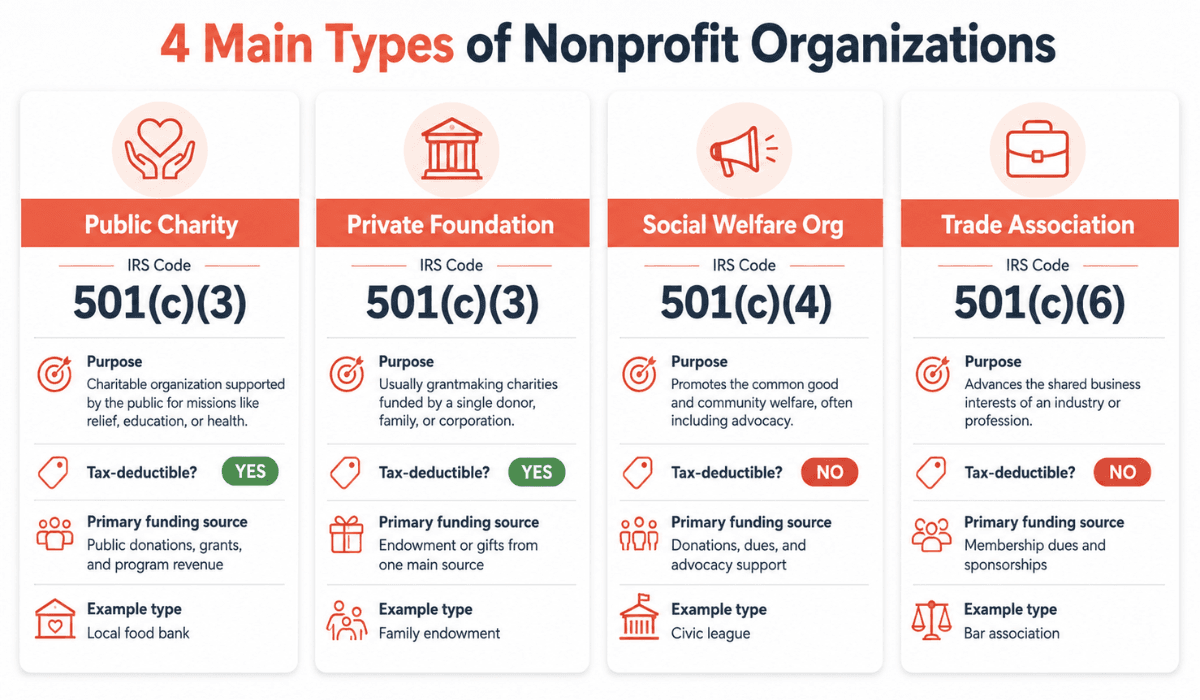
1. Public Charities
These are the most common types. These organizations serve a broad public purpose like hunger relief, housing, education, healthcare, and arts, and receive funding from a wide range of donors and grants.
Examples include local food banks, Habitat for Humanity chapters, and free health clinics. Most 501(c)(3) organizations fall here.
2. Private Foundations
These are typically funded by a single source, such as a family, individual, or corporation. Foundations primarily make grants to other nonprofits or individuals. They are subject to stricter IRS rules, including a 5% minimum annual distribution of their assets (the origin of the "5% rule" you may have encountered). The Bill & Melinda Gates Foundation is a well-known example. [2]
3. Social Welfare Organizations (501(c)(4))
These organizations promote community welfare and may engage in political lobbying to a greater degree than 501(c)(3)s. Donations are generally not tax-deductible. Civic leagues, advocacy groups, and some neighborhood associations fall into this category.
4. Trade and Professional Associations (501(c)(6))
Formed to serve the interests of a specific profession or industry, like bar associations, chambers of commerce, or medical societies. They operate for the collective benefit of their members rather than the general public.
How Does a Nonprofit Get Tax-Exempt Status?
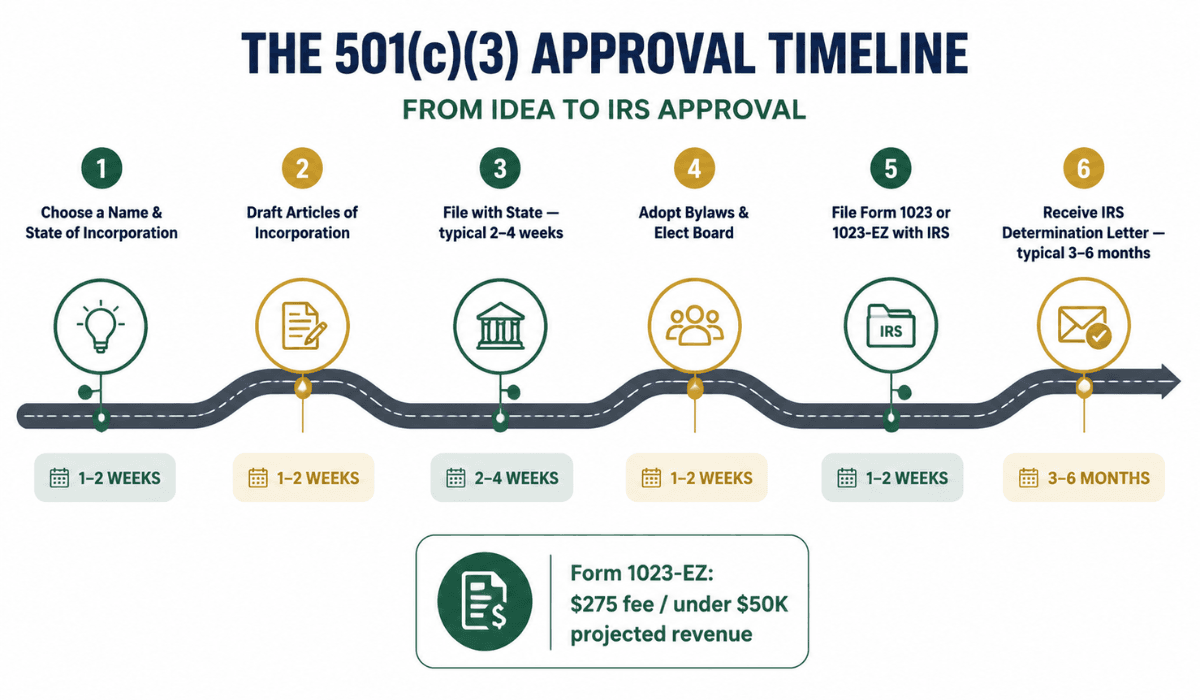
Tax exemption is not automatic. Organizations must apply for it. For 501(c)(3) status, an organization files Form 1023 (or the streamlined Form 1023-EZ for smaller organizations) with the IRS. The IRS reviews the application to confirm that the organization's purpose, governance structure, and financials meet the requirements.
Once approved, the organization:
- Is exempt from federal income taxes on activities related to its mission
- Can receive tax-deductible donations from individuals and businesses
- May qualify for state-level tax exemptions (property tax, sales tax, varies by state)
- Becomes eligible for many government and private grants restricted to 501(c)(3)s
Maintaining this status requires annual compliance: most nonprofits must file Form 990 with the IRS each year. Failing to file for three consecutive years results in automatic revocation of tax-exempt status. [3] [4]
What Is a Nonprofit Audit?
A nonprofit audit is an independent examination of the organization's financial statements, conducted by a licensed CPA. Audits are not required for all nonprofits, but they become necessary when:
- Annual revenue exceeds certain thresholds (typically $500,000–$750,000, depending on state)
- A federal grant requires an audit (federal awards over $750,000 trigger a Single Audit under the Uniform Guidance)
- State law mandates it for charitable solicitation registration
- The board or major funders require it for accountability
An audit is distinct from an IRS review or investigation. It's primarily a financial transparency tool that builds donor and funder trust. Smaller nonprofits may instead undergo a financial review or compilation, which are less intensive than a full audit.
Nonprofit vs. For-Profit: Key Differences
Factor | Nonprofit | For-Profit |
Primary purpose | Mission / public benefit | Profit for owners/shareholders |
Profit distribution | Not permitted, reinvested in mission | Distributed to owners/shareholders |
Tax status | Often tax-exempt (federal + state) | Taxable |
Donations | Tax-deductible for donors (501(c)(3)) | Not deductible |
Ownership | No owners; governed by a board | Owned by founders/investors |
Grant eligibility | Eligible for most government and private grants | Generally ineligible |
Accountability | Public filings (Form 990 is public) | Financial privacy (unless a public company) |
Nonprofit vs. Not-for-Profit: Is There a Difference?
Colloquially, the terms are used interchangeably. Technically, there's a subtle legal distinction:
A nonprofit typically refers to organizations incorporated under state nonprofit corporation law. It is a formal legal entity capable of entering into contracts, holding property, and suing or being sued in its own name. This is the standard vehicle for 501(c)(3)s.
A not-for-profit sometimes refers more loosely to any organization that doesn't seek to profit, including informal clubs, hobby groups, or unincorporated associations. These may not have formal corporate status at all.
For practical purposes: if you're forming an organization to seek tax-exempt status, accept grants, or hire employees, you want to incorporate as a nonprofit corporation.
Nonprofit Governance: Board of Directors Responsibilities
One of the most misunderstood aspects of nonprofit structure is the role of the board of directors. In a for-profit company, the board represents shareholders' interests. In a nonprofit, the board holds the organization's charitable assets in trust for the public benefit.
Board Members Carry Three Core Legal Duties:
- The duty of care requires that board members make informed decisions, attend meetings, review financial reports, and engage with organizational affairs with the level of diligence a reasonable person would apply to their own affairs.
- The duty of loyalty requires that board members act in the best interest of the organization, not in their own interest or the interest of any related party. This is the foundation of conflict of interest policies, which require board members to disclose relationships that could influence their judgment and recuse themselves from related votes.
- The duty of obedience requires board members to ensure the organization remains faithful to its stated mission and complies with applicable laws, its articles of incorporation, and its bylaws.
These duties create real legal exposure. Board members can be held personally liable for certain breaches, particularly those involving financial mismanagement or self-dealing. Most nonprofits carry Directors and Officers (D&O) insurance to protect board members, but the coverage has limits and conditions.
What effective boards actually do:
A high-functioning nonprofit board sets strategic direction, ensures financial oversight, hires and evaluates the executive director, and secures resources (including personally contributing to fundraising). The board does not manage day-to-day operations; that's the executive director's role. Confusion about this boundary is one of the most common sources of governance dysfunction in nonprofits of all sizes.
Boards typically meet quarterly at a minimum. They operate through committees like audit, finance, governance, and executive committees, which are common in mid-sized organizations. Board minutes documenting decisions are not just good practice; they're required by IRS standards and are examined during audits and grant reviews.
What Are the Benefits of a Nonprofit Organization?
For the Organization and Its Mission
Tax-exempt status significantly reduces operating costs. Contributions from donors go further when donations are deductible. Grant eligibility opens funding channels unavailable to for-profits. Many software providers (Microsoft, Google, Salesforce) offer deeply discounted or free tools to 501(c)(3)s. TechSoup, a nonprofit technology intermediary, serves as a central clearinghouse for these discounts. Qualifying nonprofits can access software and hardware at a fraction of retail cost.
Beyond technology, 501(c)(3) organizations are eligible for reduced postal rates under USPS nonprofit mailing permits, which matters for organizations doing direct mail fundraising. Many state and local governments exempt qualifying nonprofits from sales tax and property tax, further stretching program budgets.
For Employees
Nonprofit employees are often eligible for PSLF (Public Service Loan Forgiveness), a federal program that forgives remaining federal student loan balances after ten years of qualifying payments while working for a qualifying nonprofit. Benefits packages at larger nonprofits can be competitive with those of for-profit employers.
Many nonprofits, particularly in healthcare and education, offer defined benefit pension plans that have largely disappeared from the private sector. Flexibility, mission alignment, and organizational culture are frequently cited as reasons employees accept compensation below what they might earn commercially, though these soft benefits are increasingly insufficient to retain talent in a competitive labor market.
For Donors
Individuals who itemize deductions can deduct contributions to 501(c)(3) organizations from their federal taxable income, subject to AGI limits. Corporations may also deduct charitable contributions. This provides a direct financial incentive to give.
Qualified charitable distributions (QCDs) allow individuals 70½ or older to transfer up to $111,000, annually from an IRA straight to a 501(c)(3) charity, excluding the amount from taxable income, a significant tax planning tool for retirees. [5]
For the Community
Nonprofits fill gaps that neither the market nor the government addresses. They deliver services where the profit motive doesn't exist, such as rural healthcare, food insecurity, arts access, and literacy programs. They create local employment and contribute to economic activity. The nonprofit sector is one of the largest employers in the United States, employing approximately 10% of private workforce people and contributing roughly 5 to 6% of GDP, according to data from the fundraise Statistics. [6]
What Are the Disadvantages of a Nonprofit?
Honesty matters here. Nonprofits come with real structural challenges.
- Loss of ownership and control: A nonprofit has no owners. Founders cannot sell the organization or take profits out. The board of directors governs the organization, and founders who serve as executives can be removed by that board.
- Compliance burden: Maintaining tax-exempt status requires ongoing filings, governance policies, conflict of interest disclosures, and state reporting. For small teams, this overhead is significant.
- Grant dependency risk: Many nonprofits rely heavily on grant funding, which is competitive, restricted to specific uses, and can be discontinued. Organizations that don't develop diverse revenue streams are fragile.
- Salary constraints and talent competition: While nonprofit salaries have improved, many organizations, particularly small ones, struggle to compete with for-profit pay for skilled professionals. This contributes to high turnover and burnout in the sector.
- Slow decision-making: Board governance, required meetings, and committee structures can slow organizational responsiveness compared to owner-led businesses.
- Public scrutiny: Form 990 is a public document. Executive compensation, program spending ratios, and financial health are visible to anyone. This transparency is good for donors but can create reputational risk if the numbers look unfavorable.
What Are the Pros and Cons of Working for a Non profit
Why People Choose Nonprofit Work
Many professionals value mission alignment, working toward something they believe in rather than purely for shareholder returns. The sector tends to offer meaningful autonomy, community relationships, and a sense of purpose that's harder to quantify but widely reported as a factor in job satisfaction.
Public Service Loan Forgiveness (PSLF) eligibility is a concrete financial benefit for employees carrying student loan debt. Nonprofit workers at qualifying organizations who make 120 qualifying monthly payments under an income-driven repayment plan may have remaining balances forgiven tax-free. For someone with significant graduate school debt, this can represent thousands of dollars in savings. [7]
Work-life balance policies, flexible scheduling, and remote work options are often more readily available at nonprofits than in high-pressure corporate environments, though this varies significantly by organization size and sector. Human services and healthcare nonprofits, for example, often have demanding caseloads regardless of the mission context.
Professional development in the sector can be strong. Certifications such as the Certified Nonprofit Professional (CNP) credential from the Nonprofit Leadership Alliance and the Certified Fundraising Executive (CFRE) designation are recognized across the sector. Nonprofit executive roles often allow professionals to develop skills (general management skills, overseeing finance, HR, programs, and communications simultaneously) that specialists in large corporations may not encounter.
The Honest Tradeoffs
Compensation in the nonprofit sector varies widely. Large hospital systems and university foundations pay executive salaries that rival those of their private sector peers. Smaller community organizations often pay below-market rates. The sector's middle organizations with $1M–$10M in annual revenue are where salary compression is most felt.
Burnout rates are high. Understaffed teams wearing multiple hats, the emotional weight of mission-driven work, and insufficient organizational support are documented contributors to high turnover, particularly among frontline staff.
For career changers from corporate backgrounds: the transition is real. Decision cycles are slower, political dynamics around funding are different, and measuring "success" is more complex than a single revenue number.
Nonprofit vs. NGO: What's the Difference?
This distinction matters especially for professionals working internationally.
In the United States, an NGO (non-governmental organization) is not a distinct legal classification. It's an informal term often used in international development and policy contexts to refer to civil society organizations that operate independently of government. All 501(c)(3) nonprofits are NGOs in the broad sense; not all NGOs are structured as US nonprofits.
Outside the US, the term NGO has a more specific meaning. In many countries, international development organizations, humanitarian agencies, and advocacy groups operating across borders are referred to as NGOs and governed by the host country's registration requirements rather than US tax law. An organization like Doctors Without Borders operates as an NGO under international and French law, not primarily as a US 501(c)(3).
Common Reasons Nonprofits Fail
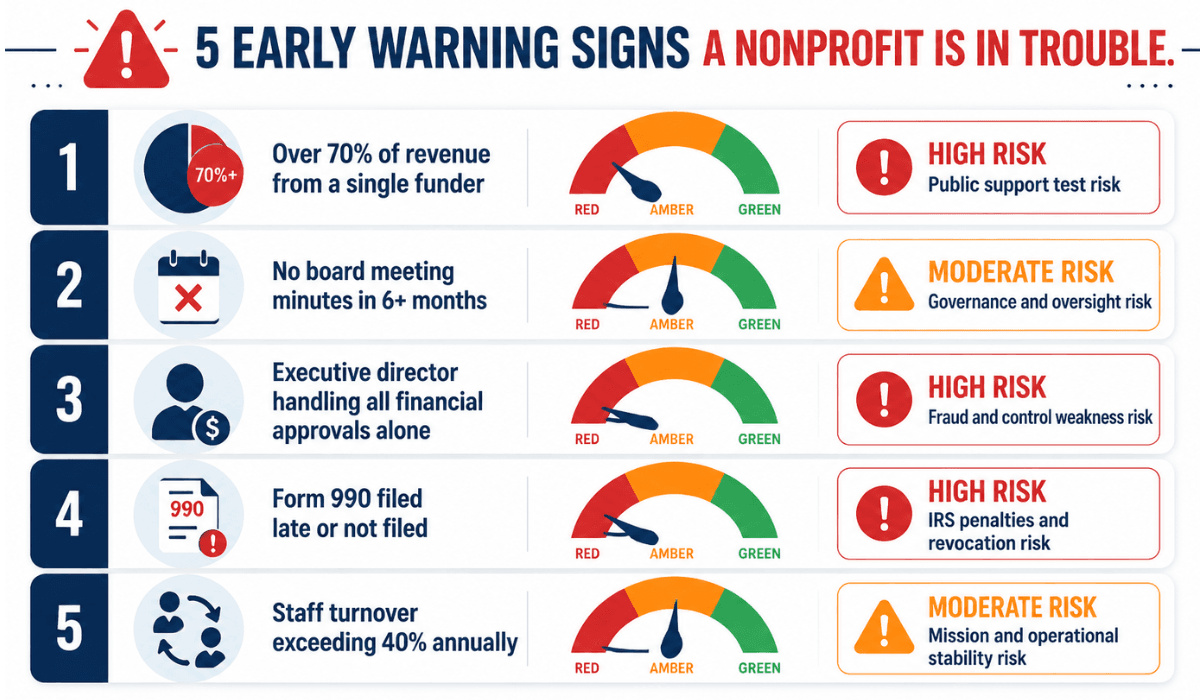
Research consistently identifies a cluster of causes behind nonprofit failure:
- Undercapitalization at launch: Many founders underestimate the cost of compliance, administration, and program delivery before funding comes in.
- Founder dependency: When the organization's identity and relationships are entirely tied to one person, succession planning fails, and board governance suffers.
- Mission creep: Taking any grant that becomes available, even when it pulls the organization away from its core purpose, dilutes effectiveness and creates reporting complexity.
- Poor board engagement: A board that rubber-stamps the executive director without active oversight creates governance failures that catch up with organizations, often at the worst time.
- No earned revenue strategy: Pure donation and grant dependency without any program revenue leaves nonprofits exposed to funding cycles.
Nonprofit vs. LLC: Which Is Right for You?
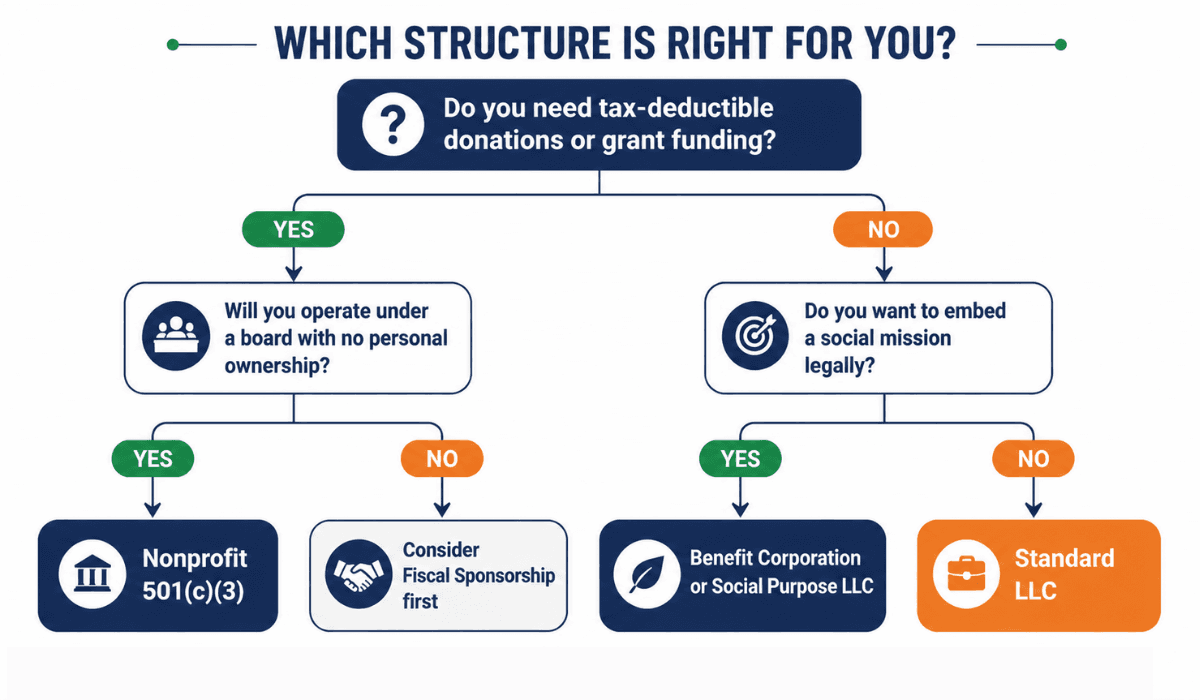
This is one of the most common questions from social entrepreneurs.
An LLC offers flexibility, ownership, and the ability to distribute profits. It's the right choice if you want to build a sustainable business model and eventually generate personal income from the enterprise. A social purpose LLC or benefit corporation allows you to formalize a social mission while maintaining a for-profit structure.
A nonprofit is right when your primary goal is mission impact, you need grant funding and tax-deductible donations, and you're willing to operate under board governance with no personal ownership stake.
There is no hybrid that gets you the best of both worlds within a single entity, but some organizations use an LLC subsidiary or a for-profit affiliate alongside a nonprofit parent for specific revenue-generating activities.
For a deeper look at formation decisions, see our business formation checklist after starting a nonprofit.
Personalized Scenarios: What's Right for Your Situation?
Scenario 1: The First-Time Community Founder
Maria runs a volunteer tutoring program out of her church and wants to formalize it to apply for school district grants. She's never started an organization before and has a $0 budget.
For Maria, the path is: incorporate as a nonprofit in her state (typically $50–$100 in state filing fees), adopt bylaws and elect a board of at least three members, then file Form 1023-EZ with the IRS (filing fee: $275) if projected annual revenue is under $50,000. The entire process can take 3–6 months. Starting with no money is doable, but Maria should plan for initial out-of-pocket costs and consider whether a fiscal sponsorship arrangement might bridge the gap while her application is pending.
Scenario 2: The Faith-Based Leader
Pastor James leads a congregation that already operates a food pantry and youth mentorship program. He wants to formalize the ministry's charitable arm to accept larger foundation grants and issue tax receipts for major donors.
Churches have a unique status; they are automatically tax-exempt under 501(c)(3) without filing, but many choose to obtain formal recognition for grant eligibility and donor documentation. Creating a separate nonprofit affiliate, or formally applying for recognition, gives funders the comfort they need. The key governance consideration: the church leadership should understand that a formally incorporated nonprofit is governed by its board, which may include non-church members, and operates under IRS rules that constrain political activity from the pulpit.
Scenario 3: The Grant-Seeking Executive Director
Pamila directs a two-year-old environmental advocacy nonprofit that has relied on individual donations. She's been told by a foundation program officer that her organization needs to strengthen its governance documentation to be competitive for a $50,000 grant.
What the foundation is likely looking for: a current strategic plan, a conflict of interest policy, board meeting minutes showing active governance, audited or reviewed financial statements, and a Form 990 demonstrating program efficiency. Pamila should prioritize getting these documents in order, not just for this grant, but because they represent the infrastructure any serious funder will scrutinize. Our grants and funding guide walks through what grant-readiness actually requires.
Scenario 4: The Social Impact Entrepreneur
David has developed a workforce training model that could generate revenue from corporate clients while also serving low-income participants. He's torn between a nonprofit and a for-profit structure.
David is a candidate for a hybrid model discussion. If his corporate-side revenue will be substantial and tied to commercial contracts, a for-profit LLC may make more sense, potentially with a nonprofit affiliate that handles the subsidized training for low-income participants funded by grants. The decision hinges on whether the grant-and-donation component is central or peripheral to sustainability. A nonprofit with an earned revenue program is also viable; the IRS calls this "related business income," and it remains tax-exempt when substantially related to the mission.
Scenario 5: The Compliance-Conscious Board Member
Sandra recently joined the board of a small arts nonprofit and discovered the organization hasn't filed its Form 990 in two years. The executive director dismissed it, saying, "We're too small."
Sandra is right to be concerned. Most nonprofits, regardless of size, must file a Form 990, 990-EZ, or 990-N (the "e-Postcard") annually. Missing three years of filings automatically revokes tax-exempt status, and the organization may not even know it's been revoked until a donor's tax deduction is rejected. Sandra should immediately confirm filing status on the IRS Tax Exempt Organization Search, engage a CPA to file any late returns, and implement a compliance calendar. Board members have personal reputational and sometimes legal exposure when governance failures go unaddressed.
How Does the CEO of a Nonprofit Get Paid?
Nonprofit executives are paid employees. Their compensation is set by the board of directors and must be "reasonable and not excessive" under IRS standards. The IRS uses a rebuttable presumption of reasonableness when:
- An independent committee approves the compensation
- The committee uses comparability data (what similar roles pay at similar organizations)
- The decision is documented in board minutes
Excessive compensation can trigger IRS intermediate sanctions, excise taxes on the executive, and, in some cases, excise taxes on the board members who approved it. Large nonprofits disclose executive compensation on Form 990, which is public.
To answer the direct question: a nonprofit CEO can make a lot of money, or very little, depending entirely on organization size, sector, and geography. There's no legal cap.
What Is the 33% Rule for Nonprofits?
The "33% rule" refers to the public support test that public charities must satisfy to maintain their classification. Specifically, a 501(c)(3) public charity must receive at least one-third (33.3%) of its total support from public sources, donations from individuals, government grants, and other qualifying sources, over a rolling five-year period. Organizations that fail this test may be reclassified as private foundations, which are subject to more restrictive rules. This is why nonprofits actively track donor diversity: a single large donor providing the majority of funding creates a public support test risk.
Is Starting a Nonprofit Worth It for a Solo Founder?
If you need grant funding and tax-deductible donation capacity, formal 501(c)(3) status is the path. But a solo founder who forms a nonprofit takes on legal and fiduciary obligations that require a board of directors, annual filings, and governance infrastructure. You will give up the ability to personally profit and you cannot own the organization. The IRS and state attorneys general have oversight authority over charitable assets.
For many solo founders with a social mission but a viable earned revenue model the practical model is:
- Starting an LLC
- Building toward sustainability
- Creating a nonprofit affiliate
The nonprofit structure is powerful but not free. Learn what it actually costs to start a nonprofit with little money.
Current Challenges Facing Nonprofits in 2026
The nonprofit sector is navigating a convergent set of pressures:
- Funding volatility: Federal grant funding has faced scrutiny and budget pressures. Nonprofits relying on government contracts are managing uncertainty about the continuity of multi-year funding.
- Workforce crisis: Sector-wide turnover, particularly in human services and healthcare, is straining program delivery. Wage compression relative to for-profit alternatives continues to drive talent toward private sector employers.
- AI adoption gap: Larger nonprofits are beginning to integrate AI tools for donor management, grant writing, and program delivery. Smaller organizations, often resource-constrained, risk falling behind in operational efficiency.
- Donor behavior shifts: Younger donors give through different channels, prefer restricted giving tied to specific outcomes, and are more likely to research organizational performance before giving. This raises the bar on impact measurement and transparency.
- Political and regulatory environment: Advocacy-oriented 501(c)(4) and some 501(c)(3) organizations are navigating increased scrutiny around political activity limits and state-level registration requirements.
Ready to Take the Next Step?
Starting a nonprofit is about helping people, not making a profit. It is a great way to fix problems in your community and get support from donors. Just remember that you must follow the law and keep honest records. If you work hard for your mission, you can make a big difference in 2026.
When you're ready to get started, Swyft Filings can help you form your nonprofit quickly and accurately.
Bibliography
- Internal Revenue Service. Exemption Requirements — 501(c)(3) Organizations. Accessed May 18, 2026.
- Internal Revenue Service.Taxes on failure to distribute income-Private foundations. Accessed May 18, 2026.
- Internal Revenue Service. Tax-Exempt Status for Your Organization (Publication 557). Accessed May 18, 2026.
- Internal Revenue Service. About Form 990, Return of Organization Exempt from Income Tax. Accessed May 18, 2026.
- Schwab. Reducing RMDs With QCDs. Accessed May 18, 2026.
- Funraise. The State of the Nonprofit Sector (2026).Accessed May 18, 2026.
- Federal Student Aid. Public Service Loan Forgiveness (PSLF). Accessed May 18, 2026.
FAQs
The top jobs are usually the CEOs or Presidents of large hospitals and universities. In 2026, some of these leaders earn over $1.5 million a year. Other high-paying roles include the lawyers and investment experts who manage the organization's assets and financial operations.
You can start with nothing, but you will quickly need money for fees. The government charges $275 just to apply for tax-exempt status, and states charge for filing papers. Many founders use fiscal sponsorship, where an existing nonprofit allows you to operate under their legal status while you raise initial funding.
You cannot give profit-sharing bonuses like a for-profit business. However, you can give performance-based bonuses if they are reasonable and tied to job responsibilities or measurable goals. As long as compensation is fair and not excessive, the IRS allows it.
They are very similar, but 'Nonprofit' is the legal tax term used in the United States. 'NGO' stands for Non-Governmental Organization and is commonly used internationally. A nonprofit is the legal structure in the U.S., while NGO is a broader global term often used for humanitarian or advocacy organizations.