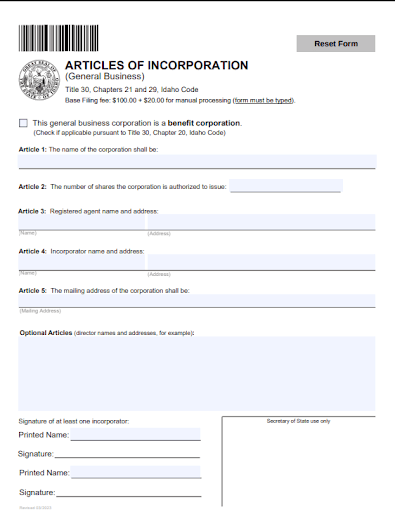
To form a C Corporation in Idaho, you file Articles of Incorporation with the Idaho Secretary of State under the Idaho Business Corporation Act. Swyft Filings prepares and files that paperwork at a $0 service fee, so you only cover a $100 state fee online or $120 by mail. Upgrade to our premium package, and we'll also draft your bylaws, set up your stock authorization, connect you with a business attorney, and provide a registered agent as an add-on.
Starting a C Corp in Idaho begins with choosing a name that clears the Secretary of State's records. From there, you appoint a registered agent and decide on your share structure before you file, since your authorized shares need to be stated on the Articles of Incorporation themselves. Once that's settled, you submit your Articles of Incorporation, draft your bylaws, and hold your first organizational meeting. The last step is obtaining an EIN from the IRS.
You can walk through each of these yourself, or let Swyft Filings form your Idaho C Corp for you. Here's each step explained in detail.
Step 1: Choose a Business Name for Your Idaho C Corp
If you haven't decided on the name, run your idea through our free business name generator. Choose two or three variations so that you have a backup if your first option is unavailable.
While you're at it, also search for a matching domain name and social media handles to make sure you have everything you need to start building your brand image.
Check if the name you have finalized meets Idaho naming rules for a C Corp:
The name must be distinguishable on the records of the Secretary of State from every other entity already on file, under Idaho Code § 30-21-301.
The name must contain "corporation," "incorporated," "company," or "limited," or an abbreviation of one of those words, under Idaho Code § 30-21-302.
If you use "company," it can't be immediately preceded by "and." "Jones and Company" doesn't work; "Jones Company" does.
The name can't falsely imply it's a government agency or a different type of entity than it actually is.
Search your top name choice on Idaho's SOSBiz portal before you draft anything else, since your Articles can't move forward until the state confirms the name is available.
You can hold a name for 4 months by filing an Application for Reservation of Legal Entity Name for $20 online or $40 by mail, which buys you time if you're not ready to file your Articles yet.
Idaho's naming statute specifically blocks this combination. "Smith and Company" reads as if you're describing a partnership between Smith and an unnamed company, which is exactly the confusion the rule exists to prevent. Drop the "and," use a different designator like "Incorporated" or "Corp.," or restructure the name entirely, since this is one of the few naming rules that Idaho will flag as an automatic rejection rather than a judgment call.
A name reservation holds your corporate name for 4 months before you've filed anything, so nobody else can grab it while you finish your paperwork. An assumed business name (Idaho's version of a DBA) is a different thing. You file for a DBA for your C Corporation if it already exists under one legal name, and you want to operate publicly under a different one. Reservation comes before formation and expires; an assumed business name filing comes after formation and stays in effect until you cancel it yourself, since Idaho DBAs don’t require renewal.
No! The Secretary of State only checks your name against other Idaho business filings, not against domain registries. Check your domain on the same day you check your name, and buy it immediately if it's available, since a domain left unregistered for even a few weeks can be picked up by someone entirely unrelated to your business. If you go with our Standard or Premium package, your first year of domain registration is included.
Step 2: Appoint an Idaho Registered Agent
Lock in your registered agent before you file your Articles of Incorporation, since the agent's name and Idaho address are required fields on that form under Idaho Code §§ 30-21-402 to 30-21-405. Pick someone who actually meets the criteria below first, then carry their details straight onto your filing.
An Idaho registered agent has to be:
An individual with a street address in Idaho, or
A business entity authorized to transact business in Idaho with a physical office in the state
Available at that address during normal business hours to actually receive documents
Naming a registered agent in the Articles provides the required designation for the corporation's formation filing. If you later change the registered agent, the new agent must accept the appointment on the applicable change filing.
No. Idaho requires a physical street address in Idaho for a noncommercial registered agent, so someone living in another state doesn't qualify, no matter how often they visit. If no one in your circle can reliably meet the location and availability requirements, a professional registered agent service solves both issues at once.
None! These are two names for the same role. Idaho's own statute calls the position a "registered agent," but you'll see "statutory agent," "resident agent," and "agent for service of process" used interchangeably across other states and older paperwork. If a form or a bank asks for your "statutory agent," they want the same registered agent information you already put on your Articles of Incorporation.
File a Statement of Change of Registered Agent, Registered Office, or Both with the Idaho Secretary of State as soon as you know the resignation is happening, ideally before it takes effect rather than after. Filing is free online, or $20 if you file by mail or in person. Once your former agent files their own resignation paperwork, it takes effect 31 days later regardless of whether you've lined up someone new by then, so don't wait until that clock runs out. Even a brief absence of a registered agent leaves your corporation without a reliable way to receive legal notices, so treat naming a replacement as the first thing you do, not something to get to later.
Not necessarily, though many small corporations use the same address for both to keep things simple. Your registered agent's address is strictly for delivering legal documents and state notices. Your principal office is wherever the business actually operates day-to-day, whether that's a storefront, a warehouse, or your home office. There's no requirement that these match. If you're using a professional registered agent service, it can keep your home address off the public record for RA address purposes while your principal office can stay where your company actually operates.
Step 3: Configure Your Share Structure
Work through your share structure before you open your Articles of Incorporation form, since your authorized share count is a required field.
Steps to set up your share structure:
Decide how many shares to authorize, covering your founders, an option pool of 10% to 20% for future employees, and enough headroom for at least one investor round without needing an amendment.
Choose par value or no-par value for your shares.
Pick your share types and classes. Give founders and early employees common stock, and add preferred stock if you expect outside investors. Consider different share classes if you need different voting or economic rights, such as giving one class greater voting power.
Assign voting rights and board appointment rights to each class before you issue a single share.
Add a right of first refusal to your shareholder agreement so a shareholder who wants to sell has to offer the shares to the company or existing shareholders first.
Set a vesting schedule, typically four years with a one-year cliff, for any equity you grant to employees instead of cash.
Write a buy-sell provision covering what happens to a shareholder's stock if they pass away.
Issue the shares once the structure is set: prepare stock certificates, log the issuance in a stock transfer ledger, confirm your offering fits a securities exemption, and file federal Form D within 15 days of your first sale if you're relying on the Rule 506(b) exemption.
A shareholder agreement can address issues such as share transfers, buy-sell rights, and disputes between shareholders. Whether you need one depends on your ownership structure and circumstances.
Yes, but the bar is low. Idaho requires corporations to state the number of shares they are authorized to issue in the Articles of Incorporation. The Articles form requires this information. Nobody actually authorizes just one share, though, since you need enough to split among founders, set aside an option pool, and leave room for an investor round. Treat the 1-share minimum as a technical floor, not a real planning number.
Yes. Idaho makes par value optional, so you can authorize no-par shares if you'd rather not assign a nominal dollar value to each one. Many startups go this route since it simplifies the accounting and avoids the (mostly cosmetic) impression that par value reflects what a share is actually worth. If you do want par value for a specific reason, like matching an investor's cap table format, Idaho lets you set it as low as you want.
No. Idaho's base filing fee for Articles of Incorporation is flat, whether you authorize one class of common stock or five classes with different voting and dividend rights. If you later need to amend your Articles to add or change a share class, a separate amendment filing fee may apply. Build the classes you're likely to need into your original filing if you can see them coming, rather than paying twice.
Nothing happens to them, because they never existed as real ownership stakes in the first place. Authorized shares are just a ceiling on how many shares the corporation is allowed to issue; unissued shares don't represent anyone's ownership, don't get distributed in a dissolution, and don't need to be accounted for separately when you wind down the business. Authorized but unissued shares do not represent ownership interests. During dissolution, the corporation winds up its affairs and distributes any remaining assets in accordance with applicable law and the rights of its creditors and shareholders.
Step 4: File Your Idaho Articles of Incorporation
File your Articles of Incorporation with the Idaho Secretary of State to make your corporation official. Set aside $100 if you're filing online or $120 if you're mailing it in.
By mail:Download and send two copies of your completed Articles to the Idaho Secretary of State, 450 N 4th Street, P.O. Box 83720, Boise, ID 83720-0080, for $120 ($100 plus a $20 manual-processing fee).
In person: Deliver to the same Boise address during business hours.
Information you'll need to file
Corporation name that meets Idaho's naming rules
Registered agent name and Idaho address
Number of authorized shares
Name and address of each incorporator
Corporate mailing address
Note: Naming your initial directors on the Articles is optional in Idaho.
No, you can leave this until after you file. If your Articles don't name initial directors, your incorporators hold the organizational meeting themselves and elect the directors there instead. Naming directors up front saves you this step later, but it's not required. It means a solo founder who hasn't yet settled on a board can file without it and sort that out at the organizational meeting.
Cost and speed are the real differences. Filing online through SOSBiz costs $100 and typically processes faster since there's no mail transit time and no manual data entry on the state's end. Mailing a paper form costs $120 because Idaho adds a flat $20 manual processing fee for any paper submission, and you're required to send two copies rather than one. Unless you have a specific reason to file on paper, online is cheaper and quicker for essentially every filer.
Yes. Idaho lets you delay your Articles' effective date by up to 90 days after the filing date. This is useful if you want your corporation to legally begin existing on a specific date, like the first of a new month or the start of a new tax year, rather than whatever random day your paperwork happens to clear. Set this on the Articles themselves when you file, since you can't add it after the fact.
The Secretary of State returns the Articles unfiled with a note about the missing information, rather than accepting a corporation with no valid registered agent on record. You fix the specific field, usually a missing Idaho street address or an agent whose eligibility doesn't check out, and resubmit. This doesn't typically cost you the filing fee twice, but it does mean your corporation isn't legally formed until the corrected version clears, so double-check your agent's address and eligibility before you submit the first time.
Step 5: Create Corporate Bylaws
The incorporators or board of directors adopt the initial bylaws as part of organizing the corporation. Many corporations handle this during the organizational process. You don't file bylaws with the state; instead, keep the adopted copy in your permanent corporate records once your directors sign off on it.
What bylaws commonly include:
Corporate name, principal address, and fiscal year
Board and officer roles, including signing authority
Shareholder voting rights and meeting procedures
Stock classes and their attached rights
The vote threshold required for major decisions
Process for transferring or selling shares
Corporation dissolution process
Write your own using the checklist above, or use a corporate bylaws service, which builds a set tailored to your actual share structure rather than handing you a generic template.
Usually yes, for most changes. Idaho's Business Corporation Act generally permits the board of directors to amend bylaws on its own, unless the bylaws themselves reserve that power to shareholders, or the change affects something Idaho law specifically requires shareholders to approve. Check what your own bylaws say about amendment authority before assuming either way, since many corporations deliberately give shareholders a say in bigger changes even when the law wouldn't require it.
Bylaws govern how the corporation itself operates: board meetings, officer roles, voting procedures, quorum rules. A shareholder agreement governs the relationship between the shareholders as people: who can sell shares and to whom, what happens if someone dies or wants out, and how disputes between shareholders get resolved. Bylaws apply equally to whoever holds the shares at any given time; a shareholder agreement is closer to a contract between specific people. Most corporations need both, and the two documents should be written to complement each other rather than duplicate or contradict each other.
There's no legal deadline forcing a review, but an annual check alongside your annual report filing is a reasonable habit. Revisit them sooner than that if something concrete changes: you add a new share class, bring on a co-founder with different expectations about control, or run into a situation your current bylaws simply don't address. Bylaws that haven't been updated in years often no longer reflect how the corporation actually operates, which becomes a real problem only when a dispute forces everyone to go back and read them closely.
Step 6: Hold an Organizational Meeting
Once the state approves your Articles of Incorporation, your initial directors, or the incorporators if directors weren't named on the Articles, hold the corporation's first official meeting. At this meeting, you'll typically:
Adopt the initial corporate bylaws (if not already adopted by the incorporators)
Elect officers, most commonly a president, secretary, and treasurer
Issue the initial shares of stock based on the structure from Step 3
Set the corporation's fiscal year
Prepare an Incorporator's Statement naming the initial directors, if they weren't named on the Articles.
Record formal minutes of the meeting and keep them with your corporate records. Nobody files these with the state, but they're often the clearest evidence that your corporation follows real formalities rather than existing only on paper, which matters if your liability protection is ever tested.
Your incorporators do. Under Idaho Code §§ 30-29-205 to 30-29-206, when the Articles don't name initial directors, the incorporators hold the organizational meeting themselves, and their first job is electing the board. Once directors are elected, the incorporators' role is complete; they don't remain on afterward unless the same people also become directors or officers.
Yes, and for a small or solo-founder corporation, that's exactly what typically happens. Idaho places no restriction on an incorporator also serving as a director or officer. The distinction between these roles is functional, not personal: the incorporator role exists to get the corporation legally formed and ends once directors are in place, while the director role continues to govern the corporation.
The meeting minutes. Write down the date, who attended, and every decision made, especially the bylaw adoption, the director election if it happened here, the officer appointments, and the initial stock issuance. Keep this document with your permanent corporate records, not just in an email or a shared drive that's easy to lose track of. If a bank, investor, or court ever asks whether your C Corporation actually followed proper formalities, these minutes are usually the first thing anyone asks to see.
Yes, but you can do it without holding an actual meeting. A sole incorporator, director, and shareholder can act through unanimous written consent instead of convening in person, which is the standard approach for a one-person corporation. You can use unanimous written consent instead of holding an in-person meeting. The corporation should still document its organizational actions, such as adopting bylaws, appointing officers, and authorizing the initial share issuance.
Step 7: File for an EIN
Once the state approves your Idaho Articles of Incorporation, apply for an Employer Identification Number. It's a nine-digit federal tax ID the IRS uses to identify your corporation, separate from your own Social Security number, for tax filings and everyday business transactions.
Here's why your Idaho C Corp needs one:
Opening a business bank account
Hiring employees, in Idaho or any other state
Filing your federal corporate tax return and your Idaho income or franchise tax return
Registering for an Idaho sales tax permit if you sell taxable goods or services
Applying for a business credit card or a business loan
Keeping your personal Social Security number off business contracts and vendor forms
Apply directly through the IRS website at no cost, which takes about 15 minutes. You'll need your business name, mailing address, entity details, and a reason for applying. If you don't have an SSN or ITIN, you can still apply by mailing or faxing Form SS-4.
Technically, the IRS application doesn't check whether your state entity is approved yet, but you shouldn't file for one before it is. If your Articles get rejected and you need to change the corporation's name or structure, you'd be stuck with an EIN tied to information that no longer matches your actual entity. Wait for your Articles to clear the Secretary of State first, then apply for the EIN using the exact legal name and details that appear on your approved formation document.
Not a separate general-purpose ID, but you will register separately with the Idaho State Tax Commission for specific tax accounts, like a sales tax permit if you sell taxable goods or services, or a withholding account once you hire employees. These registrations use your federal EIN as the identifying number rather than assigning you a completely different one, so the EIN itself serves the same purpose at both the federal and state levels.
You generally don't need to reactivate anything, since an EIN is never actually reissued to a different entity and the IRS doesn't formally "close" it in a way that requires reopening. If your corporation stopped filing returns for a while and the IRS account looks inactive, simply resume filing your required returns using the same EIN. If you're dealing with an account that was fully closed because the entity was dissolved and you're now forming a new corporation, you'll need a new EIN for the new entity rather than trying to reuse the old one.
What Are the Post-Formation Requirements for an Idaho C Corp?
Filing your Articles of Incorporation creates your Idaho C Corp, but a few ongoing requirements apply.
Open a Business Bank Account
Bring your Articles of Incorporation, your adopted bylaws, and your EIN confirmation letter to the bank when you open the account. Keeping business funds separate from personal accounts is one of the clearest habits that supports your liability protection. Read our guide to opening a business bank account for what most banks ask for.
Obtain the Business Licenses and Permits You Need
Idaho doesn't issue one general statewide business license. What you actually need depends on your industry and city, most commonly a local business license from your city or county, a sales tax permit if you sell taxable goods or services, and a professional license if you're in a regulated field like healthcare, construction, or cosmetology. Confirm what applies to you through business license service before you assume you're covered.
File Your Idaho Annual Report
This is a separate filing from your tax return, and it's free to file online. Every Idaho corporation must file an annual report with the Secretary of State by the end of the anniversary month of when it was originally incorporated. Miss the deadline, and Idaho doesn't charge a late fee, but missing the report may begin the administrative dissolution procedures after providing notice and a required cure period.
Under Idaho Code § 30-21-601, the state serves notice, and you have 60 days to cure it by filing before the corporation is actually dissolved. An annual report service can track and file this for you every year.
The corporation stays legally active during those 60 days, but it's on notice that dissolution is coming if nothing changes. File the overdue annual report any time within that window and the issue resolves itself with no penalty beyond the time you spent catching it. If you let the full 60 days pass without filing, the Secretary of State proceeds with administrative dissolution, which then requires a separate reinstatement process to fix rather than just filing the report you missed.
Yes. Idaho doesn't restrict who can submit the filing, so a bookkeeper, an attorney, or a formation service like Swyft Filings can file it on the corporation's behalf as long as they have the corporation's current information. What matters is that the information itself, registered agent, principal address, and officer or director names, is accurate and current as of the date it's filed, not who physically submits the form.
Pay Idaho Corporate Income Tax (or Franchise Tax)
Idaho taxes C Corp income at a flat rate through either the corporate income tax or the franchise tax, filed on Form 41 with the Idaho State Tax Commission.
C Corporations pay one or the other, never both, under Idaho Code § 63-3025A. For a calendar-year corporation, the return is due April 15, with an extension available to October 15 for filing, though any tax owed is still due on the original date. Most C Corps also owe a flat $10 Permanent Building Fund tax alongside their regular return.
The rate is identical, but they apply to different situations. The income tax applies to a C Corporation actually earning taxable income from doing business in Idaho. The franchise tax applies more narrowly, covering a C Corporation taxed purely for the privilege of doing business in the state, such as one formed solely to perform contracts with the U.S. Department of Energy at the Idaho National Laboratory. For nearly every standard C Corp, this distinction doesn't change what you actually owe, since you're filing the same Form 41 either way at the same rate.
How Much Does It Cost to Incorporate a C Corp in Idaho?
Item
Cost
Articles of Incorporation (online)
$100
Articles of Incorporation (mail or in person)
$120
Name Reservation, 4 months (online / mail)
$20 / $40
Certificate of Assumed Business Name / DBA (online / mail)
$25 / $45
Annual Report (online)
$0
EIN (IRS)
$0
Ready to Start a Free C Corp in Idaho?
Starting an Idaho C Corp involves paperwork and ongoing requirements that can get complicated fast, from setting up your share structure to keeping up with your anniversary-month annual report. Swyft Filings has helped 600,000+ businesses with business formation and compliance since 2015. Our team of business formation specialists understands Idaho Secretary of State requirements and can help you prepare and file your C Corp paperwork fast and accurately.
*Disclaimer: This guide shares general information about forming a C Corp in Idaho and is not a substitute for any kind of legal, tax, or financial advice.*
Check C Corp Formation Guides for Other States
C Corp rules, filing costs, and corporate tax structures vary by jurisdiction. Select any state below to view its specific C Corp laws.
Starting an Idaho C Corp means filing Articles of Incorporation, appointing a registered agent, and staying current with the free annual report. Swyft Filings has been helping businesses form and stay compliant since 2015. Our team knows the Idaho Secretary of State requirements and can file your C Corp quickly, accurately, and in full compliance.
Yes. The Permanent Building Fund tax is a flat $10 charge that applies to nearly every Idaho C Corp filing Form 41, regardless of whether the business turned a profit. It's separate from your income or franchise tax calculation, so a C Corp reporting zero taxable income still owes this $10 alongside its return.
No. Idaho doesn't require your C Corp's incorporators, directors, or shareholders to live in the state, or even in the U.S. The only Idaho address requirement is your registered agent's, who needs a physical Idaho street address regardless of where you personally live.
Yes, Idaho allows a statutory conversion, where your LLC becomes a C Corp without dissolving and reforming as a brand-new entity. Whether the EIN remains valid depends on the structure of the conversion and federal tax treatment. Confirm the impact of the EIN with the IRS or a tax professional.
If you're forming a professional C Corp for a licensed occupation, Idaho requires a name reflecting that status, typically using "Professional Corporation," "P.C.," "Chartered," or "Chtd." A standard C Corp formed under the regular Business Corporation Act doesn't need this, so it only applies if you're specifically organizing as a professional C Corp for a licensed field.