
Initial Setup
Compliance
Changes & Filings
Resolve
Protect & Legal
Learn
Excellent
7,984 reviews

Regardless of what your business does, incorporating in Ohio follows a predictable sequence. You will settle on a C Corp name the state will accept, find someone to act as your statutory agent, work out your ownership structure, submit your Articles, put bylaws in place, hold an organizational meeting, and wrap up with an EIN application. Below is a detailed explanation of what each of those steps to start a C Corp in Ohio actually involves.
Section 1701.05 of the Ohio Revised Code lays out what your Ohio C Corporation name has to look like, and it comes down to four Ohio corporation requirements.
1. Include a Corporate Designator: Your Ohio C Corporation name must end with or include one of these words or abbreviations:
Ohio also restricts the use of “benefit” or “b-” as a prefix to these corporate designators unless the corporation qualifies as a benefit corporation or falls under an applicable exception.
2. Make Sure the Name Is Distinguishable: Your proposed name for your Ohio C Corporation must be distinguishable from names already on file with the Ohio Secretary of State. This includes names of other corporations, LLCs, limited liability partnerships, limited partnerships, and registered trade names.
Simply changing a symbol, dropping an article like "the," or pluralizing a word usually isn't enough to separate your name from one that's already claimed.
3. Avoid Government-Implying Language: Your corporation's name cannot contain language that indicates or implies that the business is connected with a government agency of Ohio, another state, or the United States.
4. Match your business purpose: Your chosen name for your C Corporation in Ohio cannot suggest a purpose your corporation is not organized to pursue or that Ohio law prohibits.
Once you have chosen a final name for your Ohio C Corp, keep two or three alternate names ready in case your first choice is unavailable. Then, search the Ohio Secretary of State’s Business Entity Search to confirm that your preferred name is available.
If a similar name is already registered, you may need to choose another name. Since your first pick is unavailable, use Swyft Filings' free business name generator for more ideas.
If the business was canceled less than a year ago, you generally cannot use the same name because Ohio holds the name for one year to give the canceled business a chance to reinstate. After that one-year period, the name may become available if the business has not been reinstated.
So, before choosing the name for your Ohio C Corporation, check its status with the Ohio Secretary of State and also search federal and Ohio trademark records. This helps you avoid choosing a name that could create trademark conflicts even if Ohio considers it available.
Yes. If your preferred name is available, you can file a Name Reservation (Form 534B) with the Ohio Secretary of State for $39. The reservation grants you exclusive rights to the name for 180 days, allowing time to prepare and file your Articles of Incorporation.
Keep in mind that the name is not officially reserved until the Secretary of State processes and accepts your filing. You will receive written confirmation once the reservation is approved.
Yes. An Ohio C Corporation can do business under a different name by registering a trade name or reporting a fictitious name with the Ohio Secretary of State. A registered trade name provides exclusive rights to the name in Ohio, whereas a fictitious name does not.
If you want protection over the alternate business name, registering it as a trade name is generally the better option. The name must meet Ohio's distinguishability requirements and cannot conflict with certain existing business or trade names.
Every Ohio corporation needs someone designated to accept legal papers and official mail on its behalf, and Ohio's paperwork calls this person a "statutory agent" rather than the "registered agent" label you will see in most other states, though the job is identical. Ohio requires every corporation to maintain a statutory agent in the state.
Here are the core requirements that need to be met:
Choose an Eligible Agent: Your agent can generally be an Ohio resident or an eligible business entity authorized to act as an agent in the state.
Must Have an Ohio Address: Your statutory agent must have a physical street address in Ohio where legal documents can be delivered. A P.O. box alone isn't sufficient.
Business Hours Availability: The Ohio statutory agent should be available at the registered address during normal business hours to receive official documents.
Get the Agent's Consent: The statutory agent must accept the appointment when listed on your Articles of Incorporation. Also, get their signed or electronic agreement to take on the role before you name them in your filing.
Ongoing Requirement: Your corporation must continuously maintain a statutory agent and keep the agent's information up to date with the Ohio Secretary of State.
Tip: If you don't have a reliable Ohio address or don't want to handle legal notices yourself, hiring a professional statutory agent can help ensure important documents aren't missed.
If you act as your own statutory agent, there is generally no additional agent service fee beyond your business filing costs. If you hire a professional statutory agent service, fees typically range from about $300 to $600 per year, depending on the provider and services included. For example, Swyft Filings' statutory agent Service costs $149 per quarter, or $596 per year.
The service includes a dedicated registered office address, fast document delivery, secure online access to your documents, and nationwide coverage as your business expands. Remember, when comparing prices, don't automatically choose the cheapest statutory agent service. A lower price may mean fewer features, slower document handling, limited support, or additional fees for services you need.
There isn't one best statutory agent service for every Ohio C Corporation. The right choice depends on your budget, document delivery speed, privacy, customer support, and whether you plan to operate in multiple states. Swyft Filings' statutory agent/registered agent service is frequently recommended for its combination of privacy, pricing, and document handling, while other providers may be a better fit if you want additional compliance or legal services.
When comparing providers, look beyond the advertised price and check whether the service includes:
Ohio requires every business entity to maintain a statutory agent, so reliability is more important than simply choosing the cheapest statutory agent service provider.
Your Articles of Incorporation must state the number of shares your Ohio C Corporation is authorized to issue, so you will need to make this decision before filing. The number of authorized shares can also affect your filing fee. Ohio's base fee is $99 for up to 990 authorized shares, with additional fees applying as the number of shares increases.
Before filing, consider these key decisions:
How many shares to authorize: You can authorize more shares than you plan to issue initially. Keeping some shares unissued gives you flexibility to offer equity to future employees or investors.
Which stock classes to create: A single class of common stock may be sufficient for a simple business. If you anticipate outside investment, you may want to consider whether preferred stock will be needed later.
What voting rights to provide: Different classes can have different voting rights, so decide how control will be distributed among founders, employees, and future investors.
How fundraising may affect ownership: A future investment round can dilute existing shareholders' ownership, so consider your long-term ownership goals when structuring the initial terms.
For example, you might authorize 750,000 shares but initially issue only a portion to the founders. The remaining shares remain unissued and can later be issued to employees, investors, or for other business needs. Planning this structure upfront can help you avoid unnecessary amendments and restructuring later.
Once you have chosen your Ohio C Corporation's name, statutory agent, and share structure, it's time to file the Articles of Incorporation (Form 532A) with the Ohio Secretary of State. Ohio does not have a separate state filing specifically for a “C Corporation.” Instead, you form a for-profit corporation under Ohio law, and C corporation status is determined by how the corporation is taxed at the federal level.
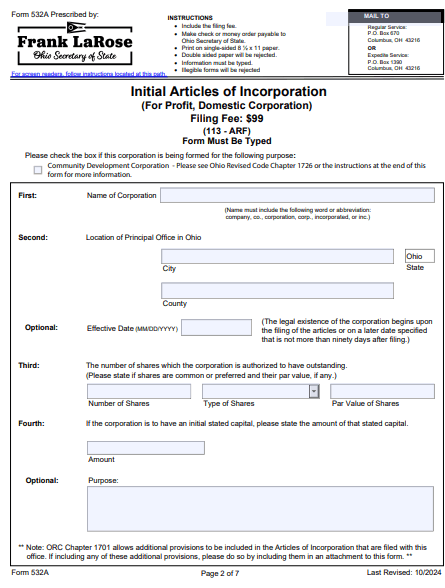
You can file your Ohio Articles of Incorporation in three ways:
1. Online: The quickest and most convenient option for most businesses. Enter your corporation's information in the Initial Articles of Incorporation Online at Ohio Business Central, including statutory agent details, incorporator information, and authorized share count through the online filing system, then pay the applicable fee.
2. By mail: Type all the information to complete the Form 532A, sign it, and mail regular (non-expedited) filing with the required $99 fee payment to:
Ohio Secretary of State
Business Services Division
P.O. Box 670
Columbus, OH 43216
If you are requesting expedited processing, mail to P.O. Box 1390, Columbus, OH 43216 instead.
*NOTE: If you are filing Articles of Incorporation (Form 532A) by mail, make sure the forms are typed, printed on single-sided 8½ × 11-inch paper, and clearly legible. Double-sided forms or forms that are difficult to read may be rejected.*
3. In-person: You can hand-deliver Form 532A (Initial Articles of Incorporation for a Domestic For-Profit Corporation) to the Ohio Secretary of State Client Service Center located at 180 Civic Center Drive, Columbus, OH 43215. The accepted in-person payment options include check, money order, cash, and major credit/debit cards.
*A NOTE ON COST*
$99 covers Articles authorizing up to 990 shares, with the fee climbing on a per-share basis above that threshold. If timing matters, Ohio offers three tiers of expedited processing of Ohio Form 532A (Initial Articles of Incorporation for a Domestic For-Profit Corporation).
2-business-day processing: $100 fee; processed within 2 business days after the filing is received.
1-business-day processing: $200 fee; processed within 1 business day after the filing is received.
Same-day processing: $300 for same-day service, which requires in-person delivery. Documents hand-delivered before 1:00 p.m. are generally processed within about four hours. Documents received after 1:00 p.m. are processed by noon on the following business day.
Unlike the Articles of Incorporation, you don’t file bylaws with the Ohio Secretary of State. Instead, you keep them with your corporate records and use them to set the rules for managing the company.
Your bylaws for your Ohio C Corp should typically cover:
Board of directors: How the board is structured, how directors are elected, and how vacancies are handled.
Shareholder meetings: When meetings are held, how shareholders are notified, and how meetings are conducted.
Board meetings: How meetings are called, what counts as a quorum, and how directors vote on decisions.
Officers: Which officers the corporation has and what responsibilities each one has.
Voting and approvals: How shareholder and board votes are taken and how corporate decisions are approved.
Committees: Whether the board will create committees and what authority they have.
Corporate records: How the corporation maintains meeting minutes, resolutions, and other important records.
Amendments: How the corporation can change its bylaws as the business grows.
Once the bylaws are drafted, the incorporator or initial board typically adopts them during the corporation’s organizational meeting. After adoption, keep the signed bylaws with your corporation’s permanent records rather than sending them to the state.
If you don’t want to draft bylaws from scratch, Swyft Filings can prepare a customized Corporate Bylaws based on your ownership and management structure. You can also pair the bylaws with a Shareholders’ Agreement if your corporation needs additional rules governing shareholder rights and responsibilities.
Ohio law allows the directors of an Ohio C Corporation to adopt bylaws to govern the corporation, but it generally does not require the bylaws themselves to be notarized or filed with the state.
For an Ohio C Corporation, it is best practice to formally adopt the bylaws and keep a signed copy with the corporation’s records. The corporation should also document the adoption through its organizational meeting minutes or written consent. This creates a clear record showing when and how the bylaws were approved.
After your Ohio Articles of Incorporation are approved, it’s time to formally organize your C Corporation. The organizational meeting is where you put the corporation’s internal structure into action.
During this meeting, the incorporator or initial directors can:
Be sure to prepare and keep meeting minutes as part of your corporate records. You generally don't file these minutes with the Ohio Secretary of State, but they provide a written record of the corporation’s decisions and help demonstrate that the business is being operated separately from its shareholders.
Yes. Ohio Revised Code § 1701.10 sets out the rules governing the organization of an Ohio C Corporation after its formation. The requirements differ depending on whether the Articles of Incorporation name the initial directors.
Initial directors are named: If the Articles of Incorporation name the initial directors, a majority of those directors can call the organizational meeting. The directors handle initial matters such as receiving stock subscriptions, appointing officers, and adopting corporate regulations (bylaws).
Initial directors are not named: If the Articles don't name initial directors, the incorporators handle the initial organization, including receiving stock subscriptions or holding a meeting to elect the directors.
Notice: When an organizational meeting of shareholders is required, the applicable notice requirements generally provide for at least 7 days' written notice, unless notice is waived as permitted by Ohio law.
90-day rule: If corporate regulations have not been adopted within 90 days after the corporation is formed, Ohio law provides a different procedure for adopting them.
Written consent and location: Ohio law permits certain organizational actions to be taken without a physical meeting by written action, and an organizational meeting may be held inside or outside Ohio.
For your Ohio C Corporation, keep the meeting minutes or written consents with your corporate records. You generally don't send these organizational documents to the Ohio Secretary of State.
Once the corporation itself exists, apply for an EIN, the federal equivalent of a Social Security number for your business. You will need it for pretty much everything that follows:
Applying directly through the IRS costs nothing. If you'd rather not deal with it, Swyft Filings can file it as part of a premium Ohio C Corp formation package.
Forming your Ohio C Corporation is only the beginning. After your Articles are approved, you need to keep the corporation in good standing and maintain its corporate records. Key post-formation requirements for an Ohio C Corp include:
Ohio phased out its traditional corporation franchise tax and has no conventional corporate income tax. Instead, businesses with meaningful Ohio revenue are subject to the Commercial Activity Tax (CAT), a gross-receipts tax rather than a profit-based tax.
Exclusion threshold: Businesses with annual gross receipts below a set threshold are excluded from the CAT entirely. Ohio has raised this threshold significantly in recent years, so it's worth confirming the current figure on the Ohio Department of Taxation's site before filing.
Rate: A flat percentage rate applies to taxable gross receipts above the threshold.
Filing frequency: Businesses that exceed the threshold generally file quarterly.
No minimum tax: Ohio eliminated its old flat minimum fee, so smaller businesses below the threshold typically have no CAT filing obligation.
In practice, this structure exempts a large share of small and mid-sized Ohio C corps from the tax entirely, but since it's based on gross receipts rather than income, it's worth tracking revenue against the current threshold each year rather than assuming last year's exemption still applies.
Open a dedicated business bank account for your Ohio C Corporation after receiving its EIN. Keeping corporate and personal finances separate helps maintain accurate accounting records and demonstrates that the corporation operates independently from its shareholders.
When opening the account for your Ohio C Corporation, the bank may request:
Use the account for business income, expenses, payroll, and other corporate transactions rather than mixing funds with personal accounts.
Ohio does not have a single statewide business license that applies to every corporation. Licensing requirements depend on the corporation's industry, activities, and location. Your Ohio C Corporation may need local licenses, permits, or zoning approvals from a city or county.
Businesses operating in regulated industries, including construction, cosmetology, real estate, food service, and healthcare, may also require state-issued professional or industry-specific licenses. Because requirements vary by business activity and location, review the requirements with the appropriate state and local authorities before beginning operations. Feeling like it’s too much to handle? Choose Swyft Filings' business license research service, where our professionals will help identify which licenses actually apply to your specific business, how to apply for them, and where to apply.
If your Ohio C Corporation sells taxable goods or services, you generally need to obtain an appropriate vendor's license from the Ohio Department of Taxation before making taxable sales. Vendor's license fees are modest and set by the state; therefore, check the Department of Taxation's site for the current amount, as county-level fees may vary.
Ohio's state sales tax rate is set by statute, with counties and transit authorities layering on local add-ons, so the combined rate a business actually charges varies by location and can shift over time. It's worth confirming the current combined rate for your specific county before setting up sales tax collection.
If your C corporation hires employees, it may also need to register with the Ohio Department of Job and Family Services for unemployment insurance. Registration requirements depend on factors such as the amount of wages paid and the number of weeks employees perform services; thresholds that are worth verifying directly with ODJFS rather than assuming they are unchanged year to year. This employer registration is separate from your vendor's license and Commercial Activity Tax obligations.
Ohio C Corp formation costs can vary depending on how you set up and manage your corporation. While the state filing fee is the primary expense, you may also need to budget for a statutory agent, licenses, permits, and optional professional services.
| Cost | Fee |
|---|---|
| Ohio Articles of Incorporation (up to 990 shares) | $99 |
| Ohio Statutory Agent Service | Varies |
| C Corp Name Reservation in Ohio (optional, 180 days) | $39 |
| Ohio Certificate of Amendment | $50 |
| EIN | $0 |
| Annual Report Fee | Not required |
Between share structure, bylaws, and figuring out which Ohio tax registrations actually apply to you, forming a corporation involves more moving pieces than most people expect. Swyft Filings has been guiding businesses through C Corp formation in Ohio for free and compliance since 2015, and our team stays current on Ohio Secretary of State expectations so your filing goes through cleanly the first time.
$0 + State Filing Fees
Disclaimer: This guide provides general information about forming a C Corp in Ohio and is not a substitute for legal, tax, or financial advice.
C Corp rules, filing costs, and corporate tax structures vary by jurisdiction. Select any state below to view its specific C Corp laws.