
Initial Setup
Compliance
Changes & Filings
Resolve
Protect & Legal
Learn
Excellent
7,984 reviews

Forming a C Corp in Michigan involves choosing a Michigan C Corporation business name, appointing a resident agent, filing Articles of Incorporation, establishing your share structure and bylaws, and obtaining an EIN.
Here's a step-by-step guide to forming your Michigan C Corp from start to finish.
Michigan law requires you to choose a name for your Michigan C Corporation that meets the state's corporate naming rules. Your proposed name must be distinguishable from every existing domestic and foreign corporation, limited partnership, and LLC already on record with LARA.
1. Use a Corporate Designator
Your Michigan corporation's name must include Corporation, Incorporated, Company, or Limited, or an abbreviation such as Corp., Inc., Co., or Ltd. The designator must clearly indicate that the business is a corporation rather than an individual, partnership, or other type of business entity.
2. Match the Corporation's Purpose
Your Michigan C Corporation name cannot state or imply that the corporation is organized for a purpose that is not permitted under Michigan law or its Articles of Incorporation.
3. Avoid Government Implications
The name cannot suggest that your Michigan C Corporation is affiliated with or connected to a state or federal government agency or a corporation chartered under U.S. law.
4. Choose a Distinguishable Name
Your Michigan corporation's name must be distinguishable from other entities and filings already on record with LARA's online business database, subject to certain statutory exceptions.
If you have selected a name for your Michigan C Corporation, it's a good idea to keep 2-3 backup names in case your first choice is unavailable. If you need more ideas, you can use Swyft Filings' free business name generator to create several options.
When forming a C Corporation in Michigan, you must designate a resident agent to receive legal documents and official correspondence on behalf of your corporation. The agent can be an eligible individual resident of Michigan or an authorized business entity with a physical street address in the state.
Make sure that your resident agent meets the following Michigan corporation requirements:
Physical Address: The registered office must be a physical Michigan address where the resident agent can be located.
Michigan Residency or Authorization: An individual agent must be a Michigan resident. A business entity serving as agent must be a Michigan corporation, Michigan LLC, or a foreign corporation or LLC authorized to transact business in Michigan.
Availability: The agent must be available at the registered office during regular business hours to receive service of process and other official documents.
Matching Office Address: The agent's business office or residence must match the registered office address listed on the Articles of Incorporation.
Whether you choose to serve as your own Michigan resident agent or hire a professional resident agent service, the appointment process generally involves these steps:
1. Select a Resident Agent: Choose an eligible individual, such as yourself or another trusted Michigan resident, or hire a professional registered agent service from Swyft Filings.
2. Confirm the Agent's Eligibility: Make sure the individual or entity meets Michigan's resident agent requirements, including a valid Michigan street address.
3. Provide the Information When Filing Articles of Incorporation: Include the resident agent's name and Michigan street address in your corporation's Articles of Incorporation when filing with LARA.
You need to determine your corporation's share structure before filing the Articles of Incorporation, as the authorized shares and related details must be included in the formation documents. In Michigan, the number of authorized shares also directly determines a portion of your state filing fee, so settling on this number before you file avoids surprises at checkout.
When setting up your Michigan C Corp's share structure, consider the following:
Determine authorized shares: Decide the total number of shares your C Corporation is authorized to issue. Michigan requires this number to be stated in the Articles of Incorporation, and it affects your organization fee. You can authorize more shares than you initially plan to issue.
Choose your stock type: Most corporations use common stock for founders and employees. You may also establish preferred stock if you expect to raise outside investment or need to provide investors with different rights or preferences.
Consider multiple classes: If needed, your corporation can have different classes or series of stock with different voting, dividend, or other rights. The appropriate structure depends on your ownership and financing plans.
Consider voting rights: Decide whether different classes of shares will have different voting rights. For example, one class may have full voting rights while another may have limited or no voting rights.
Plan for future financing: If you expect to seek venture capital or other outside investment, consider how future financing rounds could affect your authorized shares and ownership percentages.
Specify the structure in your Articles: Include the required authorized-share information in your Michigan Articles of Incorporation when forming the corporation. Keep the formation documents consistent with the share structure you intend to establish.
You can file your Articles of Incorporation online through LARA's portal or submit a paper filing by mail or in person. Choose Swyft Filings' basic package to start your Michigan C Corp for free.
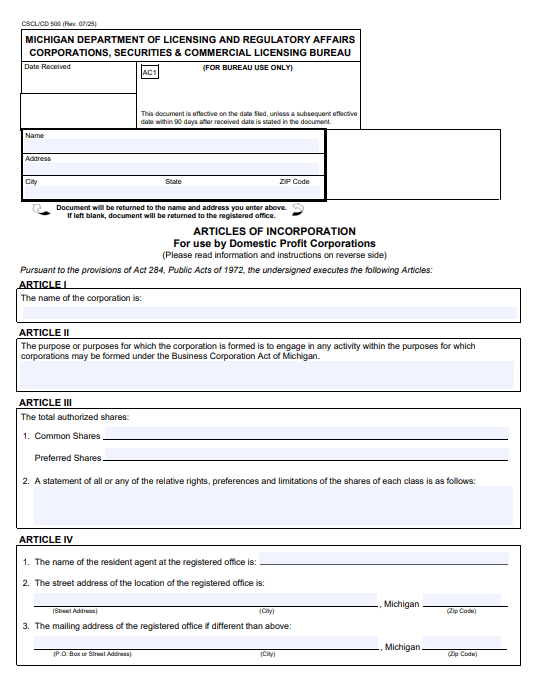
Option 1: File online
Online filing through LARA's online business services portal is generally the most convenient option for a new corporation. You will need to enter your corporation's information electronically, provide the resident agent information, identify the incorporator, specify the authorized shares, and provide the other required details. You'll then review the information before submitting the filing and pay the applicable state fees.
Option 2: File by mail
If you prefer not to file online, you can complete Form CSCL/CD-500 and mail it to LARA along with the required payment. When filing by mail, make sure the form is complete and properly signed before sending it to:
Michigan Department of Licensing and Regulatory Affairs
Corporations, Securities & Commercial Licensing Bureau
P.O. Box 30054
Lansing, MI 48909
Option 3: File in person
File your Michigan Articles of Incorporation in person by submitting your completed documents at LARA's office in Lansing. In-person filings are accepted at:
2501 Woodlake Circle
Okemos, MI 48864
To file Michigan Articles of Incorporation (Form CSCL/CD-500), you will need:
Corporation name: Must include an approved corporate suffix, such as Corp., Inc., Corporation, Company, or Limited.
Resident agent: Name and Michigan street address of the resident agent and registered office.
Business purpose: General nature or purpose of the corporation. Michigan permits an all-purpose clause for standard profit corporations.
Duration: The corporation's duration, if not perpetual.
Authorized shares: Number and class of shares the corporation is authorized to issue.
Incorporators: Names and addresses of one or more incorporators, each at least 18 years old.
Optional provisions: Any additional provisions the incorporators choose to include.
Your bylaws can establish procedures for making decisions, holding meetings, electing directors and officers, and managing the corporation's affairs.
When creating your corporate bylaws for your Michigan C Corp, consider including:
Board of directors: Define the number of directors, their roles, terms, and how vacancies or replacements are handled.
Shareholder meetings: Establish when and how shareholder meetings will be held and how shareholders will receive notice.
Board meetings: Set rules for calling board meetings, providing notice, establishing a quorum, and voting on corporate decisions.
Officers: Identify the corporation's officers, such as the president, secretary, and treasurer, and outline their responsibilities.
Voting procedures: Explain how shareholders and directors vote and how corporate decisions are approved.
Committees: Establish rules for creating and managing board committees, if needed.
Corporate records: Specify how important corporate documents, meeting minutes, and other records will be maintained.
Amendments: Establish the process for changing the bylaws as the corporation grows.
Need help drafting your Corporate Bylaws? Swyft Filings can simplify the process by preparing and drafting customized Corporate Bylaws. Start by completing a short questionnaire about your corporation's structure, shareholders, and management. Our specialists then draft your Corporate Bylaws and, if needed, a Shareholders' Agreement. You'll receive your completed documents ready for review and adoption as part of your corporation's organizational process.
Corporate bylaws should focus on the corporation's internal governance rather than information that belongs in other documents. Generally, avoid including:
Detailed financial terms for individual shareholder investments.
Specific employment terms, such as individual salaries or employee benefits.
Confidential business information, such as trade secrets or proprietary strategies.
Terms of individual stock purchases or transfers that belong in separate agreements.
Tax provisions that should be addressed through applicable tax filings and professional advice.
Provisions that conflict with Michigan law, the Articles of Incorporation, or other governing documents.
After filing your Articles of Incorporation for your Michigan C Corp, you should hold an initial organizational meeting where your incorporator or initial directors formally start the business. At this meeting, you will typically:
Adopt the corporate bylaws.
Elect officers, such as a president, treasurer, and secretary.
Issue the initial shares of stock to founders and investors.
Set the corporation's fiscal year.
Authorize opening a corporate bank account.
After forming your Michigan C Corp, apply for an Employer Identification Number (EIN). An EIN is a federal tax identification number used to identify your corporation for tax and other business purposes.
Wondering why your Michigan C Corp needs an EIN?
Here are the top reasons:
Opening a business bank account.
Hiring employees in Michigan or any other state.
Filing federal and Michigan corporate income tax returns.
Registering for Michigan taxes through Michigan Treasury Online.
Applying for a business credit card or loan.
Keeping your personal Social Security number off business contracts.
You can apply for an EIN directly on the IRS website at no cost, or have Swyft Filings file it for you as part of your Michigan C Corporation formation package.
Filing your Articles of Incorporation creates your Michigan C Corporation, but you must meet several ongoing requirements to keep it in good standing and maintain its liability protection.
Your first annual report is due the year after your Articles of Incorporation are approved, and the requirement continues annually from there.
From there, the rule is the same for every corporation regardless of formation date:
Filing deadline: May 15 each year
Where: Online through LARA's online business services system
Fee: $25 for a Michigan profit corporation when filed by May 15
Late fees: Michigan uses a graduated penalty: $10 if filed May 16-31, $20 in June, $30 in July, $40 in August, and $50 from September onward
What it does: Confirms or updates your resident agent, principal address, officer and director information on LARA's public record
If you skip it for too long, LARA can move toward administrative dissolution after a two-year grace period, which can strip away the corporation's active status and require a reinstatement filing, along with back fees, to fix it.
You can consider a professional service like Swyft Filings to file the annual report on your behalf. Our specialists prepare and file the required annual report, and you receive confirmation once the filing is complete.
Michigan imposes a 6% Corporate Income Tax (CIT) on C Corporations and entities taxed as corporations for federal purposes. Michigan also offers a small business alternative credit that can result in an effective rate of 1.8% on adjusted business income for qualifying businesses.
Corporations with less than $350,000 in allocated or apportioned gross receipts for the year, or $100 or less in annual CIT liability, generally are not required to file or pay CIT, with certain exceptions.
Open a dedicated business bank account for a Michigan C Corp as soon as your EIN is issued. Mixing personal and business funds, known as commingling, is one of the fastest ways to weaken the liability protection a C Corp is supposed to provide. Banks commonly request documents such as your Articles of Incorporation, EIN confirmation letter, and a corporate resolution or authorization identifying who is authorized to open the account.
Depending on what your corporation does and where it operates, you may need state-level licenses from relevant Michigan agencies. Regulated fields such as construction, healthcare, financial services, food service, cosmetology, and real estate require state licensing from the appropriate authority.
You can also use Swyft Filings' business license research service to identify what's actually required for your specific business, along with application links and renewal information.
If your C Corporation sells taxable goods or services, you generally need to register with the Michigan Department of Treasury for sales and use tax before making taxable sales.
If you plan to hire employees, you'll also need to register separately for Michigan income tax withholding tax through Michigan Treasury Online (MTO), which handles business tax registration and electronic filing for various Michigan taxes.
The cost of forming a C Corp in Michigan depends on the number of shares you authorize, the required state filing fees, and any additional services you choose. Here's a quick breakdown of the main costs you may encounter:
| Cost | Fee |
|---|---|
| Articles of Incorporation (1-60,000 authorized shares) | $60 minimum ($10 filing fee + $50 organization fee) |
| Articles of Incorporation (60,001-1,000,000 shares) | $110 |
| Articles of Incorporation (1,000,001-5,000,000 shares) | $310 |
| Articles of Incorporation (5,000,001-10,000,000 shares) | $510 |
| Required formation cost (minimum) | $60 |
| Name Reservation (optional, approx. 6 months) | $10 |
| Assumed Name Registration (optional) | $10 |
| Michigan Corporation Annual Report Fee | $25/year |
| Annual Report Late Fee (graduated from May 16) | $10-$50 |
| 24-Hour Expedited Processing | +$50 |
| Same-Day Expedited Processing | +$100 |
| 2-Hour Expedited Processing | +$500 |
| 1-Hour Expedited Processing | +$1,000 |
Starting a Michigan C Corp involves paperwork and ongoing requirements that can quickly become complicated, from setting up your share structure and resident agent to keeping up with LARA annual reports and Michigan tax registrations. Swyft Filings has helped businesses form corporations for free since 2015. Our team understands Michigan LARA requirements and can help you prepare and file your C Corp paperwork accurately and efficiently.
$0 + State Filing Fees
*Disclaimer: This guide provides general information about forming a C Corp in Michigan and is not a substitute for legal, tax, or financial advice.*
C Corp rules, filing costs, and corporate tax structures vary by jurisdiction. Select any state below to view its specific C Corp laws.