
Initial Setup
Compliance
Changes & Filings
Resolve
Protect & Legal
Learn
Excellent
7,486 reviews

To form a C Corp in Oregon, start by choosing a compliant corporate name. Next, appoint a registered agent and your initial officers. From there, file your Articles of Incorporation with the Corporations Division. Online filings are typically processed within a few business days.
Here’s how each step works.
Oregon law requires your corporation’s name to be distinguishable from every existing entity already on file with the Corporations Division. Getting the name right before you file prevents rejection and restarts.
1. Use a Corporate Designator
Your Oregon corporation’s name must contain Corporation, Company, Incorporated, or Limited, or an abbreviation of one of those words, such as Corp., Co., Inc., or Ltd. The designator can appear anywhere in the name, not only at the end. "Corp." and "Inc." are both acceptable.
2. Match the Corporation’s Purpose
The name cannot state or imply that the corporation is organized for a purpose that Oregon law or its Articles of Incorporation do not permit.
3. Avoid Government Implications and Restricted Terms
The name cannot suggest affiliation with a state or federal government agency. Certain regulated terms may require prior authorization from the applicable Oregon agency before use in a corporate name.
4. Choose a Distinguishable Name
Your Oregon corporation’s name must be distinguishable from other entities on file in the Oregon Business Name Availability Search. Oregon specifically states that differences such as "Inc." versus "Corp." are generally insufficient to distinguish two otherwise identical names..
Keep two or three backup names ready in case your first choice is unavailable. Use Swyft Filings’ free business name generator for ideas. Then search the Oregon Business Name Availability Search to confirm availability before committing.
Every Oregon business corporation must designate a registered agent and maintain a registered office in the state. The registered agent receives legal documents, official notices, and other correspondence on behalf of your corporation.
Make sure your registered agent meets the following Oregon corporation requirements:
Physical Oregon Street Address: The registered office must be a physical street address in Oregon suitable for personal delivery. Oregon specifically excludes P.O. Boxes, commercial mail receiving agencies, mail forwarding businesses, and virtual offices.
Principal Office Distinction: Oregon also requires the principal office address to be a physical location, not a P.O. Box, commercial mail receiving agency, mail forwarding business, or virtual office. The principal office and registered office are separate addresses, and both have this requirement.
Individual or Entity Eligibility: A registered agent can be an individual Oregon resident or an entity authorized to transact business in Oregon that maintains a physical Oregon office.
Availability: The agent must be available at the registered office during normal business hours to receive service of process and other official documents.
Whether you appoint yourself or hire a professional service, the appointment process involves these steps:
1. Select a Registered Agent: Choose an eligible individual or hire a professional registered agent service from Swyft Filings.
2. Confirm the Agent’s Eligibility: Confirm the agent has a valid Oregon physical street address, not a P.O. Box or virtual office.
3. Include the Information in Your Articles of Incorporation: Provide the registered agent’s name and Oregon street address in your Articles of Incorporation when filing through the Oregon Business Registry.
Your share structure determines how ownership is divided among shareholders and how much stock your corporation can issue. Setting it up properly from the beginning makes it easier to allocate founder ownership, bring in investors, and provide equity to employees as the business grows.
When preparing your Oregon Articles of Incorporation and share structure, consider the following:
Determine authorized shares: Decide the total number of shares your C Corporation is authorized to issue. Oregon requires this in the Articles. You can authorize more shares than you initially plan to issue.
Choose your stock type: Most corporations start with common stock for founders and employees. You may also establish preferred stock if you expect outside investment or need to give investors different rights or preferences.
Consider multiple classes: If your corporation will issue more than one class of shares, each class must be described in the Articles with its preferences, limitations, and relative rights.
Consider voting rights: Decide whether different classes of shares will carry different voting rights.
Plan for future financing: If you expect venture capital or outside investment, consider how future financing rounds could affect your authorized shares and ownership percentages.
Note on initial directors: Oregon law says the Articles may include the names and addresses of initial directors. It is not required. If you choose not to name directors in the Articles, the incorporator holds the organizational meeting to elect them after formation.
After choosing a corporate name and deciding who will serve as your registered agent, file Articles of Incorporation with the Oregon Secretary of State Corporation Division to officially create the corporation. You can file online through the Oregon Business Registry, by mail, or in person.
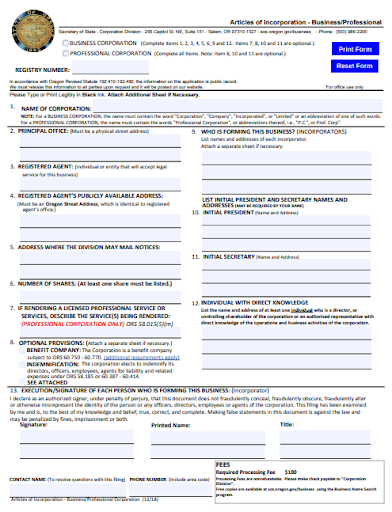
Let’s discuss each option:
Option 1: File online through the Oregon Business Registry
Online filing through the Oregon Business Registry (OBR) is the fastest and most common option. Create an OBR account if you don’t already have one, select the domestic business corporation registration, enter the required information, and pay the $100 filing fee.
Option 2: File by mail
Download the Articles of Incorporation - Business/Professional from the Secretary of State’s website. Complete the form and mail it with a $100 check or money order to:
Oregon Secretary of State Corporation Division 255 Capitol St. NE, Suite 151 Salem, OR 97310-1327
Option 3: File in person
In-person filings are accepted at the Corporation Division’s office in Salem at the same address listed above.
Oregon law specifically requires the incorporators or board of directors to adopt initial bylaws. Your bylaws establish procedures for making decisions, holding meetings, electing directors and officers, and managing the corporation’s affairs. The bylaws may contain any provisions governing the corporation’s affairs, provided they are consistent with Oregon law and the Articles of Incorporation.
When creating your corporate bylaws for your Oregon C Corp, consider including:
Board of directors: Define the number of directors, their roles, terms, and how vacancies are filled. Oregon requires a board of one or more individuals.
Shareholder meetings: Establish when and how annual and special shareholder meetings will be held, including notice requirements.
Board meetings: Set rules for calling board meetings, establishing a quorum, and voting on corporate decisions.
Officers: Identify the required officers. Oregon corporations must have a president and secretary. Define their responsibilities and note that the same individual may hold more than one office simultaneously.
Voting procedures: Explain how shareholders and directors vote and what thresholds apply for different types of decisions.
Corporate records: Specify how important corporate documents, meeting minutes, and other records will be maintained.
Amendments: Establish the process for changing the bylaws as the corporation grows.
After the bylaws are prepared, the corporation’s initial directors or incorporator must adopt them and keep the approved bylaws in the corporation’s records.
Need help drafting your Corporate Bylaws? Swyft Filings can simplify the process by preparing and drafting customized corporate bylaws. Complete a short questionnaire about your corporation’s structure, shareholders, and management. Our specialists draft your Corporate Bylaws and, if needed, a Shareholders’ Agreement. You’ll receive completed documents ready for review and adoption at your organizational meeting.
Oregon’s Secretary of State confirms that once the corporation exists, an organizational board meeting is generally held to adopt bylaws and elect officers.
At the organizational meeting, you will typically:
Adopt the corporate bylaws (if not already done by written consent).
Elect the initial board of directors, if not named in the Articles.
Appoint the required officers. Oregon requires a president and secretary at minimum.
Authorize the issuance of shares and issue initial stock to founders and investors.
Set the corporation’s fiscal year.
Authorize opening a corporate bank account.
Keep formal minutes from this meeting and every meeting that follows. Minutes are never filed with the Secretary of State, but they are among the clearest evidence that your corporation is observing proper corporate formalities. This is the foundation of the liability protection a C Corp provides.
After forming your Oregon C Corp and completing the organizational meeting, apply for an Employer Identification Number (EIN) directly through the IRS at no cost, or have Swyft Filings handle it as part of your formation package. The IRS says corporations should complete state formation before applying for the EIN. The online application takes about 15 to 20 minutes and issues the number immediately.
Your Oregon C Corp needs an EIN to:
Open a business bank account.
Hire employees in Oregon or any other state.
File federal and Oregon corporate tax returns.
Register for Oregon tax accounts through the Oregon Department of Revenue.
Apply for a business credit card or loan.
Keep your personal Social Security number off business contracts.
Filing your Articles of Incorporation creates your Oregon C Corporation, but staying in good standing requires meeting several ongoing obligations.
Every Oregon domestic business corporation must file an annual report with the Secretary of State each year to maintain its active status. The annual report is due on the anniversary of the original filing date each year, and Oregon sends a renewal notice approximately 45 days before the due date.
Here is what you need to know about Oregon’s annual report:
Due date: Anniversary of the original Articles of Incorporation filing date each year
Renewal notice: Sent approximately 45 days before the due date to the mailing address on file
Fee: $100 per year
Where: Online at sos.oregon.gov/renew or by mail
What it updates: Business information, principal office, registered agent, president, secretary, and business activity description
Dissolution risk: If the annual report is not filed within 45 days of the renewal date, the Oregon Secretary of State can administratively dissolve the corporation
Consider using Swyft Filings to file your Oregon annual report on your behalf. Our specialists prepare and file the required renewal, and you receive confirmation once the filing is complete.
Your Oregon C Corp is generally subject to the Oregon corporation excise tax if it is doing business in Oregon. The rate is 6.6% on Oregon taxable income up to $1 million and 7.6% on income above $1 million. Excise tax filers are also subject to a minimum tax based on Oregon sales. Even if the corporation has no taxable income, the minimum applies.
The minimum excise tax ranges from $150 to $100,000 depending on Oregon sales:
| Oregon Sales | Minimum Tax |
|---|---|
| Less than $500,000 | $150 |
| $500,000 to less than $1 million | $500 |
| $1 million to less than $2 million | $1,000 |
| $2 million to less than $3 million | $1,500 |
| $3 million to less than $5 million | $2,000 |
| $5 million to less than $7 million | $4,000 |
| $7 million to less than $10 million | $7,500 |
| $10 million to less than $25 million | $15,000 |
| $25 million to less than $50 million | $30,000 |
| $50 million to less than $75 million | $50,000 |
| $75 million to less than $100 million | $75,000 |
| $100 million or more | $100,000 |
Oregon also has a Corporate Activity Tax (CAT) that is separate from the corporation excise and income tax. The CAT applies based on Oregon commercial activity, not net income, and it can apply to businesses of any entity type, including C corporations.
Key CAT thresholds:
$750,000 or less in Oregon commercial activity: No CAT registration, filing, or payment obligation
More than $750,000: Registration with the Oregon Department of Revenue is required
More than $1 million: CAT return filing required; tax calculated as $250 plus 0.57% of taxable commercial activity over $1 million
Register for and manage the CAT through the Oregon Department of Revenue. A new corporation with limited early-stage Oregon commercial activity may fall below the CAT thresholds entirely, but understanding the structure from the start avoids surprises as revenues grow.
Open a dedicated business bank account after forming your corporation and obtaining your EIN. Keeping corporate funds separate from personal funds supports the corporation’s separate legal identity and makes financial recordkeeping cleaner. Banks typically request your Articles of Incorporation, EIN confirmation letter, and a corporate resolution identifying who is authorized to open and manage the account.
Whether your corporation needs a license depends on its industry and location. Regulated industries such as construction, healthcare, food service, financial services, and real estate require state-level licenses from the relevant Oregon agency. Local cities and counties may impose their own licensing or permit requirements.
Use Swyft Filings’ business license service to identify the licenses and permits that apply to your specific corporation, along with application links and renewal information.
The cost of forming a C Corp in Oregon depends on required state fees and any additional services you choose. Here is a complete breakdown:
| Cost | Fee |
|---|---|
| Articles of Incorporation | $100 |
| Name Reservation (optional, 120 days) | $100 |
| Oregon Corporation Annual Report | $100/year |
| Change of Registered Agent or Office | No state fee |
| EIN from the IRS | Free |
| Oregon corporate excise tax minimum | $150+ based on Oregon sales |
| Oregon Corporate Activity Tax | Applies only if Oregon commercial activity exceeds $750,000 |
Starting an Oregon C Corp involves filing Articles of Incorporation, appointing a registered agent, filing annual reports with the Secretary of State, and filing Oregon corporate excise tax returns with the Department of Revenue, all starting from the moment of formation. Swyft Filings has helped businesses form corporations for free since 2015. Our team understands Oregon Secretary of State requirements and can help you prepare and file your C Corp paperwork accurately and on time.
$0 + State Filing Fees
*Disclaimer: This guide provides general information about forming a C Corp in Oregon and is not a substitute for legal, tax, or financial advice.*
C Corp rules, filing costs, and corporate tax structures vary by jurisdiction. Select any state below to view its specific C Corp laws.