
Initial Setup
Compliance
Changes & Filings
Resolve
Protect & Legal
Learn
Excellent
7,984 reviews

Starting a C Corp in North Carolina takes seven steps. First, you choose a name. This goes on public record and appears on every document after it. Then you name a registered agent. This is the person or company that accepts legal mail for your corporation.
Next, you decide how your shares will work. This sets who owns what and leaves room for changes later. After that, you file your Articles of Incorporation. This is the actual filing that creates your corporation. Then you adopt bylaws. These are the internal rules for how your corporation makes decisions. You hold your first meeting. This is where you put your bylaws, shares, and officers into place. And finally, you get an EIN. This is your corporation's federal tax ID, and you'll generally need it to open a bank account or hire anyone.
None of these steps are hard on their own. But skip one, or file it out of order, and your approval can slow down by weeks.
If you find the paperwork too much, or just don't want to deal with it, Swyft Filings can handle the entire process for you. Here's what each step actually involves.
Your corporation's name becomes part of the public record the moment your Articles of Incorporation are approved. It shows up on every filing you make afterward, on your contracts, and eventually on your signage and marketing. Pick something that reads clearly out loud and actually connects with the customers you're trying to reach.
Every North Carolina C Corp name must follow these rules:
If you haven't landed on a name yet, run it through Swyft Filings' free Business Name Generator to get unique naming options. Once you have a potential name, run your proposed name through the Secretary of State's free Business Registration Search tool. This search shows you every active entity name on file so you know right away whether your name is distinguishable. If you haven't landed on a name yet, Swyft Filings' free business name generator can get you started with unique options to check.
If your name is available and you're not ready to file your Articles of Incorporation yet, North Carolina lets you reserve it for 120 days by filing an Application to Reserve a Business Entity Name with the Secretary of State, under N.C. Gen. Stat. § 55D-23. The reservation costs $30 and can be filed online or by mail. This step is optional. If you're filing your Articles of Incorporation right away, you can skip the reservation and go straight to filing, since your name gets locked in automatically once your Articles are approved.
Beyond the restricted terms above, avoid any word that implies a business purpose your corporation doesn't actually have, since North Carolina can reject a name that misrepresents your activities. Skip profanity or anything a reviewer could flag as offensive.
Don't use "Federal," "United States," or similar wording that implies a government affiliation you don't have. And don't assume punctuation or capitalization makes two names distinguishable. North Carolina treats "ABC Corp" and "A.B.C. Corp." as functionally the same name for availability purposes, so small formatting differences generally won't get a taken name approved.
First, confirm it's actually taken by running the exact name through the business registration search tool, since a partial match doesn't always mean it's unavailable.
If it is taken, you have a few options. You can adjust the name with a distinguishing word, since adding a geographic term or descriptive word is often enough to clear the distinguishability requirement. You can contact the existing entity to see if it will consent to a name that's otherwise a close match, though North Carolina still requires the result to be distinguishable on the record. Or you can keep your legal corporate name to what’s available and instead file an assumed business name for public-facing use, which in North Carolina is filed with the Register of Deeds in the county where you do business.
A registered agent is the individual or business entity legally designated to receive service of process, tax notices, and official state correspondence on your corporation's behalf.
North Carolina requires every corporation to continuously maintain a registered agent under N.C. Gen. Stat. § 55D-30. The role exists because the state and any party suing your corporation need one reliable, known address where legal paperwork can be delivered.
Your registered agent must have a physical street address in North Carolina, since P.O. boxes aren't allowed for the registered office, and must be available at that address during normal business hours. An individual agent must be a North Carolina resident.
If you name a business entity as your agent instead, it must be authorized to transact business in North Carolina and must have a business office identical to the registered office.
You name your registered agent directly on your Articles of Incorporation when you file, and if you ever need to change agents afterward, you file a Statement of Change of Registered Agent or Registered Office with the Secretary of State.
If your corporation is without a registered agent or registered office in North Carolina for 60 days or more, the Secretary of State may begin administrative dissolution proceedings. The state must send written notice, and you generally have 60 days after the notice is mailed to correct the issue. If you miss that window, your corporation loses its legal status, though you can apply for reinstatement afterward.
Before you can file your Articles of Incorporation, you need to decide how your corporation's ownership will be structured, since North Carolina requires you to state the number of authorized shares directly on the form.
Steps to set up your share structure:
A few things worth thinking through as you set this up.
Choose Your Share Types: Most founders and early employees hold common stock. Investors may seek preferred stock, which can provide preferential rights to distributions or liquidation proceeds depending on its terms.
Set Up Multiple Share Classes: Many corporations split stock into multiple classes, commonly Class A and Class B, so founders can raise money without giving up voting control. Whatever classes you create, decide upfront how much voting power each carries and whether shares in that class carry the right to appoint or remove a director, since retrofitting voting rights after shares are issued gets complicated fast.
Plan for Future Financing: If you plan to bring on investors down the line, think about how future funding rounds affect your authorized share count and how much your existing ownership could get diluted with each round, unless your shareholder agreement includes a preemptive right that limits it.
Offer Equity Compensation to Employees: Some corporations reserve a portion of their shares for employee stock options or other equity compensation, depending on their hiring and financing plans. Generally, companies set aside an option pool of 10% to 20% of authorized shares for that purpose, typically vesting over four years with a one-year cliff, meaning no shares vest until the employee has been with the company a full year.
What Happens to Shares If a Shareholder Dies: Your shareholder agreement should also spell out what happens to a shareholder's stock if they die, usually through a buy-sell provision that lets the corporation or remaining shareholders buy back the shares rather than letting them pass to an unrelated estate.
Once your structure is decided, the actual issuance involves:
If you're relying on the federal Rule 506(b) exemption, you need to file a Form D with the SEC within 15 days of your first sale.
Put all of these decisions into a shareholder agreement, since it becomes the reference document your corporation actually uses if a dispute ever comes up.
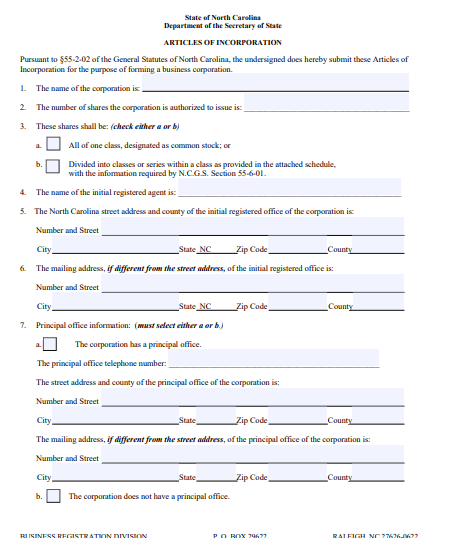
Your Articles of Incorporation are filed with the North Carolina Secretary of State's Business Registration Division, under N.C. Gen. Stat. § 55-2-02. The state filing fee is $125.
Online: You can file online through the Secretary of State's Business Registration Portal.
Mail: Mail the completed Form B-01 to the Business Registration Division, P.O. Box 29622, Raleigh, NC 27626-0622.
To complete the filing, you'll need the following details:
Bylaws are your corporation's internal rulebook. North Carolina doesn't require you to file them with the state, but you must adopt the bylaws at the organizational meeting.
What Should Corporate Bylaws Typically Include?
You can draft your own bylaws using the above points, or Swyft Filings' Corporate Bylaws service can help you draft bylaws tailored to your actual share structure and share classes rather than handing you something generic.
Once your bylaws are drafted, your initial directors or incorporator should formally adopt them at your organizational meeting and keep the adopted copy with your corporate records.
Bylaws shouldn't restate information that's already fixed in your Articles of Incorporation, such as your corporate name or your total authorized shares, since amending your Articles later would then require you to separately update your bylaws to match.
Avoid vague language that leaves core governance questions unanswered, like meeting procedures with no stated quorum or vote threshold, since that's exactly the kind of ambiguity that creates disputes.
Don't include anything that conflicts with the North Carolina Business Corporation Act, since a bylaw provision that contradicts state law generally won't be enforceable regardless of what your board adopted. And avoid overly rigid operational details, like specific software vendors or exact meeting locations, that will force you to formally amend your bylaws every time something routine changes.
This is your corporation's first official meeting. At it, a corporation does the following:
Record formal minutes of this meeting and keep them with your corporate records. These minutes are not filed with the state, but they're some of the clearest evidence that your corporation is actually following proper corporate formalities, which matters if your limited liability protection is ever challenged in court.
Holding your organizational meeting well is also the foundation for how you'll run shareholder meetings after it.
Once North Carolina approves your Articles of Incorporation, you can apply for an Employer Identification Number, or EIN. It's a nine-digit federal tax ID the IRS uses to identify your corporation separately from your own Social Security number for tax filings, banking, and everyday business transactions.
You can apply for an EIN directly through the IRS website at no cost, and it takes about 15 minutes. The application asks for the following:
Your business name
If you don't have an SSN or ITIN, or you'd rather not apply online, you can apply by mail or fax using IRS Form SS-4 instead.
Filing your Articles of Incorporation gets your corporation legally recognized, but a few things still need to happen before you're actually ready to operate.
To open a business bank account, bring your filed Articles of Incorporation, your adopted bylaws, and your EIN confirmation letter to the bank. Keeping business funds completely separate from personal accounts is one of the clearest ways to maintain the liability protection your corporation is supposed to provide.
Most North Carolina C Corps need at least one of the following depending on what they sell:
Check with your city or county clerk's office for any locally required licenses on top of state-level ones. Swyft Filings can help you find what licenses apply to your C Corporation along with the filing instructions.
For tax years beginning in 2026, North Carolina taxes C Corp income at a 2% rate on net income apportioned to the state, reported on Form CD-405 with the North Carolina Department of Revenue.
Corporations also owe an annual franchise tax based on the corporation's net worth tax base. North Carolina no longer uses the previous property-based tax bases when calculating franchise tax.
For taxable years beginning on or after January 1, 2025, the franchise tax rate for C corporations is $1.50 per $1,000 of the corporation's tax base, with a maximum tax of $500 on the first $1 million of the tax base. The minimum franchise tax is $200. For any tax base exceeding $1 million, the amount above $1 million is taxed at $1.50 per $1,000.
Both North Carolina corporate income taxe and franchise tax are reported together on Form CD-405, generally due by the 15th day of the fourth month after your tax year ends.
This is a separate filing from your tax return, submitted to the Secretary of State rather than the Department of Revenue.
When you file an annual report, it updates the state's record of your officers, directors, and registered agent, and it's due on the same date as your tax return: the 15th day of the fourth month after your fiscal year ends. The fee is $20 if filed online or $25 by mail.
| Item | Cost |
|---|---|
| Articles of Incorporation | $125 |
| Name Reservation (optional) | $30 |
| 24-Hour Expedited Processing (optional) | $100 |
| Same-Day Expedited Processing (optional) | $200 |
| Registered Agent (professional service) | Varies by provider |
| State Trademark Registration (optional) | $75 |
| EIN (IRS) | $0 |
| Annual Report (ongoing, filed with the Secretary of State) | $20 online / $25 by paper |
| Annual Franchise Tax (ongoing, minimum) | $200 |
Starting a North Carolina C Corp involves real paperwork and ongoing state requirements, from setting up your share structure to keeping up with your annual report and franchise tax. Swyft Filings has helped business owners with corporation formation and compliance since 2015. Our team understands North Carolina Secretary of State requirements and can help you prepare and file your C Corp paperwork accurately.
$0 + State Filing Fees
*Disclaimer: This guide states general information about forming a C Corp in North Carolina and is not a substitute for any kind of legal, tax, or financial advice.*
C Corp rules, filing costs, and corporate tax structures vary by jurisdiction. Select any state below to view its specific C Corp laws.