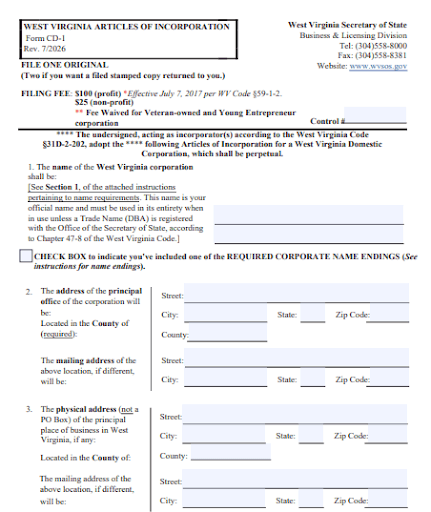
To form a C Corporation in West Virginia, you file Articles of Incorporation (Form CD-1) with the West Virginia Secretary of State, Business & Licensing Division. Swyft Filings prepares and submits that paperwork at a $0 service fee, so you only pay the $100 state filing fee. Upgrade to a paid package, and we'll also draft your bylaws, set up your stock authorization, connect you with a business attorney for consultation, and provide a registered agent as an add-on.
Starting a West Virginia C Corp means choosing a name that's available in West Virginia. Next, you appoint a registered agent who can legally accept mail on the company's behalf. From there, you decide your share structure and submit your Articles of Incorporation. Then you put your corporate bylaws in writing and run your first organizational meeting. Once all these things are done, you finish by getting an EIN from the IRS.
If you don't feel comfortable handling all the paperwork yourself, Swyft Filings will form your West Virginia C Corp for you at no service cost. You only cover the state's fee. Here's the full breakdown of each step.
Step 1: Choose a Business Name for Your West Virginia C Corp
The name you pick goes on public record the moment your Articles are approved. It's what shows up on your bank paperwork, your contracts, and eventually your storefront or website, so it's worth getting right the first time rather than filing amendments later.
The name must contain the word "corporation," "incorporated," "company," or "limited," or the abbreviation "corp.," "inc.," "co.," or "ltd."
The name may not state or imply that the corporation is organized for a purpose other than what's allowed under its Articles of Incorporation.
The name must be distinguishable on the Secretary of State's records from every other entity already on file, reserved, or registered in West Virginia.
If you're still stuck on a name, use our free business name generator to get a shortlist of creative business names in a couple of minutes. Once you've settled on a name, search it against the West Virginia Secretary of State's business organization search before you file.
Yes. Filing an application for reservation of name (Form NR-1) with the Secretary of State holds your chosen name for 120 days. You can file online or by mail. If you're still not ready to incorporate when the 120 days run out, you can submit a fresh application to hold the name again.
No. A DBA, or trade name, is a separate filing from your Articles of Incorporation. If you plan to operate under a name different from the one on your Articles, you register a trade name with the Secretary of State on its own form. Your Articles only establish your corporation's legal name, not any name you'll do business under.
A West Virginia state trademark is filed with the Secretary of State. But that will only protect your brand in West Virginia. If you plan to sell outside West Virginia, you need a federal trademark through the USPTO to cover all 50 states. Swyft Filings can help you file a federal trademark for your C Corporation.
As soon as you've confirmed a name is available with the state, or probably once filing is approved. Other things like spending money on signage, business cards, or marketing can wait. Online domain registrars typically charge $10 to $20 a year. If you choose our ‘Standard’ or ‘Premium’ package, your first year of domain registration is included.
Step 2: Appoint a West Virginia Registered Agent
West Virginia requires every corporation to keep a registered agent on file at all times. Under WV Code §31D-5-501, your agent must maintain a physical business office in West Virginia, and a P.O. box alone won't satisfy this requirement. The agent's name and address are required fields on your Articles of Incorporation.
You can, as long as you have a physical West Virginia business address and you're available there during normal business hours to receive documents in person. The tradeoff is that your name and address become part of the state's public record. A professional registered agent service can keep your personal address off that record by receiving your official mail securely and forwarding it to you on time.
If your registered agent is a person (like yourself, a family member, or a friend), West Virginia law requires that individual to be a state resident. They cannot live outside West Virginia and simply maintain a mailing address or mail drop in the state. Your agent can also be a business entity, as long as that entity is already authorized to do business in West Virginia and maintains an actual office in the state, not just a mailing address. Plenty of West Virginia corporations use a professional registered agent service rather than an individual who lives locally.
Under WV Code §31D-5-503, your agent files a statement of resignation with the Secretary of State and attaches a copy for you and for the corporation. The resignation takes effect on the 31st day after it's filed, or sooner if you appoint a replacement before then. If that window closes without a new agent named, your corporation risks falling out of good standing, which can affect everything from opening a bank account to defending yourself in a lawsuit.
Yes. File a statement of change of registered agent or registered office with the Secretary of State under WV Code §31D-5-502. You'll need your corporation's name, its current registered agent and office, the new agent's name, and the new agent's written consent to the appointment. This is a separate filing from your annual report, so updating one won't automatically update the other.
Step 3: Configure Your Share Structure
You need to state your authorized share count on your Articles of Incorporation, which means the ownership decisions have to happen before you file. Getting this right early saves you an amendment later if your structure turns out too small for the investors or employees you eventually bring on.
Work through these decisions in order:
How many total shares you're authorizing
Whether those shares carry a par value or no par value
Whether you're issuing one class of stock or splitting it into multiple classes
How voting power and board appointment rights attach to each class
Getting all of it written down, both on your Articles and in a shareholder agreement
Know the following when setting up share structure for a West Virginia C Corp:
Common stock goes to founders and early team members. It's the default share type most people picture when they think of owning part of a company.
Preferred stock often includes special rights, such as liquidation preferences or voting rights, and is commonly used in investment rounds.
Splitting stock into classes protects control, not just ownership. A common setup is Class A shares carrying more votes per share than Class B, letting a founder raise outside money without also handing over a majority say in company decisions.
An option pool is how most corporations pay in equity instead of cash. Some corporations create an option pool to reserve shares for employee equity awards. The size depends on the company's plans and financing needs.
Vesting protects the company if someone leaves early. A common vesting arrangement is four years with a one-year cliff, although terms can vary.
A buy-sell provision in your shareholder agreement should say what happens to a shareholder's stake if they pass away.
Yes. West Virginia requires your authorized share count on the Articles themselves, so this decision has to happen before you file, not after. If you're not sure how many shares to authorize, a reasonable starting point covers your founders, leaves room for an employee option pool, and accounts for at least one future investor round.
Yes. Most founders start with a single class of common stock and add preferred or additional classes when they bring on investors. Adding a class later means amending your Articles of Incorporation, so if you already know you'll need multiple classes soon, it can save you a filing to set that up from the start instead.
No. West Virginia doesn't charge based on how many shares you authorize. You can authorize far more shares than you plan to issue immediately, keeping the rest in reserve for future employees or investors, without any additional state fee.
Not necessarily, but you do need to follow the mechanics correctly. Document each stock issuance in the corporation's records and issue stock certificates if the corporation uses certificated shares. Log every transaction in your corporate stock transfer ledger, and confirm your offering qualifies for an exemption from SEC registration, usually as a private sale to a small group. If you're relying on the federal Rule 506(b) exemption, file Form D with the SEC within 15 days of your first share sale.
Step 4: File Your West Virginia Articles of Incorporation
Form CD-1 is the document that legally creates your corporation, filed with the West Virginia Secretary of State, Business & Licensing Division. The filing fee is $100 for a profit corporation, and that fee is waived for veteran-owned and young entrepreneur corporations.
By mail, email, or fax: Send the completed Articles of Incorporation, Form CD-1, to the Secretary of State, Business & Licensing Division, 1900 Kanawha Blvd E, Building 1, Suite 157-K, Charleston, WV 25305.
In person, at the Business & Licensing Division in Charleston, or at the Eastern Panhandle Business Center, 229 E. Martin St., Martinsburg, WV 25401.
What are the key details required to fill out the Articles of Incorporation:
Corporation's legal name
Principal office address and county
Mailing address, if different
Registered agent's name and address
Business email and website, if any
Business purpose
Authorized shares and par value, if for-profit
Names and addresses of incorporators
Contact information and incorporator's signature
Form CD-1 asks how many acres of West Virginia land your corporation holds or expects to hold. This is a standard disclosure field on the form itself, not something you can skip. If your corporation won't own real estate, you can state that directly on the form.
Under WV Code §31D-1-124, you can correct a filed document by delivering a corrected document to the Secretary of State that identifies the error and states the correction. If you need to change something more substantive, like your authorized share count or your corporate name, you file Articles of Amendment instead.
West Virginia doesn't require you to name your initial directors on the Articles of Incorporation itself. You can name them there if you want, or wait and have your incorporators elect the initial board at the organizational meeting after your Articles are approved.
If your corporation was formed in another state and you want to legally operate in West Virginia too, you don't refile your Articles. Instead, you submit an Application for Certificate of Authority (Form CF-1) to the Secretary of State under WV Code §31D-15-1503, along with a certificate of existence from your home state. The filing fee for a profit corporation is $100. A professional foreign qualification service can also help you complete the registration process without any hassle.
Step 5: Create Corporate Bylaws
West Virginia doesn't require corporations to file bylaws with the state, but you need them written and adopted before your organizational meeting, since adopting the bylaws is typically the first item on that meeting's agenda.
What your bylaws should spell out:
When, where, and how shareholder and director meetings happen
What counts as a quorum and how voting actually works
Director qualifications, compensation, and term length
Officer titles, their duties, and their compensation
The process for amending the bylaws themselves down the road
You can draft these yourself using the list above as a starting checklist, or use our corporate bylaws service. We draft the bylaws around your actual share structure instead of handing you a generic template.
Yes. Under WV Code §31D-2-205, either the incorporators or the board of directors may adopt the initial bylaws. If directors haven't been named yet when the bylaws are ready, the incorporators can adopt them directly, and the board can amend them later once it's seated.
No. Bylaws are an internal document, kept with your corporate records rather than filed with the state. Nobody at the state checks whether you have them when you file your Articles, but not having them creates a real gap if your corporation's legitimacy is ever questioned later, whether by a bank, an investor, or a court.
Yes. Once adopted, bylaws function as a binding internal contract among the corporation, its directors, and its shareholders. Courts routinely enforce bylaw provisions in West Virginia corporate disputes, even though the bylaws themselves are never filed with the state. Failing to follow your own bylaws can also weaken your defense if a creditor ever argues your corporation wasn't really operating as a separate legal entity from its owners, a legal theory courts call piercing the corporate veil.
Yes. Your bylaws should spell out the process for amending themselves, and most corporations let the board of directors amend the bylaws by a majority vote, subject to whatever the shareholders reserved for themselves. There's no state filing involved. Just keep the updated version with your corporate records.
Step 6: Hold an Organizational Meeting
Once the state approves your Articles of Incorporation, your initial directors, or the incorporators if directors weren't named on the Articles, get together for the corporation's first official meeting under WV Code §31D-2-204. This is where the paperwork you've been preparing actually gets put into motion.
Typical business handled at this meeting includes: Formally adopting the bylaws you drafted in Step 5 Electing officers Issuing the initial shares of stock based on the structure you configured in Step 3 Setting the corporation's fiscal year Authorizing whoever will open the corporate bank account to actually do so
Yes, even as a solo founder. It's a quick, formal step, and it's the moment your bylaws, officer titles, and initial stock issuance become official rather than assumed. A single incorporator can hold this meeting alone and sign written minutes documenting what happened.
West Virginia doesn't set a hard deadline, but holding it soon after your Articles are approved is worth doing before you open a bank account or issue any stock, since those actions typically need to be authorized at this meeting first.
Keep them with your other corporate records. You won't file them with the state, and nobody's checking that they exist, but they're often the single strongest piece of documentation showing your corporation follows real formalities rather than existing only on paper. Swyft Filings can help you put together meeting minutes.
Step 7: File for an EIN
With your Articles of Incorporation approved, the next move is applying for an Employer Identification Number. Think of it as a Social Security number for your corporation, a nine-digit federal ID that identifies your business separately from you as an individual.
Reasons your West Virginia C Corp needs one:
Opening a business bank account, since most banks won't open a corporate account without it
Hiring employees, in West Virginia or anywhere else
Filing your federal tax return and registering with the West Virginia State Tax Department
Applying for a business credit card or a business loan
You apply directly through the IRS website. The IRS doesn't charge a fee for an EIN, and the online application usually takes about 15 minutes. If you don't have a Social Security number, the online path isn't available to you, but you can still apply by mailing or faxing Form SS-4 instead.
No, you'll want to wait until your Articles are approved. The IRS application asks for your legal entity name and formation date, and applying before your corporation officially exists can lead to mismatched records that are a hassle to fix later.
What Are the Post-Formation Requirements for a C Corp in West Virginia?
Open a Business Bank Account
Bring your Articles of Incorporation, your adopted bylaws, and your EIN confirmation letter to the bank when you set it up. Once it's open, keep it strictly separate from your personal finances. Mixing the two is one of the fastest ways to undermine the liability protection a corporation is supposed to provide. See our guide to opening a business bank account for more.
Obtain Your Business Registration Certificate
West Virginia doesn't issue a single general business license that covers everyone. What nearly every business does need is a Business Registration Certificate from the West Virginia State Tax Department, a one-time $30 registration that must be displayed at your place of business. Depending on your industry, you may also need a local or industry-specific license, such as a contractor's license or a health permit.
What applies to your West Virginia C corp depends entirely on your industry and where you are physically operating. It's worth checking with the federal or state tax departments directly, or using our business license research service to sort out what's actually required for your specific business and where and how you can apply for them.
Register for West Virginia Corporate Net Income Tax
West Virginia taxes corporate net income at a flat 6.5% rate. This is separate from, and in addition to, whatever you owe the IRS federally. You'll register with the West Virginia State Tax Department and file your return through the state's online tax system.
File Your Annual Report Every Year (Due June 30)
Every West Virginia corporation must file an annual report with the Secretary of State by June 30 each year, at a $25 filing fee. This keeps the state's record of your officers, directors, and registered agent current, and it's a completely separate filing from either tax registration above. Missing it repeatedly can put your corporation at risk of falling out of good standing.
How Much Does it Cost to Incorporate a C Corp in West Virginia?
Item
Cost
Articles of Incorporation (Form CD-1)
$100
Name Reservation (optional, 120 days)
$15
Business Registration Certificate (one-time)
$30
Certificate of Authority for a Foreign Corporation (Form CF-1)
$100
Annual Report (every year, due June 30)
$25
EIN (IRS)
$0
Ready to Start a Free C Corp in West Virginia?
Forming a C Corp in West Virginia means getting the Articles of Incorporation right, appointing a registered agent, setting up your initial board, and staying on top of state requirements like the annual report and your Business Registration Certificate. Since 2015, Swyft Filings has helped 600,000+ businesses with formation. Our team knows West Virginia Secretary of State requirements inside and out, so we file your paperwork correctly the first time, and you can focus on running your business confidently.
*Disclaimer: This guide states general information about forming a C Corp in West Virginia and is not a substitute for legal, tax, or financial advice.*
Check C Corp Formation Guides for Other States
C Corp rules, filing costs, and corporate tax structures vary by jurisdiction. Select any state below to view its specific C Corp laws.
Starting a West Virginia C Corp means filing Articles of Incorporation, appointing a registered agent, and staying current with the annual report. Swyft Filings has been helping businesses form and stay compliant since 2015. Our team knows the West Virginia Secretary of State requirements and can file your C Corp quickly, accurately, and in full compliance.
Standard processing typically takes 5 to 10 business days by mail or 2 to 3 business days online once the Secretary of State receives your Articles of Incorporation. Building in a little buffer before you commit to a launch date is worth it.
West Virginia also offers expedited filing options where a next-day service costs a $25 fee, a 2-hour turnaround is for a $250 fee, and 1 hour service is for a $500 fee.
A C Corp is taxed at the corporate level and again when profits are distributed as dividends, while an LLC is typically a pass-through entity taxed only once, on the members' personal returns. C Corps also issue stock and support multiple share classes, which makes them the standard choice for founders planning to raise venture capital.
Yes. West Virginia doesn't require multiple incorporators, directors, or shareholders. A single person can serve as the sole incorporator, director, officer, and shareholder all at once.
Yes. West Virginia doesn't require directors, officers, or shareholders to be U.S. citizens or residents. A non-U.S. resident can form and own a West Virginia C Corp, though getting an EIN without a Social Security number means applying by mail or fax instead of online.
Our free service covers preparing and filing your Articles of Incorporation, the document that legally brings your corporation into existence. It doesn't cover everything that comes after; you'll still need bylaws, a registered agent, and likely a conversation with an attorney at some point. You're free to handle those pieces yourself, or upgrade to one of our paid packages and we'll take care of them for you.