
Initial Setup
Compliance
Changes & Filings
Resolve
Protect & Legal
Learn
Excellent
7,984 reviews

Forming a C Corp in Indiana involves choosing a compliant business name, appointing a registered agent, preparing and filing your Articles of Incorporation, creating corporate bylaws, holding an initial organizational meeting, and obtaining an EIN. Let’s discuss each step in detail so that you can set up your Indiana C Corp properly from day one.
Indiana's business entity naming rules under Indiana Code (§23-0.5-3-1, §23-0.5-3-2) require your C Corp name to meet specific requirements. We have listed those requirements below to ensure you choose the right compliant name for your Indiana C Corporation. Have a look:
Include a corporate identifier: Your corporation's name must include "corporation," "incorporated," "company," or "limited," or an abbreviation such as "Corp.," "Inc.," "Co.," or "Ltd."
Be distinguishable on the record: Your Indiana C Corporation's name must be distinguishable on the Indiana Secretary of State's records from existing domestic and foreign entities, certain administratively dissolved entities, reserved names, and registered assumed names. Corporate designators such as "Corp." or "Inc." are not considered when determining whether names are distinguishable.
Restricted words: The word “bank” or a derivative of it may require review and approval by the Indiana Department of Financial Institutions before it can be used in a business name.
Following these rules, choose a compliant name for your Indiana C Corp. Keep one or two alternatives available in case your preferred name does not meet Indiana distinguishability requirements. To create alternative name ideas, use Swyft Filings' free business name generator. Now, search your proposed name through the INBiz business search before filing.
Every Indiana C Corporation must designate a registered agent to receive legal notices, government correspondence, and service of process on the corporation's behalf. You can appoint your registered agent when filing your Articles of Incorporation through the Indiana Secretary of State's INBiz portal.
Here are the Indiana registered agent requirements that need to be met:
Have an Indiana address: The registered office must have a physical street address in Indiana. A P.O. box cannot be used as the registered office address.
Be available: The registered agent must be available at the registered office to receive service of process and other official documents.
Be eligible: The agent can generally be an individual resident of Indiana or an entity authorized to serve as a registered agent in the state.
Provide consent: The person or entity serving as your registered agent must consent to the appointment.
You can serve as your own registered agent if you meet Indiana's requirements. Many busy founders who don't keep predictable office hours use a professional registered agent service instead of serving personally.
Before filing your Articles of Incorporation, decide how your Indiana C Corp will structure its stock. Indiana requires the Articles of Incorporation to state the number of shares the corporation is authorized to issue. If you create multiple classes of stock, you must also state the number of shares in each class and describe their rights and preferences.
Consider these points when setting up your share structure:
Authorized shares: Decide the maximum number of shares your corporation can issue.
Issued shares: Determine how many shares you will actually issue to the founders or initial shareholders.
Stock classes: Choose whether your corporation will have one class of common stock or multiple classes.
Voting rights: Different classes can have different voting rights, including limited or no voting rights where permitted.
Economic rights: Stock classes can have different rights to dividends, distributions, or assets upon dissolution.
Preferred stock: If you expect to raise outside investment, you may consider authorizing preferred stock with specific rights and preferences.
Future needs: You can authorize more shares than you initially issue, leaving shares available for future investors, employees, or other business purposes.
Par value: If applicable, specify the par value of your shares in the Articles of Incorporation.
For a simple founder-owned C Corp, a single class of common stock may be sufficient. If you expect outside investment or want different ownership or voting arrangements, consider your stock structure carefully before filing.
Filing the Articles of Incorporation is the step that officially creates your Indiana C Corp. You must submit the required formation information to the Indiana Secretary of State, Business Services Division, and pay the applicable state filing fee. Before filing, make sure your corporation's name, registered agent, share structure, and information on the incorporator are ready.
You can file your Indiana C Corp Articles of Incorporation online or by mail.
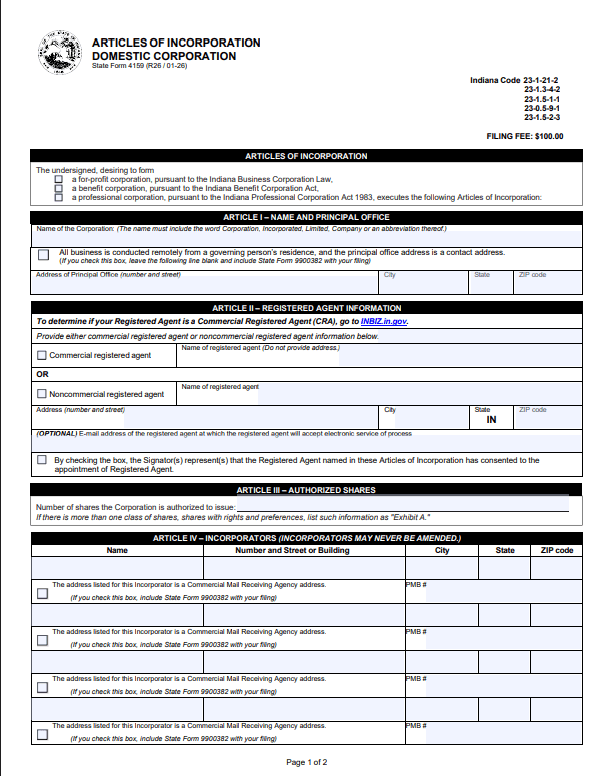
a) Online filing: You can file your Indiana C Corp Articles of Incorporation online through the INBiz portal. You’ll need an Access Indiana account to access the filing system.
Log in to INBiz: Sign in with your Access Indiana account or create one if you do not already have an account.
Select your entity type: Choose For-Profit Domestic Corporation and start the Articles of Incorporation filing.
Enter your corporation's information: Provide the required details, including:
Review and sign: Carefully review the information for accuracy and provide the required electronic signature.
Pay the filing fee: Pay the applicable $95 state filing fee for an online filing. Payment-processing fees may also apply.
Submit the filing: Submit your Articles of Incorporation electronically through INBiz.
Save your approved documents: Once the Secretary of State approves the filing, download and keep a copy of your filed Articles of Incorporation with your corporation's records.
b) Filing by mail/In-Person: Send the completed Articles of Incorporation Domestic Corporation Form 4159 along with a $100 check or money order payable to the Secretary of State to the Business Services Division, 302 West Washington Street, Room E018, Indianapolis, IN 46204.
Once your Indiana C Corp is formed, the next step is to establish its internal operating rules through corporate bylaws. Unlike your Articles of Incorporation, bylaws are an internal corporate document and are generally not filed with the Indiana Secretary of State. You should keep a copy with your corporation's records and follow the procedures outlined in them as your business operates.
Your Indiana C Corp bylaws should address important areas such as:
Swyft Filings can draft customized Corporate Bylaws for your Indiana C Corp as part of a premium package, prepared to align with your company's governance structure.
After your Articles are filed, hold an organizational meeting where your incorporators or initial directors typically:
Maintain a signed copy of the meeting minutes in your corporate records. These records can help demonstrate that the corporation followed its required formalities.
Form your Indiana corporation before applying for an Employer Identification Number, since the IRS expects the entity to already legally exist. You can apply for an EIN directly through the IRS:
Online: The IRS online application is generally the fastest option and is available at no cost.
By fax: You can submit Form SS-4 by fax if you prefer not to apply online.
By mail: You can also mail the completed Form SS-4 to the IRS.
You will typically need information such as:
Once you receive your EIN, keep the confirmation notice with your corporate records. You’ll generally use the EIN when opening a business bank account, filing federal tax returns, hiring employees, and handling other federal tax matters. Apply directly and for free through the IRS's online EIN application, or let Swyft Filings handle applying for an EIN as part of your Indiana C Corp formation package.
*NOTE: An EIN is issued by the IRS, not the Indiana Secretary of State, and you generally don't need to pay a fee when applying directly through the IRS.*
After your Indiana C Corp is formed, there are several ongoing responsibilities to keep the business in good standing and maintain proper financial records.
Indiana corporations must file a Business Entity Report with the Indiana Secretary of State every two years. This report keeps the state's records up to date with information about your corporation. The fee is $32 online or $50 by paper.
When filing your report:
Your Indiana C Corp may be subject to Indiana corporate income tax on its taxable income. The corporation should account for its state tax obligations when preparing its financial records and planning for tax payments.
Keep these points in mind:
Forming a C Corp does not automatically give you every license or permit needed to operate. Depending on what your business does and where it operates in Indiana, you may need additional state or local approvals.
Check whether your business needs:
Feeling confused about where to start? Choose Swyft Filings' business license research service where our team reviews your business details against federal, state, and local licensing requirements to identify what you may need with direct application links.
Opening a separate bank account for your Indiana C Corp helps keep corporate finances distinct from personal finances. It also makes it easier to track business income, expenses, payroll, and tax payments.
When setting up the account, you may need:
Your total cost to incorporate a C Corp in Indiana may vary based on how you file and whether you use professional services for tasks such as registered agent support, preparing corporate documents, and more.
| Cost | Fee |
|---|---|
| Indiana Articles of Incorporation | $95 (online) / $100 (paper) |
| Indiana Name Reservation (120 days) | $10 (online) / $20 (paper) |
| Biennial Business Entity Report | $32 (online) / $50 (paper) |
| Indiana Registered Agent Service | Varies |
| EIN | $0 |
With Swyft Filings, you can choose the Basic Indiana C Corp formation service package with a $0 service fee + Indiana state filing fee to get your corporation formation started. The package covers essential formation services, including preparing and filing your Articles of Incorporation.
$0 + State Filing Fees
*Disclaimer: This guide offers general information about forming a C Corporation in Indiana and isn't a substitute for legal, tax, or financial advice.*
C Corp rules, filing costs, and corporate tax structures vary by jurisdiction. Select any state below to view its specific C Corp laws.