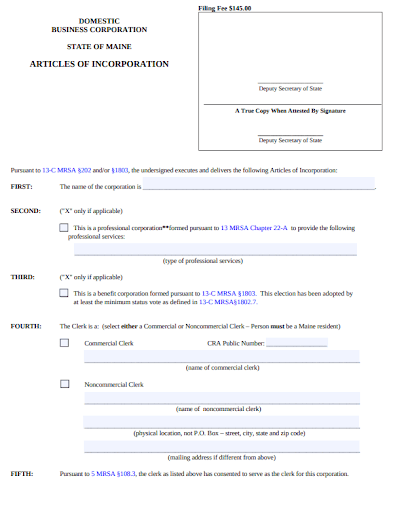
To start a C Corp in Maine, you file Articles of Incorporation with the Maine Secretary of State. Swyft Filings prepares and files your Articles of Incorporation for a $0 service fee, so you only pay the $145 state filing fee. Our premium packages include drafting corporate bylaws, EIN filing, stock authorization support, and a professional business address. We also offer registered agent services as an add-on, so you can launch with everything a Maine C Corp needs to stay compliant from day one.
We have broken down Maine C Corp formation into seven small steps. It starts with deciding a unique name for your business that’s distinguishable from the rest of the businesses registered with the state. Next, you will need to appoint a registered agent, which is called a clerk, and set your share structure. These steps are part of the preparation for the next step: filing the articles of incorporation. Once the state approves your filing, you draft the corporation bylaws and hold your first meeting. You will also need to apply for an EIN for federal tax purposes.
Each step builds on the one before it, so skipping ahead usually means having to redo work later. You can walk through each step yourself using the breakdown below, or let Swyft Filings form your C Corporation for you while you focus on running your business.
Step 1: Choose a Business Name for Your Maine C Corp
Your corporate name is how customers and the state know your business. If you are formalizing your business, your business name becomes a public record, along with other personal details, the moment you file. It will appear on every contract, invoice, and piece of marketing you produce afterward, so it's worth selecting your name wisely.
Maine C Corporations must follow these naming rules under 13-C M.R.S. §401:
Distinguishable name requirement. Your name must be distinguishable on the Secretary of State's records from every other corporation, LLC, LP, LLP, reserved name, and registered mark already on file.
Purpose-language prohibition. Your name can't contain language stating or implying that your corporation is organized for a purpose other than what's permitted under §301 and your own Articles of Incorporation.
No false government affiliation. Your name cannot imply a connection to a federal or state agency that doesn't exist.
Restricted words requiring prior approval. Words like "Bank" or "Trust" are regulated separately under Maine's banking laws in Title 9-B, and words tied to education, such as "College" or "University," fall under Title 20-A. Each restriction comes from its own title, so check both if your name touches either category.
Haven't decided on a business name yet? Add your raw ideas to our business name generator to create a list of unique names for free.
Once the name is finalized, search it in the Maine Corporate Name Search. It checks your name against every active corporation, LLC, limited partnership, and reserved or registered name on file.
Under 13-C M.R.S. §401(6), when comparing your proposed name against existing ones, the Secretary of State disregards: Entity-type words or abbreviations, like "Corporation," "Company," "Incorporated," "Limited," "Professional Corporation," or "Limited Liability Company" Whether "and" or "the" is present or absent Differences in punctuation, capitalization, or special characters In practice, this means a name that only differs from an existing one by adding "Inc." or swapping capitalization won't count as distinguishable. You need a substantively different name, not a cosmetic variation.
Two narrow exceptions exist under 13-C M.R.S. §401(4)–(5): Written consent path. The entity that already holds the name consents in writing and submits a signed undertaking to the Secretary of State, agreeing to change its own name to a distinguishable one. Court judgment path. You deliver a certified copy of a final court judgment establishing your right to use the name in Maine. Successor-entity exception. You can also use another Maine corporation's name, including its assumed or fictitious name, without either of the above, if you merged with that corporation, formed by reorganizing it, or acquired all of its assets, including the name itself.
Yes. Under 13-C M.R.S. §402, you can reserve a name for 120 days by filing an Application for Reservation of Name with the Secretary of State. The fee is $20, and the application can be filed by mail or in person. Maine reservations are not renewable, so if you need more time, you'll need to let the reservation lapse and file a fresh application under a different applicant if the same name is still available.
There's no Maine statute requiring it, but securing your domain early protects your brand before a competitor does. Check availability through a registrar like GoDaddy or Namecheap, where a standard .com domain typically runs $10 to $20 a year. Our formation packages include a done-for-you professional website with a free domain.
Trademark once you've started using your name in commerce and are ready to spend real money on branding, marketing, or expansion, not before. Filing too early doesn't help in Maine anyway, since the state won't register a mark that isn't already in active use. Once you're at that point, you have two options, depending on how far you want the protection to extend. State trademark: Maine only lets you register a mark that's already in active use in the state. Under 10 M.R.S. Chapter 301-A, marks can't be reserved for future use the way business names can. You file with the Secretary of State's Marks Division, pay $60 for one class plus $10 for each additional class, and the registration lasts 10 years with renewal available in the 6 months before expiration. Federal trademark (USPTO): A federal registration through the USPTO costs $350 per class and protects your name nationwide, not just in Maine.
You don't need to decide this when you file your Articles of Incorporation. Maine calls a DBA an "assumed name," and a corporation can adopt one at any time by filing a statement, separate from your original formation filing. A professional DBA filing service can handle this whenever you're ready to operate under a different name.
Step 2: Appoint a Clerk (Registered Agent) for your C Corp in Maine
Maine's corporation statute doesn't use the term "registered agent." Under 13-C M.R.S. §511, Maine corporations appoint a clerk, which is the same role LLCs call a registered agent.
You'll see "clerk" on your Articles of Incorporation and on the Secretary of State's business lookup. Here are Maine's requirements for a clerk:
Must be either a Maine resident individual serving as a noncommercial clerk or a commercial clerk listed with the Maine Secretary of State. A commercial clerk may be an individual or a domestic or foreign entity.
May be a director, officer, or someone with no other role at the C Corporation.
Must maintain a physical Maine street address (a P.O. box doesn't qualify) and be available during normal business hours to accept legal notices and state correspondence.
To appoint your clerk, choose someone eligible under the statute, confirm they're willing to take on the role, then list their name and Maine address directly on your Articles of Incorporation when you file.
If you don't have a Maine resident willing to take on the role, a professional registered agent service can act as your clerk. They will provide you a Maine address and handle your legal and state mail. This will also keep your personal address off the public record and ensure someone is available during normal business hours every day.
Yes. Maine lets you update your clerk at any time by filing a change with the Secretary of State. You can do it yourself by filing Form CLKRA-3 or let a change of registered agent service handle this filing. Many businesses that initially choose to be their own registered agent often end up switching to another individual or a professional service for privacy or the freedom to travel during business hours, rather than staying available at a desk at the registered address.
Yes, a few. Your home or office address becomes public record. You're required to be available at that address during normal business hours, which limits your flexibility if you travel or work off-site. And if you move or step away without updating your address, you risk missing a legal notice, which under 13-C M.R.S. §1420 is a ground for the Secretary of State to administratively dissolve your C Corporation.
Failing to maintain a clerk, or failing to notify the state when your clerk's address changes or your clerk resigns, is a ground for administrative dissolution. Here's how the process plays out under 13-C M.R.S. §1421: The Secretary of State mails a written notice of the problem to your corporation's clerk of record. You have 60 days from the date of that notice to fix the issue (for example, appoint a new clerk). If you don't correct it within the 60-day window, the Secretary of State administratively dissolves your corporation. If your C Corporation is dissolved this way, you can apply for reinstatement within 6 years of the dissolution date under 13-C M.R.S. §1422, but reinstatement means back paperwork and fees you could have avoided by keeping your clerk information current.
Step 3: Configure Your Share Structure
You need to decide your share structure before you file, since the number of shares your C Corporation is authorized to issue is stated directly on your Articles of Incorporation.
Steps to set up your share structure:
Decide how many shares to authorize.
Choose your share types.
Decide whether you need multiple share classes.
Assign voting rights and board appointment rights, if applicable.
Decide whether to restrict share transfers.
Plan for future financing rounds.
Understand how future raises will dilute existing shareholders.
Decide whether to offer equity compensation to employees.
Set a vesting schedule if you're issuing founder or employee equity.
Plan for what happens to shares if a shareholder dies.
Issue stock to your shareholders once the C Corporation is formed.
Draft a shareholder agreement that documents all of the above.
Once you've made all the decisions above, put them in writing. A shareholder agreement documents your share structure, transfer restrictions, voting arrangements, and buy-sell terms in one binding document.
Not directly. Maine's $145 Articles of Incorporation filing fee doesn't scale based on your number of authorized shares the way some states' fees do, so authorizing a large number of shares at formation doesn't cost you more upfront. The main reason to be deliberate is dilution planning, not filing cost.
Yes, but it requires filing Articles of Amendment with the Secretary of State to increase your authorized share count, which comes with its own filing fee and processing time. It's simpler to authorize a reasonably high number of shares at formation than to amend later every time you need more.
Yes. Even a C Corporation with one shareholder must state an authorized share count in its Articles of Incorporation under Maine's Business Corporation Act. Maine's for-profit corporation statute, 13-C M.R.S. §803, doesn't set a minimum number of directors either, so a single person can serve as sole shareholder, sole director, and sole officer.
Step 4: File Your Maine Articles of Incorporation
File Maine Articles of Incorporation with the Secretary of State's Bureau of Corporations, Elections and Commissions. The base filing fee is $145.
Filing methods:
Mail: Send your completed Articles of Incorporation and payment to the Secretary of State, Division of Corporations, UCC and Commissions, 101 State House Station, Augusta, ME 04333-0101.
In-person/walk-in: Deliver your filing directly to the Division of Corporations at the Bureau's Augusta office.
Online: Maine does not currently offer full online filing of Articles of Incorporation as some states do. The state's InforME Interactive Corporate Services portal handles certain recurring filings, like annual reports, but initial incorporation is filed by mail or in person.
Information you'll need to file:
Corporate name
Whether it's a professional Corporation (and the type of professional service, if so)
Whether you're electing benefit corporation status
Clerk type: Commercial (with CRA number) or noncommercial, plus their physical Maine address (no P.O. boxes) and mailing address if different
Share structure: One class with the number of authorized shares, or multiple classes/series detailed in an exhibit
Whether the corporation will have a board of directors or be managed directly by shareholders
Optional director provisions, min/max number of directors, limits on director liability, or a commitment to indemnify directors and officers
Whether you're electing preemptive rights
Any additional provisions, attached as an exhibit
Name and address of any additional incorporators
Incorporator's signature and date
Maine's Business Corporation Act requires a board of directors and provides that the board must consist of one or more individuals under 13-C M.R.S. §801. One person can serve as your corporation's sole director.
The purpose clause is a short statement of what your C Corp is organized to do. Maine allows a broad, general-purpose statement (such as "to engage in any lawful business") rather than requiring you to spell out every specific activity, which keeps you from having to amend your Articles every time your business adds a new service line.
Standard processing runs about 25-30 business days. Maine offers two expedited tiers: $50 for 24-hour processing and $100 for immediate processing. Both expedite fees are charged in addition to the $145 base filing fee, not instead of it.
If your corporation is formed in another state and you want to do business in Maine, you file for a Certificate of Authority rather than Articles of Incorporation. A foreign qualification service can handle this filing for C Corporations expanding into Maine.
You file Articles of Amendment with the Secretary of State to officially change your corporate name. This is a separate filing from your original Articles of Incorporation and carries its own fee.
The Secretary of State returns a stamped, "filed" copy of your Articles of Incorporation once processing is complete, either by mail or in person, depending on how you filed. You can also confirm your entity's active status at any time using the corporate name search tool mentioned above.
The most common reasons for rejection are a name that isn't distinguishable from an existing entity, missing required information (like an incomplete clerk address), or an unsigned document. If your filing is rejected, the Secretary of State returns it with an explanation of the defect rather than simply keeping your fee, so you can correct the issue and resubmit.
Step 5: Create Corporate Bylaws
Once you know what your bylaws need to cover, you can either draft them yourself using a checklist or have a corporate bylaws service prepare them based on your actual share structure and board setup, rather than starting from a generic template.
No. Bylaws are an internal governance document. You keep them with your corporate records, but you don't submit them to the Maine Secretary of State the way you submit your Articles of Incorporation.
Yes. Under Maine's Business Corporation Act, the initial bylaws must be adopted by either the incorporators or the board of directors. In many cases, the incorporators adopt the initial bylaws before the board begins managing the C Corporation, while in other cases the board adopts them during the organizational process. Once adopted, the bylaws become the corporation's governing document for internal operations.
Not without real risk. If you skip bylaws entirely or ignore the ones you've adopted, you weaken the formal separation between you and your C Corporation. That's one of the factors courts consider when a plaintiff seeks to pierce the corporate veil and hold shareholders personally liable for corporate debts. Treating bylaws as optional paperwork undermines the liability protection, which is the whole reason to incorporate.
There's no statutory grace period, since bylaws aren't a state filing with its own deadline. In practice, you should adopt them at your organizational meeting, right after filing your Articles of Incorporation, rather than leaving your C Corporation to operate without any internal governance rules.
Step 6: Hold an Organizational Meeting
At your organizational meeting, your initial directors (incorporators if the directors aren’t named) take the actions that formally set your C Corporation in motion:
Adopt the corporate bylaws
Elect officers (president, treasurer)
Issue initial stock to your shareholders
Set your corporation's fiscal year
Select a bank for your business account
Ratify any actions the incorporator took before the meeting
Record meeting minutes documenting every decision made. Minutes aren't just a formality: they're part of the paper trail that shows your corporation operates as a distinct legal entity, which matters if your liability protection is ever challenged in court.
It's the meeting where your C Corporation moves from "filed with the state" to "actually operating," formally adopting bylaws, appointing officers, and issuing stock so the business has the governance structure and ownership records it needs to function.
Step 7: File for an EIN
An EIN (Employer Identification Number) is a nine-digit number the IRS assigns to your corporation, functioning like a Social Security number for your business.
A Maine C Corp needs an EIN to:
Open a business bank account
File your federal Form 1120 corporate income tax return
File your Maine corporate income tax return with Maine Revenue Services
Hire employees and run payroll
Apply for business licenses and permits
Applying for an EIN is free and takes about 15 minutes if you're applying online.
You'll need your C Corporation's legal name, formation date, and the responsible party's Social Security number or ITIN. If the responsible party doesn't have an SSN or ITIN, you can apply by mail or fax using paper Form SS-4 instead.
What Are the Post-Formation Requirements for a Maine C Corp?
Open a Business Bank Account
Once your EIN confirmation letter arrives, bring the following to the bank:
Your stamped Articles of Incorporation
Your adopted corporate bylaws
Your EIN confirmation letter
Use this account exclusively for business expenses, kept completely separate from your personal finances. That separation is one of the most important habits for protecting your limited liability. Commingling personal and business funds is one of the fastest ways courts pierce the corporate veil, so open this account before your first business transaction. Read our guide to opening a business bank account for a fuller walkthrough.
Obtain the Business Licenses and Permits You Need
Maine doesn't require a single statewide general business license the way some states do, but most corporations still need at least one license depending on what they sell and where they operate. Common ones include:
Sales tax account/registration and Retailer Certificate from Maine Revenue Services, if you sell taxable goods or services
Local permits, such as a municipal business license or health permit, issued by the city or town where you operate
You can either confirm which licenses apply to your business by conducting the research yourself or let a business license research service identify your specific federal, state, and local requirements so you're not left guessing.
File Your Annual Report
Every Maine corporation is required to file an Annual Report, due June 1 each year, with an $85 filing fee. This report updates the Secretary of State's public record of your officers, directors, and clerk.
It's a separate filing from your tax return. Also, know that filing "no tax owed" on your corporate income tax return doesn't excuse you from filing the annual report. A professional annual report filing service can handle this for you each year.
Pay Maine Corporate Income Tax
Maine taxes corporate net income on a graduated scale, from 3.5% up to 8.93% at the top bracket, under Maine's corporate income tax statute. C Corps file Form 1120ME annually with Maine Revenue Services. This is separate from, and in addition to, your annual report, so budget for both as recurring obligations.
Register for Sales Tax, if Applicable
If your C Corporation sells taxable goods or services in Maine, register with Maine Revenue Services for a seller's certificate before making your first sale. Maine's general sales tax rate is 5.5%, with different rates for categories like prepared food and short-term lodging.
How Much Does It Cost to Incorporate a C Corp in Maine?
Fee
Cost
Required?
Articles of Incorporation filing fee
$145
Required
24-hour expedited processing
$50 (in addition to base fee)
Optional
Immediate expedited processing
$100 (in addition to base fee)
Optional
Name reservation (120 days)
$20
Optional
Annual report (due every June 1)
$85
Required, ongoing
Ready to Start a Free C Corp in Maine?
Starting a Maine C Corp involves paperwork and ongoing requirements that can quickly become complicated, from setting up your share structure to keeping up with state filings. Swyft Filings has helped businesses with corporation formation in Maine and compliance since 2015. Our team understands Maine Secretary of State requirements and can help you prepare and file your C Corp paperwork accurately and efficiently.
Starting a Maine C Corp means filing Articles of Incorporation, appointing a registered agent, and staying current with the annual report. Swyft Filings has been helping businesses form and stay compliant since 2015. Our team knows the Maine Secretary of State requirements and can file your C Corp quickly, accurately, and in full compliance.
There's no set number of shares required by Maine law. Many small corporations start with a round figure like 1,000 or 10,000 shares, authorizing more than they plan to issue right away so there's room to bring on investors or employees later without amending the Articles of Incorporation.
It's not required, but it's still useful. A shareholder agreement documents your share structure and any future plans to bring on co-owners, making it easier to add shareholders later without having to start your governance documents from scratch.
Owners who work for the corporation are typically paid a salary through payroll and can also receive dividends as shareholders if the corporation distributes profits. These are two separate types of payments with different tax treatment.
The $0 formation service covers preparing and filing your Articles of Incorporation, which is the core legal requirement. Most corporations also need bylaws, an EIN, a clerk, and a stock issuance process to actually operate, which is why Swyft's Standard and Premium packages bundle these together rather than leaving you to piece them together separately.