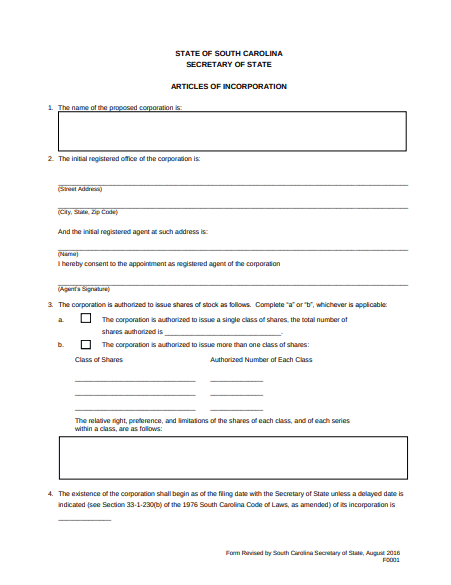
To start a C Corporation in South Carolina, you file Articles of Incorporation with the South Carolina Secretary of State. Swyft Filings prepares and submits your C Corp paperwork for a $0 service fee; you only pay the state filing fee of $135. Upgrade to a paid package, and we'll also draft your bylaws, set up your stock authorization, connect you with a business attorney, and provide a registered agent as an add-on.
How to Start a C Corp in South Carolina in 8 Steps
Forming a South Carolina C Corp starts with securing a business name, then appointing a registered agent to receive legal mail on the company's behalf. From there, you'll decide on your share structure and file your Articles of Incorporation, along with the state-required CL-1 initial report. Once the state approves you, you'll put your bylaws in writing, run your first organizational meeting, actually issue your stock, and close things out with an EIN from the IRS.
One thing that trips up founders coming from other states: South Carolina requires an attorney licensed in the state to sign a certificate confirming that the Articles of Incorporation comply with applicable state requirements. It's a small detail, but it changes who needs to be involved before you submit anything.
If you'd rather not handle the paperwork yourself, Swyft Filings will form your South Carolina C Corp for you at no service cost; you only cover the state's fee. Here's the full breakdown of each step.
Step 1: Choose a Name for Your South Carolina C Corporation
Your corporation's name goes on public record the moment your Articles are approved. It shows up on your bank paperwork, your contracts, and eventually your storefront or website, so it's worth getting right the first time instead of filing an amendment later.
South Carolina naming rules for a C Corp:
The name must be distinguishable from every other business entity currently on file with the South Carolina Secretary of State, under S.C. Code § 33-4-101.
The name must include "Corporation," "Incorporated," "Company," or "Limited," or an abbreviation such as "Corp.," "Inc.," "Co.," or "Ltd."
The name cannot imply the corporation is organized for a purpose outside what's legal under South Carolina law or its own Articles.
Certain words trigger extra review by the Secretary of State's office before they're approved, so if your name includes anything regulated (banking, insurance, or similar terms), expect the filing to take a closer look before it clears.
If you haven't settled on a name yet, run it through Swyft Filings' free Business Name Generator for a shortlist.
Once you have a name, search it against the South Carolina Secretary of State's business entities online database before you file. A name that looks available can still be rejected due to an abbreviation or punctuation difference that the system reads as identical, so filing approval is the only definitive way to know whether a name can be yours. It's also worth running a quick check of the USPTO Trademark Database so you're not building a brand around a name someone else already owns nationally.
Yes. Under S.C. Code § 33-4-102(a), you can file an Application to Reserve Corporate Name with the Secretary of State to hold your name for a nonrenewable 120-day period. The filing fee is $10. File online through Business Entities Online or download and mail the paper form (F0001) to the Secretary of State, Attn: Corporate Filings, 1205 Pendleton Street, Suite 525, Columbia, SC 29201. Because the reservation can't be renewed, you'll want your Articles ready to go before the 120 days run out, or the name opens back up to the public. If you're planning to incorporate right away, you can skip this step entirely and just file your Articles of Incorporation.
Probably not with the state. South Carolina doesn't have a general statewide DBA filing requirement for corporations, as most states do. If you want to operate under a name different from what's on your Articles, you generally register that assumed name at the county level rather than with the Secretary of State. Check with the clerk of court in the county where you operate to confirm local requirements, and see our South Carolina DBA guide for how the process works state-by-state.
South Carolina law doesn't require a domain name as part of forming your corporation, but locking one in early protects your brand while your Articles are still processing. If you choose Swyft Filings' Standard or Premium package, your first year of domain registration is included at no extra cost.
Step 2: Appoint a South Carolina Registered Agent
South Carolina requires every corporation to continuously maintain a registered agent and registered office in the state under S.C. Code § 33-5-101. This isn't something you can leave blank and circle back to. The agent's name and South Carolina street address are required fields on your Articles of Incorporation, so this needs to be settled before you file.
What South Carolina requires of a registered agent:
A real street address inside South Carolina; a P.O. box does not satisfy this requirement.
The registered office must be a physical address in South Carolina where legal documents can be properly served.
If the agent is a business entity rather than an individual, the statute requires that its business office be identical to the registered office.
Appointing one involves three things:
Pick someone who qualifies,
Get their agreement to take on the role, and
List their name and South Carolina address in your Articles of Incorporation.
The registered office has to be a physical street address in South Carolina where the agent is actually present during business hours, not just a mailing address. A P.O. box won't clear the filing, and a virtual mailbox that doesn't have someone available to accept documents in person doesn't meet the standard either. This address becomes part of the state's public record the moment your Articles are approved.
Yes, as long as you meet the address and availability requirements above. The trade-off is that your name and street address become permanently searchable in the state's public records, since it's the same address listed for your registered office. Swyft Filings' registered agent service keeps your personal address off that record by listing our office instead, while forwarding any official mail directly to you.
You can't file your Articles of Incorporation without naming one in the first place, since it's a required field on the form. The more common scenario is an agent resigning or becoming unreachable after formation, which the state usually catches when mail sent to your registered office bounces back undelivered. Once that happens, your corporation falls out of compliance, and the risk compounds the longer it goes unaddressed, as it can eventually jeopardize your good standing with the Secretary of State. To fix it, file a change of registered agent as soon as you notice the gap rather than waiting for a formal notice from the state.
File a Notice of Change of Registered Office or Registered Agent or both of a South Carolina Corporation with the Secretary of State, under S.C. Code § 33-5-102. The fee is $10. You'll need your corporation's exact name, the current registered office address on file, and your new agent's name and South Carolina street address. File online, or mail it in duplicate to the Secretary of State, Attn: Corporate Filings, 1205 Pendleton Street, Suite 525, Columbia, SC 29201.
Step 3: Configure Your Share Structure
South Carolina requires you to state your authorized shares, itemized by class, directly in your Articles of Incorporation under S.C. Code § 33-2-102. That means the ownership decisions below need to happen before you file, not after.
Steps to set up your share structure:
Decide how many total shares to authorize
Choose whether shares carry a par value or no par value
Decide on one class of stock or multiple classes
Assign voting rights and board appointment rights to each class
Document these decisions in your Articles and consider using a shareholder agreement for ownership rights and restrictions.
Consider the following things when setting up share structure for a South Carolina C Corp:
Choose Your Share Types: Founders and early employees typically hold ordinary (common) shares. You can also create preferred shares, which carry priority on payments, meaning preferred holders get paid before common holders if the company is sold or liquidated. Investors typically require these.
Set Up Multiple Share Classes: Many corporations split their stock into Class A and Class B, with one class carrying more votes per share, letting founders raise capital without giving up board control.
Assign Voting Rights and Board Appointments: Your share class determines how much voting power a shareholder has, and whether their shares include the right to appoint or remove a board member. Decide this for each class before you issue any stock.
Restrict Share Transfers: Most shareholder agreements include a right of first refusal, meaning a shareholder who wants to sell must offer the shares to existing shareholders or the corporation first, before selling to an outside buyer.
Issue Stock to Your Shareholders:
Once your structure is decided, the actual issuance involves:
Issue stock certificates if applicable and record ownership in the corporation's stock ledger.
Record the issuance in a stock transfer ledger.
Make sure your stock offering complies with applicable federal and state securities laws and any available registration exemptions.
File a federal Form D within 15 days of your first sale if you're relying on the federal Rule 506(b) exemption.
These decisions can be documented in a shareholder agreement if one is created. It is one of the reference documents your corporation and its shareholders will actually use.
Step 4: File Articles of Incorporation with the South Carolina Secretary of State
Your Articles of Incorporation are the document that legally creates your corporation, filed with the South Carolina Secretary of State. The combined state fee is $135, which includes the $25 CL-1 filing covered in Step 5.
What information do the Articles actually require?
A corporate name that meets the naming rules above
The number of shares the corporation is authorized to issue, itemized by class
The street address of your initial registered office and the name of your initial registered agent
The name and address of each incorporator, along with their signature
A certificate, signed by an attorney licensed to practice law in South Carolina, confirming the filing complies with Chapter 2, Title 33 of the South Carolina Code
That last requirement is the one most out-of-state founders don't expect. South Carolina is one of the few states that requires attorney sign-off on the Articles themselves, so factor that into your timeline if you don't already have South Carolina counsel.
You can file online through Business Entities Online, or download and mail the paper form (F0001) to the Secretary of State, Attn: Corporate Filings, 1205 Pendleton Street, Suite 525, Columbia, SC 29201.
Yes. Online filings through Business Entities Online typically process faster than paper submissions, since mailed documents have to be received, opened, and manually entered before they're reviewed. If timing matters, filing online and paying by card at submission is the more reliable path.
South Carolina requires a minimum of one director under S.C. Code § 33-8-103, so a single founder can legally serve as the entire initial board. The statute lets you set either a fixed number or a variable range in your Articles or bylaws, and there's no residency requirement tying directors to South Carolina.
If your corporation was formed in another state and you want to legally operate in South Carolina as well, you don't need to refile your Articles. Instead, you submit an Application for Certificate of Authority, also called foreign qualification, to the Secretary of State, along with a Certificate of Existence from your home state dated within 30 days.
Step 5: File Form CL-1 with the SC Department of Revenue
South Carolina requires newly formed corporations to file Form CL-1, the Initial Annual Report of Corporations, which establishes the corporation's initial license fee record. In most cases, you'll submit CL-1 together with your Articles of Incorporation, since the $135 combined fee in Step 4 already covers it.
This becomes its own separate step if your corporation doesn't begin doing business or using capital in South Carolina right when you file. In that case, the CL-1 and its $25 fee are owed directly to the South Carolina Department of Revenue instead of the Secretary of State.
If you didn't submit CL-1 with your Articles, the clock starts the day your corporation begins doing business or using capital in South Carolina. You have 60 days from that date to file the CL-1 and pay the $25 fee directly to the South Carolina Department of Revenue. Once you've registered, the Department sends a Corporate Registration Filing Requirements letter (SC1070) outlining what's due going forward.
CL-1 establishes your corporation's baseline license fee record with the state before your first full tax year. It's separate from the annual return you'll file later. This is a single filing tied to formation itself, not a recurring one.
Nothing extra is tied to CL-1 itself, but this filing registers your Corporate Income Tax account with the state, which triggers everything covered later under ongoing compliance: your annual SC1120 return, your recurring license fee, and your income tax obligation. So, CL-1 is the filing that starts the clock on all of it.
Step 6: Draft Corporate Bylaws
Bylaws are your corporation's internal rulebook. South Carolina doesn't require you to file them with the state, but you need to adopt them at your organizational meeting.
What your bylaws should spell out:
When, where, and how shareholder and director meetings happen
What counts as a quorum and how voting works at those meetings
Director qualifications, compensation, and term length
Officer titles, duties, and compensation
How the corporation determines who's officially a shareholder of record
The process for amending the bylaws themselves down the road
You can draft your own using the list above as a checklist, or use Swyft Filings' Corporate Bylaws service, which builds a set tailored to your actual share structure instead of handing you a generic template.
The state doesn't reject your Articles for not having them, and they're never filed with the Secretary of State. Failing to maintain proper corporate records, including bylaws, can create governance and compliance issues.
Your Articles are the public document that legally creates your corporation and gets filed with the Secretary of State. Bylaws are the private, internal document that governs day-to-day operations and stays with your corporate records. One brings the entity into existence; the other tells you how to run it once it exists.
No. Bylaws are adopted internally by your board or incorporator and kept with your corporate records. They're never submitted to the Secretary of State and generally don't require notarization, though you should keep the adopted copy on file in case a bank, investor, or court ever asks to see it.
Step 7: Hold Your Organizational Meeting
Once the state approves your Articles of Incorporation, your initial directors get together for the corporation's first official meeting. This is where the paperwork from the previous steps actually gets put into motion.
What gets decided at your first board meeting?
Typical business handled at this meeting includes:
Formally adopting the bylaws you drafted in Step 6
Electing officers, usually a president, secretary, and treasurer at minimum
Authorizing the stock issuance you'll formalize in Step 8
Setting the corporation's fiscal year
Authorizing whoever will open the corporate bank account to actually do so
Record formal minutes of this meeting and keep them with your corporate records. South Carolina law does not require corporations to file meeting minutes with the state, but corporations should maintain corporate records internally. These are one of the strongest pieces of documentation showing your corporation follows real formalities rather than existing only on paper. If your liability protection is ever tested in a lawsuit, minutes from this meeting are exactly what demonstrate the corporation operated as a separate legal entity from day one.
Step 8: Get a Free EIN from the IRS
With your Articles of Incorporation approved, the next move is applying for an Employer Identification Number. Think of it as a Social Security number for your corporation, a nine-digit federal ID that identifies your business separately from you as an individual.
Banks use your EIN to verify your corporation is a real, registered entity separate from your personal finances, and most won't open a business account without one. Beyond banking, you'll need it to hire employees, file your federal tax return and register with the South Carolina Department of Revenue, and apply for a business credit card or loan.
You'll need your corporation's legal name, mailing address, and a reason for applying, such as starting a new business. You apply directly through the IRS website at no cost, and the online application usually takes about 15 minutes. Swyft Filings can also handle this for you as part of a standard or premium formation package.
If you don't have an SSN, the online application isn't available to you, but you can still apply by mailing or faxing Form SS-4 to the IRS. This route takes longer than the instant online application, so plan for it if you're a founder without a U.S. Social Security number.
What Are the Post-Formation Requirements for a South Carolina C Corp?
Filing your Articles of Incorporation creates your South Carolina C corporation, but there are a few ongoing requirements to keep it in good standing and protect the liability shield it's meant to provide.
Open a Business Bank Account
To open a business bank account, bring your Articles of Incorporation, your adopted bylaws, and your EIN confirmation letter when you open the account.
Once it's open, keep it strictly separate from your personal finances: no personal bills paid from the business account, no business income deposited into your personal one. Mixing a personal and business account (also known as commingling) is one of the fastest ways to undermine the liability protection a corporation is supposed to provide.
Obtain Necessary Business Licenses and Permits in South Carolina
South Carolina doesn't issue a single statewide business license covering every corporation. Many businesses need a business license from the city or county where they operate, and some also need an industry-specific license, such as a contractor's license for construction, a health permit for food service, or a professional license for regulated fields like healthcare or accounting. Use Swyft Filings business license research service to know what licenses and permits your business needs to file and how.
If you're selling taxable goods or services, register for a South Carolina Retail License through the Department of Revenue's MyDORWAY portal before your first sale. This is separate from your local business license and applies regardless of which county or city you operate in.
Register for South Carolina Franchise Tax and Ongoing Compliance
South Carolina taxes corporate net income at a flat 5% rate. C Corporations file Form SC1120 annually with the South Carolina Department of Revenue, due by the 15th day of the fourth month after the close of your tax year (April 15 for calendar-year filers). This applies regardless of whether you owed any income or conducted any business that year.
Beyond income tax, South Carolina charges C Corporations an annual license fee calculated as 0.1% of capital stock and paid-in surplus, plus $15, with a $25 minimum. This is often referred to informally as a franchise tax, though the state calls it a license fee. It's reported and paid on the same SC1120 return as your income tax, due on the same date, so it's one combined filing covering both. Don't confuse this recurring annual license fee with the one-time $25 CL-1 fee from Step 5; they're two separate obligations that happen to share a name.
How Much Does It Cost to Start a C Corp in South Carolina?
Item
Cost
Articles of Incorporation + CL-1 (combined)
$135
Name Reservation (optional, 120 days)
$10
Change of Registered Agent
$10
Foreign Qualification (Certificate of Authority)
$135
Annual License Fee (minimum, paid with SC1120)
$25/year
Corporate Income Tax
5% of SC taxable income
EIN (IRS)
$0
Need Help With Your C Corp Formation in South Carolina?
Forming a C Corp in South Carolina means getting your Articles of Incorporation right, appointing a registered agent, setting up your initial board, and staying on top of requirements such as attorney certification and ongoing SC1120 filings. Swyft Filings has helped 600,000+ businesses get formed correctly since 2015. Our team knows South Carolina Secretary of State requirements inside and out, so your paperwork gets filed right the first time, and you can focus on running your business.
*Disclaimer: This guide shares general information about forming a C Corp in South Carolina and is not a substitute for legal, tax, or financial advice.*
Check C Corp Formation Guides for Other States
C Corp rules, filing costs, and corporate tax structures vary by jurisdiction. Select any state below to view its specific C Corp laws.
Forming a C Corp in South Carolina means filing Articles of Incorporation, designating a registered agent, and keeping current with the annual corporate license fee. Swyft Filings has been helping businesses form and maintain compliance since 2015. Our team knows the South Carolina Secretary of State requirements and can handle your filing quickly and accurately.
Yes, as long as you have a physical South Carolina street address and can be available there during normal business hours. The tradeoff is that your name and address become part of the public record.
Every South Carolina corporation is taxed as a C Corp by default. Filing IRS Form 2553 elects S Corp status instead, which passes income through to shareholders' personal returns rather than taxing it at the corporate level first. The tradeoff is a 100-shareholder limit and restrictions on eligible shareholders and stock classes. Eligible shareholders generally include individuals, certain trusts, and estates; partnerships, corporations, and nonresident alien shareholders generally cannot own S Corp stock.
Yes. South Carolina doesn't set a minimum shareholder count, so a single founder can hold 100% of the authorized shares with nothing extra required to make that legal.
Our free service covers preparing and filing your Articles of Incorporation, the documents that legally bring your corporation into existence. It doesn't cover everything that comes after; you'll still need bylaws, a registered agent, and the attorney certification South Carolina requires on your Articles. You're free to handle those things yourself, or upgrade to one of our paid packages and we'll take care of them for you.