
Initial Setup
Compliance
Changes & Filings
Resolve
Protect & Legal
Learn
Excellent
7,984 reviews

Utah routes all business corporation filings through the Utah Business Registration System. To form a C Corp in Utah, first choose a business name and appoint a registered agent. Then file your Articles of Incorporation and organize the corporation. You’ll also need an EIN and may need to register for Utah taxes.
Here's how each step works from start to finish.
Utah requires your corporation's name to be distinguishable from every existing entity already on file with the Division of Corporations and Commercial Code. The DCCC evaluates distinguishability at the time of filing; a preliminary search is useful but not a guarantee of acceptance.
1. Use a Corporate Designator
Your Utah corporation's name must include Corporation, Incorporated, or Company, or an accepted abbreviation such as Corp., Inc., or Co. Under the Utah Revised Business Corporation Act, the designator is required to identify the business as a corporation.
2. Match the Corporation's Purpose
The name cannot state or imply that the corporation is organized for a purpose that Utah law or its Articles of Incorporation do not permit.
3. Avoid Restricted or Misleading Terms
Utah prohibits names that are deceptively similar to other registered entities and names that imply government affiliation. Regulated terms, such as "bank," "insurance," "trust," or similar words, may require approval from the relevant Utah regulatory agency before use in a corporate name.
4. Choose a Distinguishable Name
Your Utah corporation's name must be distinguishable from other entities on file with the DCCC. Use the Utah Registered Name Availability Search to check name availability. The DCCC warns that an online search is not an absolute guarantee; a dissolved entity's name can remain unavailable during its reinstatement period, and the final determination is made when the filing is reviewed.
Keep two or three backup names ready in case your first choice is unavailable. Use Swyft Filings' free business name generator if you need ideas.
Every Utah business corporation must maintain a registered agent with a physical street address in Utah. The registered agent receives legal documents, official notices, and other correspondence on behalf of your corporation throughout its existence.
Make sure your registered agent meets the following Utah corporation requirements:
Physical Utah Street Address: The registered office must be a physical street address in Utah. A P.O. Box can be provided as a mailing address in addition to the street address, but it cannot replace the required physical address.
Individual or Entity Eligibility: A registered agent can be an individual, a Utah business entity, or a commercial registered agent registered with the Division of Corporations. The registered agent must have or maintain an address in Utah.
Availability: The agent must be available at the registered office during normal business hours to receive service of process and other official documents.
Whether you appoint yourself or hire a professional service, the appointment process involves these steps:
1. Select a Registered Agent: Choose an eligible individual or hire a professional registered agent service from Swyft Filings.
2. Confirm the Agent's Eligibility: Confirm the agent has a valid Utah physical street address.
3. Include the Information in Your Articles of Incorporation: Provide the registered agent's name and Utah street address in your Articles of Incorporation when filing through the Utah Business Registration System.
Before you file with the DCCC, you need to decide your corporation's share structure and gather all the information required by Utah's Articles of Incorporation.
Setting it up properly from the beginning makes it easier to allocate founder ownership, bring in investors, and provide equity to employees as the business grows.
When preparing your Utah Articles of Incorporation and share structure, consider the following:
Determine authorized shares: Decide the total number of shares your C Corporation is authorized to issue. Utah requires this number in the Articles. You can authorize more shares than you initially plan to issue, and Utah does not charge extra based on the share count.
Choose your stock type: Most corporations start with common stock for founders and employees. You may also establish preferred stock if you expect outside investment or need to give investors different rights.
Consider multiple classes: If your corporation will issue more than one class of shares, each class must be designated in the Articles along with a description of the preferences, limitations, and relative rights of each class.
Consider voting rights: Decide whether different classes of shares will carry different voting rights. One class might have full voting rights while another has limited or no voting rights.
Plan for future financing: If you expect venture capital or outside investment, consider how future rounds could affect your authorized shares and ownership percentages.
State a corporate purpose: Utah requires a purpose or purposes to be stated in the Articles of Incorporation. A general lawful-purpose statement is acceptable for most business corporations.
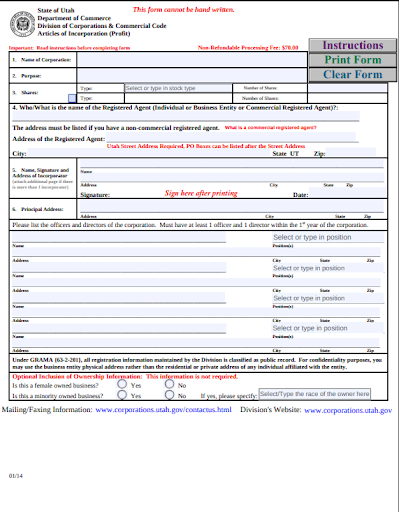
After choosing a corporate name and deciding who will serve as your registered agent, file Articles of Incorporation to officially create the corporation.
You can file online through the Utah Business Registration System, by mail, or in person.
Let's discuss each option:
Option 1: File online through the Utah Business Registration System
Online filing through the Utah Business Registration System is the fastest and most common option. You will need a UtahID to access the system. Create one at login if you don't already have one.
Select "Formations & Registrations," choose the appropriate entity type, enter the required information, provide registered agent details, electronically sign the filing, and pay the $70 filing fee.
Option 2: File by mail
Download the Articles of Incorporation (Profit) form from the DCCC website. Complete the form and mail it with a check or money order for $70 payable to the State of Utah to:
Utah Department of Commerce Division of Corporations and Commercial Code 160 East 300 South P.O. Box 146705 Salt Lake City, UT 84114-6705
Option 3: File in person
In-person filings are accepted at the DCCC's office in Salt Lake City. Bring your completed Articles of Incorporation and payment. The office address is:
Utah Department of Commerce Division of Corporations and Commercial Code 160 East 300 South Salt Lake City, UT 84114
After the DCCC approves your Articles of Incorporation, complete your corporation's internal organization. At the organizational meeting or through written consents, the incorporators or initial directors typically:
Adopt corporate bylaws.
Elect directors (if not already determined).
Appoint officers, such as a president, secretary, and treasurer.
Authorize the issuance of shares and issue initial stock to founders and investors.
Adopt corporate resolutions covering initial business decisions.
Set the corporation's fiscal year.
Authorize opening a corporate bank account.
Need help drafting your Corporate Bylaws? Swyft Filings can simplify the process by preparing and drafting customized Corporate Bylaws. Complete a short questionnaire about your corporation's structure, shareholders, and management. Our specialists draft your Corporate Bylaws and, if needed, a Shareholders' Agreement, ready for review and adoption at your organizational meeting.
After forming your Utah C Corp, apply for an Employer Identification Number (EIN) from the IRS. An EIN is the federal tax ID number used to identify your corporation for tax filings, business banking, and state tax registration. Here are the top reasons your Utah C Corp needs one:
Opening a business bank account.
Hiring employees in Utah or any other state.
Filing federal and Utah corporate franchise and income tax returns.
Registering for Utah tax accounts through the Utah Taxpayer Access Point (TAP).
Applying for a business credit card or loan.
Keeping your personal Social Security number off business contracts.
You can apply for an EIN directly through the IRS website at no cost, or have Swyft Filings file it for you as part of your Utah C Corporation formation package.
After your Utah Articles of Incorporation are approved, complete the corporation's organization by holding an organizational meeting.
If you named initial directors in the Articles, a majority of those directors call the meeting to appoint officers, adopt bylaws, and handle any other opening business. If you did not name initial directors, the incorporator or incorporators call the meeting instead to elect directors, appoint officers, and adopt bylaws.
Either way, Utah law also allows you to skip the live meeting entirely and take all organizational actions through written consents signed by each incorporator, a practical option for solo founders. The meeting can be held inside or outside Utah.
Filing your Articles of Incorporation creates your Utah C Corporation, but staying in good standing requires meeting several ongoing obligations.
Every Utah domestic profit corporation must file an Annual Report/Renewal with the DCCC each year to maintain its active status. The renewal is tied to the corporation's anniversary date, not a fixed calendar deadline.
Here is what you need to know about Utah's annual report:
Due date: One year from the corporation's formation date, and annually thereafter. The DCCC sends a renewal notice to the registered agent approximately 60 days before the anniversary date.
Filing window: The renewal period opens 60 days before the anniversary date.
Fee: $18 for domestic profit corporations
Late fee: $10 additional if filed after the expiration date
Where: Online through the Utah Business Registration System using your UtahID, or by mail with the renewal coupon and payment
What it does: Maintains active status and updates DCCC records with current registered agent, principal office, officer, and director information
Consider using Swyft Filings to file your Utah annual report on your behalf. Our specialists prepare and file the required renewal, and you receive confirmation once the filing is complete.
Open a dedicated business bank account as soon as your EIN is issued. Mixing personal and business funds is one of the fastest ways to weaken the liability protection a C Corp provides. Banks typically request your Articles of Incorporation, EIN confirmation letter, and a corporate resolution identifying who is authorized to open and manage the account.
Whether your corporation needs a license depends on its industry and where it operates. State-level licenses are issued by the relevant Utah regulatory agency for the industry. Local city and county governments may impose their own licensing or permit requirements.
Use Swyft Filings' Utah business license service to identify the specific licenses and permits that apply to your corporation, along with application links and renewal information.
After obtaining your EIN, register for applicable Utah tax accounts through the Utah Taxpayer Access Point (TAP), the Utah State Tax Commission's online portal for tax registration, filing, and payments. Not every Utah C Corp needs every tax account — register only for the accounts that apply to your corporation's activities.
Common Utah tax registrations for a C Corp:
Corporate franchise and income tax: Every Utah C Corp incorporated in Utah, qualified in Utah, or doing business in Utah generally must file a corporate franchise and income tax return using Form TC-20. The 2026 rate is 4.45% with a $100 minimum.
Sales and use tax: If your corporation sells taxable goods or services in Utah, register for a sales and use tax permit through TAP.
Withholding tax: If your corporation hires employees, register for Utah income tax withholding before the first payroll.
Unemployment insurance: Handled separately through the Utah Department of Workforce Services.
The cost of forming a C Corp in Utah depends on required state filing fees and any additional services you choose. Here is a complete breakdown:
| Cost | Fee |
|---|---|
| Articles of Incorporation (non-refundable) | $70 |
| Name Reservation (optional, 120 days) | $22 |
| Annual Report/Renewal | $18/year |
| Annual Report/Renewal Late Fee | +$10 |
| Registration Information Change (outside renewal period) | $17 |
| Utah Corporate Franchise and Income Tax (minimum) | $100/year (tax, not a filing fee) |
| EIN from the IRS | Free |
Starting a Utah C Corp involves Articles of Incorporation, a registered agent, an annual renewal with the DCCC, and corporate franchise tax filings with the State Tax Commission, all of which begin at the moment of formation. Swyft Filings has helped businesses form corporations for free since 2015. Our team understands Utah DCCC requirements and can help you prepare and file your C Corp paperwork accurately and on time.
$0 + State Filing Fees
*Disclaimer: This guide provides general information about forming a C Corp in Utah and is not a substitute for legal, tax, or financial advice.*
C Corp rules, filing costs, and corporate tax structures vary by jurisdiction. Select any state below to view its specific C Corp laws.