Learn how to run a free Utah business entity search, check name availability, and understand why Utah's process looks different from most other states.
Utah does not have a Secretary of State's office handling business filings. Every LLC, corporation, and DBA in the state is registered and searched through the Division of Corporations and Commercial Code instead, which is part of the Department of Commerce. That single difference is why so many searches for a "Utah Secretary of State business search" land people in the wrong place. This guide covers the real tool, how to read what it returns, and the naming rules that decide whether a filing clears.
Key Takeaways
Utah has no Secretary of State for business filings. The Division of Corporations and Commercial Code runs the search, the reservations, and the entity filings instead. [1]
A clear search result is not a guarantee. Utah states directly that a name is only available once the Division gives final approval on a filing. [1]
Utah renews on an anniversary-month cycle, not a fixed date. Your renewal is due by the last day of the month your entity was originally registered. [5]
A Utah DBA is a state filing for everyone, including sole proprietors. Unlike many states, Utah does not push this down to the county level. [3]
A DBA renews every year, the same as an entity. It is a separate filing from your entity's annual renewal, but it runs on the same yearly cadence and the same $18 fee. [4]
Utah Business Entity Search at a Glance
Detail | Information |
Official tool | Business Entity Search, run by the Division of Corporations and Commercial Code. Also called the Utah business entity search, UT business entity search, or Utah business lookup [1] |
Operated by | Utah Department of Commerce, Division of Corporations and Commercial Code. Utah has no Secretary of State for this function [1] |
Cost | Free; no account required to search [1] |
Search by | Business name, entity number, or registered agent name [1] |
Covers | LLCs, corporations (for-profit and nonprofit), limited partnerships, LLPs, DBAs, and qualified foreign entities |
Does not cover | Businesses that never filed anything, and federal trademarks |
Assumed names (DBAs) | Filed with the Division of Corporations at the state level, for every business type [3] |
Contact | Division of Corporations and Commercial Code, 160 East 300 South, Salt Lake City, UT 84111, (801) 530-4849 |
What the Utah Business Database Covers
The Utah business database is the Division of Corporations' public record of every entity and assumed name filed in the state. It confirms an entity's registration, its status, its registered agent, and its principal individuals. It does not track unregistered businesses or federal trademark rights.
What You Will Find:
- Limited liability companies: Domestic and foreign LLCs.
- Corporations: For-profit, professional, and nonprofit corporations.
- Partnerships: Limited partnerships and limited liability partnerships.
- Assumed business names: DBAs registered by any entity or individual, since Utah files these at the state level. [3]
- Foreign entities: Out-of-state companies holding an active registration to conduct business in Utah.
What Is Not in the Database:
- Unregistered sole proprietors: A sole proprietor operating under their own legal name files nothing and appears nowhere in the search.
- Federal trademarks: Utah's search only reflects state filings, never the federal trademark register.
- Business licenses: Utah requires a separate city or county business license in most jurisdictions, which does not appear in this search.
- Tax account numbers: A federal EIN comes from the IRS, and a Utah sales tax license comes from the State Tax Commission. Neither shows up here.
How To Perform a Utah Business Entity Search Step-by-Step
Step 1. Open the Division of Corporations Business Search
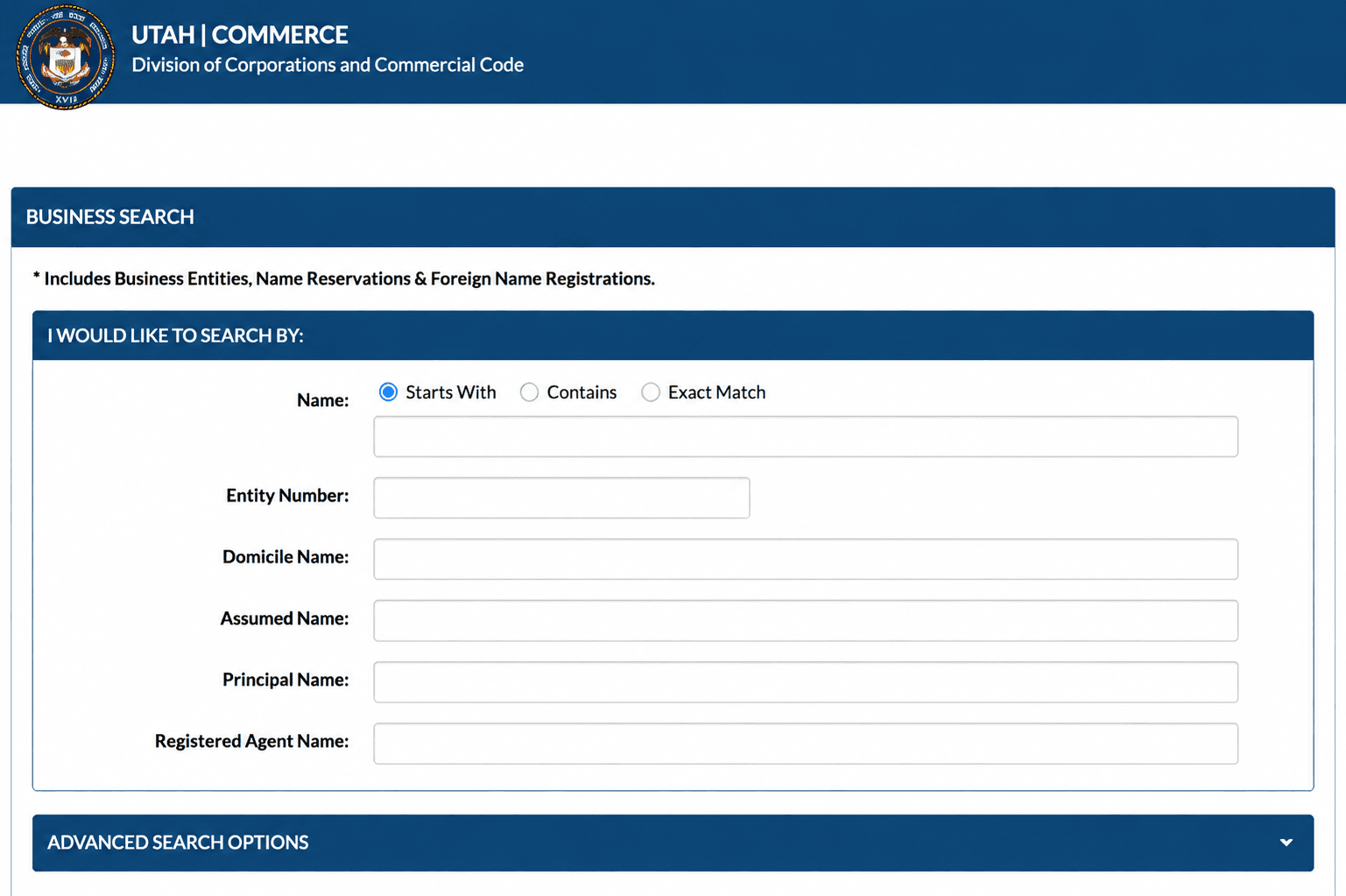
Go to the Division of Corporations Business Entity Search. [1] No account, login, or fee is required to search.
Step 2. Choose How You Are Searching
Utah lets you search by business name, entity number, or registered agent name. Pick the field that matches what you actually know.
- Business name: The default, when you know or can guess the name.
- Entity number: Exact and instant, returning one record with no ambiguity.
- Registered agent name: A reverse lookup that finds every entity one agent represents.
Step 3. Search Broadly Before You Narrow
A precise first search is more likely to miss a real conflict than a broad one.
- Drop the ending: Search "Wasatch Roofing," not "Wasatch Roofing LLC."
- Drop the punctuation: Hyphens, apostrophes, and commas get in the way of a clean match.
- Search fewer words: One distinctive keyword surfaces more conflicts than a full legal name.
- Use the entity number when you have it: It returns exactly one record.
Step 4. Open the Record and Read the Details
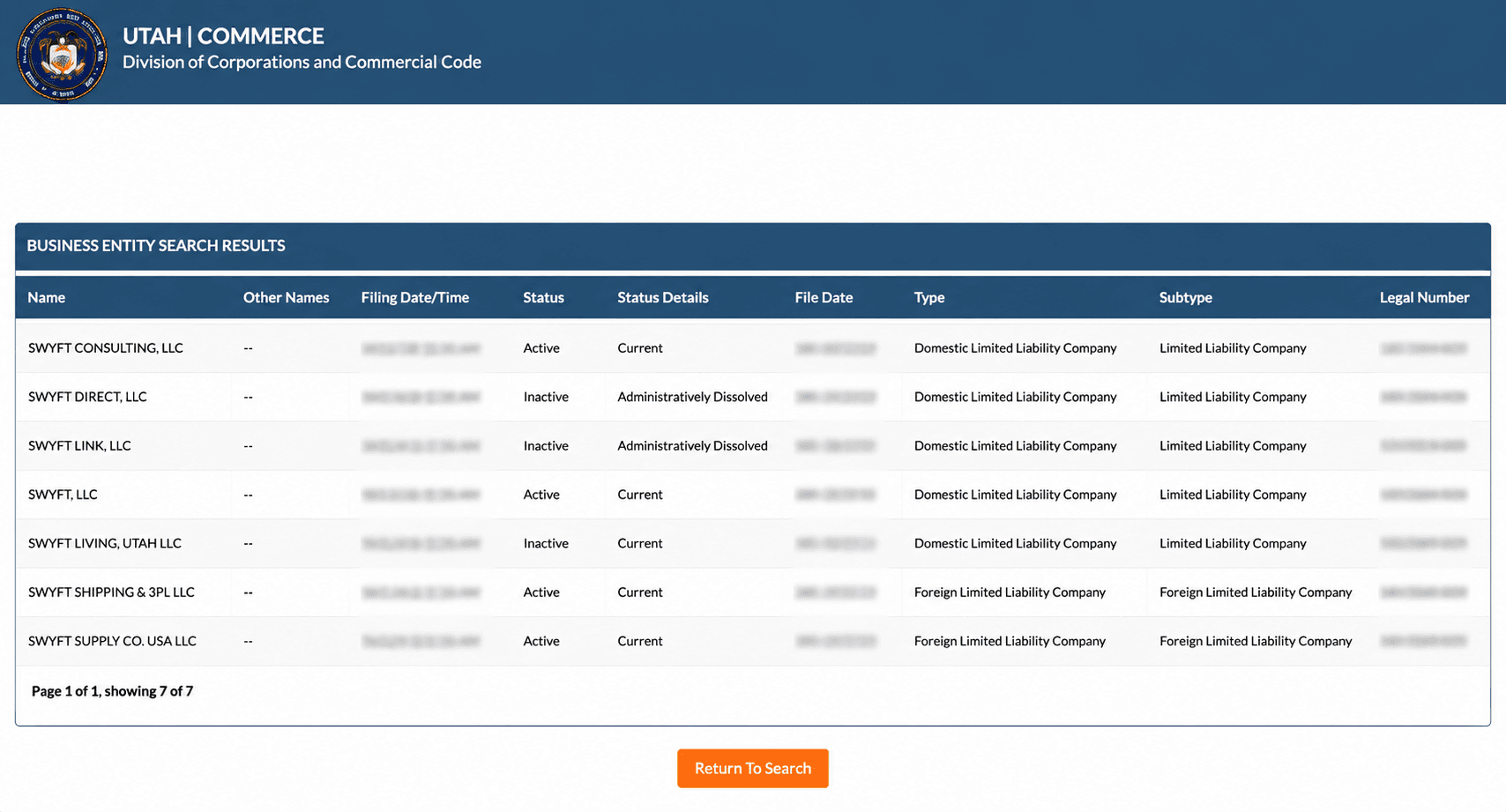
Selecting a result opens the full record: entity type, entity number, status, registration date, registered agent, and principal office address.
Step 5. Confirm the Result Against the Naming Rules
A name that comes back clear in the search still has to pass Utah's distinguishability standard when the Division actually processes a filing. Treat a clear search as a strong signal, not a final answer. [1]
How To Read Your Utah Entity Search Results
Field | What It Tells You | Why It Matters |
Entity name | The exact registered legal name | It should match the name on any contract or invoice |
Entity number | Utah's unique identifier for the entity | Confirms you opened the right record. Save it with the date you checked |
Status | Whether the entity is active, expired, or dissolved | The single most important field on the page |
Entity type | LLC, corporation, nonprofit, LP, or LLP | Sets which filings and naming rules apply |
Registration date | When it was registered in Utah | Check it against the track record the business claims |
Registered agent | Who accepts legal service in Utah | A stale or resigned agent is a compliance signal |
Principal office address | Where the business says it operates | A mail drop or out-of-state address is worth a question |
What Utah Entity Statuses Mean
Utah's status field tells you whether an entity is current on its yearly renewal, not just whether it once existed.
What You See | What It Means | What To Do |
Active | Registered and current on its yearly renewal | Proceed with normal due diligence |
Expired | The renewal was missed and the 30-day grace period has passed | Ask when it will be cured before you rely on the entity |
Administratively Dissolved | The Division dissolved it after continued non-renewal | It cannot conduct normal business until reinstated |
Withdrawn | A foreign entity ended its Utah registration | Confirm where it is currently registered instead |
Why a Utah Status Changes
Utah runs renewals on an anniversary-month system. Your entity's renewal is due by the last day of the calendar month it was originally registered in, every year, for an $18 fee. [5] Miss it, and the entity is marked Expired after a 30-day grace period. A $10 late fee applies at that point, and administrative dissolution proceedings begin around 60 days past due. Reinstating an LLC or corporation after dissolution costs $54. [4]
Renewals are filed online through the Division's Business Registration system and currently take 7 to 10 business days to process. [5] Because the deadline is tied to each entity's own registration month, two companies formed the same week can still land on different renewal months.
Utah Business Name Search vs. Federal Trademark Search
Clearing Utah's business search protects the name at the state level only. It says nothing about federal trademark rights. Utah checks a proposed name against other Utah filings alone, so a name can be fully distinguishable in Utah and still infringe a mark that a business in another state registered years ago with the USPTO.
Run both searches if the brand matters beyond Utah's borders: the Division's Business Entity Search for state-level distinguishability, and the USPTO trademark database for a name that could be used or defended nationwide.
Why Utah Business Name Applications Get Rejected?
A name can pass an initial search and still get rejected when the actual filing is reviewed. Utah's distinguishability standard is stricter than most people expect. [2]
Common reasons a name gets flagged as too similar:
- The only difference is the entity designator. Swapping "LLC" for "Inc." does not make two otherwise identical names distinguishable.
- The only difference is punctuation or spacing. A hyphen, apostrophe, or extra space is not enough on its own.
- The only difference is capitalization. Utah's records do not treat capitalization as distinguishing.
- A word was dropped that Utah considers non-distinctive. Words like "the," "a," or "group" often do not carry enough weight to separate two names.
What generally clears the bar is a genuinely different core word, a materially different combination of words, or a meaningful change such as a singular name becoming plural. If a filing comes back rejected, open the conflicting record in the Business Entity Search and compare it directly.
How To Check if a Business Name Is Available in Utah
- Search the full proposed name in the Division's Business Entity Search first, exactly as you plan to file it. [1]
- Search again using only the single most distinctive word, dropping the entity designator.
- Search once more without punctuation, since Utah's comparison ignores it.
- Open any close match and read its full status before assuming it is a real conflict.
- Search the federal trademark register separately, since Utah's search does not cover it.
A clear result is preliminary. The Division makes the final call only when it processes and approves the actual filing. [1]
Still deciding what to call the business? The free Swyft Filings business name generator is a sensible first stop before you pay a reservation fee.
Utah Business Naming Rules and Restricted Words
Utah requires every name to be distinguishable from names already on file, and each entity type carries its own required designator. [2]
Required Designators by Entity Type
Entity Type | The Name Must Contain |
Limited liability company | "Limited Liability Company," "Limited Company," LLC, or L.C. |
Corporation | "Incorporated," "Corporation," "Company," or a matching abbreviation |
Limited partnership | "Limited Partnership" or LP |
Limited liability partnership | "Registered Limited Liability Partnership" or LLP |
Words That Need Approval or Are Restricted
- Financial and professional terms: Banking-related words require written consent from the appropriate regulator before they can be used.
- Educational terms: Words like university and college require written consent from the relevant accrediting or licensing body.
- Olympic-related terms: The word Olympic is federally restricted and carries extra weight in Utah given the state's Olympic history.
- Government-implying wording: A name cannot suggest affiliation with a government agency without documentation proving that affiliation.
A clear search is not the same as approval. Availability is only settled once the Division processes and accepts the filing itself. [2]
How To Reserve a Business Name in Utah Without Filing LLC Papers
If you are not ready to form your LLC or corporation yet, you can hold the name on its own first.
Detail | Information |
Filing | Name reservation, filed with the Division of Corporations [4] |
Fee | $22, nonrefundable [4] |
Term | 120 days from the date it is filed |
What it does | Holds the name so no one else can register it while you prepare your formation documents |
- Confirm the name is clear in the Division's Business Entity Search first.
- File the name reservation online through the Business Registration system.
- Pay the $22 fee.
- File your formation document, or your DBA, within the 120-day hold to lock the name in.
A reservation does not create an entity or register a DBA. It only blocks other filers for 120 days. If your formation paperwork is already ready, you can skip the reservation and file directly instead.
Difference Between a Utah DBA and a Registered Business Name
These two filings sound similar and do very different things, so it helps to keep them separate from the start.
Registered Business Name (Entity) | DBA (Assumed Business Name) | |
What it creates | A legal entity, such as an LLC or corporation | A nickname an existing entity or individual can trade under |
Legal protection | Structural liability protection, for LLCs and corporations | None. It only records a name publicly |
Who files it | The business owner forming the entity | Any entity, or an individual sole proprietor, that wants to trade under a different name |
Initial filing fee | $22 to $70 depending on entity type | $22 [4] |
Renewal cycle | Every year, on the entity's anniversary month, for $18 | Every year, for $18, as its own separate filing [4] |
A DBA never creates liability protection on its own. A sole proprietor who files a Utah DBA is still personally liable for the business. The filing only gives the public a name to search against, which is exactly why it belongs in this database at all. [3]
Swyft Filings can handle your Utah DBA registration alongside your entity formation.
Utah Division of Corporations Online Filing System
Every Utah business filing, including the search, reservations, DBAs, entity formation, and annual renewals, runs through the same Division of Corporations online system at businessregistration.utah.gov. Knowing the layout before you log in saves time.
- Business Entity Search: The free public lookup. [1]
- Form a New Business: Covers LLCs, corporations, partnerships, business trusts, and DBAs from a single starting point.
- Renew a Business: The annual report and renewal filing, also handled from the same account.
- Update an Existing Business: Amendments, dissolutions, reinstatements, conversions, and registered agent changes all run through this same system rather than separate forms.
Most filings are processed instantly. Anything that requires manual review takes 2 to 4 business days, and a renewal specifically takes 7 to 10 business days. [5] Creating a single account before you need it means your reservation, your formation filing, and your first renewal all live in one place.
Checking Domain Name Availability for Utah Registered Businesses
Clearing the Division's Business Entity Search confirms Utah will accept the name on a filing. It says nothing about whether the name works as a brand online.
- Check the domain in the same sitting. A parked or already-listed .com is effectively unavailable, even if the entity name is completely clear.
- Check the handles you actually intend to use. A consistent name across your site and your social profiles is what makes a new business findable.
- Do this before you reserve, not after. Losing the domain after paying a $22 reservation fee means starting the naming process over.
Utah Business Name Search for Foreign Entities Registering In-State
An LLC or corporation formed in another state cannot operate in Utah under its home-state paperwork alone. It has to register as a foreign entity first, and the name search is the first step.
- Run the Division's Business Entity Search on your existing legal name before filing anything. [1]
- If the name is taken in Utah, plan to register under an alternate name for use in the state.
- Request a Certificate of Existence, or Certificate of Good Standing, from your home state.
- File a foreign registration for your entity type with the Division of Corporations. [4]
- Appoint a Utah registered agent with a physical street address.
The filing fee is $59 for a foreign LLC or for-profit or nonprofit corporation, and $70 for a foreign LLP or limited partnership. [4] The entity then follows the same $18 anniversary-month renewal every year as a domestic entity.
Swyft Filings can handle your Utah foreign qualification, so the paperwork and the deadline are not yours to manage.
Utah Business Name Search Fees and Renewal Requirements
Searching is always free. These are the costs attached to holding, registering, and renewing a name in Utah, taken directly from the Division's current fee schedule. [4]
Service | Fee | Notes |
Utah business entity search | Free | No account needed [1] |
Business name reservation | $22 | Holds the name 120 days, nonrefundable |
DBA registration | $22 | Initial filing |
DBA renewal | $18 | Filed every year, as its own separate filing |
Step-by-Step Business Name Search Checklist for a New Utah LLC Owner
If this is your first Utah filing, work through this list in order.
- Write down two or three name candidates before you search anything.
- Run each candidate through the Division's Business Entity Search.
- Drop the entity designator and search the distinctive word alone to widen the net.
- Compare any close match directly rather than assuming a search result is final.
- Check the domain and the social handles you actually intend to use.
- Search the USPTO trademark database separately if the brand matters beyond Utah.
- Reserve the winning name for $22 if you are not ready to file immediately.
- File your LLC formation document, or your DBA, before the 120-day reservation expires.
How To Verify a Utah Company Before You Deal With It
- Search the exact legal name printed on the contract or invoice, not the brand name on the sign.
- Confirm the status reads Active rather than Expired or Administratively Dissolved.
- Save the entity number, the status, and the date you checked.
- Check the registration date against the years of experience the business claims.
- Read the registered agent and confirm the address is a real Utah street address.
- Check whether the brand name shown to you appears as a registered DBA of the entity.
Red Flags Worth a Second Look
- A company using LLC or Inc. in its name with no Utah record at all.
- An Expired or Administratively Dissolved status behind a business presenting itself as fully compliant.
- A brand name that does not appear as a registered DBA of the entity you found.
- A registered agent address that is only a mail drop, or an agent who has resigned.
Let Us File Your Utah Business
Once your search confirms a name is clear, filing is the step that follows. Swyft Filings has helped more than 600,000 businesses get started since 2015. We handle Utah LLC formation, C Corp and nonprofit filings, registered agent service, DBA registration, annual renewal filing, and foreign qualification, so no deadline is yours to track.
Bibliography
- Utah Division of Corporations and Commercial Code. Business Entity Search. Accessed August 13, 2026.
- Utah Division of Corporations and Commercial Code. Business Name Information. Accessed August 13, 2026.
- Utah Division of Corporations and Commercial Code. DBA / Assumed Business Name. Accessed August 13, 2026.
- Utah Division of Corporations and Commercial Code. Fiscal Year 2026 Fee Schedule. Effective July 1, 2025. Accessed August 13, 2026.
- Utah Division of Corporations and Commercial Code. Annual Report/Renewal Guide. Accessed August 13, 2026.
FAQs
It is the Division of Corporations and Commercial Code's free public database covering every LLC, corporation, partnership, and DBA on file in the state. Utah has no Secretary of State handling this function.[1]
Use the same Business Entity Search tool, entering the business name or entity number. Results show the status, entity type, registered agent, and principal address.[1]
Search the full name, then the single most distinctive word alone, then again without punctuation. A clear result is preliminary until the Division approves your actual filing.[1]
$22, holding the name for 120 days. It is optional, so you can skip it and file your formation document directly if your paperwork is ready.[4]
Yes. Expired and administratively dissolved entities remain in the database with their status shown, which is often the most useful signal in the whole record.