To form a C Corporation in Minnesota, you file Articles of Incorporation with the Minnesota Secretary of State. Swyft Filings prepares and files that paperwork at a $0 service fee, so you only pay a $135 state fee if you file by mail or $155 online.Need more C Corporation formation support in Minnesota? Upgrade to our premium formation package to include custom bylaws, set up your stock authorization, connect you with a business attorney, and provide a registered agent as an add-on.
Starting a C Corp in Minnesota begins with choosing a name that is clear in the Secretary of State's records. The next step is to decide who will be your registered agent. When that's done, you will configure your share structure and then file your Articles of Incorporation. Once your approvals come through, you can put your bylaws in writing. After this, it's time to hold your first organizational meeting. You will also need to get an EIN from the IRS.
Your C Corporation formation is not yet complete; you will need to apply for relevant business licenses and permits and open your business bank account. Your yearly responsibilities include filing your Minnesota franchise tax and filing an annual report.
If you do not know how to prepare and file your paperwork yourself, you can use Swyft Filings' basic formation package to form your Minnesota C Corp at no service cost.
Our other formation packages (Standard and Premium) include additional filing perks you will need to form your corporation in Minnesota:
A free domain name and a done-for-you website
Document review by a business attorney
Corporate bylaws preparation
Stock authorization and setup
Privacy protection with a professional business address
Initial corporate resolutions
Business banking essentials
If you want to know what C Corp filing includes, we have written the complete process in the steps below. Keep reading for more detail.
Step 1: Choose a Business Name for Your Minnesota C Corp
Your business name goes on the filing documents, so it needs to be distinguishable from other business names already operating or reserved in Minnesota under Minnesota Statutes § 302A.115.
Minnesota naming rules for a C Corp:
The name must contain a corporate designator such as "Corporation," "Incorporated," "Company," or an abbreviation of one of those terms, under Minnesota Statutes § 302A.115, subd. 1(b).
The name can't use language reserved for a different entity type, so terms like "Limited Liability Company" or "LLC" are off the table for a corporation.
Professional corporations organized under Chapter 319B (law, medicine, accounting, and similar licensed fields) must add "Professional Corporation," "P.A.," or the matching designator for that profession.
If you're still deciding on a name, run a few options through our business name generator to get a shortlist fast.
Minnesota considers the following to distinguish one business from another: use of Roman numerals, contractions, abbreviations, elimination of prepositions, plural forms of words, etc. A name that reads as unique to you can still get flagged over spacing, punctuation, or an abbreviation the system treats as identical.
If you are not ready to file a name yet, you can hold it for up to 12 months. It is done by submitting a Name Reservation under Minnesota Statutes § 302A.117, for $35 by mail or $55 online or in person, with the option to renew before it expires.
If you plan to operate under a name other than the one on your Articles of Incorporation, file a Certificate of Assumed Name with the Minnesota Secretary of State under Minnesota Statutes Chapter 333, for $30 by mail or $50 online or in person. Minnesota adds a step most states have dropped: after the state files your certificate, you still have to publish it in a qualified legal newspaper in the county where your principal or registered office sits, for two consecutive issues, and keep the newspaper's affidavit of publication with your records. If you skip the publication step, your assumed name filing will be incomplete even though the state has already accepted it.
Yes. Minnesota doesn't cap the number of assumed names a corporation can hold. Each one needs its own Certificate of Assumed Name, its own $30 or $50 filing fee, and its own newspaper publication in the county where the filing is made. Run each DBA through the same distinguishability check as your legal name before you file, since an assumed name that collides with another registered business gets rejected the same way a corporate name would.
You lose that exact domain unless you buy it back from whoever registered it, which can cost far more than the $10 to $20 a year a fresh registration runs. Register your domain in the same week you file, before you announce the name publicly. If you go with our ‘Standard’ or ‘Premium’ formation package, your first year of domain registration is included, so this isn't a separate task to remember.
Yes, as long as neither one holds a trademark on it. Minnesota's distinguishability check under Section 302A.115 only compares your name against other entities already on file in Minnesota, not against every corporation nationwide. A company using the same name in Texas can coexist with yours in Minnesota with no issue, right up until one of you registers a trademark. A federal trademark through the USPTO blocks a confusingly similar name in any state where the goods or services overlap, so if you plan to sell outside Minnesota, a name that's clear at the state level isn't automatically clear at the trademark level.
Step 2: Appoint a Minnesota Registered Agent
Minnesota works differently here than most states. Every corporation must maintain a registered office in Minnesota, but appointing a registered agent is optional for domestic corporations, under Minnesota Statutes § 302A.121.
Even without a named agent, your registered office still has to be a real Minnesota street address (a P.O. box alone doesn't qualify) that can receive service of process and state mail.
Most founders name an agent anyway, since it gives the state and any process server a specific person to contact rather than just an address.
If you do appoint a registered agent, list the agent's name and Minnesota street address on your Articles of Incorporation, and keep that information current under Minnesota Statutes § 302A.123.
Any individual Minnesota resident who's willing to accept the role can serve, including yourself, a co-founder, or an employee. A business entity can also serve as your agent as long as it's authorized to transact business in Minnesota. There's no age or citizenship requirement in the statute, but whoever you name must be reachable at the registered office during normal business hours to actually do the job.
Naming yourself or another person at your business address costs nothing beyond the time it takes to update your filing if that person ever changes. Professional registered agent services in Minnesota have different package rates. Swyft Filings charges $149 per quarter for registered agent service. That covers a dedicated registered office address in Minnesota to receive official state mail and legal notices, plus secure document uploads to your account, which is typically available on your dashboard within a few hours.
Since Minnesota doesn't require a registered agent for domestic corporations, going without an agent doesn't put you out of compliance on its own. It does mean legal documents and service of process can be delivered directly to an officer of the corporation. If nobody can be reached, it will be delivered to the Secretary of State as the state's fallback recipient under Minnesota Statutes § 302A.901. That's a slower, riskier path than having a specific agent watching for mail, since a lawsuit notice sitting at the Secretary of State's office doesn't fully guarantee you'll see it before a default deadline passes.
Registered agent fees are generally deductible as an ordinary business expense on your corporation's federal and Minnesota tax returns, the same way you'd deduct any other vendor cost tied to running the business. Keep the invoice from your registered agent service with your corporate records for your accountant, and confirm the specifics with a tax professional since deductibility can depend on how your corporation is structured.
Step 3: Configure Your Share Structure
You need to state your authorized share count on your Articles of Incorporation, so configure your shares before you file.
Steps to set up your share structure:
Decide how many shares to authorize
Choose par value or no-par value
Choose your share classes
Assign voting rights and board appointment rights
Document the share structure in the Articles of Incorporation and the corporation's internal records and agreements, as applicable
Yes, but it takes an amendment. Increasing your authorized shares, adding a new class, or changing voting rights requires filing Articles of Amendment with the Minnesota Secretary of State. It costs $35 by mail or $55 online. You will need the required corporate approvals, which can include board and shareholder approval depending on the type of amendment. Build in more room than you think you need at formation, since an amendment mid-negotiation with an investor slows down a round that's otherwise ready to close.
Work backward from three groups: Your founders' initial ownership, an option pool for future employees (commonly 10% to 20% of the total), and room for at least one investor round without needing an amendment. A common starting point for an early-stage Minnesota C Corp is somewhere between 1 million and 10 million authorized shares at a low par value, split across those three buckets. The exact number matters less than making sure you've genuinely accounted for all three before you file, since authorizing too few almost always means amending later at a less convenient moment.
Step 4: File Your Minnesota Articles of Incorporation
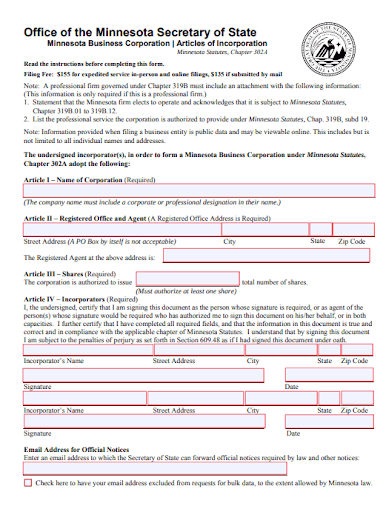
Minnesota's Articles of Incorporation are the document that legally creates your corporation and is filed with the Secretary of State under Chapter 302A. The fee is $135 by mail or $155 online or in person.
By mail: Send your completed Articles of Incorporation form and payment to Minnesota Secretary of State, Business Services, 60 Empire Drive, Suite 100, Saint Paul, MN 55103. Mail filings typically take 5 to 7 business days.
In person: File at the same Business Services address for expedited, while-you-wait processing.
What information you'll need to file articles of incorporation in Minnesota
Corporation name: It must include "Incorporated," "Corporation," "Limited," or "Company" (or an abbreviation)
Registered office address: A physical Minnesota street address (no P.O. boxes)
Registered agent name (optional): If you have one, list their name at the registered office address
Number of authorized shares: At least one share
Incorporator information: Name, address, and signature for each incorporator (at least one required, must be 18 or older)
Contact person: Name and daytime phone number for questions about the filing
Email address (optional): For official notices and annual renewal reminders
Professional service details (only for professional firms): A statement electing Chapter 319B status, plus the specific professional service authorized
The Secretary of State returns the filing with a note explaining the defect, usually a name conflict, a missing required field, or an unsigned document. You fix the specific issue and resubmit. A rejection doesn't cost you the filing fee twice in most cases, but it does reset your place in the processing queue. A name that hasn't been properly checked against the Minnesota Business Search beforehand is the single most common way founders lose a week they didn't need to lose. A formation service helps you avoid such filing errors, increasing chances of approval the first time you file.
Not retroactively. Minnesota lets you specify a delayed effective date on the Articles themselves when you file, up to 90 days out, which is useful if you want your corporation to begin on a specific date, like January 1, for tax purposes. Once the Articles are filed and that date has passed, changing when the corporation legally came into existence isn't something an amendment can undo. So, decide the effective date before you submit, not after.
The incorporator is the person who signs and files the Articles of Incorporation. It is a one-time role that exists to get the corporation legally formed. A director sits on the ongoing board that governs the company after formation, making decisions about officers, major transactions, and corporate policy. One person can be both, and in a solo-founder Minnesota C Corp, that's usually exactly what happens. The distinction matters mainly on paper: your incorporator's job ends once the Articles are accepted, while your directors' responsibilities continue for as long as they hold the seat.
A certified copy is an approved copy of filing documents. You can order one directly from the Minnesota Secretary of State's business copy and certification service, or have your formation service obtain a certified copy for you. You will need a certified copy to register as a foreign corporation elsewhere or open a business bank account, so it's worth ordering one as soon as your Articles are approved rather than applying and waiting for it later.
Step 5: Create Corporate Bylaws
Bylaws are your corporation's internal rulebook. Minnesota doesn't require you to file them with the state, but you need them in place before your organizational meeting, since adopting the bylaws is typically the first item on that meeting's agenda.
What must be included in bylaws:
Corporate name, principal address, and fiscal year
Board and officer roles, including signing authority
Shareholder voting rights and meeting procedures
Stock classes and their attached rights
The vote threshold required for major decisions
Process for transferring or selling shares
Corporation dissolution process
Write your own using the checklist above, or use a corporate bylaws service, which builds a set tailored to your actual share structure rather than handing you a generic template.
Keep bylaws focused on governance, not day-to-day operations. Leave out individual employment terms like: Specific salaries or benefits The fine print of an individual stock purchase agreement Confidential business information such as trade secrets Anything that conflicts with Minnesota law or your own Articles of Incorporation Those details belong in separate contracts or internal policies you can update without touching your core governance document every time something changes.
The corporation still legally exists, since bylaws aren't a filing requirement. What you lose is a documented process for how decisions actually get made, which matters most the first time there's a disagreement between shareholders or directors, and nobody can point to an agreed-upon procedure. If the corporation is ever sued and a creditor argues the business wasn't run as a genuinely separate entity from its owners, missing bylaws are one more piece of evidence a court can use to pierce the corporate veil and hold shareholders personally liable.
Not by statute, but they do need to be formally adopted, typically by a board resolution recorded in your organizational meeting minutes. Many corporations still have the initial directors sign the adopted bylaws or the resolution approving them, since a signature makes it easier to prove adoption actually happened if that's ever questioned later. Keep whatever version you adopt, signed or not, with your permanent corporate records.
Bylaws aren't filed with the Minnesota Secretary of State, so they're not part of the public record the way your Articles of Incorporation are. They live with the corporation's own internal records, usually alongside meeting minutes and the stock ledger. If you're a shareholder of a Minnesota corporation and need a copy, request it directly from the company, since Minnesota corporate law generally gives shareholders the right to inspect corporate records, including bylaws, during regular business hours with reasonable notice.
Step 6: Hold an Organizational Meeting
Once the state approves your Articles of Incorporation, your initial directors, or the incorporators if directors weren't named on the Articles, hold the corporation's first official meeting. At this meeting, you'll typically:
Adopt the corporate bylaws
Elect officers, most commonly a president, secretary, and treasurer
Issue the initial shares of stock based on the structure from Step 3
Set the corporation's fiscal year
Authorize whoever will open the corporate bank account to do so
Record formal minutes of this meeting and keep them with your corporate records. Nobody files these with the state, but they're often the clearest evidence that your corporation follows real formalities rather than existing only on paper, which matters if your liability protection is ever tested.
Yes. Minnesota doesn't require the organizational meeting to happen in a physical room, and a video call or conference call satisfies the requirement as long as everyone entitled to participate can hear and be heard. Record the same minutes you would for an in-person meeting, noting the date, who attended, and what was decided, since the format doesn't change what needs to be documented.
Your corporation still legally exists, since holding this meeting isn't itself a filing requirement checked by the Secretary of State. Without it, you don't formally adopt your bylaws, issue your initial shares, or elect your officers. It means the corporation technically has no bylaws in force and no stock actually issued to anyone. Most founders who skip this step end up doing it later anyway, once a bank or investor asks for board resolutions or a stock ledger that was never created.
If you're the sole incorporator, director, and shareholder, you can hold this meeting by yourself and document it through a signed action in lieu of a meeting rather than an actual gathering. Minnesota law generally allows directors and incorporators to act by unanimous written consent instead of convening in person, which is the standard approach for a solo founder. You still need to produce and keep the same documents: the adopted bylaws, the stock issuance record, and the officer appointments, even though there's no one else in the room.
Step 7: File for an EIN
Once the state approves your Minnesota Articles of Incorporation, apply for an Employer Identification Number. It's a nine-digit federal tax ID the IRS uses to identify your corporation, separate from your own Social Security number, for tax filings and everyday business transactions.
Here's why your Minnesota C Corp needs one:
Opening a business bank account
Hiring employees in Minnesota or any other state
Filing your federal corporate tax return and registering with the Minnesota Department of Revenue for franchise tax
Registering for a Minnesota sales tax account if you sell taxable goods or services
Applying for a business credit card or a business loan
Keeping your personal Social Security number off business contracts and vendor forms
Apply directly through the IRS website at no cost, which takes about 15 minutes. You'll need your business name, mailing address, entity details, and a reason for applying. If you don't have an SSN or ITIN, you can still apply by mailing or faxing Form SS-4.
You don't need a new EIN for most errors. Send a letter to the IRS explaining the correction, whether it's a misspelled business name, wrong address, or incorrect entity information, along with your EIN and a copy of the confirmation notice you received. The IRS updates its records without reissuing the number, since the EIN itself is tied to the legal entity, not to any specific field on the original application.
Generally yes, if the conversion changes the entity's legal structure at the federal level, such as converting a C Corp into a partnership or a sole proprietorship. Converting from a C Corp to an S Corp is different, since that's a tax election filed on Form 2553 rather than a change in legal entity, so the existing EIN stays valid. Check the IRS's current rules for your specific conversion before assuming either way, since the answer depends on exactly what you're converting into.
What Are the Post-Formation Requirements for a Minnesota C Corp?
Filing your Articles of Incorporation creates your Minnesota C Corp, but a few ongoing requirements keep it in good standing.
Open a Business Bank Account:
To open your business bank account in Minnesota, bring your Articles of Incorporation, your adopted bylaws, and your EIN confirmation letter to the bank.
Once you form a separate business bank account, make sure you pay all business-related expenses from this account. Keeping business funds separate from personal accounts is one of the clearest habits that supports your liability protection.
Obtain Necessary Business Licenses and Permits:
Minnesota doesn't issue one general statewide business license. What you actually need depends on your industry and city; most commonly, a local business license from your city or county, a sales tax permit if you sell taxable goods or services, and a professional license if you're in a regulated field like healthcare, construction, or cosmetology.
Knowing which license and permit to file for your business takes a lot of research. You can use our business license research service to sort out what's actually required for your specific business and where and how you can apply for it.
Register for Minnesota Corporate Franchise Tax:
Minnesota taxes C Corp net income at a flat 9.8% rate through the Corporation Franchise Tax, filed on Form M4 with the Minnesota Department of Revenue. This is separate from and in addition to your federal corporate tax. For a calendar-year corporation, the return is generally due April 15, with an automatic extension to October 15 for filing, though any tax owed is still due on the original date.
File Your Minnesota Annual Renewal:
This is a separate filing from your franchise tax return, and it's free for domestic corporations. Under Minnesota Statutes § 302A.821, every Minnesota corporation must renew by December 31 each year to confirm its officer, registered office, and address information. Failure to file required renewals may eventually lead to administrative dissolution. Reinstatement costs $25 by mail or $45 online or in person. Our annual report service can track and file this for you every year.
Register for Sales Tax, If Applicable:
If your C Corp sells taxable goods or services, register with the Minnesota Department of Revenue before making taxable sales. Minnesota's state sales tax rate is 6.875%, with local rates that push the average combined rate to around 8.14% depending on where you're located.
How Much Does It Cost to Incorporate a C Corp in Minnesota?
Item
Cost
Articles of Incorporation (mail)
$135
Articles of Incorporation (online or in person)
$155
Name Reservation, up to 12 months (mail / online)
$35 / $55
Certificate of Assumed Name / DBA (mail / online)
$30 / $50
Annual Renewal
$0
EIN (IRS)
$0
Need Help With Your C Corp Formation in Minnesota?
Starting a Minnesota C Corp involves paperwork and ongoing requirements that can get complicated fast, from setting up your share structure to keeping up with the state's December 31 renewal deadline. Swyft Filings has helped 600,000+ businesses with corporation formation and compliance since 2015. Our team of business formation specialists understands Minnesota Secretary of State requirements and can help you prepare and file your C Corp paperwork accurately.
Starting a Minnesota C Corp means filing Articles of Incorporation, appointing a registered agent, and staying current with the annual renewal. Swyft Filings has been helping businesses form and stay compliant since 2015. Our team knows the Minnesota Secretary of State requirements and can file your C Corp quickly, accurately, and in full compliance.
There's no cap on how many shareholders a Minnesota C Corp can have, so the real question is what you'll need. Cover your founders, leave room for an employee option pool, and account for at least one investor round, since authorizing too few now usually means amending your Articles later.
Not urgently, but draft one anyway if you expect to bring on co-founders, employees, or investors later. Setting the rules while you're the only person affected is simpler than negotiating them once other people hold shares.
No. Salary applies to shareholders who actively work in the business and are treated as employees for that work. A shareholder who isn't employed by the corporation can hold shares and receive dividends without ever drawing a salary, though anyone doing substantial work for the company is generally expected to be paid reasonable compensation for it rather than taking everything as dividends.
The corporation pays Minnesota's 9.8% franchise tax and federal corporate tax on its profits first. Then, if any of those already-taxed profits get distributed to shareholders as dividends, shareholders pay personal income tax on that money again.
Our free filing service covers preparing and filing your Articles of Incorporation, the document that legally creates your corporation. It doesn't cover everything else that goes into running one, so you'll still need bylaws, a decision on a registered agent, and likely an attorney conversation along the way. You can handle those yourself, or upgrade to one of our paid packages and we'll take care of them for you.
Processing time depends on how you file. Online filings through the Secretary of State's Business Filings Online portal usually process in about 24 hours. Mail filings take 5 to 7 business days from the date the state receives your paperwork. In-person filings at the Business Services office in Saint Paul are processed the same day, while you wait.
Yes. Filing in person at the Secretary of State's Business Services office gives you same-day, while-you-wait processing for $155. Filing online also moves faster than mail, with approval in about 24 hours for the same $155 fee. Mail filings are the slowest option at 5 to 7 business days, so choose online or in-person filing if timing matters for your launch.