
Initial Setup
Compliance
Changes & Filings
Resolve
Protect & Legal
Learn
Excellent
7,984 reviews

Georgia's incorporation process follows a predictable sequence, with one quirk most other states don't have, i.e., a newspaper publication requirement. You will settle on a compliant Georgia C Corp name, line up a registered agent, decide your share structure, file your Georgia Articles of Incorporation, publish your notice of intent, put bylaws in place, hold an organizational meeting, and finish with an EIN.
Here's what each step involves in detail:
To start a Georgia C Corp, you need to select a compliant name first. Georgia's naming rules for corporations are set forth in O.C.G.A. § 14-2-401 and consist of a few core requirements and restrictions for corporate names in the state of Georgia. Let’s have a look at each Georgia C Corporation naming rule:
1. Include a Corporate Designator: Your C Corp name in Georgia must contain the word "Corporation," "Incorporated," "Company," or "Limited," or an accepted abbreviation ("Corp.," "Inc.," "Co.," "Ltd.").
2. Character Limits and allowed characters: Georgia C Corp total name length, including punctuation and spaces, generally can't exceed 80 characters. It must use only English letters, Arabic numerals, Roman numerals, and standard keyboard symbols/special characters.
3. Be Distinguishable on the State's Records: Your Georgia C Corp name has to be distinguishable upon the records of the Secretary of State from every other registered domestic and foreign business entity, including LLCs, limited partnerships, and all.
4. Avoid Implying an Unauthorized Purpose: The chosen Georgia C Corp name can't suggest your corporation is organized for a purpose different from what's stated in your Articles of Incorporation and allowed by Georgia law.
5. No Use of Restricted Words Without Approval: Certain words associated with regulated industries, such as “Bank,” "Trust," "Credit Union," or "Insurance," may require approval from the appropriate state agency.
Once you have finalized the name for your C Corporation in Georgia, write it down. If you need additional name suggestions, use Swyft Filings' free business name generator. Once done, use the Georgia Corporations Division business search to confirm that your preferred name is available.
To reserve a C corporation business name in Georgia, file a name reservation request either online or by mail.
File Online: Go to the Georgia Secretary of State ECorp Portal, create an account, select "name reservation," and pay the $25 fee by credit card. Processing takes about 7 business days.
File by Mail: Download and complete the Georgia Name Reservation PDF Form, then mail it with a $35 check or money order (covering the $25 filing fee and $10 service charge) to the Georgia Secretary of State. Processing takes about 15 business days.
Under Georgia Code § 14-2-501, every Georgia corporation must continuously maintain both a registered office and a registered agent in the state. These requirements ensure that the corporation has a reliable location and a designated person or business available to receive legal and official documents on its behalf.
The requirements for a registered agent for a C corp in Georgia include:
Physical Address in Georgia: Your Georgia registered agent must have a physical street address in Georgia (also called a registered office). A P.O. box alone doesn't satisfy this.
Age Eligibility: At least 18 years old.
Availability During Business Hours: The registered agent needs to be reachable at that address to accept legal and state documents as they arrive.
Ongoing Requirement: Georgia law requires the corporation to maintain a registered agent at all times. It's not a one-time formation step.
The registered agent and registered office give the state and the public a reliable way to contact your C corporation about official matters. If your registered agent or office changes, you should update the information with the state to avoid missing important legal notices or creating compliance issues.
If you don’t want to serve as your own registered agent or don’t have someone you trust who meets the requirements, you can also choose a professional service, such as Swyft Filings’ registered agent service, to handle these responsibilities for your corporation.
Yes, if you have a physical Georgia street address and can reliably be present during normal business hours to accept documents.
However, the corporation itself cannot serve as its own registered agent. If you don't live in Georgia, don't have a suitable Georgia address, or simply don't want to receive legal documents at your personal or business address, you can appoint another eligible individual or hire a professional Swyft Filings registered agent service instead.
A Georgia C Corp must continuously maintain a registered agent and registered office in the state. If the corporation fails to maintain a valid Georgia-registered agent for the C Corp, it may fall out of compliance and eventually face administrative dissolution by the Georgia Secretary of State.
It can also create problems with receiving legal documents. For example, if the corporation is sued and no valid agent is available to receive service of process, the company could miss important notices and potentially fail to respond within the required time.
Georgia law allows several types of individuals and entities to serve as a corporation’s registered agent:
An individual resident of Georgia: Your registered agent can be an individual Georgia resident, including you, a family member, an employee, or a friend.
A Georgia business entity: A domestic corporation, nonprofit corporation, or LLC authorized to transact business in Georgia can serve as a registered agent.
A foreign business entity authorized to operate in Georgia: An out-of-state corporation, nonprofit, or LLC that is properly authorized to conduct business in Georgia may also serve as a registered agent.
Professional registered agent services for a Georgia C Corp can range from around $100 to several hundred dollars per year, depending on the provider and the services included.
If you are looking for a professional registered agent service in Georgia for a C Corp, Swyft Filings’ registered agent service starts at $149 per quarter. This includes a dedicated registered office address, secure document uploads to your account, a secure online dashboard, and nationwide availability.
Yes. You can change your Georgia C Corp’s registered agent after formation. Georgia does not require a separate statement of change form. Instead, you can update the registered agent through these two filings.
Annual Registration: If you are filing during the regular annual registration period, you can update your registered agent as part of the filing. The annual registration fee for a Georgia corporation is $60.
Amended Annual Registration: If you need to change your registered agent outside the regular registration period, you can file an Amended Annual Registration (Form CD 900). The state filing fee is $20 online or $30 by mail.
Before filing your Georgia C Corp formation documents, decide how ownership of the corporation will be divided into shares. Unlike Delaware, Georgia's base filing fee doesn't scale sharply with authorized share count or par value choice, which gives Georgia corporations more flexibility to authorize a larger number of shares without a major cost penalty.
Before filing, do the things listed below:
1. Decide How Many Shares to Authorize: Authorize enough shares for current ownership and future investors or employees. You don't need to issue all authorized shares immediately.
2. Choose the Type of Stock: C Corps can issue multiple classes or series of stock (such as Common Stock and Preferred Stock) with different voting rights, dividend preferences, or liquidation rights.
3. Determine Founder Ownership: Decide each founder's share allocation based on your agreed ownership percentages, and document the arrangement in your corporate records.
4. Understand Authorized vs. Issued Shares: Authorized shares are the maximum your corporation can issue; issued shares are those actually distributed to shareholders in exchange for capital or services.
5. Plan for Future Investors and Employees: Consider future fundraising and employee equity needs, since issuing additional shares can reduce existing shareholders' ownership percentages.
6. Voting Rights by Class: Different classes can carry different voting weight, which matters for how control is distributed among founders and future investors.
7. Dilution Over Time: Future funding rounds will dilute existing shareholders, so keep your long-term ownership goals in mind when setting the initial structure.
When forming a Georgia C Corp, you can structure your stock into one or more classes or series, each with its own rights and preferences. For each class, clearly define:
For a simple startup, one class of common stock may be sufficient. If you plan to raise outside investment, you may need multiple classes of stock, such as common and preferred, with different shareholder rights.
With your name, registered agent, and share structure settled, file your Articles of Incorporation with the Georgia Secretary of State's Corporations Division. Georgia allows you to file your Articles of Incorporation in several ways:
Option 1: File Online
The standard online filing option is the quickest and easiest method. The Georgia Secretary of State generates the Articles of Incorporation based on the information you enter.
To file online:
Online filings of the Articles of Incorporation are generally processed in about 7 business days. Expedited processing is available for an additional fee; for example, processing in 2 business days costs an additional $100, and same-business-day processing costs an additional $250.
Option 2: Submit Your Own Articles Online
Georgia also allows you to prepare your own Articles of Incorporation and file them electronically. This option is useful if your Articles contain provisions that you want to draft yourself.
To use this method:
Paper filings submitted online generally take about 10–14 business days to process, although expedited options are available.
Option 3: File by Mail
If you prefer a paper filing, you can mail your Articles of Incorporation to the Georgia Secretary of State.
You will need to:
Office of Secretary of State
Corporations Division
2 Martin Luther King Jr. Dr. SE
Suite 313, West Tower
Atlanta, GA 30334
(404) 656-2817
Paper filings submitted by mail generally take about 15 business days from the date of receipt. Expedited processing is available for an additional fee.
Option 4: File in Person
You can also hand-deliver your Articles of Incorporation to the Georgia Secretary of State’s Corporations Division.
Bring:
The Corporations Division accepts in-person filings at its Atlanta office, Monday through Friday, 8:00 a.m. to 5:00 p.m., except state holidays. Processing times vary, and expedited options are available for an additional fee.
Expedited Options
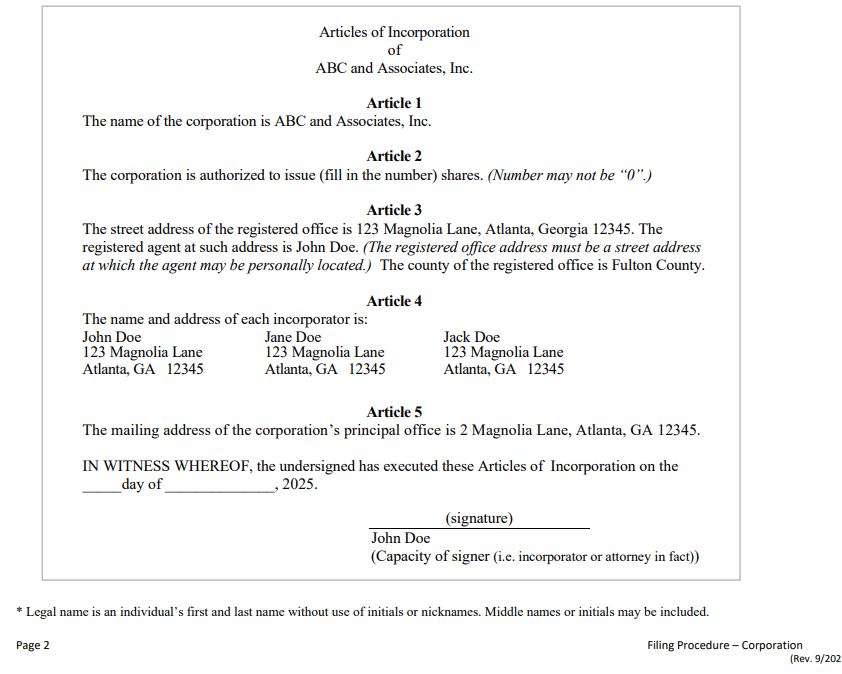
For a Georgia profit corporation, your Articles generally need to include:
The Articles must be signed by an incorporator or an attorney-in-fact, and the signature does not need to be notarized. Once the Secretary of State approves your filing, it will issue a Certificate of Incorporation, officially establishing your Georgia C Corporation.
The Transmittal Information Form (Form CD 227) is submitted with your Articles of Incorporation when filing a Georgia corporation. It serves as a cover sheet and provides the Georgia Secretary of State with the basic information needed to process your formation filing.
The form also explains the corporation's initial annual registration requirements and confirms that the information provided will become part of the Secretary of State's business entity records.
Important: Form CD 227 is not the Articles of Incorporation itself. It accompanies the Articles when using the applicable paper filing process.
To file your Georgia C Corporation online, go to the Georgia Corporations Division online services portal and create a user account. Select Create or Register a Business, then choose I am creating a new domestic business and select Domestic Profit Corporation.
Enter your corporation's details, including its business name, addresses, registered agent information, and authorized share count. Pay the standard $110 fee, which includes the $100 filing fee and $10 service charge, using an approved credit card, then submit your filing. Standard online processing generally takes about 5 to 7 business days, while expedited processing is available for an additional fee.
This is the step most out-of-state founders don't expect, and it's unique to corporations, as Georgia LLCs don't have to do this. Under O.C.G.A. § 14-2-201.1, publishing notice of your incorporation isn't an afterthought; it's built directly into the filing itself.
When you submit your Articles, you (or your incorporator) must also deliver an "undertaking" to the Secretary of State, essentially a formal commitment to publish the required notice. Failing to follow through on that commitment leaves your filing technically incomplete.
Which newspaper qualifies:
Georgia law requires that the notice be published in the official legal organ of the county where your registered office is located. Every Georgia county has one designated newspaper of record or, alternatively, a newspaper of general circulation in that county whose most recent circulation statement shows at least 60% paid subscriptions. You can find your county's legal organ through the Georgia Superior Court Clerks' Cooperative Authority or by calling the Clerk of Superior Court in your registered office's county.
Deadline:
The notice must go to the newspaper no later than the next business day after you file your Articles of Incorporation. This is a tight window by design. For example, if you file on a Monday, you need the request out the door by Tuesday.
What the notice must say:
The Secretary of State specifies close to the exact wording to use. At minimum, it must include:
How long it runs:
The notice must be published once a week for two consecutive weeks, beginning within 10 days of the newspaper's receipt of your request.
Cost:
A flat $40 publication fee, paid directly to the newspaper, not to the Secretary of State, and not bundled into your Articles filing fee.
Proof of publication:
Georgia doesn't require you to file proof of publication with the Secretary of State. That said, it's worth requesting a copy or affidavit of publication from the newspaper and keeping it with your corporate records. It's good evidence of compliance if the question ever comes up.
Missing the next-business-day deadline doesn't automatically void your Articles, but it leaves you out of compliance with a statutory requirement tied directly to your incorporation. Practically, the fix is simply to complete the publication as soon as possible.
But the safest path is not to miss the window in the first place, since the requirement is framed as part of the incorporation process itself, not a separate optional step.
| What is the difference between Georgia notice of incorporation vs notice of intent to incorporate +
Both phrases appear in practice and refer to the same statutory notice. Some publishers and templates use "Notice of Incorporation"; others use "Notice of Intent to Incorporate." What matters isn't the header wording but that the required content (corporation name, registered office address, registered agent name, and the Georgia Business Corporation Code reference) is all present. | | :---- |
Georgia doesn't require you to file bylaws with the Secretary of State; they live in your corporate records and govern how the company actually operates.
Start with the structural basics, including board composition, officer roles, meeting procedures, and voting rules, then layer in provisions specific to your corporation, like share transfer restrictions for a closely held company or committee structures for a larger board. The incorporator or initial directors formally adopt the bylaws at the organizational meeting.
Once your Articles are approved (and your publication requirement is satisfied), hold an organizational meeting to formally activate your corporation's structure. At this meeting, the incorporator or initial directors typically:
Keep minutes as part of your permanent corporate records. You won't file them with the state, but they are the documentation that shows your corporation is being run as its own legal entity.
With the corporation formally in existence, apply for an EIN. You'll need it to open a bank account, hire employees, file federal and Georgia taxes, apply for licenses and permits, and keep your personal Social Security number off business paperwork. Applying directly through the IRS is free, but Swyft Filings can also handle it as part of a Premium Georgia C Corp formation package.
Getting your Articles approved and your publication notice satisfied is only the beginning. To stay in good standing, your Georgia C Corp has ongoing obligations.
Georgia is unusual in requiring a filing shortly after formation of a C Corp, not just an annual one.
Initial registration: File your first annual registration within 90 days of incorporation with the Georgia Secretary of State.
What to include: Provide your corporation's principal officers and other required business information.
Annual renewal: After the initial filing, renew your registration every year between January 1 and April 1.
Fee: The annual registration fee is $60, including the $50 filing fee and $10 service charge.
Missed deadline: Failing to file your annual registration can result in the corporation being administratively dissolved.
Corporations formed between October 2 and December 31 have a different initial-registration timeline.
Keep your Georgia C corporation's finances separate from your personal finances by opening a dedicated business bank account after formation.
EIN: Obtain your federal Employer Identification Number before opening the account.
Documents: The bank may request your Articles of Incorporation, EIN confirmation, bylaws, and corporate resolutions.
Authorized users: Your organizational documents or board resolution should identify who can manage the account.
Separate finances: Use the corporate account for business income and expenses rather than mixing personal and corporate funds.
Records: Keep bank statements and transaction records with your corporate financial documents.
Maintaining separate finances helps demonstrate that the corporation operates as a distinct legal entity.
Your Georgia C Corp may have state corporate income tax and net worth tax obligations. The Georgia Department of Revenue administers these taxes and provides corporate tax forms and filing information.
Register: Corporations can register through the Georgia Tax Center (GTC).
Corporate tax: Georgia imposes a corporate income tax on corporations.
Net worth tax: A corporation may also owe Georgia net worth tax based on its net worth.
Tax return: Georgia corporations generally use Form 600 to report applicable corporate taxes.
Estimated taxes: Depending on your tax liability, you may be required to make estimated tax payments.
Federal filing: Your Georgia C Corp also has separate federal corporate tax obligations.
Check the Georgia Department of Revenue's current requirements for your corporation's specific tax situation.
Forming a Georgia C Corp does not automatically give you every license or permit required to operate your business. So, check these things out:
Local requirements: Your city or county may require a business license, occupational tax certificate, or other local registration.
Industry requirements: Certain industries require additional state or professional licenses.
Professional services: Regulated businesses may need approval from the appropriate Georgia licensing board.
Activities: Your specific products or services may determine which permits apply.
Renewals: Track expiration dates and renew licenses or permits when required.
Need help? Swyft Filings' Business License Research Service can help you identify which licenses and permits may apply to your Georgia C Corp based on your business activities and location. It can also provide information on where and how to apply for the required licenses.
Your Georgia C Corp may need additional tax registrations depending on what it sells and whether it has employees.
Sales tax: If you sell taxable goods or services, determine whether you must register to collect and remit Georgia sales tax.
Georgia Tax Center: Tax registrations can generally be completed there.
Employees: If you hire employees, you may need to register for Georgia withholding tax.
Unemployment tax: Employers may also need to register with the Georgia Department of Labor for unemployment insurance.
Other obligations: Your business activities may create additional state tax or licensing requirements.
The cost of forming a C Corp in Georgia depends on more than the state filing fee. You may also need to budget for name reservation, registered agent services, licenses, and other startup costs.
| Cost | Fee |
|---|---|
| Georgia Articles of Incorporation | $110 |
| Newspaper Publication Notice (runs 2 consecutive weeks) | $40 |
| Georgia Registered Agent Service | Varies |
| Name Reservation (optional, 30 days) | $25 online / $35 mail |
| Initial Annual Registration (within 90 days) | $60 |
| EIN | $0 |
Between the share structure decisions, the bylaws, and Georgia's easy-to-miss newspaper publication requirement, there's more to a clean Georgia filing than the one-page Articles suggest. Swyft Filings has been guiding businesses through C Corp formation and compliance in Georgia since 2015, and our team stays current on what the Secretary of State's Corporations Division expects so your filing goes through cleanly the first time.
$0 + State Filing Fees
*Disclaimer: This guide provides general information about forming a C Corp in Georgia and is not a substitute for legal, tax, or financial advice.*
C Corp rules, filing costs, and corporate tax structures vary by jurisdiction. Select any state below to view its specific C Corp laws.