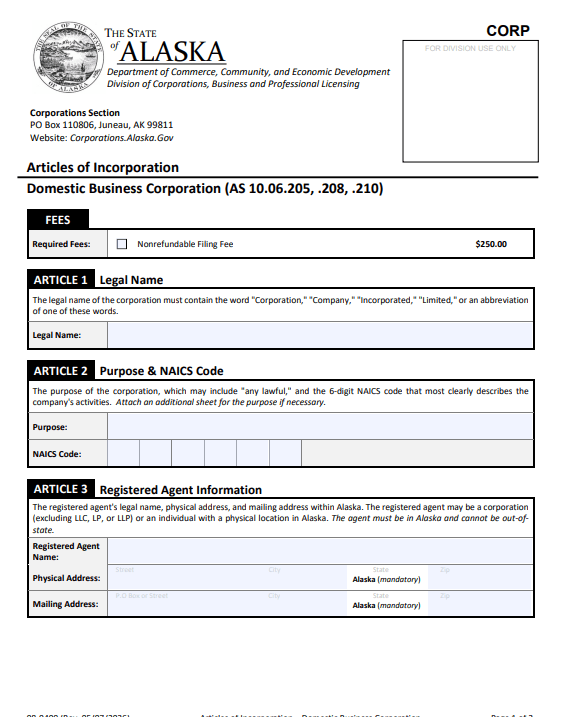
Swyft Filings' Basic Alaska C Corporation formation package lets you start your corporation for free. Our package covers a name availability check, preparation and filing of your Articles of Incorporation, and support from a formation specialist along the way, all at a $0 service fee. You only have to pay the mandatory $250 state filing fee.
Need additional support with C Corporation formation in Alaska? Choose our premium packages to add more services such as bylaws drafting, support for multiple stock classes, initial corporate resolutions, EIN assistance, registered agent, and more.
Alaska bundles a two-year business license fee directly into its formation cost, which is why the state fee is higher than the filing fee alone would suggest. Beyond that, the process is straightforward. Choose a compliant C Corporation name, appoint a registered agent, set your share structure, file your Articles of Incorporation, adopt bylaws, hold an organizational meeting, and get your EIN.
Step 1: Choose a Name for Your Alaska C Corporation
Your Alaska C corporation's name is the first detail customers, partners, and the state will associate with your business. That’s why Alaska requires C corporations to use a name that meets its naming rules.
Alaska C Corp Name Requirements
1. Use a corporate designator: Your C corporation's name must include an approved corporate designator, such as:
Corporation or Corp.
Incorporated or Inc.
Company or Co.
Limited or Ltd.
2. Make the name distinguishable: Alaska generally will not consider a name distinguishable if the only differences are:
Punctuation, spacing, or capitalization
Adding or removing a corporate designator
Articles, prepositions, or conjunctions such as “the,” “and,” or “of”
3. Avoid restricted or misleading names: Your Alaska C Corp name also cannot:
Imply that your business is a city, borough, village, or other local government entity.
Suggest a business purpose that conflicts with the purpose stated in your Articles of Incorporation.
Be misleading or deceptively similar to another registered business.
Once you have chosen a unique title and verified its availability through the Alaska Corporations Database, prepare a backup option in case your first choice is too similar to an existing entity. You can also use Swyft Filings’ free business name generator to create several options.
Yes. An Alaska corporation can change its legal name by following the state's applicable corporate filing requirements. Before adopting the new name, check that it meets Alaska's distinguishability and naming requirements.
Yes. A state business-name search does not replace a trademark search. Before settling on a name, check federal trademark records and other sources for potential conflicts. Alaska itself recommends a thorough search that may include trademark records, business records, professional license records, and other sources.
No. Reserving a business name with Alaska protects the name's availability for the applicable reservation period; it does not give you federal trademark rights. Consider a separate trademark search before investing heavily in the name.
An Alaska corporation's name must include “Corporation,” “Company,” “Incorporated,” or “Limited,” or an abbreviation of one of these terms. The name must also be distinguishable from other registered or reserved names on state records and cannot imply a purpose different from the one stated in the Articles of Incorporation.
Generally, an Alaska corporate name cannot contain “city,” “borough,” or “village” or otherwise imply that the corporation is a municipality. However, the actual name of a city, borough, or village can be used in a corporate name.
No. An Alaska corporation does not specifically have to use “Inc.” You can use Corporation, Company, Incorporated, or Limited, or an accepted abbreviation such as Corp., Co., Inc., or Ltd.
Yes. Submit a name reservation application to the Division either online or by mail for a $25 fee, and your name is held for 120 days. This is optional. Most filers who are ready to incorporate skip straight to filing their Articles instead.
Step 2: Appoint an Alaska Registered Agent
Every Alaska C Corp must designate a registered agent to receive official state correspondence, legal notices, and service of process on the corporation's behalf. You can appoint an individual or a qualified business as your registered agent when filing your Articles of Incorporation.
Requirements for an Alaska Registered Agent
Your registered agent must meet Alaska's requirements, including:
Physical Alaska address: The agent must have a physical street address in Alaska. A P.O. box alone is not sufficient.
Availability: The agent must be available at the registered office during normal business hours to receive official documents.
Eligible individual or entity: An individual (at least 18 years old) who meets Alaska's requirements or an authorized corporation may serve as the registered agent.
The corporation itself may not act as its own registered agent in Alaska, which differs from the rule in a number of other states.
How to Appoint Your Registered Agent
Choose an agent: You can serve as your own agent if you qualify, appoint another eligible individual, or hire a professional registered agent service.
List the agent on your formation documents: Provide the registered agent's name and physical Alaska address when completing your Articles of Incorporation.
Keep the information current: If your registered agent changes after C Corp formation, file the appropriate change with the Alaska Division of Corporations and pay the applicable fee.
Failure to maintain a current, valid registered agent and address puts the corporation out of compliance with the Division and can jeopardize its standing, since there's no reliable channel left to receive service of process or state notices.
File a Notice of Change of Registered Agent/Office with the Division. Swyft Filings' change-registered-agent service can also handle this so you don't have to track the filing yourself.
Yes. Your mom can generally serve as the registered agent for your Alaska C Corp if she meets Alaska's registered-agent requirements. She does not necessarily have to be a shareholder, director, or officer of your corporation.
However, if she does not live in Alaska or cannot maintain a qualifying Alaska registered office, you would need to appoint another eligible individual or a qualified registered agent service.
Step 3: Set Your Alaska C Corp Share Structure
Alaska's Articles of Incorporation require you to state the number of authorized shares before you file. Zero is not an acceptable entry.
Decide on a total authorized share count that gives you room to issue more later without amending your Articles.
Choose whether to authorize multiple classes or series of shares, and define each class's rights if so.
Set a par value for your shares, if you are using one. Alaska treats par value as a nominal figure unrelated to market value.
Reserve unissued shares for future investors or key hires.
An Alaska C Corporation must have the officers required by its bylaws or appointed by its board of directors. The corporation may have a president, secretary, treasurer, and other officers as established in its governing documents. One person can generally hold multiple officer positions, unless the corporation's bylaws provide otherwise. The board of directors is responsible for appointing the corporation's officers and defining their duties and authority.
Alaska requires a number greater than zero, but sets no specific minimum or "standard" figure. So, match your authorized share count to your ownership and fundraising plans.
Par value is the nominal value assigned to a share in the C Corporation's formation documents. It does not represent the share's market value or necessarily indicate what an investor will pay for the stock. If your corporation uses par value, state the applicable amount in its Articles of Incorporation.
Step 4: File Your Alaska Articles of Incorporation
Go to the Division's online filing system and select the “Corporation Forms & Fees”.
Then, choose a form by entity type (domestic business corporation), click "Proceed to online filing, " log in, and enter your corporate name, registered agent and office details, incorporator information, and authorized share structure.
Pay the combined \$250 fee (\$150 filing fee plus \$100 biennial business license tax) by credit card.
Filing by mail:
Send your completed Articles of Incorporation along with a $250 check to the Corporations Section, PO Box 110806, Juneau, AK 99811-0806.
Your corporate name, purpose, registered agent name and Alaska address, incorporator names and addresses, and the number of authorized shares (with par value, if applicable).
Yes. An Alaska corporation can amend its Articles of Incorporation after formation to change information such as its corporate name, authorized shares, or other provisions. The corporation must file the appropriate Amended and Restated Articles of Incorporation form with the Alaska Division of Corporations, Business and Professional Licensing and pay the applicable $25 filing fee.
The $250 combines a $150 filing fee with a $100 business license tax, which covers your C Corporation's biennial business license for its first two-year period. This bundling is specific to Alaska and catches a lot of first-time filers off guard when comparing state fees.
Yes. Alaska allows domestic business corporations to file their Articles of Incorporation online through the Division's online filing system. Select the corporation filing option, provide the required business and share information, and pay the applicable $250 fee electronically.
Step 5: Adopt Bylaws for Your Alaska C Corp
Once your Alaska Articles of Incorporation are filed, put the corporation's internal rules in place through bylaws. These rules explain how the corporation will handle day-to-day governance and how directors, officers, and shareholders will make important decisions.
Your Alaska C Corp's bylaws should generally cover:
Board and shareholder meetings: Explain how meetings are called, conducted, and documented.
Voting procedures: Establish voting requirements and quorum rules for corporate decisions.
Directors and officers: Define how they are elected or appointed and outline their responsibilities.
Corporate records: Set rules for maintaining minutes, resolutions, and other company records.
Stock matters: Establish procedures for issuing and transferring shares.
Amendments: Explain how the corporation can change its bylaws in the future.
After the bylaws are prepared, formally adopt them and keep the approved version with your corporate records. Need professional help in this? Swyft Filings can prepare customized Corporate Bylaws for your Alaska C Corp around your specific governance structure.
No, and if you mail bylaws in with your Articles, the Division's instructions note they will simply be returned without being filed. Keep them with your internal corporate records instead.
Yes. Bylaws can generally be amended as the corporation grows or its governance needs change. The amendment process should follow the procedures established in the existing bylaws and applicable law.
Bylaws may address shareholder rights, meetings, voting, and related procedures, but they generally are not a substitute for maintaining a separate record of the C corporation's shareholders and stock ownership.
You can use a standard bylaws template as a starting point, but the bylaws should fit your corporation's ownership, share structure, board, officers, and governance arrangements. Customized bylaws preparation from Swyft Filings may be more appropriate when the corporation has multiple shareholders or more complex governance needs.
Step 6: Hold Your Organizational Meeting
Your Alaska C Corp organizational meeting is the first formal meeting where the corporation's initial decisions are documented. After filing the Articles of Incorporation, use this meeting to establish how the corporation will operate and record its key organizational actions.
At the meeting, the directors can:
Adopt the bylaws: Formally approve the corporation's internal governance rules.
Elect officers: Appoint individuals to positions such as president, secretary, and treasurer.
Approve stock issuance: Authorize the issuance of shares to the initial shareholders.
Set financial procedures: Approve opening a corporate bank account and establish the corporation's fiscal year.
Document decisions: Record the meeting through minutes or written resolutions and keep them with the corporation's records.
Keep signed minutes from this meeting with your corporate records as they are your clearest evidence that the C Corporation followed proper formalities if that's ever questioned later.
The directors or incorporator can take initial organizational actions, such as adopting bylaws, appointing officers, authorizing stock issuance, approving a corporate bank account, and addressing other startup matters.
Not necessarily. Who participates depends on the corporation's structure, bylaws, and the matters being approved. Directors or the incorporator may handle many initial organizational actions.
Keep the meeting minutes, written consents, resolutions, and other organizational documents with the corporation's official records. Maintaining these documents together helps establish a clear record of the corporation's initial decisions.
Step 7: Apply for Your EIN
After organizing your Alaska C Corp, apply for an Employer Identification Number (EIN) from the IRS. You may need it to open a business bank account, hire employees, file federal tax returns, and handle other business-related activities.
Corporation’s legal name: Use the exact name listed in your Articles of Incorporation.
Responsible party: Provide the required information for the individual responsible for the corporation.
Business structure: Identify the company as a corporation.
Formation details: Provide information such as the state where the corporation was formed.
Apply directly and for free through the IRS's online EIN application, or let Swyft Filings handle it as part its premium Alaska C Corp formation package.
Most C corporations need an EIN to identify the business for federal tax and other business purposes. It is also commonly required when opening a corporate bank account or hiring employees.
Apply after your corporation has been formed and you have the information needed for the application. Getting the EIN early can help you move forward with banking, tax, payroll, and other business setup tasks.
The time depends on the application method. An online application through the IRS can generally provide the EIN immediately after the application is completed successfully.
What Are the Post-Formation Requirements for a C Corp in Alaska?
After forming your Alaska C Corp, you still need to keep up with state filings, taxes, licensing, and corporate records. The main requirements include the following:
1. File Your Biennial Report
Alaska domestic business corporations must file a Biennial Report every two years. The due date is January 2 of the applicable even- or odd-numbered year, based on the year your corporation was formed.
The filing fee is $100, increasing to $137.50 when the late fee applies. You can file the report online or by submitting a hard copy. Keep your registered agent, business address, officers, and other company information up to date when filing. Alaska allows filing to open on October 2 of the previous year, giving businesses time to complete the report before the January deadline.
2. Pay Corporate Income Tax
An Alaska C Corp is subject to Alaska corporate income tax on taxable income. Unlike a sole proprietorship or other pass-through business, a C corporation generally pays income tax at the corporate level. Your corporation should determine its Alaska taxable income, apply the applicable tax rate and deductions, and file the required corporate tax return with the Alaska Department of Revenue.
Because tax brackets, thresholds, and filing requirements can change, review the current state requirements when preparing your return rather than relying on the rates that applied when you incorporated.
3. Renew Your Alaska Business License
Keep your Alaska business license active after incorporation. A regular Alaska business license can be issued for either one year for $50 or two years for $100, and licenses expire on December 31 of the applicable year. Track your expiration date and renew on time.
If your license lapses, additional requirements and fees may apply depending on how long it has been expired. If your business requires an endorsement, such as one associated with certain regulated products or activities, you may also need to maintain those endorsements separately.
4. Check Local Licenses and Permits
Forming a C Corp at the state level does not necessarily cover all the licenses or permits your business may need. Depending on where you operate and what your corporation does, you may have additional requirements from a city, borough, municipality, or state agency.
For example, businesses operating in regulated industries may need professional or industry-specific licenses in addition to the general business license. Before beginning operations, review the requirements that apply to your location and activities. Keeping these licenses current is an ongoing responsibility, so add renewal dates to your compliance calendar. Swyft Filings' business license research service can help you determine what applies to your business and provide direct application links so you can apply for them.
5. Open a Business Bank Account
Keep your Alaska C Corp's finances separate from your personal funds by opening a dedicated business bank account. Banks typically ask for documents such as your corporation's Articles of Incorporation, EIN, business license, and information about the owners or authorized signers.
Use the account for business income, expenses, payroll, and other corporate transactions rather than mixing them with personal finances. Maintaining separate financial accounts also helps keep your corporation's financial records organized and supports the separation between the corporation and its owners. Before choosing a bank, compare account fees, transaction limits, online banking features, and other services that fit your business needs.
What Does It Cost to Incorporate a C Corp in Alaska?
The cost of incorporating a C Corp in Alaska depends on the state's filing fees and any additional services you choose for your business.
Cost
Fee
Articles of Incorporation Filing Fee
$150
Biennial Business License Tax (bundled at formation)
$100
Combined State Fee to Incorporate
$250
Name Reservation (optional, 120 days)
$25
Biennial Report (domestic corporations)
$100
EIN
$0
Ready to Start Your Free Alaska C Corp?
Start your Alaska C Corp with Swyft Filings for a $0 service fee + state fees with the Basic package. If you need additional support, you can choose a premium Alaska C Corp formation package that includes services such as corporate bylaws, initial resolutions, stock setup assistance, and more.
*Disclaimer: This guide offers general information about forming a C Corporation in Alaska and isn't a substitute for legal, tax, or financial advice.*
Check C Corp Formation Guides for Other States
C Corp rules, filing costs, and corporate tax structures vary by jurisdiction. Select any state below to view its specific C Corp laws.
Starting an Alaska C Corp means coordinating two agencies, an Initial Report, and a Business License. Swyft Filings has been helping businesses form and stay compliant since 2015. Our team knows the Alaska Division of Corporations requirements and can file your C Corp quickly, accurately, and in full compliance.
No! Alaska uses a biennial (every-two-years) reporting cycle instead of an annual one. Domestic for-profit corporations file by January 2 of the filing year that matches their formation year's odd- or even-numbered parity, for a $100 fee.
Yes. You generally do not have to be an Alaska resident to form a C Corp in the state. However, the corporation must maintain a qualified registered agent with a physical address in Alaska.
Yes. Although Alaska has no individual income tax, it applies a graduated corporate income tax with rates ranging from 0% to 9.4% depending on income level. This is one of the more distinctive aspects of doing business there.
Only as an individual, not as the corporation itself. Alaska doesn't allow a corporation to act as its own registered agent, unlike many other states. An individual resident can serve as agent if they meet the age and residency requirements.