
Switching to a sole proprietor is cheaper and simpler, but ends the legal wall protecting your personal assets. Here's when it's the right call.
Many single-member LLC owners already report their income the same way a sole proprietor does. Once the annual reports and state fees stop pulling their weight, dropping the LLC structure altogether is worth a second look.
Turning an LLC back into a sole proprietorship isn't a form you fill out and file. There's no conversion paperwork. Instead, you dissolve the LLC with the state, close out its taxes and debts, and pick up your business activity as an individual.
Key Takeaways
- The process of changing an LLC to a sole proprietorship involves dissolving the existing business.
- Business owners must follow precise filing and dissolution procedures to avoid getting fined or becoming liable for taxes unpaid by an improperly dissolved business.
- After you dissolve the company, you can start working as a sole proprietor with minimal filing requirements.
Do I Lose Liability Protection When I Switch From an LLC to a Sole Proprietorship?

As an LLC, your personal assets stay separate from your business. If a customer sues you or a creditor comes after the business, only the company's assets are on the line. Your house, your car, and your personal savings are protected.
Once you dissolve your LLC, that separation is gone. As a sole proprietor, there's no legal wall between you and your business. If something goes wrong, whether it's a lawsuit, an unpaid debt, or a client dispute, your personal assets can be used to cover it.
This doesn't mean the switch is a bad idea. It means the decision should be based on your actual risk, not just cost. If you are still making up your mind about the switch, here is a comparison for you.
LLC vs. Sole Proprietorship:
Feature | Sole Proprietorship | LLC |
Registration | Not registered with the state | Registered with the Secretary of State |
Liability | You're personally responsible for business debts and lawsuits | Your personal assets are separate from the business |
Taxes | Income reported on your personal return | Income passes through to your personal return, but the LLC may owe franchise or annual fees |
Paperwork | Minimal, may need a local license or DBA | Annual reports, registered agent, formation filings |
Confusion between a sole proprietorship and LLC is very common for startups or first-time business owners. If you feel you need to know more about these two, read:
- What Is A Limited Liability Company (LLC)
- What is a Sole Proprietorship
- Should I Form a Sole Proprietorship or a Single-Member LLC
- Forming a Sole Proprietorship: Pros and Cons
What Are the Steps to Change Your LLC to a Sole Proprietorship
There's no direct conversion form. Turning an LLC back into a sole proprietorship means dissolving the LLC, then continuing your business activity as an individual. Here's the order that works.
Step 1: Get Member Approval to Dissolve
You have most likely drafted an LLC operating agreement during the formation procedure. That document should contain the procedure for dissolving the company or an event that triggers the dissolution.
If the dissolution is voluntary, members will typically need to vote on the decision to dissolve, and the operating agreement states whether a majority or unanimous vote is required to pass it. You may need to draft an official notice for internal records and record the vote alongside every member’s signature, signifying their approval.
If the LLC is manager-managed, the manager is usually responsible for closing out the business's affairs before the members release them from that duty. Member-managed LLCs can elect a member to finalize the dissolution process.
If you're a single-member LLC, this step is simple. Write and sign a statement confirming you've chosen to dissolve. You only have to draft a written and signed notice that you’ve “voted” on dissolving the company.
Step 2: File Your Articles of Dissolution
Once dissolution is approved internally, file the paperwork with the state. Most states call this document Articles of Dissolution or a Certificate of Termination, and you'll file it with the Secretary of State or equivalent office.
Some states require you to finish "winding up the company affairs" before filing for dissolution, while others require you to file the document and start the process. "Winding up" means that the company legally cannot perform any services or sell products and only exists to wrap up its affairs.
The fee for articles of dissolution varies a lot by state. For example, Washington charges no filing fee for LLC dissolution [1], while New York charges $60 [2].
A few states go even further with dissolution requirements. Nebraska requires you to publish a notice of dissolution in a local newspaper for three consecutive weeks before the dissolution is final [3]. Check your state's exact requirements before you file.
If your LLC is registered as a foreign entity in other states, you'll need to file a withdrawal in each of those states too.
Step 3: Notify Creditors and Wind Down Accounts
As part of winding up the company affairs, you must notify all creditors, vendors, and other business partners, usually in writing. Additionally, you'll need to submit a notice to the creditors of how long they can claim any outstanding debt or repay that debt.
Keep enough cash in a dedicated account to cover any late claims or remaining debts. Don't distribute the rest until you're confident every obligation is settled. Once everything clears, you can close the LLC's business bank accounts.
Step 4: File Final Tax Returns
Before your company can close for good, you will need to file a final tax return with the IRS. File your LLC's final federal, state, and local tax returns, and check the box marking it as a final return. The form depends on how your LLC was taxed. A single-member LLC reports its last year of activity on Schedule C. A multi-member LLC files a final Form 1065. An LLC taxed as a corporation files a final Form 1120 or 1120-S.
If your business has employees, you must pay them their final paychecks and pay taxes on those.
Step 5: Close Your LLC's EIN
Your LLC's EIN belongs to the LLC, not to you personally. The IRS can't technically cancel an EIN, but it can close the business account tied to it [4].
Send a letter to the IRS with your LLC's legal name, its EIN, your business address, and the reason for closing the account. Mail it to the IRS in Cincinnati, Ohio. As a sole proprietor without employees, you can use your Social Security Number for tax purposes going forward. If you plan to hire employees, you'll need a new EIN, since you can't transfer the LLC's EIN to your sole proprietorship.
Step 6: Transfer Assets and Contracts to Your Name
Once the LLC's financial obligations are cleared, transfer its remaining assets to yourself. This includes cash, equipment, inventory, and intellectual property.
Contracts need the other party's agreement to reassign them to you personally. This step can take longer than expected if you have several vendor or client contracts still active, so start it early.
Step 7: Set Up Your Sole Proprietorship
With the LLC dissolved, you're a sole proprietor the moment you keep doing business under your own name. A few things to handle as you restart:
If you decide to stay in business and provide the same services as before, you will need to do the following:
- Obtain sales and professional business licenses as requested by the state departments. You may be able to transfer your previous licenses until they need to be renewed.
- Get a new EIN from the IRS. You might not need an EIN if you don’t intend to (re)hire employees or don’t need to pay excise, alcohol, or tobacco taxes, among other things.
- Register a DBA (doing business as) name. By default, a sole proprietor uses their legal name to conduct business, and some states require a DBA or trade name for all sole proprietors who intend to sell products or provide taxable services.
- Open a new bank account to separate your business and personal finances.
- Update your marketing materials, create a new website, and start your business as a sole proprietor.
Looking to convert your sole proprietorship into an LLC instead? We have the decision-making resources for you:
- How to Switch From Sole Proprietor to LLC (What Nobody Tells You)
- 13 Reasons Why Sole Proprietors Should Consider Forming an LLC
Why Business Owners Switch From an LLC to a Sole Proprietorship
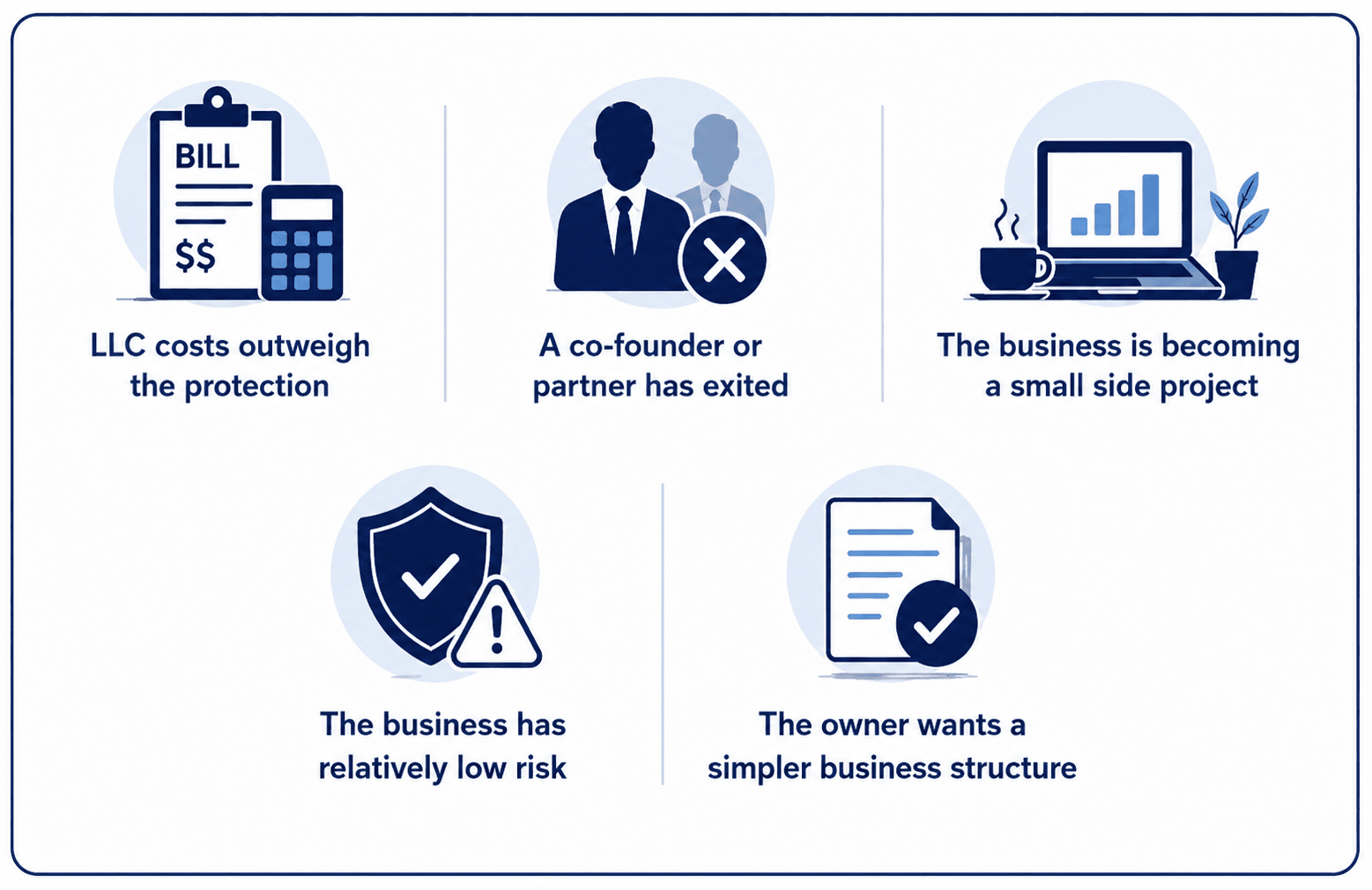
The LLC's Costs Outweigh What It's Protecting:
Annual report fees, registered agent fees, and franchise tax add up every year, whether your business made $5,000 or $50,000. If your revenue has slowed down or your risk is genuinely low, you may be paying to protect assets that were never really at risk.
A Co-Founder or Partner Has Exited:
If your LLC had multiple members and you're now running it alone, you don't need the multi-member structure anymore. Some owners simplify down to a sole proprietorship instead of restructuring as a new single-member LLC.
You're Winding a Side Project Down, Not Scaling It Up:
If what started as a formal business is turning into freelance or consulting work on the side, the LLC's paperwork and fees may no longer match how the business actually runs.
You Never Needed The Liability Protection to Begin With:
Some businesses, especially service-based or freelance work with little risk of lawsuits or debt, formed an LLC out of caution rather than necessity. If that protection hasn't been tested and probably won't be, it can be reasonable to let it go.
You Want to Reduce Your Tax Filing Complexity:
A single-member LLC that hasn't elected corporate tax treatment already files taxes almost identically to a sole proprietorship. For some owners, dropping the LLC removes a layer of state-level filing without changing much about their day-to-day taxes.
Whatever your reason, it's worth weighing against what you give up, which is the liability protection covered next. If your business carries real risk, that trade-off deserves more thought than the cost savings alone.
Also Read: Why You Should Dissolve an Unused Business Before Year’s End
Should I Dissolve My LLC Myself or Get Help?
Dissolving an LLC on your own means tracking state deadlines, IRS paperwork, and creditor notices all at once. Swyft Filings has helped 600,000+ businesses with their formation and dissolution needs since 2015, and our business formation specialists can help you close your LLC correctly. Feel free to reach out to us for more.
Bibliography
- Washington Secretary of State. "Certificate of Dissolution, LLC & PLLC." July 24, 2026.
- New York Department of State. "Articles of Dissolution for Domestic Limited Liability Companies." July 24, 2026.
- Nebraska Legislature. "Revised Statute 21-193, Notices; Publication; Filing." July 24, 2026.
- Internal Revenue Service. "Canceling an EIN, Closing Your Account." Accessed July 24, 2026.
- Internal Revenue Service. "About Form 8832, Entity Classification Election." Accessed July 24, 2026.