

A Limited Liability Company (LLC) is a legal business structure registered at the state level that protects your personal assets from business debts and lawsuits. It combines the liability protection
Key Takeaways
An LLC protects your personal assets if your business gets sued.
It passes profits directly to your personal tax return, no double taxation.
You can own an LLC alone or with partners, i.e., a Single Member LLC or a Multi-member LLC (Partnership)
The Average state filing fee of an LLC in the U.S.A. costs between $35–$500
Most small businesses, freelancers, and real estate investors benefit from forming an LLC
What Is The Meaning Of LLC?
A Limited Liability Company (LLC) is a legal business structure you register with your state. When you form an LLC, it acts as a legal shield between you and your personal assets (house, car, or bank balance, etc). It means if a partner or a vendor sues your LLC, the court doesn’t go after your personal assets to pay the debt. Thus, an LLC is a perfect blend of the liability protection of a corporation with the simple, flexible taxes and management of a partnership or sole proprietorship. [1]
An LLC is its own separate legal "person." It can own property, sign contracts, open bank accounts, borrow money, sue others, or be sued. An LLC gets all these benefits without affecting your personal assets. The only condition is that your business remains compliant, including maintaining a separate business account and on-time filing of the annual fee.
⚠️ Important: LLC protection is not absolute. Consult a business formation expert for advice specific to your situation to ensure your business stays protected.
How Does An LLC Work For Beginners?
In an LLC, the owners are called members, and there's no limit on how many you can have (no restrictions on who can be a member: individuals, other companies, even foreigners). You can run it solo as a single-member LLC or partner up with others as a multi-member LLC.
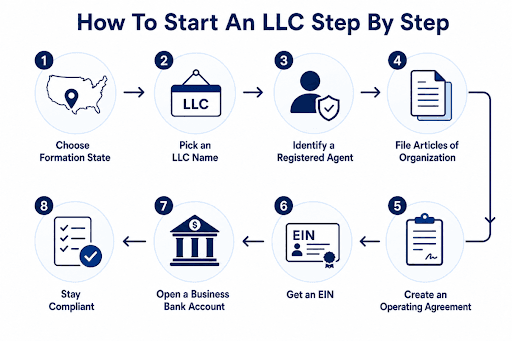
States govern the rules, so formation starts with filing "Articles of Organization" (a simple form) plus a fee that’s usually $35 to $500. The next steps include appointing a registered agent (self, family member, or professional) and obtaining an EIN.
No board meetings or shareholder votes are required. You customize everything via an optional operating agreement.
The IRS does not tax the LLC itself. Instead, profits and losses "pass through" to the owners, called members. Each member pays taxes on their share through their personal tax return. This is called pass-through taxation.
Here is how it works step by step:
- You register your LLC with your state
- Your business gets its own legal identity
- You run the business and collect profits
- Profits flow to your personal tax return (no business-level tax)
- If something goes wrong legally or financially, the law looks at the business, not you personally (provided your business stays compliant)
Check out our step-by-step guide to forming a limited liability company and know every requirement in detail.
What Is The Difference Between An LLC And Sole Proprietorship For A Small Business?
Feature | Sole Proprietorship | LLC |
Personal liability | You are fully liable | Your personal assets are protected |
Setup cost | Free or very low | $35–$500 in state fees |
Taxes | Pass-through | Pass-through |
Business credit | Hard to build | Can build separately |
Credibility | Informal | Formal, registered entity |
Best for | Testing an idea | Running a real business |
your savings. As an LLC member, the business absorbs the hit, not you.
If you are already running a business as a sole proprietor, converting to an LLC is one of the smartest moves you can make.
📊 2026 LLC Market Trends: Why Now Is the Time to File?
Most sole proprietors and startups often wonder whether an LLC is right for their business or not. Here are LLC and business formation statistics for 2026:
- A total of 5.62 million business applications were lodged in the U.S. during the 2025 calendar year. [2]
- Business applications in the first quarter of 2026 are up 19.43% compared to the same three-month period in 2025. [3]
- The U.S. averaged approximately 468,000 new business applications per month throughout 2025. [4]
- Roughly 32% of all 2025 business applications (approx. 1.8 million) were classified as "High-Propensity," meaning they are likely to hire employees and pay wages within 4 quarters. [5]
- The Southern U.S. remains the powerhouse for new businesses, contributing over 198,000 applications per month in late 2025, nearly 42% of the national total. [6]
What Are The Advantages Of Forming An LLC?
- Personal asset protection: Your home, savings, and personal property are off-limits in a business lawsuit, as long as you keep business and personal finances separate.
- Pass-through taxation: The LLC does not pay federal income tax. Profits flow to your return. You pay taxes once, not twice
- Tax flexibility: By default, you are taxed as a sole proprietorship (if a single-member LLC)or a partnership (If a multi-member LLC). But you can elect to be taxed as an S Corp or C Corp if that saves you more money as you grow. [7]
- Simple to run: An LLC does not require any board meetings, formal minutes, or annual resolutions. You can set your own rules through an operating agreement, which is optional.
- Builds business credibility: Banks, vendors, and clients take an LLC more seriously than a freelancer without a legal structure. It also lets you open a business bank account and build a business credit score.
- Name protection. Your LLC name is officially registered in your state. No other LLC can use it in your state.
Are There Any Disadvantages Of Forming An LLC?
- Self-employment tax: Because profits pass-through to you personally, you pay the full 15.3% self-employment tax (Social Security + Medicare). Employees only pay half because employers cover the other half. (You can deduct half of this tax from your taxable income.) [8]
- State fees add up: LLC Formation costs range from $35 to $500 per state. Many states also charge annual report fees too. California charges an $800 annual franchise tax regardless of income. These costs can be difficult for a low-cost startup to manage.
- Not ideal for raising investment: Venture capitalists typically want C Corporations because they can issue stock. LLCs cannot issue shares, which makes them less attractive for VC funding or IPOs.
- Member changes can be complicated: If a partner leaves or dies, some states may require you to dissolve and re-form the LLC unless your operating agreement addresses it.
Want a deeper breakdown of the pros and cons? Read the full guide on forming LLC advantages and disadvantages
What Are The Tax Advantages and Disadvantages Of An LLC?
Tax Aspect | What It Means for You |
Pass-through taxation | Business profit is taxed only once, on your personal return [9] |
Self-employment tax | You pay 15.3% on net income (half is deductible) |
S Corp election | Can reduce self-employment tax if you pay yourself a salary |
C Corp election | Useful if you plan to reinvest profits rather than distribute them |
No double taxation | Unlike C Corps, you do not pay tax at both the business and personal level |
According to the IRS, most single-member LLCs are taxed as disregarded entities by default. You can change this by filing IRS Form 8832 (for C Corp status) or IRS Form 2553 (for S Corp status). [10]
Before you file, read 15 Common LLC Mistakes to Avoid in 2026 (And How to Avoid Them)
Special Cases: Is The LLC Structure Worth It?
Is An LLC Worth It For A Freelance Graphic Designer?
Yes, and here is why.
As a freelancer, you are your business. One unhappy client can sue you for damages. Without an LLC, your personal savings are at risk. With an LLC, the lawsuit targets the business, not your bank account.
An LLC also makes you look more professional. Clients are more likely to sign contracts and pay larger invoices when they see "LLC" in your business name. And if you earn more than $40,000–$50,000 a year, electing S Corp tax status through your LLC could save you thousands in self-employment taxes. The setup cost is often low (Swyft Filings LLC formation packages start at $0 plus state fees) for most freelancers, making it worth it.
What Are The Benefits Of An LLC For Real Estate Rental Property Owners?
Real estate investors have a lot to protect and a lot to lose, too.
If a tenant gets injured on your property and sues, an LLC keeps that lawsuit away from your other properties and personal assets. A Series LLC is especially powerful here: you can put each rental property in its own "cell," so a problem with one property does not drag the others into the lawsuit.
Additional benefits for real estate investors:
- Easier to transfer ownership of the property by assigning LLC membership
- Pass-through taxation keeps your accounting cleaner
- Separate bank accounts per LLC = clear paper trail for the IRS
- Builds business credit for future property financing
💡 In case you are wondering, A series LLC is a special type of LLC that acts as a master entity and allows the creation of separate, individual "series" or divisions underneath it.
Is An LLC A Good Business Structure For An E-Commerce Store Owner?
Yes! If you sell products online, you face real liability risks like defective products, shipping disputes, customer injuries, and chargebacks. An LLC draws a line between your store's problems and your personal life.
For e-commerce owners, an LLC also helps with:
- Opening a merchant account or payment processor
- Registering for a sales tax permit (required in most states)
- Building business credit for inventory financing
- Protecting your brand name in your state
Most e-commerce sellers can form a single-member LLC in their home state and run their store through it, worry-free.
Takeaway:
An LLC is a good starting point for most small business owners, offering essential asset protection and tax flexibility. Once profitable, you can elect S Corp status to save on taxes.
If you are ready to form an LLC or want to know about its formation or other business structure options, reach out to us today. Our business formation specialists are happy to help you.
Bibliography:
- U.S. Small Business Administration. Choose a business structure. Accessed on 1 May, 2026
- U.S. Census Bureau, Business Formation Statistics 2025 Summary. Accessed on 1 May, 2026
- U.S. Census Bureau, Monthly BFS Release (April 2026). Accessed on 1 May, 2026
- U.S. Census Bureau, BFS Historical Data Tables. Accessed on 1 May, 2026
- U.S. Census Bureau, Business Formation Statistics Reports. Accessed on 1 May, 2026
- U.S. Census Bureau, Regional Business Formation Series.Accessed on 1 May, 2026
- Internal Revenue Service. S Corporations. Accessed on 1 May, 2026
- Internal Revenue Service. Self-Employment Tax (Social Security and Medicare Taxes). Accessed on 1 May, 2026
- Internal Revenue Service. Limited Liability Company (LLC). Accessed on 1 May, 2026
- Internal Revenue Service. Single Member Limited Liability Companies. Accessed on 1 May, 2026