
Key Takeaways
Choosing between a sole proprietorship and a single-member LLC comes down to one main tradeoff: simplicity versus protection.
A sole proprietorship is the easiest business structure to start, while a single-member LLC usually gives you stronger personal liability protection and a more professional business setup.
If you are testing a business idea with little risk, a sole proprietorship may be enough. If you have clients, contracts, inventory, employees, or any meaningful exposure, a single-member LLC is usually the better long-term move.
Key takeaways
- A sole proprietorship is the simplest structure to start and maintain.
- A single-member LLC creates a separate legal entity in most states.
- A single-member LLC is usually treated as a disregarded entity for federal income tax purposes unless it elects otherwise.
- Both structures often report income on the owner’s personal return by default.
- The right choice depends on risk, budget, credibility, and growth plans.
What is a sole proprietorship?
A sole proprietorship is a business owned and operated by one person without forming a separate legal entity. In most cases, the business and the owner are legally the same, which keeps setup and ongoing paperwork simple.
This structure is common for freelancers, consultants, independent contractors, and very small businesses that want to get started quickly. It works best when risk is low, and the business can run without much formal separation.
Best fit for a sole proprietorship
Use a sole proprietorship when you want the fastest and least expensive way to start. It can make sense for side hustles, small service businesses, and short-term projects with limited liability exposure.
Main drawback
The biggest drawback is that there is usually no legal wall between the business and the owner. If the business owes money or gets sued, personal assets can be at risk depending on the facts and local law.
Also Read: What is a Sole Proprietorship? For more details!
What is a single-member LLC?
A single-member LLC is a limited liability company with one owner. It is generally treated as a separate legal entity from its owner, which is why many business owners use it for a cleaner business structure.
The LLC can help separate business activity from personal assets, and it often looks more established to clients, banks, and vendors. That matters when you want a structure that can scale with the business.
Best fit for a single-member LLC
Use a single-member LLC when your business has contracts, products, deposits, recurring clients, or higher operational risk. It is often the better choice when you want liability separation and a more credible business presence.
Main drawback
The main tradeoff is cost and compliance. You usually need a state filing, and some states add recurring requirements, fees, or formalities that a sole proprietorship does not have.
Also Read: What Are the Different Types of LLCs?
Sole proprietorship vs. single-member LLC
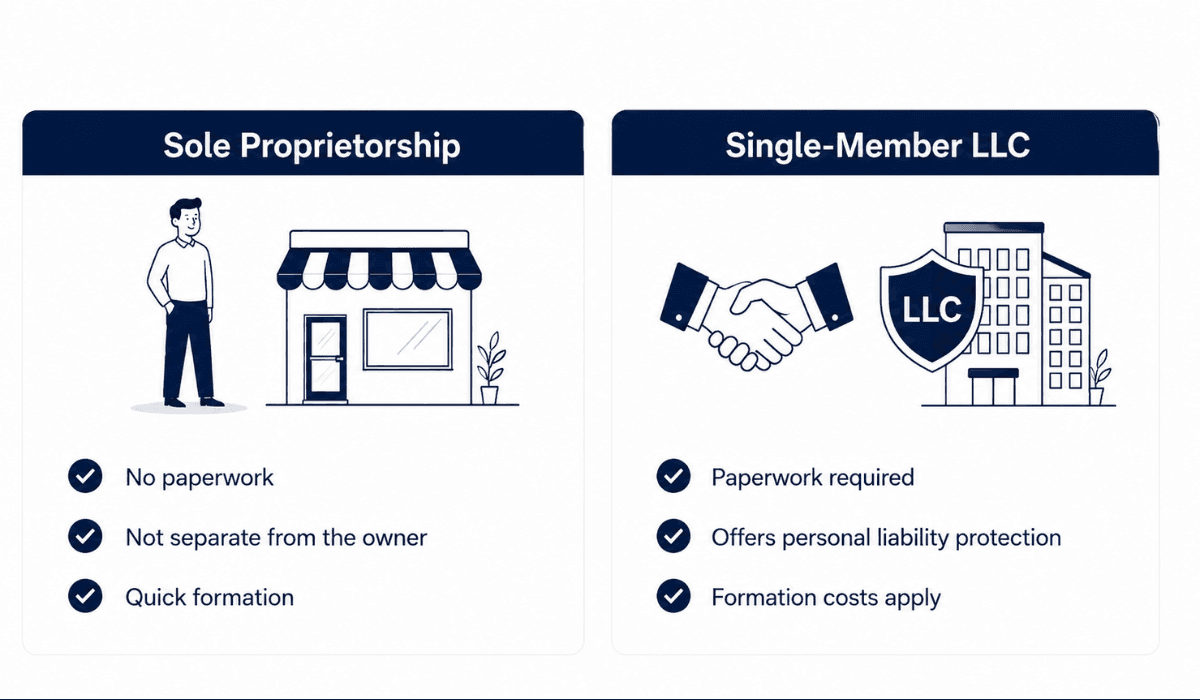
Factor | Sole Proprietorship | Single-Member LLC |
Legal status | Not separate from the owner. | Separate legal entity in most states. |
Personal liability | The owner is generally personally responsible for business obligations. | Usually offers more liability protection when maintained properly. |
Formation | Usually automatic when you start doing business. | Requires state filing and approval. |
Cost | Low or no formation cost. | Filing fees and ongoing costs may apply. |
Default taxes | Reported on the owner’s return. | Usually taxed like a sole proprietorship by default unless an election is made. |
Credibility | Less formal. | More established and professional. |
Compliance | Minimal ongoing formalities. | More ongoing requirements in many states. |
Also Read: Forming a Sole Proprietorship: Pros and Cons
How liability protection differs in a sole proprietorship vs. an LLC
The biggest difference is liability protection. A sole proprietorship generally does not create a legal shield between business and personal assets, so business claims may reach the owner directly.
A single-member LLC is designed to create that separation, but it is not a magic shield. If you mix personal and business money, ignore formalities, or sign personal guarantees, you can weaken the protection.
What can weaken an LLC | What strengthens an LLC |
Mixing personal and business finances. | Open a separate business bank account. |
Failing to keep records and accounts separate. | Use a separate business card and bookkeeping system. |
Signing personal guarantees on loans or contracts. | Sign contracts in the LLC’s name. |
Ignoring state compliance requirements. | Keep operating records up to date. |
Treating the LLC like a personal bank account. | Follow your state’s filing and renewal rules. |
Sole proprietorship vs. LLC: Taxes and reporting
By default, a single-member LLC is usually treated as a disregarded entity for federal income tax purposes. That means the IRS generally treats the income as belonging to the owner, and the business activity is often reported on the owner’s personal return.
That default tax treatment is one reason people confuse LLCs with sole proprietorships. The tax treatment can look similar, but the legal structure is not the same, and the liability profile can be very different.
Important tax note
A single-member LLC may choose a different tax classification by filing the proper election, which is one reason it can be more flexible than a sole proprietorship. Even when taxes are similar, the legal separation may still make the LLC worth it.
When a sole proprietorship makes sense
A sole proprietorship makes sense when you want simplicity, low cost, and a fast launch. It can be a practical choice for solo service businesses, early-stage experiments, and very low-risk work.
It is also a good option if you are not ready for extra filings or annual maintenance. For some owners, the lowest-friction setup is exactly what they need in the early stage.
Use this checklist
- Your business risk is low.
- You are testing an idea.
- You want the cheapest possible start.
- You do not need a formal structure yet.
- You are comfortable with simple reporting.
When a single-member LLC makes sense
A single-member LLC makes sense when you want more separation between business and personal life. It is usually the stronger choice if you sign contracts, handle products, work with higher-value clients, or want a more professional business identity.
It also helps if you plan to grow, hire, or eventually change your tax strategy. Many owners start here because the structure gives them more flexibility later.
Use this checklist
- You want stronger liability separation.
- You work with clients or vendors who expect a formal entity.
- You plan to open a business bank account.
- You want a structure that can support future growth.
- You want more control over tax elections later.
Common mistakes to avoid while choosing a sole proprietorship vs. an LLC
Many owners choose the cheaper option without considering the risk. That can be a mistake if the business has clients, contracts, or meaningful exposure.
Another common mistake is assuming an LLC automatically protects everything. The protection is real, but it depends on how you run the business and whether you keep the entity clean.
Mistakes checklist
- Choosing based on price alone.
- Mixing business and personal money.
- Ignoring state filing deadlines.
- Signing personal guarantees without understanding the risk.
- Comparing taxes and ignoring liability.
Also read: Common LLC Mistakes and How To Avoid Them
How to switch to an LLC later

You can usually start as a sole proprietor and form an LLC later. That is a common path for owners who begin small and then outgrow the simplest setup.
The typical transition includes choosing a business name, filing formation documents, getting an EIN if needed, updating banking and contracts, and separating records. That transition is usually manageable if you plan it carefully.
Here are the steps to form an LLC:
- Pick the LLC name.
- File the state formation document.
- Get an EIN if your situation requires one.
- Open a separate business bank account.
- Move contracts and invoices into the new entity.
- Update bookkeeping and tax records.
Still unsure? Use this simple decision matrix:
Situation | Better choice |
Testing a low-risk idea | Sole proprietorship |
Need the simplest setup | Sole proprietorship |
Want liability separation | Single-member LLC |
Sign contracts or handle products | Single-member LLC |
Want more credibility | Single-member LLC |
Want the lowest upfront cost | Sole proprietorship |
Also Read: How To Start An LLC Online
Final recommendation
If your business is tiny, low-risk, and still in the testing phase, start with a sole proprietorship. If you want better liability separation, more credibility, and a cleaner foundation for growth, choose a single-member LLC.
For most serious one-person businesses, the LLC is the stronger long-term choice because it gives you more protection and more flexibility without changing the basic way your income is taxed by default.
FAQs
Often, yes, by default. The IRS generally treats a domestic single-member LLC as a disregarded entity unless it elects a different tax classification.
No. A sole proprietorship can still be the right choice for very small, low-risk businesses that prioritize simplicity, minimal paperwork, and lower startup costs.
Not always. You may need a DBA if you want to operate under a business name that differs from your LLC's registered legal name.
Yes. Many business owners start as sole proprietors and later form an LLC when their revenue grows, their liability risks increase, or they want a more formal business structure.
A DBA only allows you to conduct business under a different name, while an LLC creates a separate legal entity in most states. If you only need a trade name, a DBA may be sufficient. If you also want liability protection and a formal business structure, an LLC is typically the better option.