An Employer Identification Number (EIN) is a unique nine-digit number the Internal Revenue Service (IRS) assigns to businesses in the United States.
Think of it as a Social Security Number (SSN) for your business. It looks like this: XX-XXXXXXX.
Just like your SSN identifies you as a person to the government and financial institutions, an EIN identifies your business.
The IRS uses your EIN to:
- Track your business tax filings
- Process payroll tax payments
- Identify your business on official documents
Your EIN stays with your business for life, unless you change your legal structure or ownership. Keep reading to know more about why businesses need it and how to apply for it with the IRS.
What Does EIN Stand For?
EIN stands for Employer Identification Number.
You may also hear it called:
- Federal Tax ID Number, because it is issued federally by the IRS
- FEIN (Federal Employer Identification Number) is the same thing, just more specific
- Federal Tax Identification Number (TIN) is the umbrella term; EIN is one type
- Business Tax ID is the informal name used by banks and vendors
All of these terms refer to the same nine-digit IRS-issued number. The naming can be confusing, but if someone asks for your "federal tax ID," they want your EIN.
Also Read: EIN Requirements: What You Need To Know
What Is an EIN Number Used For?
Your EIN is one of the most important numbers in your business life. Here is exactly what you use it for:
1. Filing Federal Business Taxes
You put your EIN on every federal tax return your business files, including income taxes, payroll taxes, and excise taxes.
2. Opening a Business Bank Account
Most banks and credit unions require your EIN before they will open a business checking or savings account. Even some banks that technically don't require it will still ask for one.
3. Hiring Employees
The moment you bring on your first employee, you need an EIN. You use it to report wages, withhold taxes, and file your employer payroll forms (like Form 941).
4. Applying for Business Loans and Credit Lines
Lenders use your EIN to pull your business credit report and assess your business's financial history. No EIN usually means no business loan.
5. Setting Up Vendor and Wholesale Accounts
Many suppliers and wholesale distributors require your EIN before they will sell to you at wholesale prices. It helps them verify that you are a legitimate business.
6. Establishing Business Credit
Your EIN is the foundation of your business credit profile. Every credit card, loan, or line of credit you apply for using your EIN builds your business credit score over time.
7. Protecting Your Personal Social Security Number
Instead of giving your personal SSN to clients, contractors, and vendors, you give them your EIN. This protects your personal identity and reduces the risk of fraud.
8. Filing for Business Licenses and Permits
Many state and local governments require your EIN on license and permit applications for your business.
Who Needs an EIN?
The IRS requires you to have an EIN if your business meets any of the following:
Situation | EIN Required? |
You have employees (even just one) | ✅ Yes |
Your business is a corporation | ✅ Yes |
Your business is a partnership | ✅ Yes |
Your business is a multi-member LLC | ✅ Yes |
You file employment, excise, or firearms/tobacco/alcohol tax returns | ✅ Yes |
You withhold taxes on income paid to a non-resident alien | ✅ Yes |
You have a retirement plan for the self-employed, like Solo 401(k) | ✅ Yes |
You operate as a trust, estate, or non-profit | ✅ Yes |
You bought or inherited a business | ✅ Yes |
If you run any business beyond a solo freelance operation with zero employees, you may need an EIN.
Who Does NOT Need an EIN?
If you are a sole proprietor or single-member LLC with:
- No employees
- No Solo 401(k)
- No need to file employment, excise, or firearms/tobacco/alcohol returns
- No non-resident alien workers
...then you are technically not required to have an EIN. You can use your personal SSN for tax purposes.
However, getting an EIN anyway is almost always a smart move. Here's why:
- You keep your SSN private (less risk of identity theft)
- You look more professional to clients
- You're ready to hire when the time comes
- Banks often still ask for one
- It's completely free and takes about 15 minutes
What Are The Benefits of Having an EIN
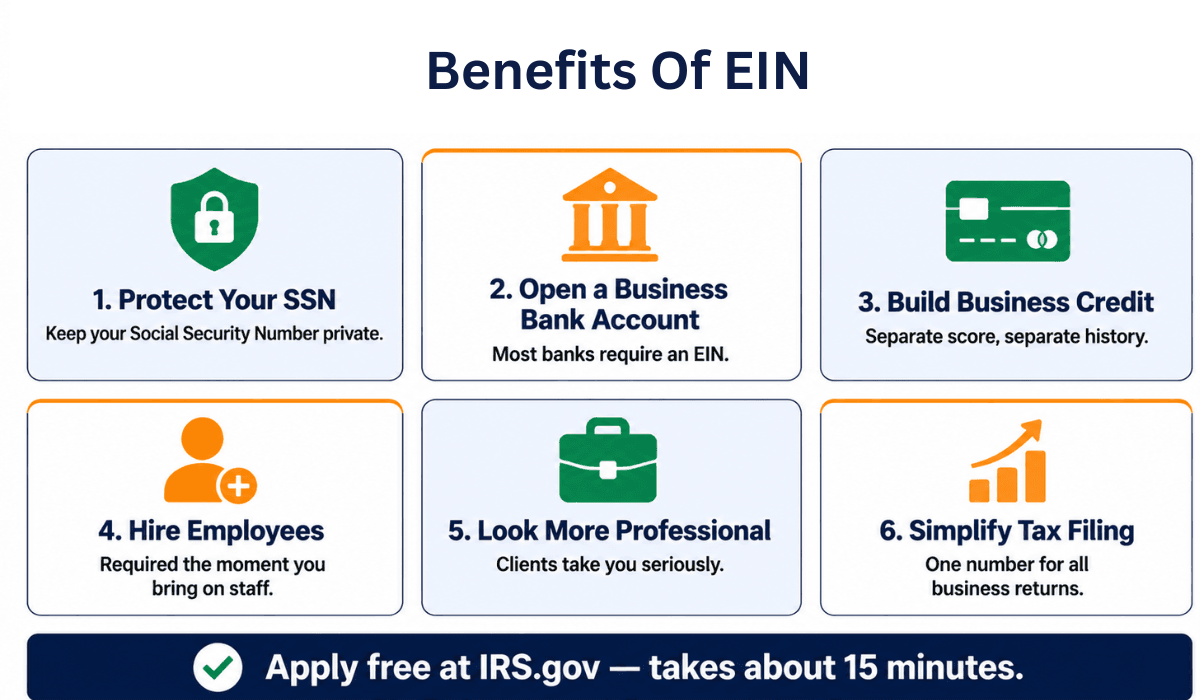
Benefit 1: Build Business Credit From Day One
One of the most underrated benefits of an EIN is business credit. When you use your EIN to apply for credit cards, loans, and vendor accounts, those accounts report to business credit bureaus like Dun & Bradstreet, Experian Business, and Equifax Business.
Over time, a strong business credit score can help you:
- Qualify for better interest rates on loans
- Get approved for higher credit limits
- Separate your personal credit from your business's financial health
Also Read: How to Get an EIN to Open a Business Bank Account
Benefit 2: Protect Your Personal Identity
Every time a sole proprietor without an EIN sends an invoice or signs up for a contractor account, they hand over their SSN. That's a real risk of identity theft. An EIN lets you keep your personal number private.
Benefit 3: Open a Business Bank Account
A dedicated business bank account:
- Makes bookkeeping clean and simple
- Strengthens your liability protection (especially for LLCs)
- Makes tax time much easier
- Looks professional to clients and partners
Most major banks like Chase, Bank of America, Wells Fargo, and others require an EIN to open a business account.
Benefit 4: Look Legitimate to Clients and Vendors
When you provide an EIN on contracts, W-9 forms, or vendor applications, it signals that you run a real, formalized business, not a side gig that might disappear tomorrow.
Benefit 5: Hire Employees When You're Ready
Even if you have no employees right now, getting your EIN sets you up to grow. When you're ready to bring on your first team member, the groundwork will already be in place.
Benefit 6: Simplified Tax Filing
Your EIN organizes everything under one identifier. All payroll taxes, income taxes, and business returns reference the same number, making it easier for your accountant, your bank, and the IRS to track your business activity.
EIN vs. SSN: What's the Difference?
Feature | EIN | SSN |
Issued by | IRS | Social Security Administration |
Who it identifies | A business entity | An individual person |
Format | XX-XXXXXXX | XXX-XX-XXXX |
Public or Private | Semi-public (used on business docs) | Private (protect it) |
Cost | Free | Free (issued at birth/citizenship) |
Used for | Business taxes, payroll, and banking | Personal taxes, credit, identity |
Is an EIN the Same as Your SSN?
No. They are two different numbers issued by two different federal agencies. Your SSN identifies you as a person. Your EIN identifies your business.
Can You Use Your EIN as an SSN?
No. An EIN cannot be used in place of an SSN for personal tax returns, personal credit applications, or any personal financial purpose.
Is It Better to Use Your EIN or SSN for Business?
Use your EIN for all business purposes. The key reasons:
- Privacy: Keeps your personal SSN out of business contracts, invoices, and vendor databases
- Credit separation: Builds a business credit profile independent of your personal credit
- Professionalism: Presents your business as a formal legal entity
EIN vs. TIN vs. FEIN vs. Tax ID: Are They the Same?
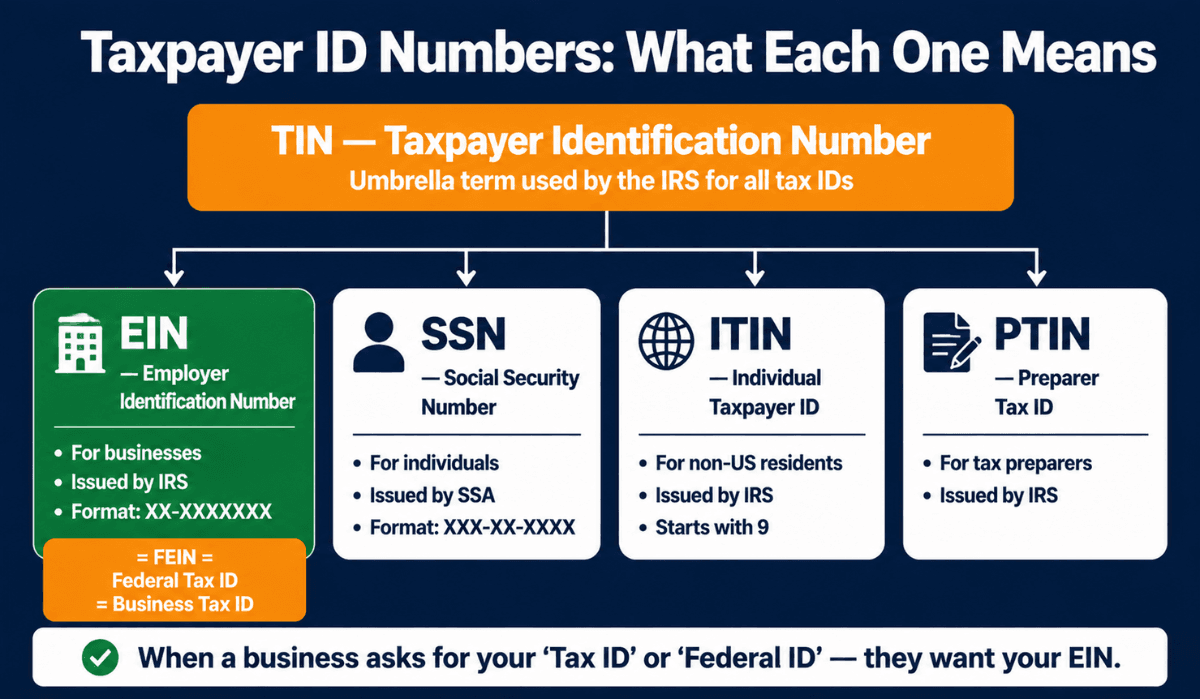
This is one of the most confusing parts of business taxes. Here's a simple breakdown:
TIN (Taxpayer Identification Number) is an umbrella term. The IRS uses TINs to identify taxpayers, both individuals and businesses. Types of TINs include:
- SSN for individual people
- EIN for business entities
- ITIN (Individual Taxpayer Identification Number) for people who don't have an SSN but need to file U.S. taxes (common for non-resident aliens)
- PTIN (Preparer Tax Identification Number) for tax preparers
FEIN simply stands for "Federal EIN". It's the same number, just emphasizing the federal (as opposed to state) origin. Federal Tax ID is another term for the EIN.
Bottom line: If you're a business and someone asks for your "tax ID," "federal tax ID," "FEIN," or "EIN," they all want the same nine-digit number the IRS gave your business.
How to Apply for an EIN (Step-by-Step)
Getting an EIN is completely free when you apply directly through the IRS. Here are all four ways:
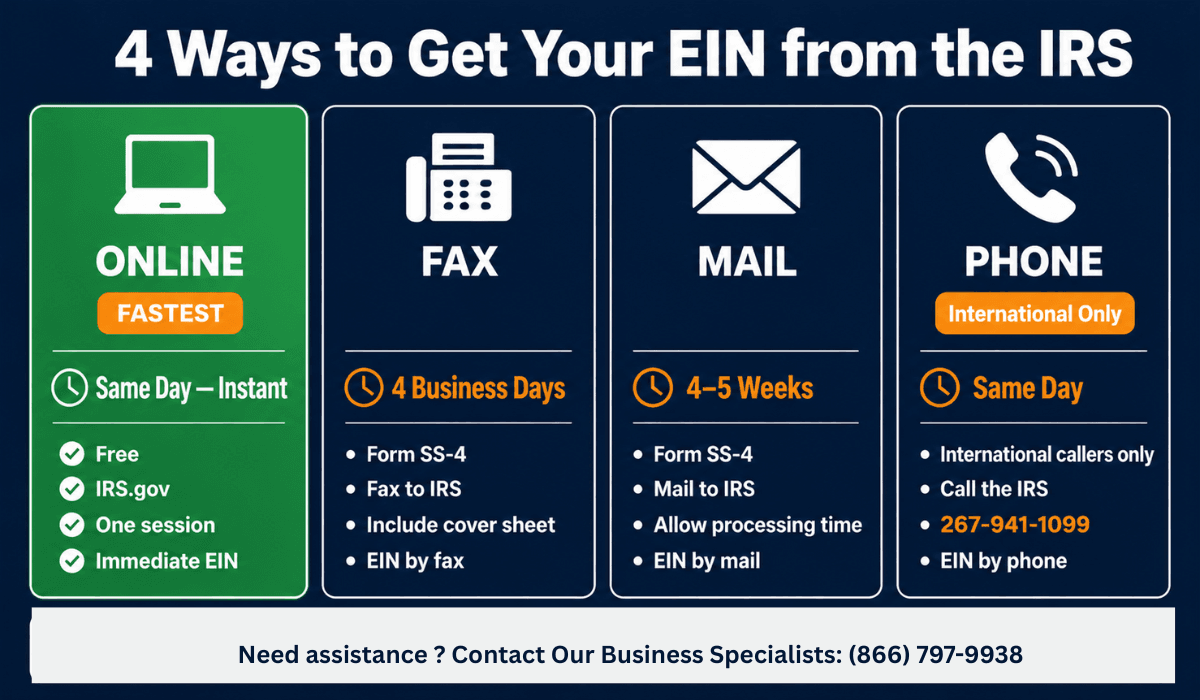
Option 1: Apply Online (Fastest)
Where: IRS EIN Online Application
Time: About 15 minutes. You get your EIN immediately upon approval.
Requirements:
- You must be the responsible party (owner/principal officer)
- You need a valid SSN or ITIN
- You must complete the session in one sitting (it times out)
- Your principal business must be located in the U.S. or U.S. territories
- Limit: One EIN per responsible party per day
Steps:
- Go to the IRS EIN Assistant page
- Select your business type (sole proprietor, LLC, corporation, etc.)
- Answer questions about your business and the reason for applying
- Provide the responsible party's SSN or ITIN
- Submit and receive your EIN instantly on screen
- Download and save your confirmation (the IRS will also mail Form CP-575)
Option 2: Fax Form SS-4
Where: Download Form SS-4 from IRS.gov
Time: About 4 business days
Fax number: Depends on your state; check the SS-4 instructions for the correct number
Option 3: Mail Form SS-4
Where: Mail the completed form to your IRS regional office (address listed in SS-4 instructions)
Time: 4–5 weeks
Option 4: Phone (International Applicants Only)
Who it's for: Business owners without U.S. residency
Phone: 267-941-1099 (not toll-free), Monday–Friday, 6 a.m.–11 p.m. ET
Time: Same day
Also Read: How to Apply For a Business EIN to know the process in detail.
Why Can't I Get an EIN Online?
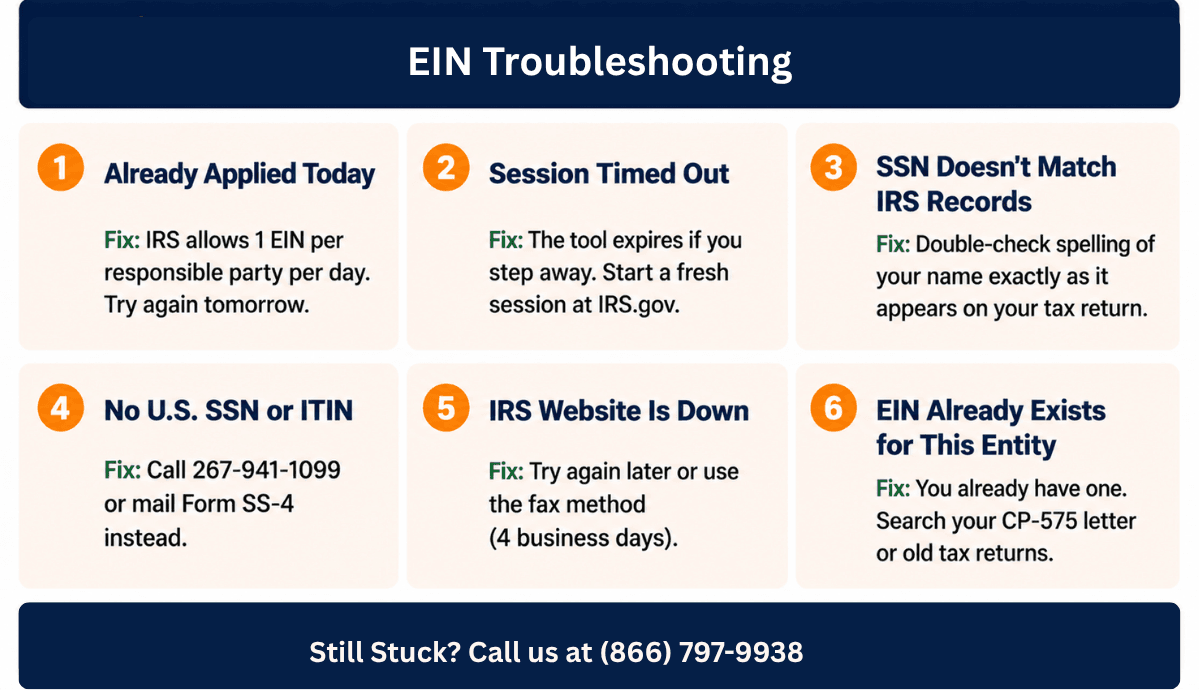
This is one of the most common frustrations new business owners face. Here are the main reasons the IRS online EIN application fails or gets blocked:
1. You Already Applied Today
The IRS limits EIN applications to one per responsible party per day. If you or your accountant already applied using your SSN today, you'll need to wait until the next business day.
2. Your Session Timed Out
The IRS online tool requires you to complete your application in a single session. If you stepped away, got distracted, or the page sat idle too long, the session expired. Start over from the beginning.
3. Your SSN or ITIN Doesn't Match IRS Records
The system verifies your identity in real time. If there's a mismatch like a typo, a name that doesn't exactly match IRS records, or outdated information, the application will be rejected. Double-check every field.
4. You Don't Have a U.S. SSN or ITIN
The online tool is only available to applicants with a valid U.S. SSN or ITIN. If you don't have one, you must apply by phone (267-941-1099) or by mailing Form SS-4.
5. You're Trying to Apply on Behalf of Someone Else (Without Authorization)
The online tool is designed for the responsible party to apply on their own behalf. Third-party applications must use Form SS-4 with a properly executed power of attorney (Form 2848).
6. The IRS Website Is Down
The IRS online tool has a history of occasional outages, especially during tax season. If you get an error message that isn't about your information, try again later or use the fax/mail method.
7. You Already Have an EIN for This Entity
Each business entity gets one EIN. If you previously applied and already received a number for this specific business, you cannot get a new one; you need to find the one you already have.
How to Look Up Your EIN Number
Forgot your EIN? Here's where to find it:
Check These Documents First:
- IRS CP-575 Notice: The confirmation letter that the IRS mailed when you first applied. This is the most reliable source.
- Past federal tax returns: Your EIN appears on Form 1120, 1065, Schedule C, or any other business return you've filed
- W-2 forms: If you've had employees, your EIN is on their W-2s
- Business bank account statements or paperwork: You provided your EIN when opening the account
- Business loan applications: It's on any financing paperwork
- State license or permit applications: Many states collect your EIN on these forms
Call the IRS:
If you can't find it anywhere, call the IRS Business & Specialty Tax Line: 1-800-829-4933 (Monday–Friday, 7 a.m.–7 p.m. local time). They will verify your identity and provide your EIN over the phone.
Looking Up Another Business's EIN:
The IRS does not provide a public EIN lookup database. However, you may be able to find another business's EIN through:
- SEC filings: Publicly traded companies list their EIN on annual reports (10-K) filed at SEC.gov
- Non-profit records: 501(c)(3) organizations must list their EIN on their Form 990, which is publicly available at ProPublica's Nonprofit Explorer or the IRS Tax Exempt Organization Search
- Business credit reports: If you are a vendor or lender with a permissible purpose
Can You Change or Cancel an EIN?
Changing Your EIN
Your EIN is meant to be permanent. You generally cannot change it just because you want a new one. However, you may need a new EIN if your business structure or ownership changes significantly, including:
- A sole proprietor who forms an LLC or corporation
- A single-member LLC that adds a partner (becomes a multi-member LLC)
- A partnership that incorporates
- A corporation that merges with another
Check the IRS page on when you need a new EIN to confirm whether your situation requires one.
Canceling an EIN
The IRS usually does not delete EINs. Once assigned, an EIN is permanently attached to that business entity. However, you can close your business account with the IRS by sending a letter to:
Internal Revenue Service Cincinnati, OH 45999
Include your EIN, the legal name of the business, the business address, and the reason for closing. The IRS will mark the account as closed or deactivated, but the EIN itself is never reused or reassigned.
Real-Life EIN Scenarios
Scenario 1: The Freelance Graphic Designer
Maria has been doing freelance design work for three years. She files taxes under her own SSN and sends a W-9 with her personal Social Security Number to every client. A client recently called her to say her SSN had been compromised.
What she should do: Apply for an EIN as a sole proprietor. It takes 15 minutes and costs nothing. From now on, she puts her EIN on every W-9, and her personal SSN stays private.
Scenario 2: The Side-Hustle E-Commerce Seller
James started selling handmade furniture on Etsy and Instagram. Business is going well, and he wants to open a dedicated business checking account to separate his finances. The bank tells him he needs an EIN.
What he should do: Apply online through the IRS EIN Assistant. Once he has the number, he takes it to the bank along with his business formation documents and opens the account the same week.
Scenario 3: The New LLC Owner Who Wants to Hire
Priya just formed her marketing LLC. She's the only member right now, but she's planning to hire a part-time assistant in a few months. Her attorney told her she needs an EIN before she can run payroll.
What she should do: Apply for an EIN now, before she hires. This gives her time to set up her payroll system, register for state payroll taxes, and have everything in place on Day 1 of her employee's first shift.
Also Read: How to Start a Business: 3 Simple Steps to File the Right Paperwork
Scenario 4: The Consultant Who Wants Business Credit
David runs a one-person IT consulting firm structured as a single-member LLC. He's been using his personal credit card for business expenses, and his personal credit score is taking a hit from the high utilization.
What he should do: Get an EIN (if he doesn't already have one), then apply for a business credit card using his EIN. Over time, his business credit history builds separately from his personal credit, protecting his personal score and creating a dedicated financial profile for his business.
Scenario 5: The Non-Profit Founder
Angela is starting a community food bank as a 501(c)(3) non-profit. Before she can apply for tax-exempt status with the IRS (Form 1023), she needs an EIN; it's one of the first requirements.
What she should do: Apply for an EIN online before filing any other formation or tax-exempt paperwork. The EIN goes on her Form 1023 and all future IRS filings.
Also Read: Complete Guide to LLC Formation, Taxes & Compliance 2026
State Tax IDs vs. Federal EIN
Your federal EIN is issued by the IRS and works nationwide. But many states also require a separate state tax ID number for things like:
- State income tax withholding from employee wages
- Sales tax collection and remittance
- State unemployment insurance (SUTA) taxes
- State business licenses
Your federal EIN and state tax ID are two different numbers for two different purposes.
Takeaway:
An EIN is more than a tax requirement; it is your business’s financial identity. By securing your Federal Tax ID, you protect your privacy, unlock business banking, and build credible credit. Take this simple step today to professionalize your venture and prepare for long-term growth.
Official Government Resources
- Internal Revenue Service. Apply for an Employer Identification Number (EIN) Online." IRS.gov. Accessed May 2026.
- Internal Revenue Service. Instructions for Form SS-4. Accessed May 2026.
Disclaimer: This article is for informational purposes only and does not constitute legal, tax, or financial advice. Consult a qualified tax professional or attorney for guidance specific to your business situation.
FAQs
No. The IRS issues EINs at no cost. If any website is charging you a fee, you are paying a third-party service; you can always get your EIN directly from the IRS for free.
No. Your SSN is a personal identifier issued by the Social Security Administration. Your EIN is a business identifier issued by the IRS. They are different numbers used for different purposes.
Corporations, partnerships, multi-member LLCs, and any business with employees are required to have an EIN. Sole proprietors and single-member LLCs without employees may not be legally required to have one, but it is strongly recommended.
If your small business has employees, operates as a corporation, partnership, or multi-member LLC, or files certain types of tax returns, then yes, you need an EIN. Even if none of those apply, getting an EIN is still a smart move.
Check your IRS CP-575 confirmation letter, past tax returns, business bank statements, or loan paperwork. If you still can't find it, call the IRS Business & Specialty Tax Line at 1-800-829-4933.
The IRS does not have a public EIN lookup tool. You'll need to find it through your own documents or call the IRS directly.
Your CP-575 IRS confirmation letter, past tax returns, W-2 forms, business bank account paperwork, loan applications, and state license applications.
Yes. Political action committees (PACs) must obtain an EIN. They are required to file tax returns with the IRS and must have a federal tax ID to do so.
The $600 rule refers to the IRS reporting requirement that requires businesses to issue a Form 1099-NEC to any contractor paid $600 or more in a year. To do this, you need the contractor's tax ID, either their SSN or their EIN (provided on Form W-9). Having your own EIN means you can give it out instead of your SSN.
No. Each business entity has one EIN. However, if you operate multiple legally separate business entities, each one will have its own EIN.
Even without employees or a formal business structure, a sole proprietor benefits from an EIN by protecting their personal SSN, opening a business bank account, building business credit, looking more professional to clients, and preparing for future growth.
The IRS does not cancel EINs. However, you can close your IRS business account by sending a written request to the IRS Cincinnati office with your EIN, business name, address, and reason for closing. The EIN number itself is permanently retired and never reused.