
Key Takeaways
- A series LLC splits one company into internal series, each meant to hold its own assets and debts.
- That internal shield is conditional on separate records and state-specific wording.
- About 22 states, plus DC and Puerto Rico, recognize series LLCs. Florida joined July 1, 2026.
- Fees and tax treatment vary sharply by state.
- Owners with two locations are often better served by separate LLCs.
A series LLC promises separate protection for each asset under one company. See how it differs from a traditional LLC, where it is allowed, and when it pays off.
What Is a Series LLC?
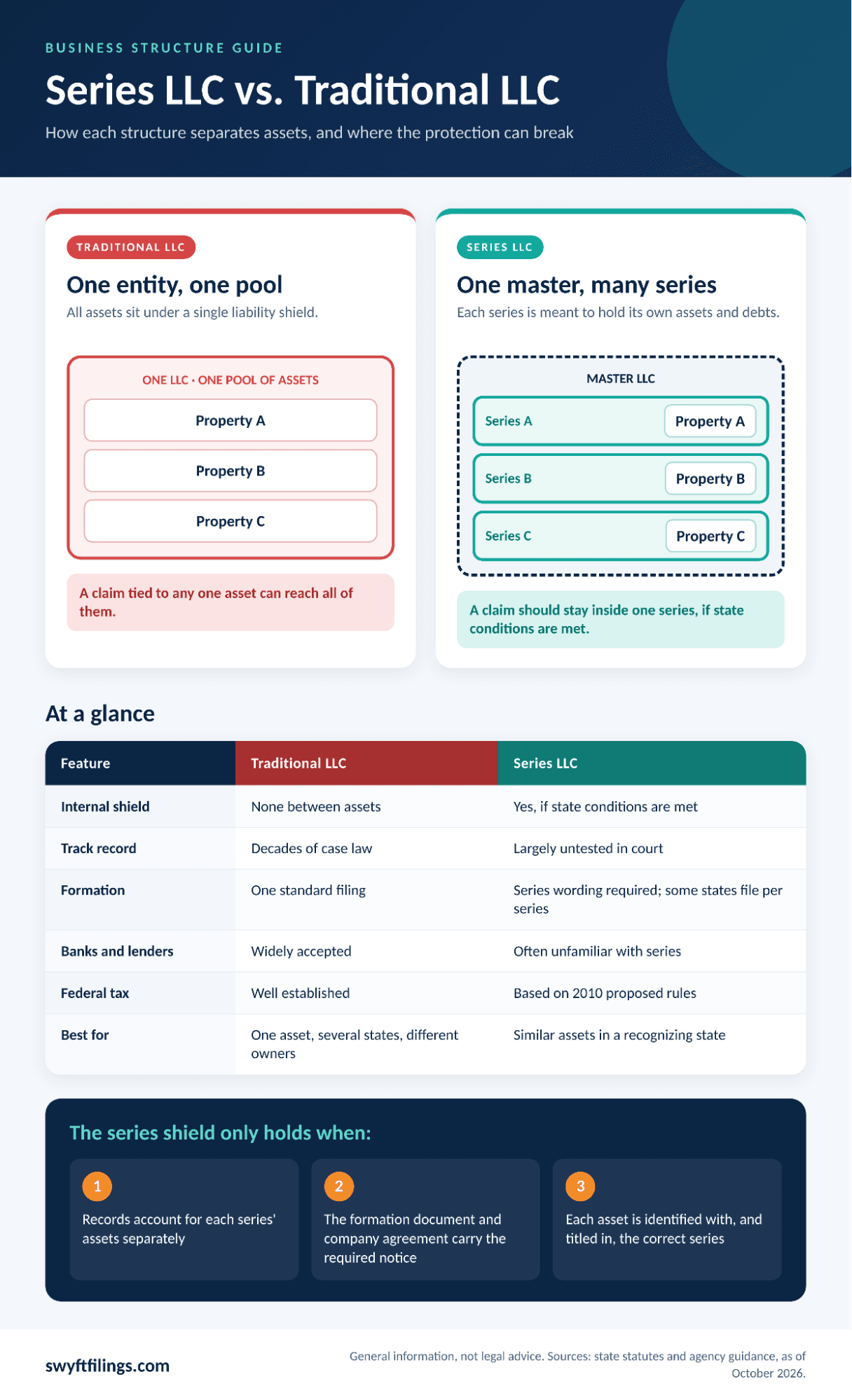
A series LLC is one “master” LLC that creates internal compartments called series, or cells. Each series is meant to hold its own assets and liabilities, so a claim against one series should not reach the others. A traditional LLC is a single entity with a single pool of assets.
Both structures give you the external shield between your personal assets and the business. The series adds an internal, sideways shield between series. Terminology differs by state, including “protected series” and “registered series,” so check which model your state uses.
Legal status varies too. Illinois treats each series as a separate entity, and Wyoming treats it as a separate person. Florida says a protected series is not a separate entity and gets no record number of its own.
Series LLC vs. Traditional LLC: Side-by-Side
Feature | Series LLC | Traditional LLC |
Structure | One master LLC with internal series | One entity, one pool of assets |
Internal liability shield | Yes, if state conditions are met | None between assets |
Legal track record | Largely untested | Decades of case law |
Formation | Series-enabling language required; some states file per series | One standard filing |
Bank, lender, and title acceptance | Often unfamiliar | Widely accepted |
Federal tax treatment | Based on 2010 proposed rules | Well established |
Best for | Similar assets in a recognizing state | One asset, multiple states, or different owners |
How the Liability Shield Works Between Series
The shield is conditional, not automatic. Texas is a clear example. A series’ debts are enforceable only against that series’ assets, but only if records account for each series’ assets separately and the formation document and company agreement contain the required notice. Miss either step, and the structure can collapse into a single LLC.
States that follow the Uniform Protected Series Act use “associated assets.” An asset must be identified as belonging to a series to be protected. Arkansas, which adopted the Act effective October 1, 2019, also requires a protected series designation filing.
Courts apply ordinary LLC veil-piercing rules to a series, and no series statute addresses piercing directly. Mixing funds across series hands a creditor that argument.
Series LLC Benefits
- Internal asset separation: One master LLC can hold several properties or business lines in separate compartments.
- Fewer entity-level filings: Depending on the state, the parent keeps one registered agent and one annual report instead of one per entity.
- Easier expansion: Nevada lets you create a series by adopting an operating agreement, with no articles filed for the series.
Series LLC Limitations
- Untested in court: The Bankruptcy Code does not recognize series LLCs, so outcomes are uncertain. In Alphonse v. Arch Bay Holdings (5th Cir. 2013), the court applied Louisiana law to decide whether the series or the master LLC was the proper party in a Delaware series dispute.
- Choice-of-law risk: A court in a state with no series statute may not honor the internal shield, which could expose every series and the master LLC.
- Divided professional opinion: Some advisors recommend avoiding series LLCs entirely, citing court uncertainty and lender reluctance. Others support them with caveats.
Which States Allow Series LLCs? (As of October 2026)
Published counts range from 14 to 24 jurisdictions, so treat any list with caution. The table follows the most detailed recent audit, which covered all 52 jurisdictions and links to statutes. Confirm your state with its Secretary of State before you file.
Status | Jurisdictions |
Domestic series allowed (22 states, plus DC and Puerto Rico) | Alabama, Arkansas, Delaware, Florida, Illinois, Indiana, Iowa, Kansas, Missouri, Montana, Nebraska, Nevada, North Dakota, Ohio, Oklahoma, South Dakota, Tennessee, Texas, Utah, Virginia, West Virginia, Wyoming |
Sources disagree | Wisconsin, North Dakota |
Foreign series only | Arizona, California, Hawaii, Maine, Maryland, Vermont |
No domestic regime | New York, Pennsylvania |
Florida’s law is the newest. The Florida Department of State confirms that you cannot file a Florida series LLC outright. An existing Florida LLC becomes one when it designates its first protected series.
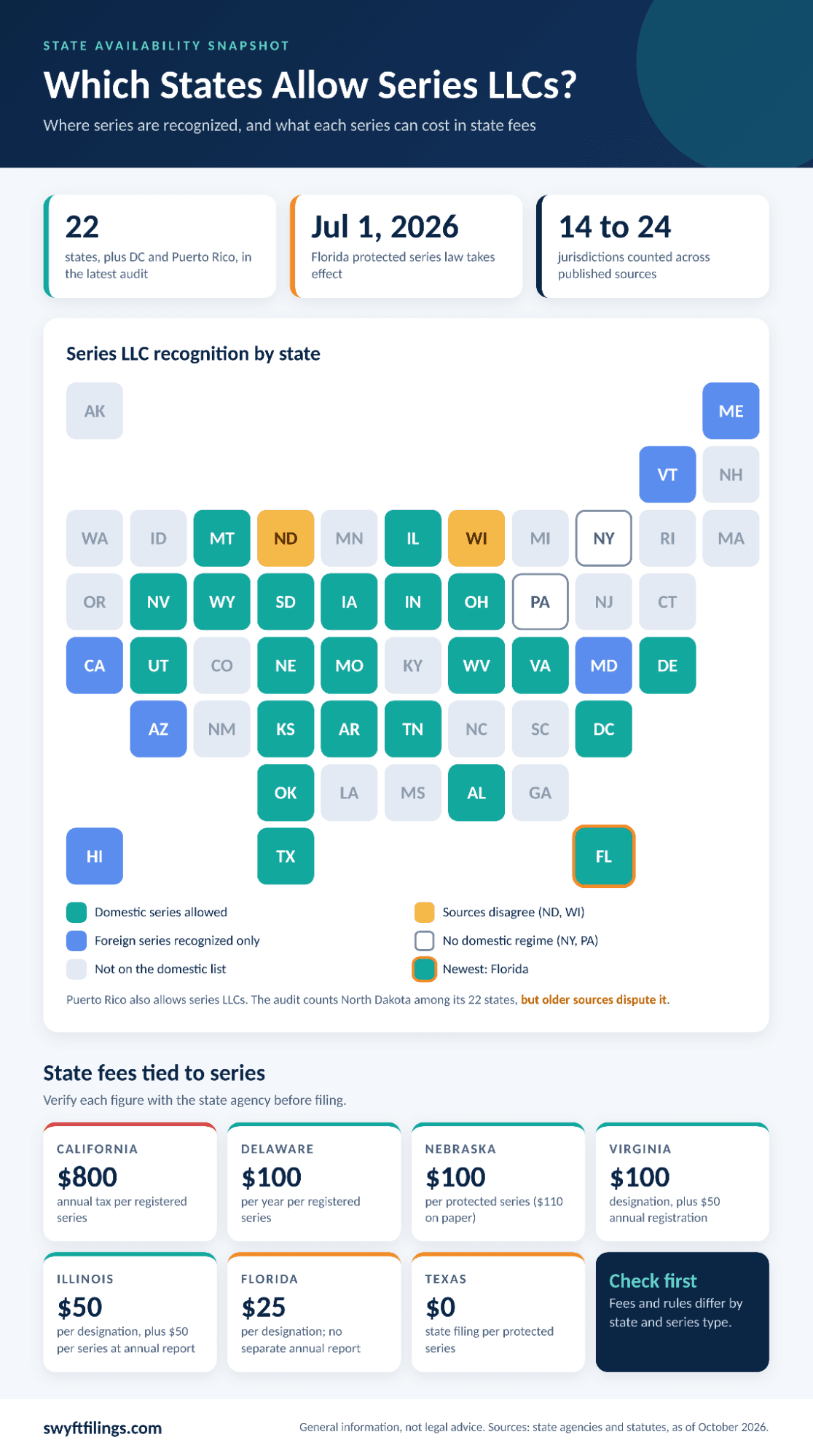
Wisconsin and North Dakota need extra care. Older sources say neither provides separate liability between series. The newer audit says North Dakota offers conditional segregation under NDCC §10-32.1-102. Read the statute before relying on either.
Series LLC for Real Estate
The common setup places one property in each series under one master LLC, so a claim at one property should not reach the others. Three issues decide whether it works.
- Title: Record each deed in the name of the series that owns it. Property left in the master LLC’s name is reachable by claims against it.
- Lenders and insurers: Mortgage lenders, title companies, and insurers often do not understand series structures. Some lenders take security over the umbrella and all series instead of the one borrowing, which defeats the purpose.
- Property in another state: A series formed in one state may not be respected where the property sits. A Texas series holding property in a state with no series law carries that risk.
Series LLC vs. Holding Company
A holding company is a parent LLC that owns separate subsidiary LLCs. Each subsidiary is a standalone entity with its own filings. Our guide on whether an LLC can own another LLC covers that structure in detail.
Holding companies win on separation and lose on cost. Each entity needs its own registered agent, EIN, bank account, and annual report. One Texas attorney ranks a landlord’s options from least to most protective: one LLC for all properties, then a series LLC, then multiple traditional LLCs. Where a state has no series law, formation advisors usually call a holding company the realistic choice. Either way, you must keep the entities separate, because a sued parent can put its subsidiary interests at risk.
Series LLC vs. Restricted LLC
A restricted LLC is a Nevada structure, not an alternative way to organize business assets. By default, it cannot make distributions to members for 10 years after formation or after the election amendment, unless the articles say otherwise (NRS 86.345). It works mainly as an estate-planning vehicle for moving assets within families.
Tax Treatment and Filing Requirements
Federal treatment rests on 2010 proposed regulations. They would treat each series as an entity formed under local law, then classify it under the check-the-box rules. They do not say whether a series with no assets or activity is a separate entity, and they do not address employment taxes. Confirm their current status with a CPA before relying on them.
State treatment differs. California treats each registered series as a separate LLC that pays its own $800 annual tax and files its own return, according to the Franchise Tax Board. Tennessee’s tax department concluded that each series is a separate LLC for franchise and excise tax.
Series LLC Cost Comparison
Savings depend on the state, and no break-even number, such as “three assets,” holds up everywhere. These figures are state fees gathered from public sources. Verify each one with the state agency.
State | Series-related state costs |
Texas | $300 filing for series or traditional LLCs; protected series need no state filing, extra registered agent, or annual report |
Illinois | $400 filing; $50 per Certificate of Designation; annual report $75 plus $50 per qualifying series |
Nebraska | $100 online or $110 paper per protected series designation; biennial filing covers parent and each series |
Virginia | $100 designation and $50 annual registration per protected series |
Delaware | $400 parent annual tax; registered series add $100 per year; protected series need no extra filing |
Florida | $25 per designation; no separate annual report; $5 certificate of status per series |
California | $800 annual tax per registered series, plus the applicable LLC fee |
Operating Agreement Essentials
Have an attorney tailor the agreement. A generic template will not do. Cover these points:
- The statutory notice language your state requires, in both the formation document and the agreement.
- How series are created, managed, and dissolved, and who manages each one.
- For Delaware, an exhibit listing each protected series, and possibly a short agreement per series.
- Ownership, associated assets, records, distributions, and termination, matched to the statute.
- Separate books. Separate bank accounts, insurance, and contracts per series help show separation, though they are not universal statutory requirements.
Is a Series LLC a Good Idea?
Your situation | Better fit |
One asset | Traditional LLC |
Two locations | Often two separate LLCs, which are simpler and cleaner even at a higher upfront cost |
Several rentals in one recognizing state | Series LLC, if you keep separate records and your lender accepts it |
Assets in a non-recognizing state or several states | Traditional LLCs or a holding company |
Different owners per asset | Separate LLCs |
Lenders that require standalone entities | Separate LLCs |
If you are weighing one LLC with DBAs against separate entities, read our guide on running multiple businesses under one LLC. For a wider view of structures, see the different types of LLCs. This is general information, not legal advice.
Can You Convert a Traditional LLC to a Series LLC?
Sometimes. The method is state-specific.
- Texas: amend the certificate of formation and company agreement.
- Delaware: file a certificate of amendment adding series language, and update the operating agreement.
- Florida: designate your first protected series.
Other states require series status at formation, which means dissolving and re-forming. After converting, allocate assets and separate records by series. Our guide to changing an LLC to a series LLC walks through the process. Use the state table above for current availability.
Next Steps With Swyft Filings
Swyft Filings does not offer series LLC formation. If separate entities fit your goals, we can form your LLC in any state, prepare your operating agreement, and provide registered agent service. Operating outside your home state? Foreign qualification registers you there, and ComplianceGuard tracks annual report deadlines. Swyft Filings is not a law firm, so have an attorney or CPA review legal and tax questions.
FAQs
In many states, yes. Delaware, for example, lets each series have its own members and managers. Still, differing ownership per asset is a situation where advisors say separate LLCs may be cleaner.
Generally, yes, if the statute and operating agreement provide for it. Florida offers articles of protected series dissolution for this purpose.
There is no universal rule. Published guidance conflicts: some sources say one EIN covers all series, others say each needs its own. The answer depends on how each series is classified and on your facts, so confirm with a CPA before opening accounts.
That is the intent. Sign in the series’ name, not the umbrella entity’s name, so the contract clearly belongs to one series.