
Key Takeaways
- Yes, a trust can own an LLC if the operating agreement permits it.
- Probate is avoided only after you sign a written assignment.
- Revocable trusts add no creditor protection; irrevocable trusts add some but cost control.
- A revocable trust usually leaves your income taxes unchanged.
- Check the operating agreement and lender terms before transferring.
A trust can own an LLC, but the operating agreement, trust type, and tax status decide how. Learn the benefits, tax effects, and the steps to transfer your membership interest.
Yes, a trust can own an LLC. The trustee holds your membership interest, and the LLC keeps operating as before. Whether the move helps depends on three things: what your operating agreement allows, which trust type you use, and how the LLC is taxed. We will walk you through each in order.
Can a Trust Own an LLC?
State LLC laws generally let a trust be a member, but your operating agreement can restrict it. Many agreements require other members' consent before any transfer, so a single-member LLC has the easiest path. For more information about the membership process, see how to add a member to an LLC.
Multi-member LLCs can have a trust as one member. Be careful when one trust holds a couple's combined interests. In some states, that can make the LLC look single-member and weaken protection against outside creditors. Some practitioners suggest a separate trust for each spouse. Ask an attorney about your state.
Why Owners Put an LLC Into a Trust
Continuity - A successor trustee can step in if you die or become incapacitated, without waiting for a court to appoint someone. Without that, a single-member LLC can stall: no one has authority to sign, approve distributions, or deal with the bank until a court names a representative. That delay is what hurts operating businesses most.
Probate avoidance - This works only if the interest is actually assigned to the trust.
Asset protection: limited - A revocable trust gives no protection from your personal creditors, and it does not strengthen the LLC's own liability shield. The shield still depends on keeping a separate bank account and following your operating agreement. Irrevocable and asset-protection trusts can add protection, but the rules are state-specific.
Keep the roles straight. The LLC limits business liability. The trust decides who owns and controls the interest later. They work together, not as substitutes.
Revocable vs. Irrevocable Trust for LLC Ownership
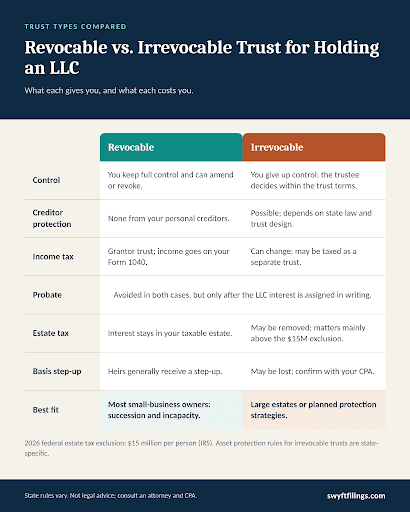
For most small-business owners, a revocable trust does the job: succession, incapacity planning, and probate avoidance while you keep control. An irrevocable trust means giving up control, so it rarely makes sense without a specific goal.
Estate tax is the usual reason to go irrevocable. The 2026 federal exclusion is $15 million per person, so most owners are well below it.
Check Your Operating Agreement First
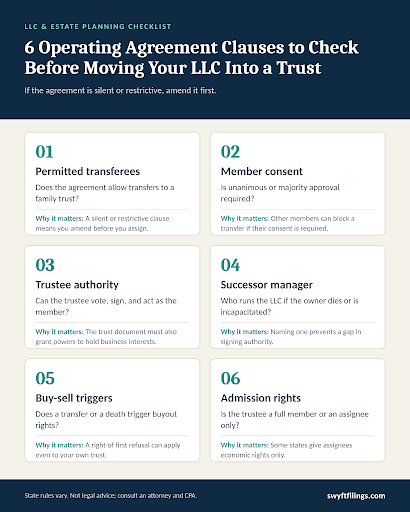
The trust can step in only if the agreement lets it. If you never wrote one, state default rules apply, and they may not fit a trust at all. A custom operating agreement fixes that.
In a multi-member LLC, also look for a right of first refusal. It can let the other members block or buy out a transfer, even to your own trust.
Assignee rights vary too. Georgia law can treat an assignee as holding economic rights only, unless the members admit the trustee as a full member. Write the admission into the agreement.
If clauses are missing, adopt an operating agreement amendment and update your member ledger. If your state lists members or managers publicly, you may also need to file Articles of Amendment.
How to Put an LLC Into a Trust: Step by Step
State rules vary, so confirm each step with counsel.
- Create a trust, or confirm yours authorizes the trustee to hold business interests.
- Review the operating agreement and collect any required member or manager consent.
- Check lender covenants, buy-sell terms, insurance, and the LLC's tax classification.
- Sign a written assignment of membership interest, with the trustee accepting it.
- Amend the operating agreement, member ledger, and any certificates. A members' resolution can document the approval.
- File a state amendment where required.
- Update your bank, insurance, and lender records, and fund the trust with future assets.
A good assignment names the LLC, states the percentage transferred and the effective date, and carries signatures from both the owner and the trustee. Attach it to the operating agreement records. A line on the trust's asset schedule is not a substitute, because it does not change who holds the interest.
Do this while you have capacity. Once you cannot sign, someone acting for you needs express authority, and without it a court may have to get involved.
You do not need a federal beneficial ownership report. FinCEN's final rule, effective August 14, 2026, permanently exempts U.S. companies from BOI reporting. Banks still collect ownership details at account opening, and some states run their own ownership filings, so check yours.
Tax Consequences of a Trust-Owned LLC
- Revocable trust: A revocable trust is a grantor trust, and a single-member LLC is disregarded. Income stays on your Form 1040, and the transfer is not a taxable event (see the IRS grantor trust Q&A). If spouses co-own the LLC, ask a CPA whether partnership rules apply.
- QBI deduction: When a grantor trust owns the LLC, you compute the deduction as if you held it directly (Form 8995 instructions; 26 CFR 1.199A-6). Congress made the deduction permanent.
- S corporations: A revocable trust can hold S corp shares during your life. After death, it has two years before it must qualify as a QSST or ESBT. An ESBT pays tax at the top rate at the trust level.
- Irrevocable trusts: Tax treatment can change. Revocable-trust assets generally stay in your taxable estate, so heirs typically get a stepped-up basis. Assets moved to an irrevocable trust may lose that step-up, which can mean larger capital gains later. Get CPA input first.
- Outdated warning: Some articles say transferring an interest can terminate the partnership for tax purposes. That "technical termination" rule was repealed for years after 2017.
Who Signs for a Trust-Owned LLC?
The trustee signs as the member, for example, "Jane Doe, Trustee of the Doe Family Trust." Day-to-day documents, such as contracts and bank forms, are signed by the manager or managing member under the operating agreement. With a revocable trust, you can usually serve as your own trustee, so little changes in daily operations.
Plan for the handoff. Name a successor trustee who can handle business decisions, and a successor manager in the operating agreement. If they are different people, make sure the documents say who has the final word on major decisions.
Real Estate LLCs: Lenders and Liability
Ask your lender before moving a mortgaged property's LLC interest. Some lenders treat ownership changes as a due-on-sale trigger, and some lend to trusts but not LLCs. Get written approval where the loan documents are unclear.
Order matters. Practitioners commonly advise titling the property in the LLC first, then assigning the LLC interest to the trust, rather than putting the same property in both. They also recommend one property per LLC with separate bank accounts, so a claim against one property cannot easily reach the others. Holding several LLCs in one trust does not merge them, but commingling money can.
Alternatives and When You May Not Need This
Some firms prefer a transfer-on-death designation of the LLC interest to a trust, since it avoids transferring now. Others assign now to avoid gaps. Partners can add a buy-sell agreement that sets who may buy a deceased member's share and at what price, so heirs do not become unwanted co-owners.
A will alone does not solve the problem, because the LLC interest still passes through probate. You may not need a trust if your estate is small, no one will take over the business, or you already use another probate-avoidance tool.
What Does It Cost?
Fees vary widely. Drafting the trust itself costs more. Swyft Filings handles LLC filings and operating agreements; an estate planning attorney should draft the trust, and a CPA should review the tax effects.
FAQs
No. A trust is not an asset an LLC can own. An LLC can act as a trustee or hold property for a trust, but ownership flows the other way: the trust owns the membership interest.
The assignment itself is a short document, but the trust, the operating agreement, and tax status interact. Use an estate planning attorney for the trust and any consent issues, and a CPA for tax questions.
Typically not. The LLC remains the same legal entity, and only the member changes. Update your operating agreement, member ledger, and bank records so they match the new ownership.
Yes, if the trust names them. Many couples serve as co-trustees. The operating agreement must still let a trustee act as a member, and the successor you pick should be able to run the business.