Key Takeaways
- One LLC can operate multiple businesses, but all activities share the same legal entity and liability exposure.
- Separate LLCs help protect business assets and keep liabilities separate, especially when businesses operate in different industries.
- A holding company can centralize ownership of multiple LLCs, but it does not automatically provide better liability protection or tax savings.
Understand the key differences between an LLC and a holding company, including liability protection, taxes, costs, and how to choose the right structure for multiple businesses.
Should you run everything under your existing LLC, form a separate LLC for each business, or establish a holding company?
The answer depends on what you're trying to protect and how you plan to grow.
An LLC is a legal business entity, while a holding company is an entity that owns other businesses or assets. A holding company can itself be an LLC. For owners of multiple businesses, the real choice is often between one LLC, several independently owned LLCs, and a holding LLC with subsidiaries.
Each arrangement offers different levels of liability separation, administrative complexity, and ownership flexibility.
Here's how to decide which one makes sense for your business.
LLC vs. Holding Company: Key Differences
Factor | One LLC for Multiple Businesses | Holding Company Structure |
Structure | One LLC operates multiple businesses | A parent company owns separate business entities |
Liability protection | Liabilities of one activity can affect assets held by the same LLC | Separate subsidiaries can help isolate liabilities |
Formation costs | Generally lower | Generally higher |
Ongoing paperwork | Less administration | Separate filings, records, and compliance |
Taxes | Depends on LLC tax classification | Depends on parent and subsidiary tax classifications |
Adding investors | Can be more complicated for individual ventures | Often easier to structure investments by subsidiary |
Best for | Small, related, lower-risk businesses | Multiple growing businesses with different risks |
Example: You Own Three Businesses
Option 1: One LLC Operates All Three Businesses
All three activities belong to one legal entity. Using different trade names or DBAs does not create separate liability protection.
Option 2: A Holding Company With Three Subsidiaries
Each subsidiary is a separate legal entity, helping contain business-specific liabilities when properly maintained. However, liability protection is not absolute.
Which Structure Should You Choose?
- Choose one LLC if your businesses are closely related, have relatively low liability risks, and keeping costs down is your priority.
- Choose separate LLCs if your businesses face different risks and you want liability separation without introducing a parent company.
- Choose a holding company with subsidiary LLCs if you want centralized ownership, plan to acquire more businesses, or expect to bring in investors or sell individual businesses.
What About Taxes?
A holding company does not automatically reduce your taxes. The IRS generally treats a single-member LLC as a disregarded entity for federal income tax purposes unless it elects corporate taxation. Multi-member LLCs are generally taxed as partnerships by default.
Your tax outcome depends on the ownership structure, tax elections, state laws, and how profits move between entities.
A business attorney and CPA should review the structure before you transfer ownership or assets.
Should You Form Separate LLCs for Businesses in Different Industries?
Separate LLCs are often worth considering when your businesses operate in different industries with different liability risks.
For example, separating a marketing agency, an e-commerce business, and a rental-property business into individual LLCs can help prevent liabilities arising from one business from automatically affecting the others.
You can own these LLCs directly or through a holding company, depending on your ownership and management needs.
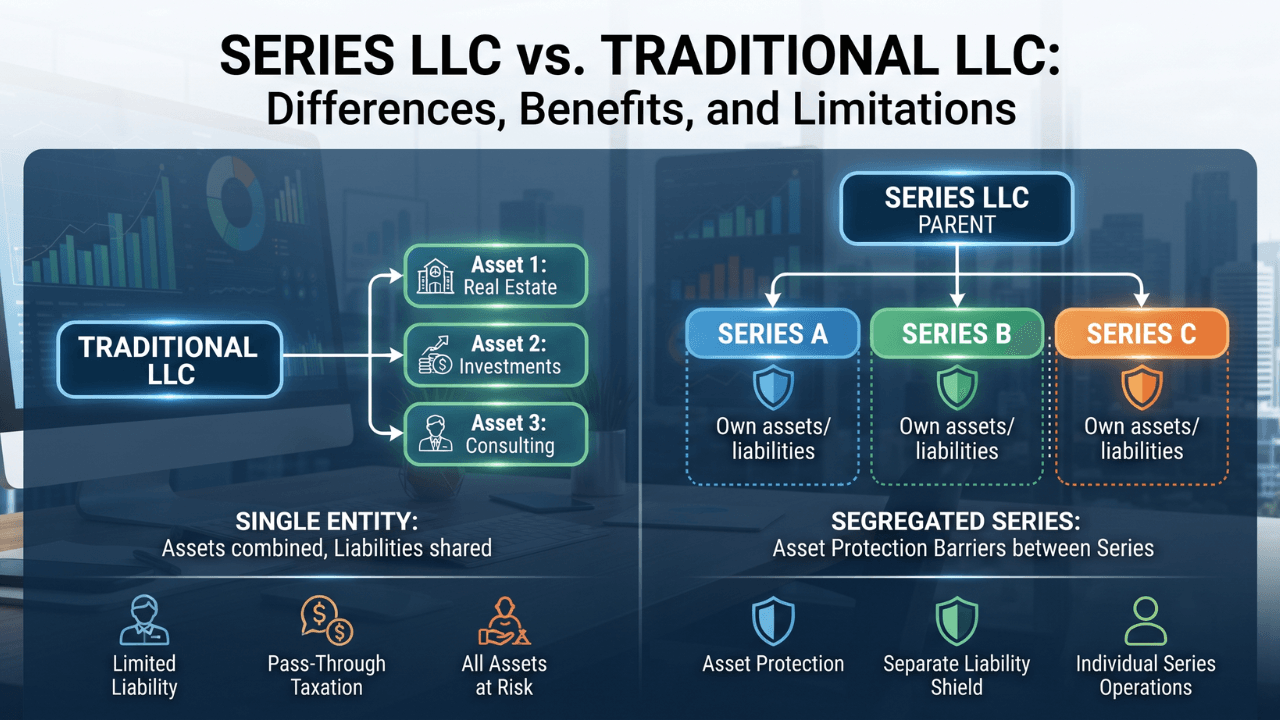
Holding Company vs. Series LLC: Which Is Better for Multiple Businesses?
A Series LLC is another structure worth considering, particularly for certain real estate or asset-holding arrangements.
Where permitted by state law, a Series LLC may allow an LLC to establish separate series associated with particular assets or business activities.
For example, Delaware law allows LLCs to establish protected series with separate liability protections, provided they meet specific legal requirements, including maintaining separate asset records.
This differs from a conventional holding-company structure, where each subsidiary LLC is separately formed as its own legal entity.
However, Series LLC rules vary considerably by state. Their treatment across state lines, filing requirements, and available liability protections require careful review.
A Series LLC should not be assumed to offer identical protection or lower costs in every jurisdiction.
For owners operating in multiple states, independently formed subsidiary LLCs may be easier to evaluate because each entity's formation and registration status can be considered separately.
Before choosing a Series LLC, confirm that the relevant states recognize the structure and understand the rules governing each series.
If you already operate an LLC and are considering this alternative, learn how to convert an existing LLC into a Series LLC, including the state-specific requirements and filing steps involved. |
NOTE: These are general starting points. A business attorney and tax professional can help evaluate the actual risks and costs of your situation. |
How Do You Set Up a Holding Company for Multiple LLCs?
If a holding-company structure fits your goals, establishing one generally involves forming or selecting a parent entity and arranging for it to own the intended subsidiaries.
The broad process is:
- Choose the parent entity and formation state. Consider where the businesses operate, state requirements, ownership plans, and potential registration obligations.
- Form the holding LLC. File the required state formation documents, designate a registered agent, and establish an appropriate operating agreement.
- Form or acquire the operating LLCs. Arrange for the holding LLC to own the intended membership interests, subject to applicable legal requirements.
- Document ownership and financial arrangements. Maintain suitable operating agreements, banking arrangements, records, and documentation for transactions between entities.
- Meet ongoing compliance obligations. Track applicable state filings, fees, tax registrations, business licenses, and other requirements.
If you already own LLCs, placing them under a new holding company may involve transferring membership interests rather than forming replacement businesses.
Before doing so, review existing operating agreements, financing documents, ownership restrictions, and potential tax consequences.
For a detailed explanation of LLC-to-LLC ownership and the formation process, read Can an LLC Own Another LLC?. |
Choosing the Right Structure for Your Businesses
You don't need a holding company simply because you own more than one business.
One LLC may be suitable for closely related activities. Separate LLCs can help isolate different business risks. A holding LLC can add centralized ownership when your portfolio becomes more complex.
The right choice is the one that provides the legal separation and ownership flexibility you actually need without adding unnecessary expense.
Ready to establish a new business entity? Explore Swyft Filings' LLC formation services to get started, and consult qualified legal and tax professionals before implementing a complex ownership structure.
FAQs
Yes. A holding company may own interests in other LLCs as well as real estate and other assets. However, directly owning property can expose the holding company to property-related liabilities. Some owners instead place individual properties in separate subsidiary LLCs to help separate liabilities.
It depends on the holding company's federal tax classification, activities, and other requirements. A disregarded single-member LLC without employees or certain excise-tax obligations may not need a separate EIN for federal tax purposes. However, a bank or state requirement may make obtaining one necessary.
Depending on the entity's tax classification and governing agreements, owners may receive distributions or other properly structured payments. The tax treatment depends on the circumstances. Not all payments are deductible business expenses or tax-free distributions, so owners should consult a qualified tax professional about their specific situation.
Yes. Restructuring existing business ownership may be possible by establishing a parent holding company and transferring eligible membership interests to it. However, these transfers can involve approvals, contractual restrictions, tax consequences, and other legal requirements. Professional legal and tax review is important before changing ownership.
Not necessarily. Asset protection primarily comes from maintaining separate legal entities for different businesses and assets, rather than simply adding a holding company. For example, if your online store faces a lawsuit, assets belonging to your separately maintained marketing agency or rental property LLCs are generally protected from that claim, whether you own those LLCs directly or through a holding company. A holding company centralizes ownership and management but does not automatically provide greater liability protection than properly maintained separate LLCs.
An LLC holding company can simplify ownership and management of multiple businesses, organize acquisitions and future investments, support succession planning, and facilitate coordinated funding between subsidiaries. Properly maintained subsidiary LLCs can also help separate business liabilities. However, a holding company adds formation and maintenance costs, recordkeeping responsibilities, potential conflicts with minority owners, and greater legal and tax complexity when transferring or restructuring businesses.