
Key Takeaways
- One LLC can legally run multiple businesses via DBAs, but all ventures share the same liability shield.
- A lawsuit against one business exposes assets of every business under that LLC.
- DBAs are naming tools only — no new entity, no added protection.
- Tax filing changes format, not amount owed, regardless of structure.
- Separate LLCs, a holding company, or a Series LLC offer stronger liability separation for riskier or unrelated ventures.
Two unrelated businesses, one LLC; it is legally allowed, but risky. Learn how DBAs work, what it does to your liability shield, and three safer structures to consider.
In July 2026 alone, Americans filed 578,926 new business applications, according to the U.S. Census Bureau. A good share of those filings came from people who already own a company and are simply adding a second one.
Say you run a landscaping business and want to add snow removal. Or you freelance as a consultant and just launched a small online shop on the side. Do you need a brand new LLC for that, or can your current one carry both?
The short answer is your existing LLC can almost always take on a second business. The real question is whether it should. This guide breaks down how running multiple businesses under one LLC actually works, where it saves you money, where it can quietly put your whole company at risk, and the alternatives worth considering before you decide.
Can You Legally Run Two Businesses Under One LLC
Yes. Every state lets you form an LLC for any lawful purpose, and no state caps how many products, services, or industries one LLC can operate in. Your formation paperwork almost never requires you to list every activity your company will pursue, and most states do not require you to amend anything or notify them when you add a new line of business later.
So if you already formed an LLC and want to launch a second, unrelated venture through it, you generally do not need permission from anyone. Your LLC can sign contracts, hire staff, and collect revenue from as many business activities as you want. Being allowed to combine businesses and being smart to combine them are two different questions, which is exactly what the rest of this guide untangles.
The Two Ways to Structure Multiple Businesses Under One LLC
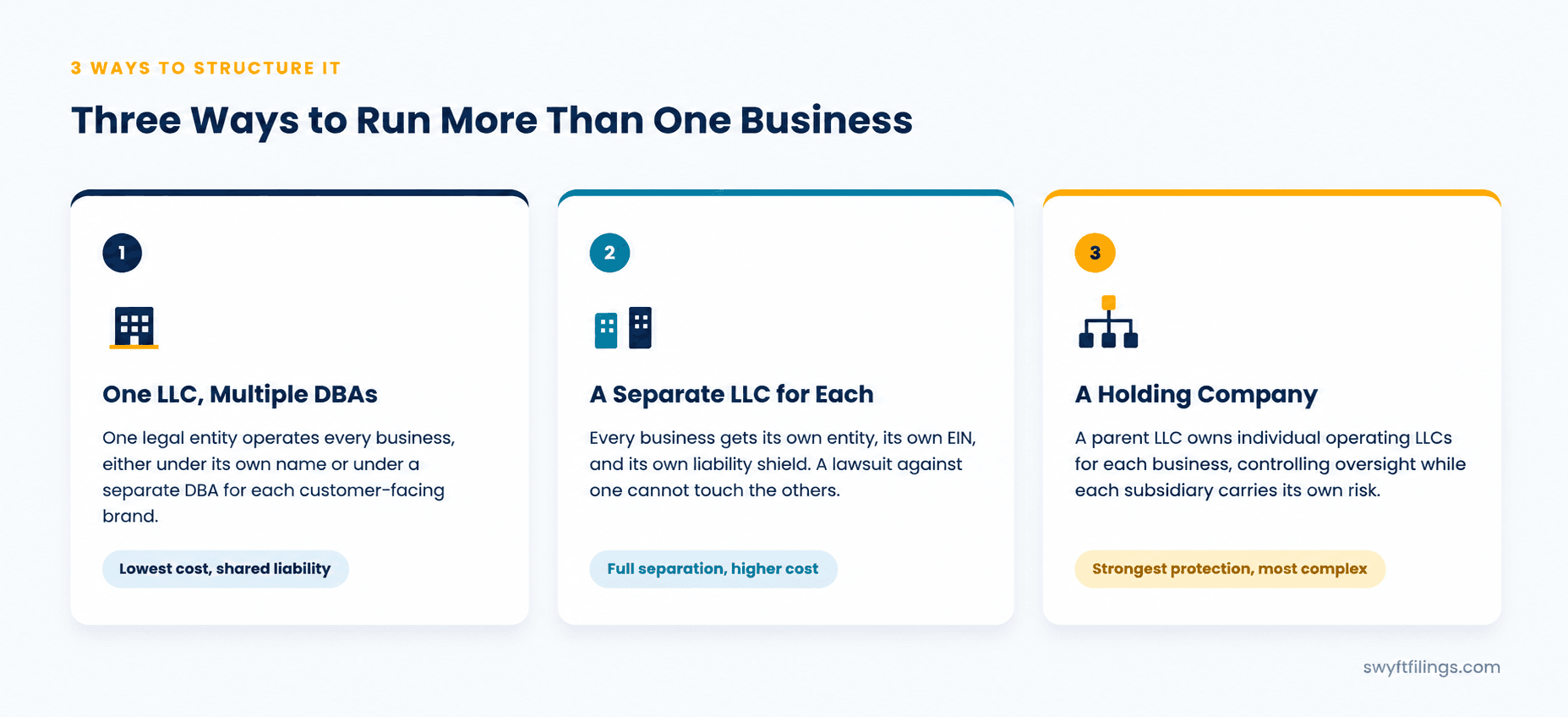
Business owners combine ventures under one LLC in one of two ways.
Run everything under your LLC's legal name: Every invoice, contract, and customer interaction uses your official LLC name, no matter which business activity generated it. This works well when your two ventures are closely related or when separate branding does not matter to your customers.
Register a DBA for each business: A DBA, short for doing business as (also called a trade name, fictitious name, or assumed name depending on the state), lets your LLC operate publicly under a different name for each venture while remaining the same legal entity.
For example, Harper Ventures LLC could run a food truck under the DBA Harper's Curbside Kitchen and a catering service under Harper Events Co. Both share one EIN, one tax return, and one liability shield. Customers never see the LLC's legal name.
A DBA is a naming tool, not a legal shield. It does not create a new entity or separate liability between your ventures. Requirements vary by state. Florida renews DBAs every 5 years with a published notice, Texas renews every 10 years, and New York requires no renewal.
The Real Upside of One LLC for Multiple Businesses
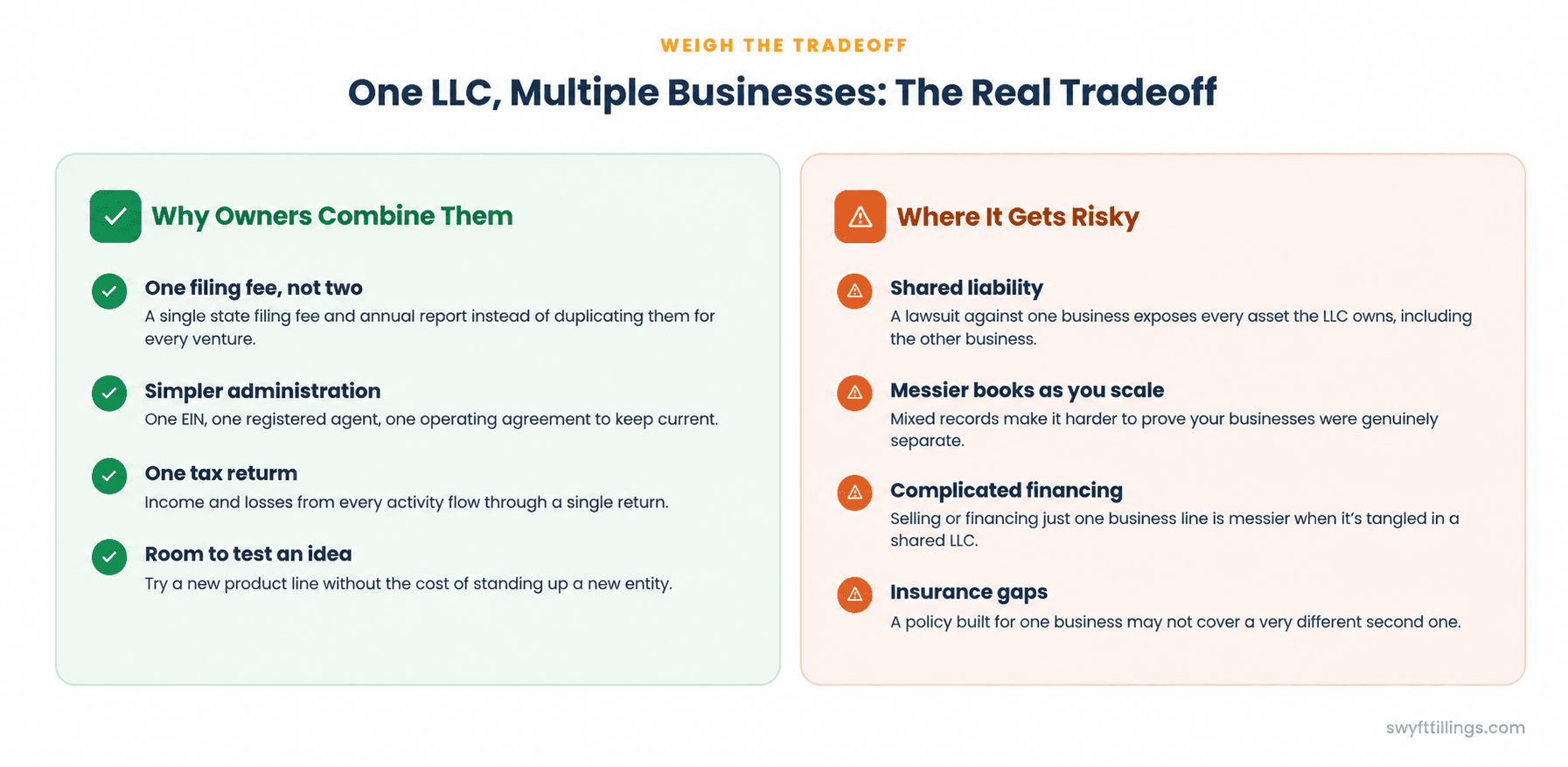
Combining ventures under a single LLC comes with a few clear advantages.
- One filing fee, not two. A single state filing fee and annual report instead of duplicating them for every venture.
- Simpler administration. One EIN, one registered agent, and one operating agreement to keep current.
- One tax return. Income and losses from every activity flow through a single return, which usually means a lighter bill from your accountant.
- Room to test an idea. Try a new product line or side venture without the cost and paperwork of standing up a new entity.
- Shared resources. Cash and credit in one business line can support the other during a slow month.
For an established business experimenting with a second line, that simplicity is genuinely valuable.
The Hidden Risk That Catches Owners Off Guard
Here is the tradeoff nobody mentions enough. When two businesses share one LLC, they share the exact same liability shield, and that protection cuts both ways.
If a customer sues one business line, every asset the LLC owns, including the bank balance and equipment of your unrelated business, is exposed, not just the assets tied to the business that got sued.
A few other risks compound that exposure:
- Messier books as you grow: Tracking separate revenue and expenses for each activity takes real discipline. Mixed records make it harder to prove your businesses were properly separated if a dispute lands in court.
- Complicated financing: Selling one business, bringing on a partner for just one line, or getting a loan tied to a specific venture gets messy when it is tangled inside a shared LLC.
- Insurance gaps: A policy written for one type of business may not cover a very different second line, and insurers may ask questions if your registered activity does not match what you actually do.
Courts can also go further than most owners expect. Some states now recognize enterprise liability, where a judgment against one company can reach a commonly owned affiliate if the businesses were not run as genuinely separate operations. The less related your two businesses are, and the riskier either one is, the more this shared structure works against you.
How the IRS Treats Your Combined Businesses
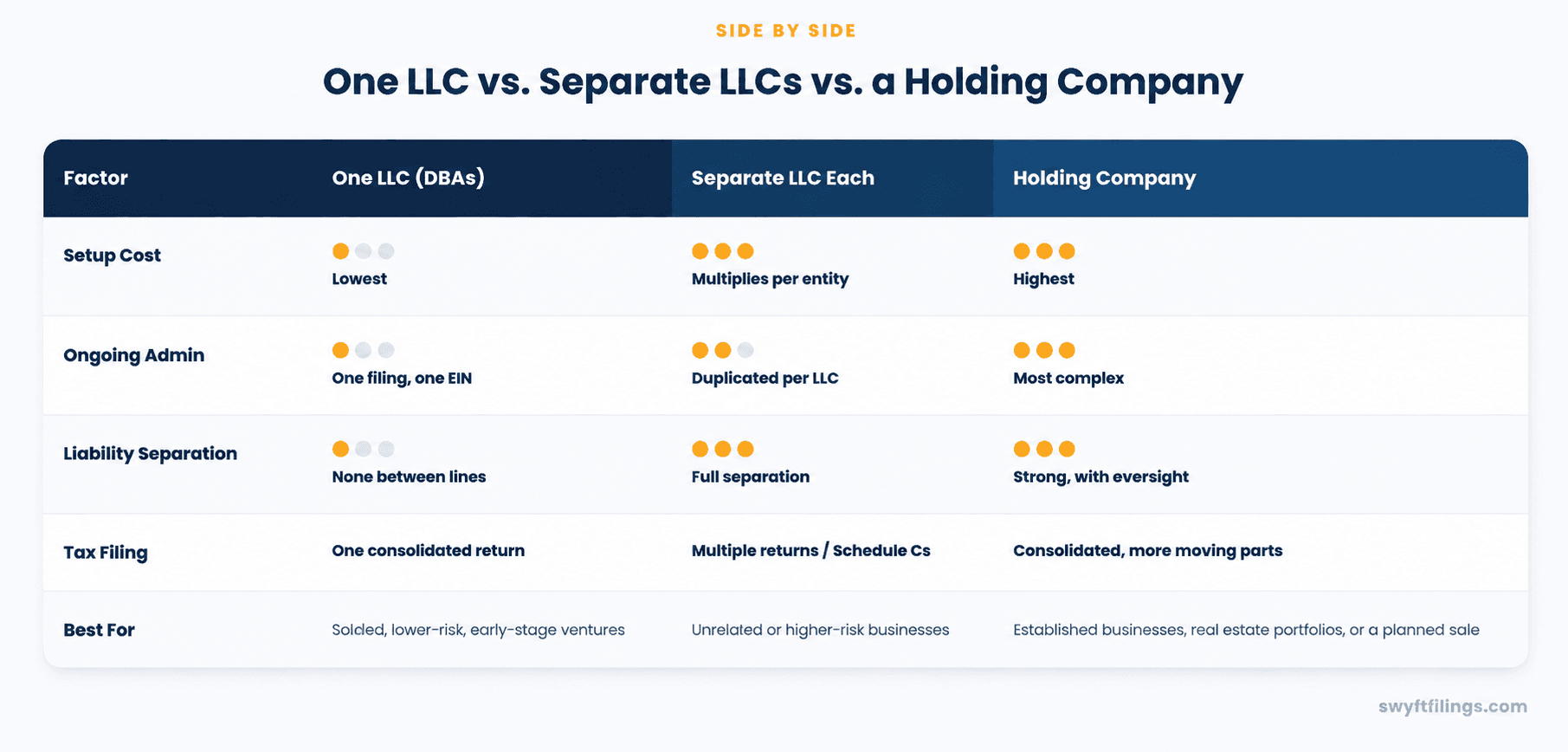
Running two businesses through one LLC almost never changes how much tax you owe. It changes how you report it.
If you are a single-member LLC, each business activity typically gets reported on its own Schedule C, and every Schedule C flows into your personal Form 1040. If you have partners, your LLC files one Form 1065 for all activities combined, and each member gets a single K-1 showing their share. An LLC taxed as an S-Corp consolidates everything into one return before profit passes through to the owners.
Compare that to separate LLCs, where each entity typically files its own return, and the totals still land on your personal return the same way. The dollar amount you owe tends to end up similar either way. The real difference is paperwork, not your tax bill.
One habit matters regardless of which structure you choose. Keep separate bookkeeping for each business activity, ideally with its own bank sub-account. It makes tax season faster and shows you which business is actually making money.
Three Alternatives Worth Considering
If shared liability makes you nervous, you have other options.
A separate LLC for each business
This fully isolates liability. A lawsuit against one has no legal claim on the assets of the others. The tradeoff is duplicated cost, since each LLC needs its own filing, EIN, and operating agreement. For higher-risk industries like contracting or food service, that overhead is often worth paying.
A holding company with subsidiary LLCs
Here, a parent LLC owns individual operating LLCs for each business. The subsidiaries run day to day and carry their own liability and their own registered agent, while the holding company centralizes shared assets like equipment or intellectual property. It offers strong protection short of fully separate companies, but it is also the most expensive and complex option, and usually calls for an attorney's help.
A Series LLC, where your state allows it
A Series LLC lets one parent LLC create internal series, each with its own assets, members, and liability shield, without filing a brand new entity for every venture. It is popular with real estate investors managing several properties, though recognition varies by state. Read Swyft's full breakdown of how a Series LLC works before relying on one.
How to Decide What Fits Your Business
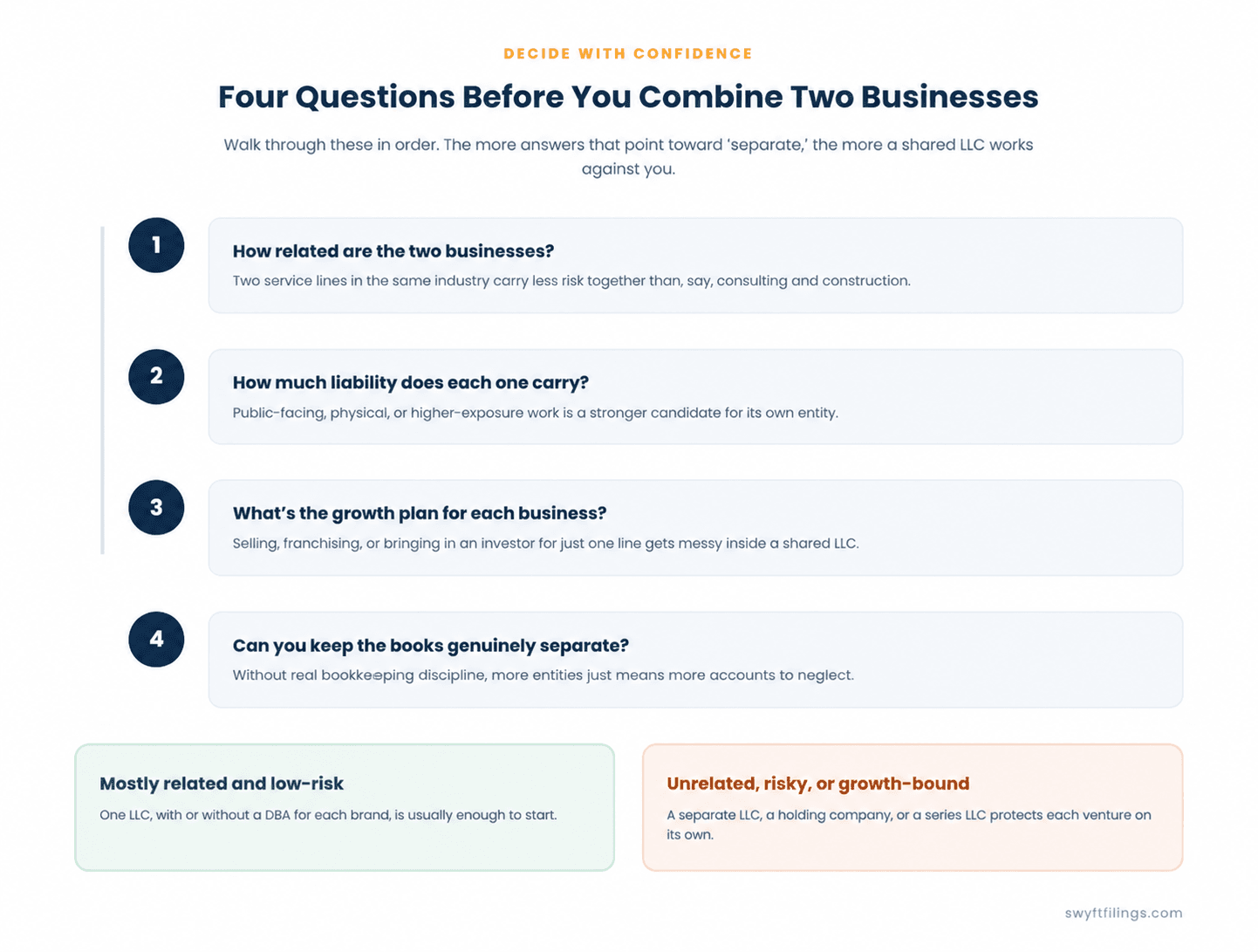
Before you default to just adding it to your existing LLC, run through four questions.
How related are the two businesses? Two service lines in the same industry carry less risk together than, say, a consulting practice and a construction company.
How much liability does each one carry? A business that handles the public, physical goods, or heavier legal exposure is a stronger candidate for its own entity.
What is your growth plan? If you might sell, franchise, or bring in an investor for just one line, separating it now avoids an ugly untangling process later.
Can you actually keep the books separate? Without the discipline or bookkeeping help to track finances distinctly, adding more entities will not fix that. It just adds more accounts to neglect.
Whichever way you lean, update your operating agreement to reflect the new line. Swyft's free operating agreement template is a solid place to start.
The Bottom Line
There is no single right answer here. Plenty of owners run several profitable ventures under one LLC for years without issue, and just as many separate everything from day one out of caution.
What matters is choosing on purpose, with a clear read on the liability tradeoffs, instead of defaulting into a shared LLC by accident.
FAQs
It is not legally required, but it is strongly recommended. A dedicated sub-account for each business activity makes it easier to prove your businesses were run separately if a dispute comes up, and it saves your accountant time at tax season.
Yes. It is a common move as one business line outgrows the others. You typically form a new LLC, transfer the contracts, assets, and accounts tied to that business, and retire the old DBA. The exact paperwork varies by state.
It can. Lenders financing one specific venture want to see its revenue and assets cleanly separated from your other activities. If you plan to seek financing, a partner, or an investor for a single business line, keep that line in its own LLC from the start.
Generally no. LLCs and partnerships already own roughly **40% of America's rental units**, according to HUD and Census data, and a claim tied to one property puts every other property in that LLC at risk. Most investors use one LLC per property, a holding company, or a Series LLC instead.
No. A DBA is just a public nickname for your LLC, not a separate entity, so it never gets its own **EIN**. Every business and every DBA under your LLC shares the same EIN, bank accounts, and tax return.
Nothing stops you. Your LLC can sign contracts and collect revenue under its own legal name for as many business activities as you want. The only real cost is branding, since customers, vendors, and even your bank may struggle to tell your business lines apart.