
Initial Setup
Compliance
Changes & Filings
Resolve
Protect & Legal
Learn
Excellent
7,486 reviews

In Texas, you form your LLC by filing a Certificate of Formation (Form 205) with the Texas Secretary of State, either through SOSDirect or by mail. You need your business name, principal office address, email address, and registered agent details to complete the Certificate of Formation. Once your LLC is approved by the Secretary of State, you can apply for an EIN if you will be hiring employees, opening a bank account, or filing taxes. The completion steps include applying for the licenses and permits as per your specific business activity.
Swyft Filings handles the paperwork and state filings in all 50 states. Select our basic package to start an LLC for free in Texas. We also offer professional registered agent services, so you can avoid using your personal Texas address as the registered agent address in public filings. Our online dashboard securely stores a copy of your paperwork and keeps it accessible at all times.
The business name can be what you want, but it needs to follow four major rules in Texas:
The name must be distinguishable from every other business name already on file with the Texas Secretary of State.
It must include a mandatory suffix such as "Limited Liability Company," "LLC," "Limited Company," or "L.C."
It should not use names that indicate what your business is not. This includes names that imply a government affiliation ("FBI," "Treasury," "State Department," "Federal," "United States") or names that imply illegal activity or are offensive.
A name that falsely suggests a tie to a government agency, and some words, like "Bank" or "University," need extra written approval before you can use them.
A registered agent must be available at a physical street address in the state of formation during business hours. They receive lawsuit notices and other business-related documents on your Texas LLC’s behalf and forward them to you. The registered agent address is documented in the Certificate of Formation and is part of the public record. This is why many owners choose a professional service to keep their home address private and have the freedom to visit other places.
The Certificate of Formation, also called Form 205, officially forms your Texas LLC with the state. Texas charges a $300 fee for this form. A 2.7% processing fee applies to online credit card payments, bringing the total to approximately $308 to $310.
You can file online through SOSDirect for the fastest processing. Mail filings are also possible, but they typically take more time to process.
Note that the Texas Secretary of State no longer accepts filings by fax. Choose Swyft Filings’ basic package to form your Texas LLC for free.
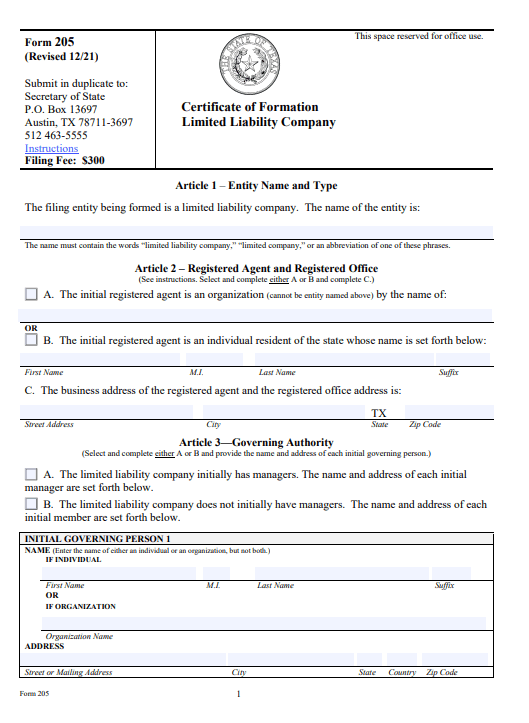
What information does the Texas LLC Certificate of Formation (Form 205) require?
You need the following things to file Form 205:
An LLC operating agreement helps to define ownership roles, profit-and-loss distribution, and entry and exit rules for members. Most states don't require one, but it's still worth having. Without it, a court applies the state's default rules, which may not match how you actually want to run things.
You can write your operating agreement using clear, simple language. If you'd rather have something built specifically for your state and situation, Swyft walks you through a short questionnaire and generates a customized operating agreement for you. Either way, make sure every member signs it, and keep a copy somewhere safe.
Main terms to add in a Texas LLC operating agreement:
Start with the general business information about your business. This includes business information such as the business address, member details, and LLC term.
Specify LLC structure (member-based or manager-based) and outline the specific voting rights of members.
Write the names and addresses of the members, their specific roles, and what percentage of ownership each member holds.
State the current tax status of your LLC and mention the process to change the tax status in the future. Name which members have the authority to make those decisions in the future.
List a clause on how membership gets transferred to a new member and how a member leaves.
Provide clear instructions on business dissolution and how any remaining assets will be distributed.
The Internal Revenue Service issues a nine-digit number, called an EIN, to businesses that need it for federal tax purposes. This includes hiring employees, opening a bank account, and filing taxes in the U.S. You can apply for an EIN directly on the IRS website and get it for free in minutes. The application requires the following details:
If you don’t have a Social Security Number, you can apply for an EIN by filing Form SS-4.
Texas LLCs have annual franchise tax and public information report obligations with the Comptroller. The main purpose of filing this report is to keep your business information current with the state.
If your revenue falls under the no-tax-due threshold of $2,650,000 for the 2026 report year, you don’t owe franchise tax. However, you are still required to file a Public Information Report (PIR) or Ownership Information Report (OIR), even if no tax reporting is due.
Texas does not require a single, general state business license for every LLC. What you need depends on your industry and location. If you sell taxable items or services, you may need a Sales and Use Tax Permit from the Texas Comptroller, which is free to apply for. Many professions, such as cosmetology, air-conditioning contracting, and towing, require a license from the Texas Department of Licensing and Regulation. Check with your city and county too, since some require a local permit to operate.
You'll typically need your EIN, formation documents (such as your Certificate of Formation), and an operating agreement to open the account. Most major banks and credit unions in Texas offer business checking accounts, so compare fees, minimum balance requirements, and online banking features before choosing one. For a deeper walkthrough of the process, check out this guide on starting a business bank account.
| Item | Cost |
|---|---|
| Certificate of Formation (Form 205) filing fee | $300 |
| Name reservation (optional, Form 501, 120 days) | $40 |
| Assumed name certificate (DBA, if used) | $25 |
| Standard expedited filing (optional, 2-3 business days) | $50 (2-3 business days) $500 (next day) $750 (same day) |
| Texas registered agent service (if hired) | Varies by provider |
| Franchise tax (most small LLCs) | $0 if under the no-tax-due threshold |
Starting an LLC in Texas yourself is possible, but it takes time, research, and follow-up. Here is how doing it yourself compares to forming your Texas LLC with Swyft Filings.
| Item | DIY | Swyft Filings |
|---|---|---|
| Texas LLC Operating Agreement | You draft your own from scratch or use a free template | A custom LLC operating agreement is included. |
| Texas Registered Agent | You handle it on your own | Professional RA service is available |
| Attorney access | You'd need to hire one separately | Personalized guidance from a business attorney is available |
| Domain Name + Website | You build and host it yourself | Done-for-you website + domain included, through partner UENI |
| Texas Business license Research | You do yourself | Available as an add-on |
| Texas DBA filing | You handle yourself | Available as an add-on |
| Document Vault | Not available. You manage your own files | Secure online portal, 24/7 document access |
| Texas Compliance management | You track deadlines yourself | Compliance support is available through ComplianceGuard |
| Tax consultation | Not included. You'd book this separately | Free 30-minute tax consultation included, through partner 1-800Accountant |
| Support | None | Lifetime customer support |
Since 2015, Swyft Filings has helped over 600,000+ owners with business formation and compliance management. Our business formation specialists manually review your application for accuracy. Take the first step toward building your LLC with confidence. Skip the guesswork and let Swyft Filings handle your paperwork!
$0 + State Filing Fees
*Disclaimer: This guide provides general information about forming an LLC in Texas and is not a substitute for legal, tax, or financial advice.*
LLC rules, fees, and processing times vary by state. Select a state below to check its specific costs and filing requirements.