Key Takeaways
- No federal law requires a separate bank account for an LLC.
- Still, mixing funds can weaken your limited liability protection.
- Banks usually ask for your EIN, Articles of Organization, and a government ID.
- Open the account before your first payment or expense.
- Compare fees, minimums, and deposit options before you choose.
No federal law requires an LLC bank account, yet skipping one can cost you more than you think. See where the real requirement comes from and how mixing funds can put your personal assets at risk.
Do you need a business bank account for an LLC? No federal law says you must have one. In practice, though, an LLC business bank account is the simplest way to protect your personal assets, keep your taxes clean, and look credible to customers and lenders. This guide covers what the rules actually say, what mixing funds can cost you, and how to set up your account correctly.
Does an LLC Need a Business Bank Account Legally?
No federal statute requires one, and most state LLC laws do not either. Some online guides call it "required," but that overstates the law. The requirement usually comes from somewhere else: your operating agreement, a lender, or a payment processor that wants to pay an account in your company's name.
State rules do vary, so check your state's LLC requirements before you assume anything. If you are still learning how the structure works, our guide to limited liability companies is a good starting point.
Why Every LLC Needs a Separate Bank Account
So, do I need a separate bank account for my LLC? Legally, no. Financially, these five benefits of a business bank account say yes:
- Liability protection. The FDIC notes that business banking offers limited personal liability protection by keeping company and personal funds apart.
- Cleaner records. The IRS also recommends separate accounts because they make recordkeeping at tax time easier.
- Professional payments. Customers can write checks to your company name instead of yours.
- Separate deposit insurance. FDIC rules insure deposits of corporations, partnerships, and unincorporated entities separately from the owners' personal accounts, up to $250,000. Ask your bank how it classifies your LLC.
- Borrowing power. Lenders often review several months of statements, and a clear account history supports future loan applications.
One caution: federal rules cap your liability for unauthorized personal debit card use, but they do not cover business debit cards. Your bank agreement and state law may help, so turn on transaction alerts and report problems right away. |
Commingling Funds and Piercing the Corporate Veil
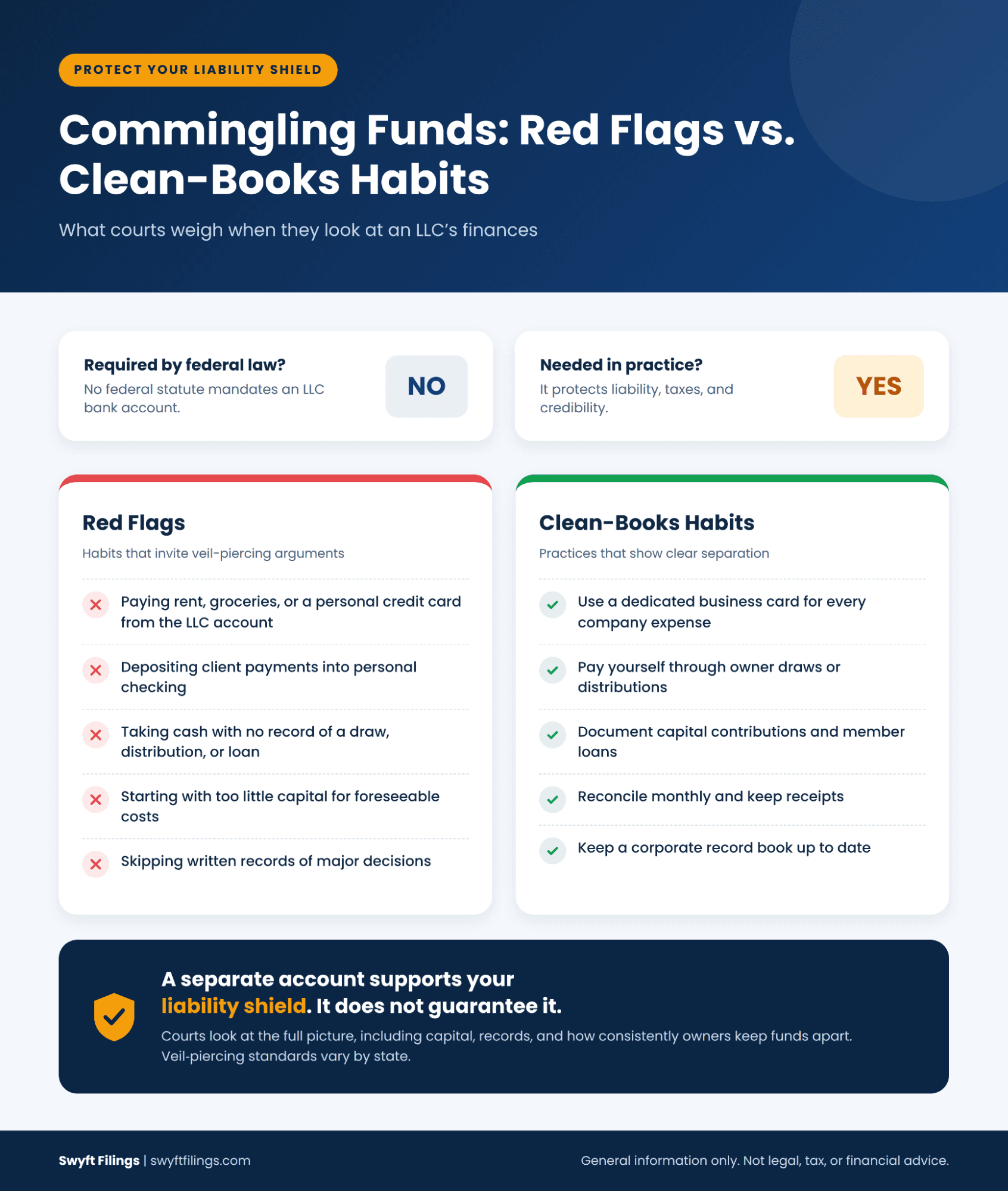
Commingling means mixing personal and business money. It is a leading factor courts weigh when deciding whether to pierce the corporate veil, which lets creditors reach your personal assets. Standards vary by state, and judges look at the full picture rather than one mistake. Common examples include:
- Paying rent, groceries, or a personal credit card from the LLC account
- Depositing client payments into your personal checking account
- Taking cash from the business with no record of whether it was a draw, a distribution, or a loan
- Starting the company with too little capital to cover foreseeable costs
What the account does and does not do A separate business bank account supports your liability shield, but it does not guarantee it. Courts also look at whether you kept written records of major decisions. A Digital Corporate Kit helps you organize those records. |
Can an LLC Use a Personal Bank Account?
Short answer: you can, but don't. A sole proprietorship can legally run on a personal account. An LLC is a separate legal entity, so commingling risk starts the day it is formed, even during the first year of a side hustle. Some banks also prohibit business use of personal accounts and may close them. Personal checks cannot carry your company name, and tracing expenses during an audit gets harder.
Already mixed your funds? Stop now, open a business account, and document past transactions. Record personal payments as owner draws or distributions, and money you put in as a capital contribution or loan. A tax professional can help clean up older entries.
How to Open a Business Bank Account for an LLC
To open a business bank account for an LLC, expect similar LLC bank account requirements at most banks. Gather these items before you apply:
- Articles of Organization approved by your state
- EIN confirmation letter from the IRS
- Government-issued photo ID for each owner or signer
- Operating agreement, which some banks request
- Your exact legal name, including "LLC," and ownership details for identity verification under the USA PATRIOT Act
Then follow these steps for opening a bank account for an LLC:
- File your Articles of Organization.
- Get your EIN.
- Choose a bank using the comparison below.
- Apply online or in a branch with your documents.
- Make your first deposit as a documented capital contribution.
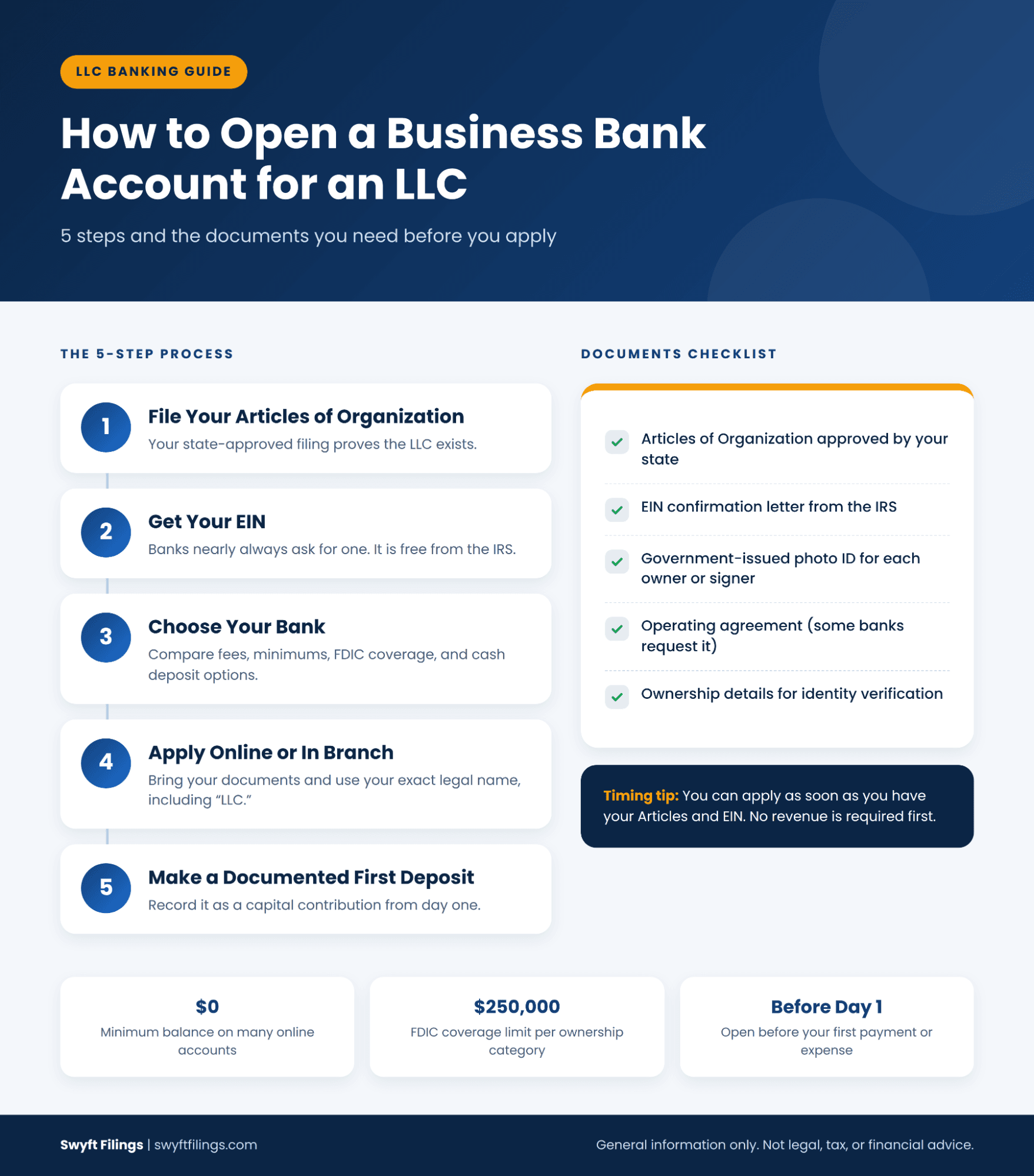
You can apply as soon as you have your Articles and EIN. You do not need revenue first. Aim to open the account before your first payment or expense.
Taxes and EIN: What the IRS Expects
The IRS does not require a business bank account, but your tax classification shapes your records. A single-member LLC is a disregarded entity, so you report income on Schedule C of Form 1040. A multi-member LLC files Form 1065 as a partnership. The IRS single-member LLC page explains the details.
A single-member LLC with no employees can often use the owner's SSN for federal purposes, but banks nearly always ask for an EIN. You can apply for an EIN for free, and Swyft's Standard package includes it. If you later consider an S corp election, compare your options in our LLC vs. S corp vs. C corp guide.
Operating Agreement Clauses for Your LLC Business Bank Account
Banks may ask for your operating agreement, and it is the best place to put banking rules in writing. Ask your attorney to include:
- Authorized signers, and who may open or close accounts
- A promise to keep LLC funds separate from members' personal funds
- Rules for capital contributions
- How and when distributions are paid
- How member loans to the LLC are documented and repaid
These clauses give you written proof of separation if a creditor ever questions it.
Best Business Bank Account for LLC: What to Compare
No single best bank account for an LLC fits every owner. The right pick depends on how you get paid and where you deposit. Compare these account types:
Account type | Example | FDIC coverage | Typical costs |
Online (fintech) | Mercury, Relay | Through partner banks; the platforms are not banks themselves | Often $0 monthly fee and $0 minimum on entry plans |
National bank | Chase Business Complete | Direct; branches and ATMs for cash | $15 monthly, waived with a $2,000 minimum daily balance |
Regional bank | WaFd Free Business Checking | Direct; local branch support | $0 maintenance fee, no minimum balance |
For any business checking account for an LLC, look beyond fees to free incoming ACH transfers, accounting software sync (QuickBooks, Xero, or FreshBooks), and sub-accounts. Fees change often, so confirm current terms with each bank.
Best Practices After Opening Your LLC Checking Account
- Use a dedicated business debit or credit card for every company expense.
- Pay yourself through owner draws or distributions, never by swiping the business card for personal spending.
- Set up a tax sub-account and move a set percentage of each deposit into it.
- Reconcile transactions monthly in accounting software and keep receipts.
- Track annual reports and state deadlines with ComplianceGuard to keep your LLC in good standing.
Conclusion
No law forces you to open an LLC business bank account, but separating business and personal money protects your liability shield, simplifies taxes, and builds credibility with lenders and customers. Gather your Articles of Organization and EIN, then open the account before your first expense.
Still planning your launch? Read our starting a business guide, and ask about Swyft's free business tax consultation.
FAQs
Usually not. Banks want the exact name on your Articles of Organization. You only need a DBA if you operate under a different trade name and want the account to carry it.
Often yes, but requirements are stricter. Some banks require an in-person visit, so confirm the process before you apply.
Not for US-formed companies. FinCEN's August 2026 final rule exempts domestic companies from federal beneficial ownership reporting. Banks may still ask who owns your LLC, and some states, including New York, have their own transparency rules for foreign LLCs.
It depends on your state's series LLC law and how you structure the entity. Because series exist to keep assets and liabilities apart, many owners give each one its own account. Ask your attorney.