

Start your business in 2026 with our 20-step checklist, covering idea validation, funding, and legal setup. Get expert tips for growth!
A 20 step checklist can help you start a new business efficiently.
The first few steps include validating your business idea with real people, researching your target customers, and competitors.
Estimate startup costs, the break even point, and funding options before moving to legal setup.
Legal setup includes choosing a business name and location, LLC registration, EIN, licenses, bank account, and insurance.
For growth, hire professionals for key tasks, build your digital presence, and focus on landing your first 10 customers.
You are sitting at your desk, staring at a screen, but your mind is somewhere else. There’s a business idea that keeps coming back to you, even late at night.
You feel excited about it, but one question keeps surfacing: How do I actually get started?
If this is your story, know that you are not alone. Many aspiring founders have great ideas but feel unsure about the next steps. Between unfamiliar terms, legal requirements, and questions around funding, it’s easy to feel stuck, even when the motivation is strong.
But we want 2026 to be the year you become a founder.
All you need to get started is a good roadmap. Therefore, we researched various reliable sources and created a 20 point checklist to help you start a new business. We explain everything in simple steps so that it doesn't feel overwhelming.
Stay tuned with us to know more.
Phase 1: Research & Planning
Step 1: Write A Business Plan
A business plan is the foundation of your startup. Just write about it on one page. It doesn’t necessarily need to be long.
Write about the name of your business and ask yourself these questions:
- What are you selling?
- What is your business objective or vision?
- Who are the members of your business?
- What are the capital needs of this startup?
The answers to these questions will give you clarity
Here is a simple template you can follow to create your business plan:
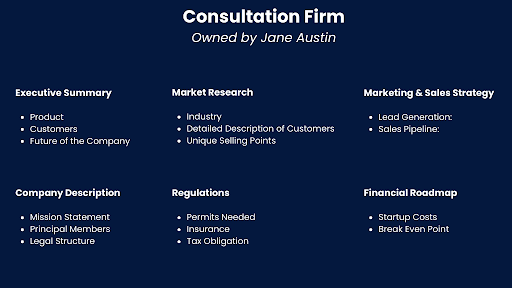
A business plan
Step 2: Conduct Market Research To Validate Your Idea
You have already written your business plan; the second step is to validate your idea with market research. Gather as much information as you can (online and offline) about your potential customer.
Ask people what they’re using today, what’s frustrating about it, and what a better solution would be worth. Understand their pain points and identify opportunities for your products or services.
Ways to validate your business idea:
- Talk to your family and friends
- Post about your query on Reddit
- Check online case studies and data
- Interview 5 customers
Tip: Use authorized sources like the SBA for market research. [1]
Step 3: Study Your Competitors
You have validated that your business idea has demand. You know your target audience, their needs, and the solution. But now is the time to ask yourself:
Is anyone else already providing this solution?
Most of the time, the answer will be yes. And this is why you have to read your competitor. The only way to earn profit and surpass your competitors is ‘uniqueness’. Think about the gaps:
- What are the unique selling points of your business?
- What sets you apart from your competitors?
- What makes the customer unhappy with existing solutions?
Tip: It is a good thing to learn from the misfortune of others. Study 5 competitors and their journeys to make sure you avoid any mistakes they have made.
Step 4: Estimate Startup Costs + Break Even
You have a rough idea of how much money you might need to start your business. Now is the time to go into detail. List one time costs (licenses, equipment) and ongoing monthly expenses (rent, software).
Next, calculate your break-even point. This means figuring out how many products or services you need to sell each month just to cover your costs. Once you reach this point, your business moves out of the loss zone and starts making a profit.
When you know this number, your idea becomes clearer. Instead of guessing, you’ll have a clear sales target to work toward.
The estimated startup cost and breakeven graph will look something like:
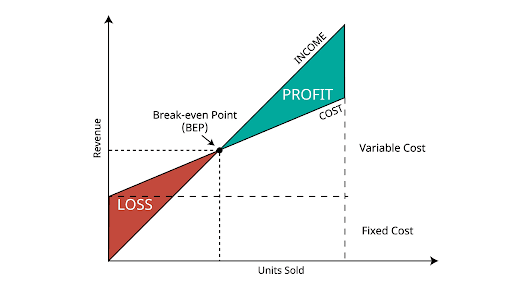
Startup cost and breakeven graph
Step 5: Fund Your Business
After the cost estimation, the next step is to arrange the funds. If you have already saved the money, you are good to go. But if you are looking to arrange money for a startup, you can use one of these common ways:
Friends and Family: Often the first place founders turn. Just be sure to put everything in writing to keep your relationships healthy!
Crowdfunding: Crowdfunding is a way to raise money by collecting small amounts from many people, usually through an online platform. People contribute because they believe in your idea or want what you’re offering.
Loans: If you need a large amount of money upfront, you can apply for a small business loan. A loan gives you cash that you repay over time, usually with interest.
Investors: Investors provide money in exchange for a share of your company. You don’t repay this money, but you give up some ownership and decision making control.
Note: Most successful small businesses start small with bootstrapping (using their own savings) and only take on debt or investors once they’ve proven their idea works.
Phase 2: Setup & Legal
Step 6: Finalize Your Business Name
Your business name is your brand personality. Pick a name that customers can easily say, type, and remember. Select a name that is catchy but professional. Try following these things when naming your business:
- The Brainstorm: Suppose you are selling handmade bags, think about words like Stitch, Craft, Carry, Hide, or Loom. Combine them with something personal or a location (e.g., "Everest Leatherworks" or "The Urban Stitch").
- The Radio Test: Say it out loud, text it to a friend, and see if they spell it correctly on the first try. If they don’t, choose a simpler version.
- Check the "Digital Neighbors": Before you fall in love with a name, check if the .com domain and social media handles (@YourBrand) are available.
Step 7: Finalize Business Location:
Your business location plays an important role in your success. For cafés or retail stores, being in a busy area can help attract more customers compared to a location with low foot traffic.
Location also matters for online businesses. The government and your customers need to know where your business is officially based.
Tip: You can use a registered or virtual address to meet legal requirements and build trust with customers.
Step 8: Choose The Right Structure
Your structure affects taxes, paperwork, and how separated your personal assets are from business risk. Most first time founders pick from sole proprietorship, LLC, partnership, or corporation.
This doesn’t need to be a complicated decision. Think of it as a risk and paperwork choice, based on the type of business you’re starting.
Simple business structure comparison:
Structure | Best for | What to watch |
Sole proprietorship | Testing fast | Less separation from personal liability |
LLC | Most small businesses | State fees + annual rules |
Partnership | Co-founders | Risk unless clearly documented |
Corporation | Scaling, investors | More complexity |
Step 9: Register Your Business
If you want to protect your personal savings, car, or home, it is important to register your business. Most beginners choose an LLC because it is flexible and involves less paperwork than a corporation.
You can register your business on your own. However, many founders find the legal structure and filing steps confusing. In that case, LLC filing services can help. These services assist with:
- Checking and filing your business name
- Setting up a business address
- Completing and submitting state forms
They are often an affordable option for first time founders who want to avoid mistakes and save time.
Also check out, Top 10 Ways to Choose the Right Registered Agent Service!
Step 10: Get Your Tax Ids In Order
An EIN (Employer Identification Number) is a Social Security number for your business. The IRS uses this to track your taxes, but you’ll need it for almost everything else, too.
Why you need it right away:
- To open a business bank account (most banks won't talk to you without one).
- To hire your first employee (or even a freelancer).
- To apply for business licenses.
Good news: Most LLC filing services include getting an EIN in their packages.
Also read, How to Get an EIN to Open a Business Bank Account!
Step 11: Get The Proper Licenses And Permits
Licenses are not "one size fits all." What you need depends on what you sell and where you are located. Some cities require even the home based businesses to obtain a simple local registration or a Sales Tax Permit to sell products legally.
Business Type | Often Needs Permits? | Examples |
Consulting/Freelance | Sometimes minimal | Local business registration |
Food/Beauty/Health | Yes | Health department permits |
Home Services | Yes | Contractor or professional licensing |
Ecommerce | Depends | Sales tax setup & home-use permits |
Step 12: Open A Business Bank Account
A business bank account keeps your personal money safe and your business records clean. When you form an LLC, the law sees your business as a separate person from you. So, it's best to have a separate bank account for business expenses.
What You’ll Need to Bring?
Banks are strict about identity. To avoid a wasted trip, bring these documents:
If you are a... | You will often need... |
Sole Proprietor | Personal ID + Social Security Number (SSN) |
LLC or Corporation | EIN + Formation Documents (Articles of Organization) |
Any Business | Proof of Address (like a utility bill) |
Step 13: Business insurance
Insurance protects you from the "what ifs." If you sell products like handmade bags, ‘product liability’ is a must. If you hire help, workers’ compensation is often required by law.
Insurance | What it covers | Who needs it? |
General Liability | Accidents/Property damage | Local services |
Professional Liability | Mistakes in work | Consultants/Agencies |
Product Liability | Product-related claims | E-commerce/Bag Brands |
Step 14: Set Up Accounting
Before you get too busy with customers, you need to set up your financial safety net. This can be easily done by setting up accounting. It helps you know if your business is actually working.
Beginner-Friendly Accounting Rules:
- Keep Business Expenses Separate: Never mix personal and business money. It makes tracking expenses 10x harder.
- The 30 Minute Weekly Review: Spend a few minutes every weekend categorizing your spending (software, supplies, marketing). This prevents any kind of panic when you file your taxes.
Phase 3: Operations & Foundation
Step 15: Hire The Right Professionals
You can’t do everything on your own, and trying to do so can quickly wear you out. That’s why hiring professionals matters.
So, instead of struggling with things outside your expertise, you can get help from experts. This way, you save time, avoid costly mistakes, and stay focused on growing your business.
Step 16: Basic Contracts + Internal Docs
Even if you're a "solopreneur," you need rules. Draft a simple Operating Agreement that says how the business is run.
For example:
If you're consulting, a contract defines exactly what you will (and won’t) do. It stops "scope creep," where a client asks for extra work for free.
Step 17: Secure Your Digital Presence
In 2026, if you aren't online, you don't exist to your customers. Your digital presence is your 24/7 salesperson.
Buy your domain name (like www.yourbrand.com) and claim your handles on Instagram, TikTok, and Pinterest. Even if you aren't ready to post yet, you want to make sure no one else grabs your name.

A website page example
Phase 4: Launch & Early Growth
Step 18: Run A “First 10 Customers” Plan
Avoid waiting for a "Grand Opening" to get sales. Focus on your first 10 customers. Reach out to friends, family, or your local community. Ask for honest feedback and, more importantly, reviews. These first 10 sales are your proof that the world actually wants what you’re making.
Step 19: Track Weekly Metrics
If you don't track it, you can't fix it. Spend 20 minutes every Sunday night looking at your "Business Scorecard."
- Leads: How many people asked about your business?
- Sales: How many actually paid?
- Burn Rate: How much did you spend on software/supplies this week?
- Cash Flow: Do you have more money in the bank than you did last Sunday?
Step 20: Improve + Scale (First 90 Days)
Your first version won't be perfect, and that's okay. Use your weekly metrics to see what is working.
- If 80% of your sales come from Instagram, stop trying to do LinkedIn. Double down on what works.
- If people love your bags but hate the shipping time, find a faster shipping partner.
- The Goal: By day 90, you should have a repeatable system that shows you exactly how to acquire one new customer.
Takeaway:
Building a business becomes much easier when you stop trying to do everything at once. Follow these 20 steps starting from today.
If you need help with the technical side, such as choosing a structure or filing paperwork, Swyft Filings can help. We take care of the paperwork so you can stay focused on building your brand and making sales.
Remember, every entrepreneur faces challenges, but with determination, the right strategies, and a clear roadmap, you can build a successful business from the ground up.
Now, it’s time to roll up your sleeves and get to work! Good luck!
Bibliography:
- U.S. Small Business Administration. Market research and competitive analysis. Accessed on Feb 9, 2026
- IRS. Get an employer identification number. Accessed on Feb 9, 2026