
The LLC paperwork process can be done DIY, and hiring an attorney is not a legal requirement; it is a choice you make based on how complicated your business is.
If you've been putting off registering your side hustle because you assumed you'd need to hire a lawyer first, you're not alone; it's one of the most common questions first-time founders ask.
The answer is that you do not need a lawyer to start an LLC. Every state lets you file your Articles of Organization yourself, directly with the Secretary of State.
This guide walks through when it makes sense to file it yourself, when a lawyer is worth the cost, and what real business owners on Reddit say about the choice they made.
Key Takeaways
No state requires a lawyer to form an LLC; you can file the paperwork yourself.
DIY filing works well for small, single-owner LLCs with a simple structure.
A business lawyer for LLC formation only makes the most sense when you have multiple owners, outside investors, or a business in a regulated industry.
LLC attorney cost typically runs $500–$2,500, compared to $0–$300 for an online filing service (plus state fees).
Online LLC formation services are the middle ground: more guided than DIY, more affordable than a lawyer.
Is an Attorney Legally Required to File LLC Articles of Organization?
No state law requires you to hire an attorney to set up an LLC. The formation process is a state-level filing, not a court proceeding, so you're free to complete it on your own or through an online formation service.
That said, "legally required" and "recommended" are two different things. A lawyer for LLC formation isn't mandatory, but their input can be useful once your business grows and includes a complex ownership and profit distribution. [1]
What Are the Main Steps to Start an LLC
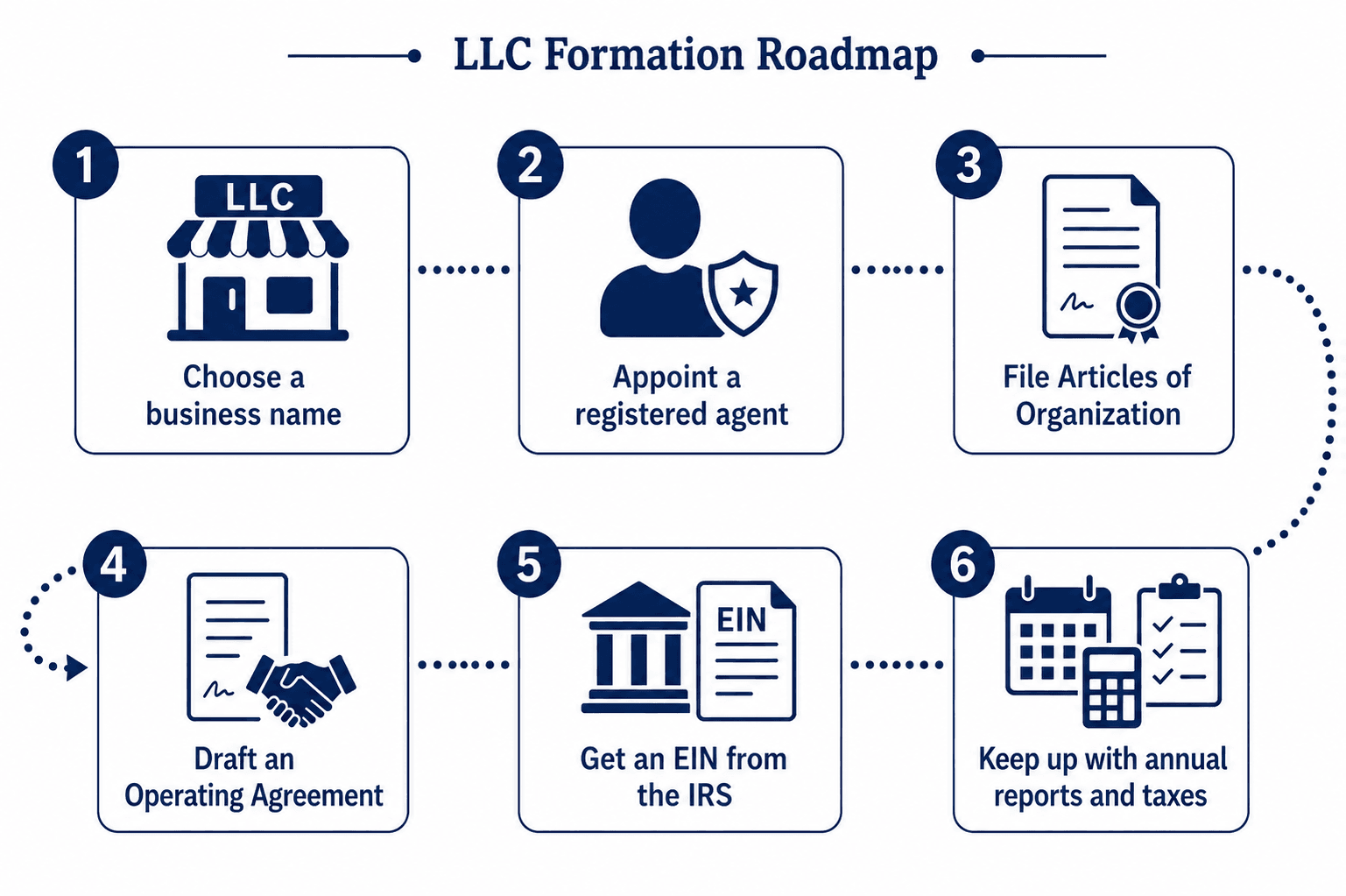
Before you decide on a business name, you need to decide which state you want your LLC to start in. Every state has almost the same process with a few variations. To find out state requirements, check our guides to start an LLC in all 50 states here!
1. Choose a Business Name
Your state checks your proposed name against its existing business registry and confirms that it includes an LLC designator, such as "LLC" or "Limited Liability Company." This is just a database search, so you can do it yourself on your Secretary of State's website or trust the specialization of a professional filing service.
2. Appoint a Registered Agent
A registered agent is a person or service authorized to receive legal notices and state correspondence on your LLC's behalf. Most states just require the agent to have a physical address in-state and be available during business hours, so you, a co-owner, or a registered agent service can fill this role. No legal expertise is involved in the appointment itself.
Further Reading: 8 Reasons to Hire a Professional Registered Agent for Your LLC!
3. File Articles of Organization
This is the actual formation document, submitted to your Secretary of State with basic details like your LLC's name, address, and registered agent (fees usually run $50–$500). The form itself is simple, and every question is factual (your business name, address, agent), so most owners fill it out without issue.
If you want peace of mind, you can hire an experienced formation professional. They handle the business filings on a daily basis and are familiar with state-specific quirks. A professional can catch errors that might otherwise lead to a rejected filing and delayed approval.
4. Draft an Operating Agreement
This document outlines ownership percentages, how profits are split, and how decisions get made. It isn't a legal requirement for LLC formation, but most owners choose to have one anyway to avoid disputes down the line. [2]
If you have multiple owners with uneven contributions, unclear roles, or specific provisions for what happens when a partner exits, a lawyer-drafted agreement might give you peace of mind. That said, most owners draft a custom operating agreement through a formation service rather than an attorney and never run into legal issues later.
5. Get an EIN from the IRS
Your Employer Identification Number is what banks and the IRS use to identify your business for tax purposes. The IRS issues these for free through an online application that takes about 10 minutes, with no legal review involved. [3]
6. Keep up With Annual Reports and Taxes
Most states require an annual report filing (and fee) to keep your LLC in good standing, plus your usual federal and state tax filings. These are recurring compliance tasks, not legal decisions, though a tax professional is worth bringing in if you're weighing an S Corp election or have a more complex tax situation.
Also Read: How to File Taxes for an LLC With Zero Income (2026 Guide)
DIY vs. Online Filing Service vs. Business Attorney for LLC
Feature
DIY Filing
Online Formation Service
Business Lawyer for LLC
Cost
State filing fee only ($50–$500)
State fee + $0–$300 service fee
State fee + $500–$2,500+
Speed
Same day to a few days
Same day to a few days
Days to a few weeks (depends on consultations)
Best for
Simple, single-owner LLCs
Most standard LLCs, including multi-member
Outside investors, regulated industries
Personalized advice
None
Free attorney consultations included
Available
Operating agreement
You draft it yourself
Often included as a customized document
Drafted by an attorney for your ownership structure
Also Read: A Complete Guide On How to Create An LLC For Free
How Much Does an LLC Attorney Cost?
LLC attorney fees generally fall between $500 and $2,500, depending on your state, the lawyer's experience, and how complex your business is. Lawyers typically bill in one of three ways: [4]
- Flat fee: A set price for standard LLC formation.
- Hourly rate: This is common for more complex filings or ongoing advice.
- Retainer: An upfront payment for continued legal support.
For comparison, an online formation service usually costs $0–$300 plus state fees, and filing yourself only costs the state fee.
When Owners Consider Hiring an LLC Formation Lawyer
You're more likely to benefit from legal help if:
- Your LLC has multiple owners with uneven contributions or complex equity splits.
- You're seeking outside investors or venture funding.
- You're forming a professional LLC (law, medicine, accounting) with extra licensing rules.
- Your business operates in a heavily regulated industry (finance, healthcare, real estate).
- You want an operating agreement that requires legal input
If none of these apply, filing yourself or using an online formation service is a common and practical choice.
What Small Business Owners on Reddit Say
A thread in r/smallbusiness asks this exact question:
Do I need an attorney to start an LLC?
The discussion reflects what most formation specialists also conclude: most small business owners with straightforward, single- or even-split multi-owner LLCs filed themselves or used an online service without issue. The recurring advice from more experienced lawyers is to save the legal budget for situations that actually need customized documents like uneven ownership splits, outside investment, or industry-specific compliance, rather than the initial filing itself.
TheRealSteve72 comments:

Another Redditor, GleamLaw commented:

How to Get Attorney Support Without the Big Attorney Fee?
Some formation services bundle attorney access directly into the plan instead of making you choose between a business formation specialist and a lawyer.
Swyft Legal Suite, for example, includes:
- Personalized guidance from a business attorney licensed in your state
- Unlimited access to legal expertise for new matters as they come up
- Legal review of your contracts and business documents
- Access to 250+ customizable legal and business templates
- Free changes to your Articles of Organization, if you need to amend them later.
It's available with a free trial (7 days, 1 month, or 2 months, depending on your LLC formation package), so you can get attorney input on your specific situation without even hiring and paying one.
Check out: How to Switch From Sole Proprietor to LLC (What Nobody Tells You)
Takeaway
Forming an LLC doesn't require a lawyer. Most business owners file themselves or use an online formation service without any issues.
The decision to hire a lawyer for LLC formation depends on how many owners you have, how complex your equity structure is, and whether your industry has additional compliance requirements. For most first-time entrepreneurs and freelancers, an online formation service offers the right balance of guidance and cost.
Swyft Filings offers affordable business formation in all 50 states, and with Swyft Legal Suite, you can add attorney guidance and document review without paying full attorney rates. Ready to file? Get started with us today.
Bibliography
- Internal Revenue Service. "Get an Employer Identification Number." Accessed July 16, 2026.
- U.S. Small Business Administration. "Register Your Business." Accessed July 16, 2026.
- U.S. Small Business Administration. "Choose a Business Structure." Accessed July 16, 2026.
- ContractsCounsel. "How Much Does a Lawyer Charge For an LLC?” Accessed July 16, 2026.
FAQs
Yes. Every state allows you to file Articles of Organization yourself or through an online formation service. So, no attorney is required.
Attorney fees for LLC formation typically range from $500 to $2,500, depending on your state and the complexity of your business, on top of the state filing fee.
State filing fees alone usually run $50 to $500. Add $0–$300 if you use an online formation service, or $500+ if you hire an attorney.
The most common issues are filing errors (incorrect or incomplete paperwork), skipping the operating agreement, forgetting to get an EIN, and not designating a registered agent correctly. A formation service can help catch these before they cause delays.
Yes! For a small business, this is usually fine. For multi-owner LLCs with uneven contributions, a professionally drafted agreement is more suitable because it can prevent ownership and profit distribution disputes down the line.