
Key Takeaways
- Yes, single-member and multi-member LLCs can both hire employees, with no legal cap on how many people you can employ.
- Hiring an outside worker is a separate question from whether you, as the owner, can be an employee of your own LLC. The two follow different rules.
- By default, LLC owners aren't W-2 employees of their own LLC. You take an owner's draw or profit distribution and pay self-employment tax on your share of the profit instead.
- Electing S-Corp or C-Corp tax status with the IRS is what allows an active owner to be paid a reasonable W-2 salary instead.
- Hiring your first employee means getting an EIN, verifying work eligibility, collecting the right withholding forms, and meeting state-level requirements like unemployment insurance and workers' compensation.
Starting solo doesn't mean staying solo. Here's whether your LLC can legally hire employees, and what actually changes once someone else joins payroll.
If you started your LLC as a one-person operation, it's easy to assume your business structure limits how you grow. It doesn't.
An LLC, single-member or multi-member, can hire employees just like any other business entity. What actually gets complicated is a different question: how you, the owner, get paid once other people are on payroll too.
Here's how hiring works under an LLC, and what changes once you bring someone else on board.
Can an LLC Hire Employees?
Yes. Before you hire anyone, the first thing to get right is how you classify them, since that decision drives almost everything else about your tax and paperwork obligations.
According to the IRS, when another person performs work for you, you must first correctly classify that person as an independent contractor or an employee.
If you classify someone as an employee, you take on new tax and legal obligations:
- Obtaining an Employer Identification Number (EIN).
- Withholding, depositing, reporting, and paying employment taxes.
Beyond classification, the basic rules on LLC hiring are straightforward:
- An LLC can hire full-time, part-time, temporary, or seasonal employees.
- There's no cap on headcount tied to your LLC status itself.
- A single-member LLC can hire employees too. Being the sole owner doesn't limit your ability to bring on staff (more on this below).
Employees vs. Independent Contractors
Getting this classification right matters more than the type of schedule someone works. Misclassifying an employee as a contractor can leave you on the hook for unpaid payroll taxes and penalties.
W-2 Employee | 1099 Independent Contractor | |
Who controls the work? | You direct how, when, and where the work gets done | They control their own methods and schedule |
Tax withholding | You withhold income tax, Social Security, and Medicare | No withholding, they pay their own self-employment tax |
Paperwork | Form W-4, Form I-9, Form W-2 at year-end | Form W-9, Form 1099-NEC at year-end |
Benefits | May be eligible for employer-provided benefits | Not entitled to employee benefits |
Classification comes down to control, not the label on the paperwork.
According to the IRS's common-law rules, the real test evaluates factors such as:
- Behavioral control: Do you direct how, when, and where the work gets done?
- Financial control: Who covers business expenses and supplies the tools?
- Type of relationship: Are there written contracts, employee-type benefits, and an expectation of ongoing work?
If you control how, when, and where the work happens, the IRS generally treats that worker as an employee, even if you hand them a 1099.
Are LLC Owners Considered Employees of Their Own LLC?
Generally, no, not by default.
According to the IRS's own guidance on paying yourself, partners are not employees and shouldn't be issued a Form W-2 for distributions or guaranteed payments. That is the default treatment for most LLC owners:
- Multi-member LLCs are taxed as partnerships by default.
- Single-member LLCs are taxed as disregarded entities unless you elect otherwise.
Tax Classification | Can the Owner Be a W-2 Employee? |
Default (disregarded entity or partnership) | No. Owners take draws or distributions and pay self-employment tax on their share of profit. Multi-member LLCs taxed as partnerships issue members a Schedule K-1, not a W-2 |
S-Corp election | Yes. Officers are generally employees and must receive reasonable W-2 compensation before taking additional profit as distributions |
C-Corp election | Yes, for the same reason. Corporate officers are generally employees |
If you stay in the default classification, your profit is subject to self-employment tax, which covers your own Social Security and Medicare contributions.
If you elect S-Corp status instead, the IRS expects your officer compensation to be reasonable for the work you actually do, not an arbitrarily low number designed to avoid payroll tax.
Courts have repeatedly backed the IRS when it re-characterizes owner distributions as wages after a shareholder-employee's salary was set too low, which triggers back employment taxes and penalties.
Can a Single-Member LLC Have Employees?
Yes. However, the distinction between income tax status and employment tax status often causes confusion for single-member LLC owners.
For income tax purposes, a single-member LLC is usually treated as a "disregarded entity," meaning its financial activity passes through directly to your personal tax return rather than being filed on a separate corporate return.
However, that disregarded status does not carry over to hiring. According to the IRS single-member LLC guidance:
- For purposes of employment tax and certain excise taxes, a single-member LLC is treated as a completely separate entity.
- The LLC must obtain and use its own EIN if it employs any workers.
In practice, this creates a two-track tax setup:
- For income taxes: Your disregarded SMLLC generally reports revenue and deductions under your personal SSN or owner EIN.
- For employment taxes: Once you hire staff, the LLC must report and deposit all payroll taxes under its own dedicated business EIN.
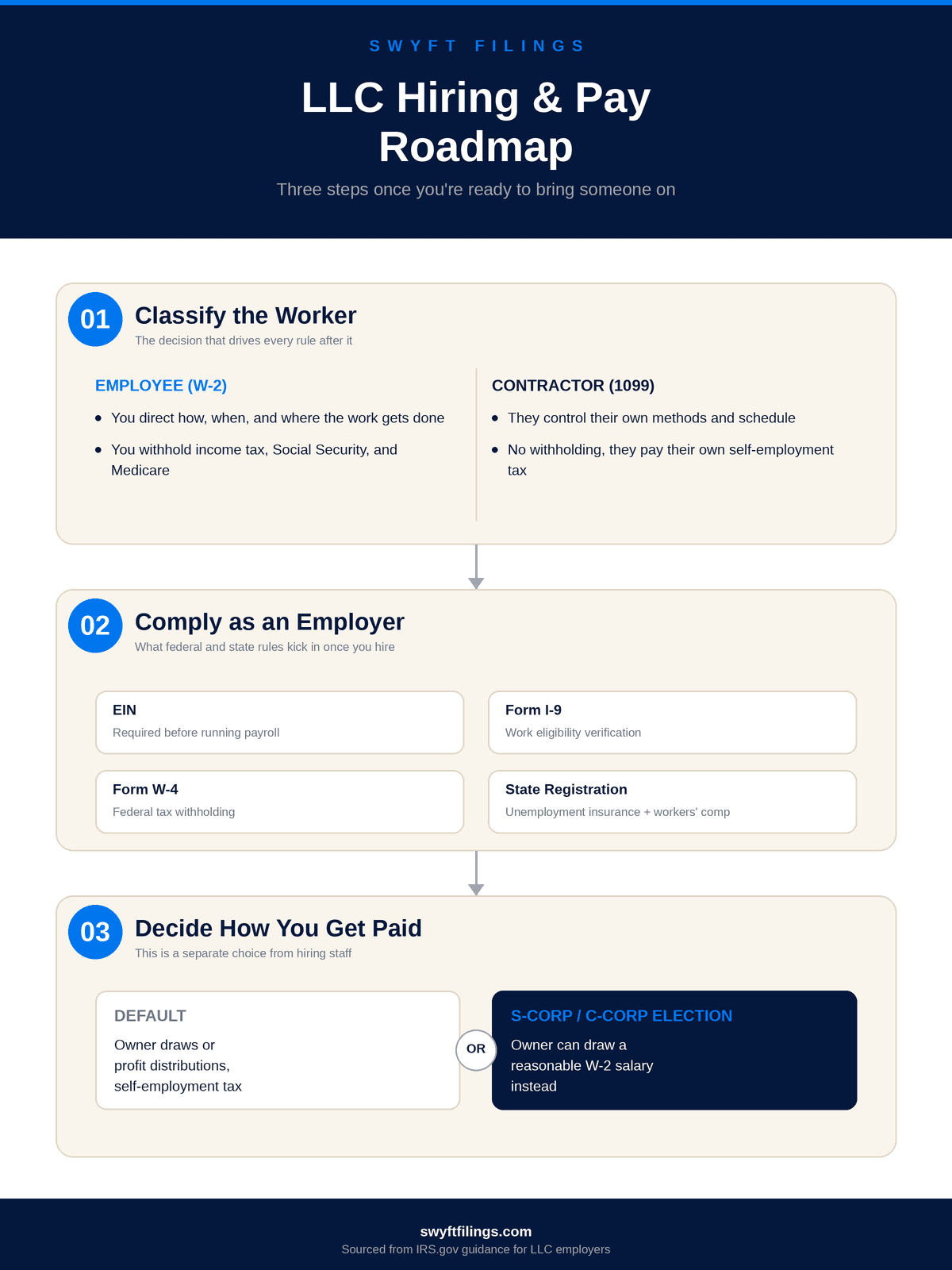
Federal Requirements for Hiring Your First Employee
- Get an EIN: Required before running payroll or reporting taxes.
- Apply for free via the IRS online application if your business operates in the U.S. and you have the owner's SSN or ITIN.
- Apply by phone, fax, or mail if operating internationally.
- See our breakdown of the EIN process for step-by-step guidance.
- Verify work eligibility: Complete Form I-9 for every worker to verify employment authorization.
- Collect Form W-4: Determines federal income tax withholding per paycheck (download Form W-4 from the IRS). If an employee fails to submit one, withhold as single with no adjustments.
- Set up payroll tax withholding: Withhold and remit federal income, Social Security, and Medicare taxes (reported quarterly on Form 941 and annually on Form 940).
State Requirements When You Hire
Federal rules are only half the picture. Once you have an employee, most states expect several things from you as a new employer, though the exact process and deadlines vary by state:
- Register for state tax withholding, separate from your federal EIN.
- Register for state unemployment insurance, which funds benefits for workers who lose their job.
- Carry workers' compensation insurance, generally required once you have even one employee, though specific thresholds vary by state.
- Display required labor law posters where employees can see them.
- Report new hires to your state's new-hire reporting program, a standard requirement across states, though reporting windows differ, so check your own state's specific deadline.
Can I Hire My Spouse or Other Family Members?
Generally, yes.
If a family member does legitimate work for your LLC at a fair, market-rate wage, they can be hired through normal payroll withholding just like any other employee.
That said, employment tax rules for family members can differ depending on the family relationship and entity setup. The IRS covers family employee rules directly, which is worth reviewing before putting a spouse, parent, or child on payroll.
Does Hiring Change How My LLC Is Taxed?
Not by itself. Hiring an employee does not alter your LLC's underlying tax classification.
Instead, it adds a layer of employer-level filings on top:
- Quarterly Form 941
- Annual Form 940
- Year-end Form W-2s and W-3 for each worker
These filings apply whether your LLC is taxed as a disregarded entity, partnership, S-Corp, or C-Corp. If you separately want the option to pay yourself a W-2 salary as the owner, that requires a proactive election: filing for S-Corp or C-Corp tax status with the IRS.
New Employer Checklist
Step | What It Covers |
Classify the worker | Employee vs. independent contractor |
Get an EIN | Required before running payroll |
Collect Form I-9 | Work eligibility verification |
Collect Form W-4 | Federal income tax withholding |
Register for state withholding | Separate from your federal EIN |
Register for state unemployment insurance | State-specific process |
Secure workers' compensation insurance | Check your state's requirement |
Display labor law posters | Federal and state postings |
Report the new hire to your state | Timing varies by state |
Ready to Formalize How You Pay Yourself?
Hiring your first employee is often the moment LLC owners start asking whether they should be paid differently too.
Swyft Filings has helped 600,000+ business owners manage their LLCs since 2015. If you're ready to explore paying yourself a W-2 salary, our specialists can help you file an S Corp election and figure out whether it's the right move for your business.
FAQs
Yes. Single-member and multi-member LLCs can both hire employees, with no legal cap on how many.
Generally no, by default. Owners typically take draws or distributions and pay self-employment tax. Electing S-Corp or C-Corp status is what allows an owner to be paid a W-2 salary instead.
There's no maximum. Your LLC structure itself doesn't limit headcount.
If you're in the default tax classification, yes, on your share of the LLC's profit. This changes only if you elect S-Corp or C-Corp status and pay yourself a W-2 salary instead.
No. You need an EIN before you can withhold and report payroll taxes for any employee, even in a single-member LLC that otherwise uses your Social Security number for income tax purposes.