
Is direct conversion from a nonprofit to a limited liability company possible? It is not, but there are other ways to achieve the same. Keep reading to explore your options.
Running a nonprofit comes with real restrictions. You can't distribute the organization's profits to yourself as an owner, and its resources must be used to support its exempt purposes. Also, a board of directors oversees the organization and may need to approve major decisions under its governing documents and state law. If that's starting to feel limiting, it's natural to wonder if switching to an LLC would give you more freedom.
If you have a 501(c)(3) charitable organization, you generally can't simply convert it into a for-profit LLC and distribute its charitable assets to the LLC's owners. Depending on the state and the organization's structure, state-law conversion or merger procedures may exist, but those procedures don't allow charitable assets to be diverted for private benefit. This guide breaks down what's actually possible, what the process looks like, and what to do instead if a straight conversion isn't on the table.
Key Takeaways
A 501(c)(3) nonprofit generally can't convert directly into an LLC. Its assets are dedicated to charitable purposes and must go to another 501(c)(3) or a government entity, not to LLC members.
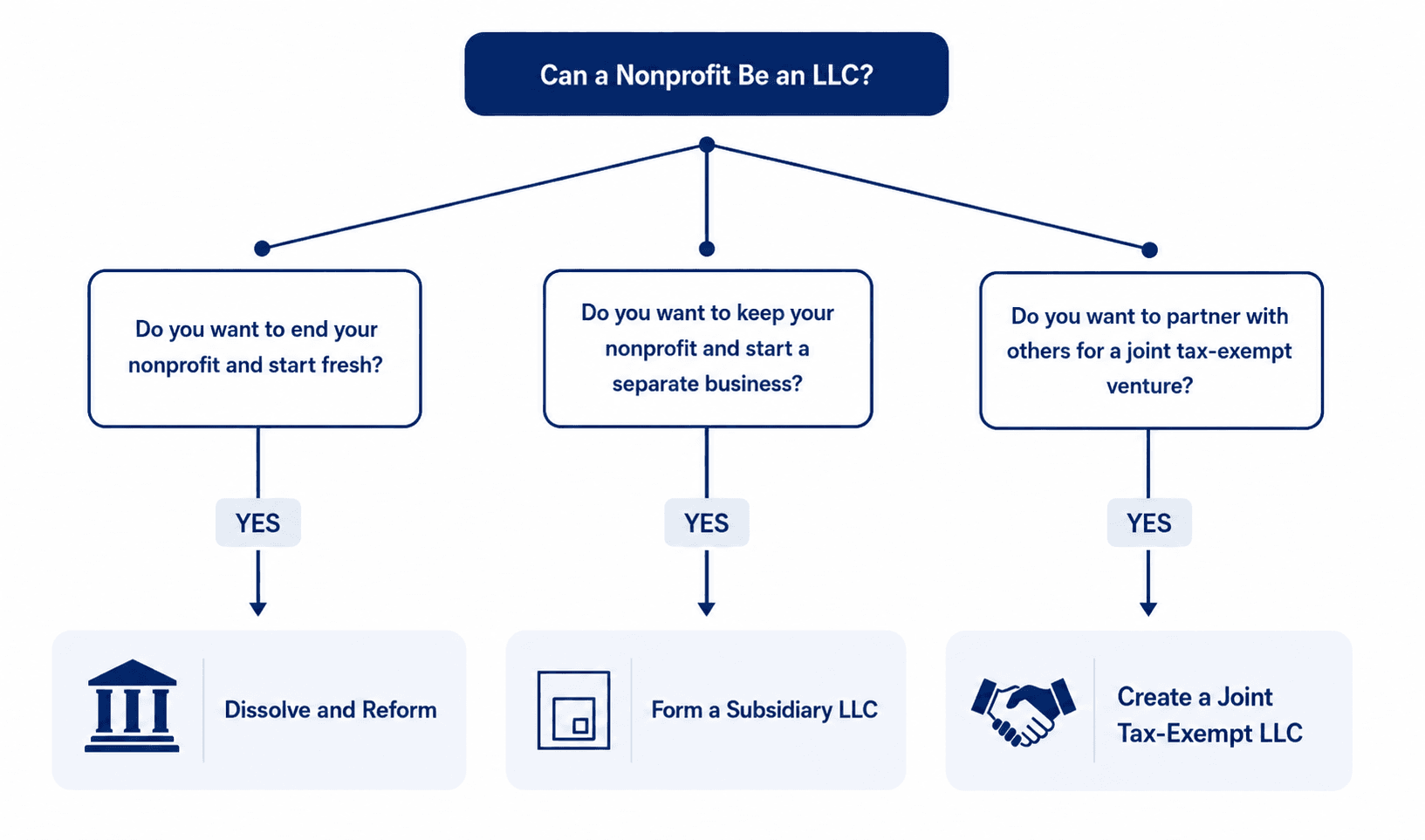
The realistic path is to dissolve the nonprofit, transfer its assets to another qualifying organization, and form a separate LLC to run any for-profit activity going forward.
A nonprofit can own an LLC as a subsidiary without giving up its own tax-exempt status. This is different from converting the nonprofit itself.
An LLC can only qualify as tax-exempt in a narrow case: when every member of the LLC is already a 501(c)(3) organization or a government entity.
Nonprofit vs. LLC: How Do They Compare?
Before looking at conversion, it helps to see how differently these two structures operate day-to-day.
Purpose
A nonprofit exists for a charitable, educational, or public purpose. None of its income can benefit a private individual or shareholder. [1] An LLC is a for-profit structure built to generate income for its members. There's no requirement that it serves any public benefit.
Common Examples
Nonprofits include charities, foundations, museums, and community programs. LLCs cover almost everything else, from consulting practices to retail shops and real estate holdings.
Taxes
A nonprofit with approved 501(c)(3) status doesn't generally pay federal income tax on income related to its exempt purposes, although it may owe tax on certain unrelated business income. An LLC's federal tax treatment depends on how it is classified for tax purposes. Many LLCs are taxed as pass-through entities, so profits generally flow through to their owners rather than being taxed at the entity level.
Ownership and Governance
A charitable nonprofit corporation generally has no owners or shareholders. A volunteer board of directors oversees it, and most states require at least three unrelated board members who hold a fiduciary duty to the organization's mission, not to any individual. An LLC is owned by its members, who can take profits directly and manage the business themselves or appoint a manager to run day-to-day operations.
Reporting and Oversight
A nonprofit files an annual return with the IRS, usually Form 990, 990-EZ, or 990-N depending on its size, to keep its tax-exempt status current. It also answers to its state's Attorney General on matters involving charitable assets.
An LLC has far fewer ongoing federal filing requirements. Most of its obligations are limited to state-level annual reports and standard tax filings.
Can You Convert a Nonprofit Into an LLC?
Your nonprofit's assets aren't fully yours to move, even if you founded the organization yourself. For 501(c)(3) organizations, the organizing documents generally include a dissolution provision, if applicable. That clause requires any remaining assets to go to another 501(c)(3) organization or a government entity if the nonprofit ever closes.
You can't redirect that money or property to yourself or to LLC members, even after years of building the organization.
That means a nonprofit cannot simply "become" an LLC by filing a form or changing its name. What's actually possible looks more like this:
- Step 1: The board votes to dissolve. This has to follow whatever process your organization's bylaws and state law require, including proper notice and a formal resolution.
- Step 2: Outstanding debts and obligations get settled. Contracts, employee wages, and any pending liabilities need to be resolved before assets are distributed.
- Step 3: Remaining assets transfer to another qualifying organization. This is typically another 501(c)(3) nonprofit with a similar mission, or in some cases a government entity for public use. The board (and sometimes the state Attorney General's office) oversees this step to confirm it's handled correctly.
- Step 4: The nonprofit formally dissolves. Articles of dissolution get filed with the state, and a final Form 990 is filed with the IRS.
- Step 5: A new LLC gets formed separately. The nonprofit's charitable assets cannot simply be transferred to the new for-profit LLC for the benefit of its owners.
Does Dissolution Work the Same in Every State?
Before a nonprofit can distribute its assets, California requires sign-off from the Attorney General's Registry of Charities and Fundraisers. The nonprofit must ask the AG for a letter either approving the planned distribution of assets or confirming that the nonprofit has no assets. This letter must be filed with the Certificate of Dissolution sent to the Secretary of State. [5]
New York works similarly but through the courts or the Attorney General's Charities Bureau. The Attorney General reviews and approves the proposed distribution of charitable assets before they are transferred. Once that approval comes through, the organization has 270 days to carry out the plan, pay liabilities, distribute assets, and close out its business. Smaller nonprofits with limited reserves may qualify for a simpler no-assets process instead. [6]
Texas routes primarily through the Secretary of State rather than requiring pre-approval from the Attorney General for every case. The nonprofit's board votes to dissolve, pays off any debts, gives its remaining assets to another charity with a similar mission, and files a certificate of termination with the Secretary of State.
The Texas Attorney General's office retains oversight authority and can examine records, but the filing itself is handled by the Secretary of State's office. [4] Because these requirements differ this much between just three states, check your own state's Attorney General or Secretary of State charities division before setting a timeline, and loop in a nonprofit attorney who's handled a dissolution in your state specifically.
Regardless of which state you're in, none of these dissolution procedures can be used to shift a 501(c)(3) nonprofit's assets directly into a for-profit LLC. The asset-dedication requirement comes from federal tax law, not state entity law, so no state-level filing shortcut overrides it.
Can a Nonprofit Own an LLC?
A 501(c)(3) nonprofit can form and wholly own an LLC subsidiary in some circumstances. Depending on how the LLC is classified for federal tax purposes, its income may be reported as part of the nonprofit's tax filings. Activities that are unrelated to the nonprofit's exempt purpose may also create unrelated business income tax obligations. [3] The nonprofit may maintain its tax-exempt status, but the structure and the LLC's activities must comply with applicable tax rules.
Here's what this can look like in practice. A community arts nonprofit might form an LLC to operate a small gift shop or a paid workshop series, keeping that commercial activity legally and financially separate from its core grant-funded programs. The nonprofit still exists, still holds its 501(c)(3) status, and still answers to its board. The LLC just gives it a contained space to run something more commercial without putting the whole organization's tax-exempt status at risk.
This route works well if you want to:
- Separate a revenue-generating activity from your core charitable programs
- Potentially limit liability for a specific project or property, so a lawsuit or debt tied to that activity may not reach the nonprofit's other assets, depending on how the LLC is structured and operated.
- Test a new income stream without restructuring the whole organization
- Hold real estate or other property in a way that limits the nonprofit's direct exposure
It's a meaningfully different move than converting the nonprofit itself, since the nonprofit continues to exist and stays in control the entire time.
What Are the IRS Rules for a Fully Tax-Exempt LLC?
There's one more scenario worth knowing about, even though it applies to very few organizations: an LLC can itself qualify as tax-exempt, but only if every single member of the LLC is already a 501(c)(3) organization or a government entity. [2]
In that setup, the LLC's operating agreement has to clearly state its charitable purpose, restrict membership to qualifying tax-exempt organizations, and include the same kind of asset-dedication language a nonprofit corporation would use if it dissolved. This structure shows up mainly in joint ventures between two or more nonprofits, or between a nonprofit and a government entity, where each party wants to share ownership of a specific project through a single LLC.
This is not a path for an individual founder who wants LLC-style flexibility combined with nonprofit tax perks. If you're the sole member and you don't already hold 501(c)(3) status, the exemption does not apply.
Disadvantages to Weigh Before Converting
Even where a conversion path exists, it's worth being honest about what you'd be giving up:
- Loss of tax-exempt status: The organization would no longer receive the federal tax benefits associated with Section 501(c)(3) status, and its new business structure would be subject to the tax rules that apply to its chosen entity and tax classification.
- Donors lose their deduction: Contributions to a typical for-profit LLC aren't tax-deductible, which can affect a nonprofit's fundraising model.
- Grant eligibility disappears: Many foundation and government grants are restricted to 501(c)(3) organizations, so moving away from 501(c)(3) status can reduce access to some funding opportunities.
- Stakeholder trust takes work to rebuild: Staff, volunteers, and long-time donors may need a clear explanation of why the mission is changing structure, especially if the nonprofit brand has built up community goodwill over time.
None of this means switching is the wrong call. It just means the decision works best when it's made with a full picture of the tradeoffs, not just the parts that solve your current frustration.
Thinking About Converting From an LLC to a Nonprofit Instead?
If you're actually in the reverse situation, running an LLC and wanting to become a nonprofit, that's a more common and more direct process. You'll generally form a new nonprofit corporation, apply for 501(c)(3) status, and wind down the LLC. Read our full guide on How to Convert an LLC to a Nonprofit 501(c)(3) for the step-by-step process.
Why Would a Nonprofit Choose an LLC Structure Over a Corporation?
Nonprofit corporations and LLCs are built around different priorities, and that's usually what's actually driving this question. Nonprofit leaders tend to start looking at an LLC for one of a few reasons:
- Revenue restrictions feel too tight: A nonprofit corporation's net earnings can't benefit private individuals, which limits how revenue can be used. An LLC has no such requirement. Members can take profits directly, the way owners of any for-profit business would.
- Board oversight slows things down: A nonprofit corporation is legally required to have a board of directors, and major decisions need its approval. An LLC can be run by its members directly, with no board layer required, which makes decisions move faster.
- Donor-restricted funds limit flexibility: Grants and donations to a nonprofit often come earmarked for a specific program, so the money can't move where it's actually needed most. An LLC doesn't operate under the same charitable-donation restrictions that apply to a nonprofit, although its funds can still be subject to contractual or other restrictions.
- The mission has quietly shifted toward commercial work: Some organizations start charitable and, over time, end up running something closer to a business, like consulting, product sales, or paid programming, that doesn't fit the nonprofit corporate model anymore. A corporation's structure assumes a charitable purpose; an LLC doesn't.
If any of that sounds familiar, an LLC may address some of these structural limitations, but it also comes with different tax, legal, and funding consequences. Members can take profits directly, decisions move faster without board sign-off, and there's no donor-restriction system to work around. The trade-off is what you give up to get there, which we have already covered above.
What Are the Next Steps?
If a straight conversion isn't realistic for your situation, you still have workable options. Talk to your board about whether dissolving and starting fresh makes sense, or look into forming a subsidiary LLC if you just need more operational flexibility without leaving your mission behind.
Since 2015, Swyft Filings has helped over 600,000 owners with business formation. If you decide a new LLC is the right next step, we can help you start an LLC with your state's filing handled for you. And if you haven't started your charitable organization yet, we can also help you start a nonprofit the right way.
Bibliography
- IRS. Exemption Requirements - 501(c)(3) Organizations. Accessed on August 14, 2026.
- IRS. Standards for Section 501(c)(3) Status of Limited Liability Companies (Notice 2021-56). Accessed on August 14, 2026.
- IRS. Limited Liability Companies as Exempt Organizations-Update. Accessed on August 14, 2026.
- Texas Secretary of State. Certificate of Termination of a Domestic Nonprofit Corporation or Cooperative Association (Form 652). Accessed on August 14, 2026.
- California Attorney General. Dissolution. Accessed on August 14, 2026.
- New York Attorney General. Charities, Non-Profits & Fundraisers FAQs. Accessed on August 14, 2026.