
Learn how to run a free Washington business entity search, and know what business entity status means. Also know how to check business name availability.
The Washington Secretary of State keeps a free public record of every registered business in the state through a system called CCFS, the Corporations & Charities Filing System. Most first-time filers search a name, see nothing, and assume it's clear to file. That single search misses a piece of Washington's setup that trips up a lot of new business owners: entity formation runs through the Secretary of State, but trade name registration runs through the Department of Revenue instead.
This guide covers the search, how to read what it returns, where each filing actually belongs, and how to find the people and records behind a Washington business before you rely on it.
Key Takeaways
Washington splits its filings across two agencies. The Secretary of State handles entity formation and the entity search. The Department of Revenue handles trade name (DBA) registration and the UBI number. [1][4]
A name reservation lasts 180 days and cannot be renewed. Once it expires, you either file the entity or lose the hold entirely. [3]
Reservations are by mail or in-person only. Unlike most other filings in CCFS, Washington does not accept name reservations online. [3]
Registering a trade name on an existing business costs $15 total: a $10 processing fee plus a $5 per-trade-name fee. [6]
Avoid pluralizing a name when you search. Washington's own guidance says a plural or singular mismatch is a common reason a real match gets missed. [2]
What the Washington Business Database Covers
CCFS is the Secretary of State's public record of every entity formed or registered in Washington. It confirms an entity's registration, its status, its registered agent, and its filing history. It does not include trade names, since those are filed with a separate agency, and it does not include federal trademark rights.
What You Will Find:
- Limited liability companies: Domestic and foreign LLCs and PLLCs.
- Corporations: For-profit, nonprofit, and cooperative associations.
- Partnerships: Limited partnerships and limited liability partnerships.
- Charities, fundraisers, and trusts: Searchable through the same CCFS system under a separate charity search tool. [2]
- Trademarks: Washington state trademarks, searchable within CCFS, separate from federal trademarks. [2]
What Is Not in the Database:
- Trade names: Registered with the Department of Revenue's Business Licensing Service, not the Secretary of State. [4]
- Federal trademarks: CCFS only reflects state filings, never the federal trademark register.
- Records over 10 years inactive: Entities inactive for more than a decade are moved out of the online system and into the Washington State Digital Archives. [2]
- Sole proprietors operating under their own legal name: They file no formation document with the Secretary of State, so they appear nowhere in CCFS.
How To Perform a Washington Business Entity Search Step-by-Step
Step 1. Open CCFS and Find Corporation Search
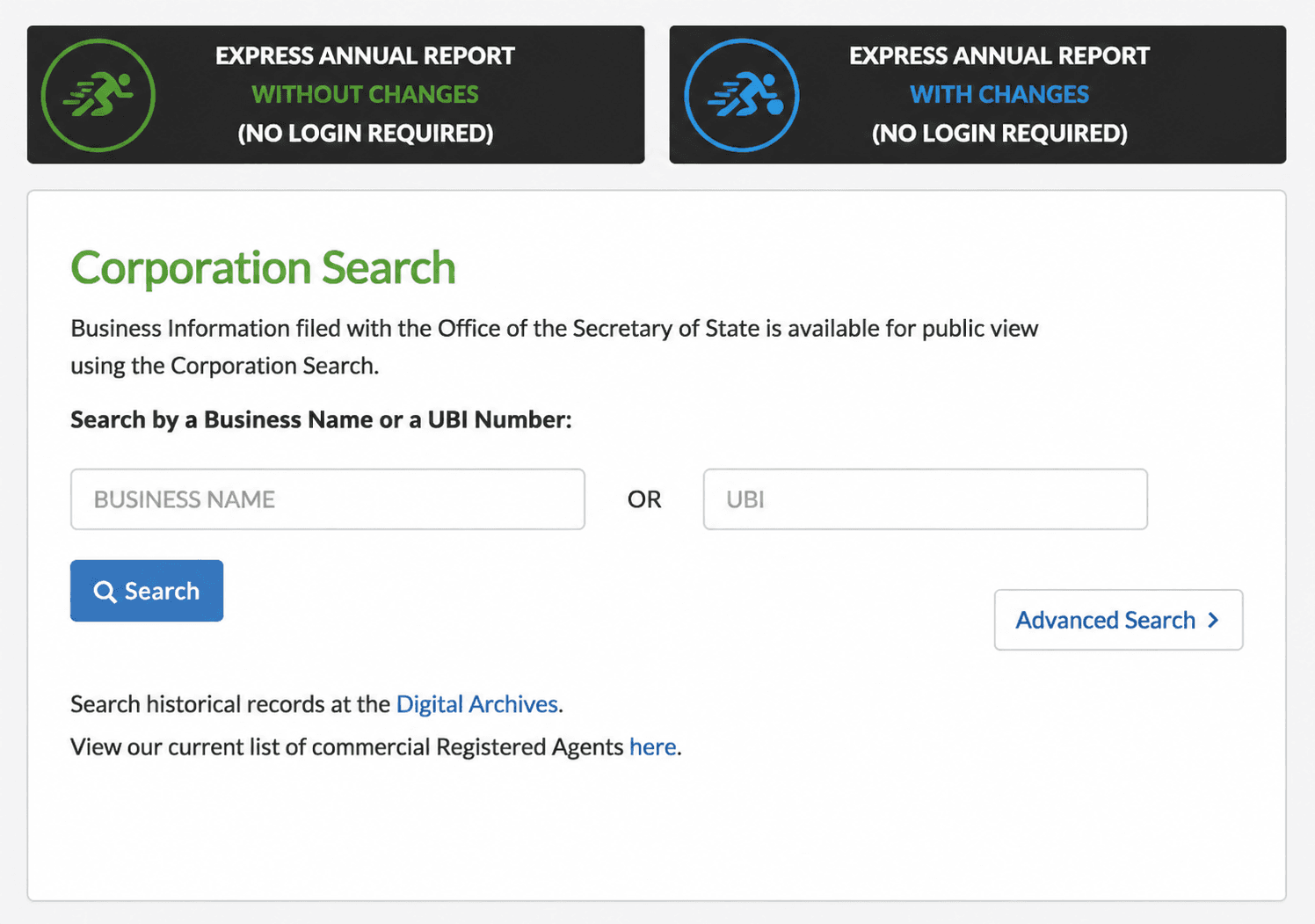
Go to CCFS and scroll down to the Corporation Search section. [2] No login is required for a public search.
Step 2. Search by Name or UBI Number
Type in the business name or the nine-digit UBI number and click Search. A UBI search returns exactly one record, since it's unique to that entity. [2]
- Avoid pluralizing the name you search. A plural mismatch is one of Washington's own documented reasons a real result gets missed. [2]
- Search for fewer words. One distinctive keyword surfaces more conflicts than a full legal name.
Step 3. Use Advanced Search for a Broader Lookup
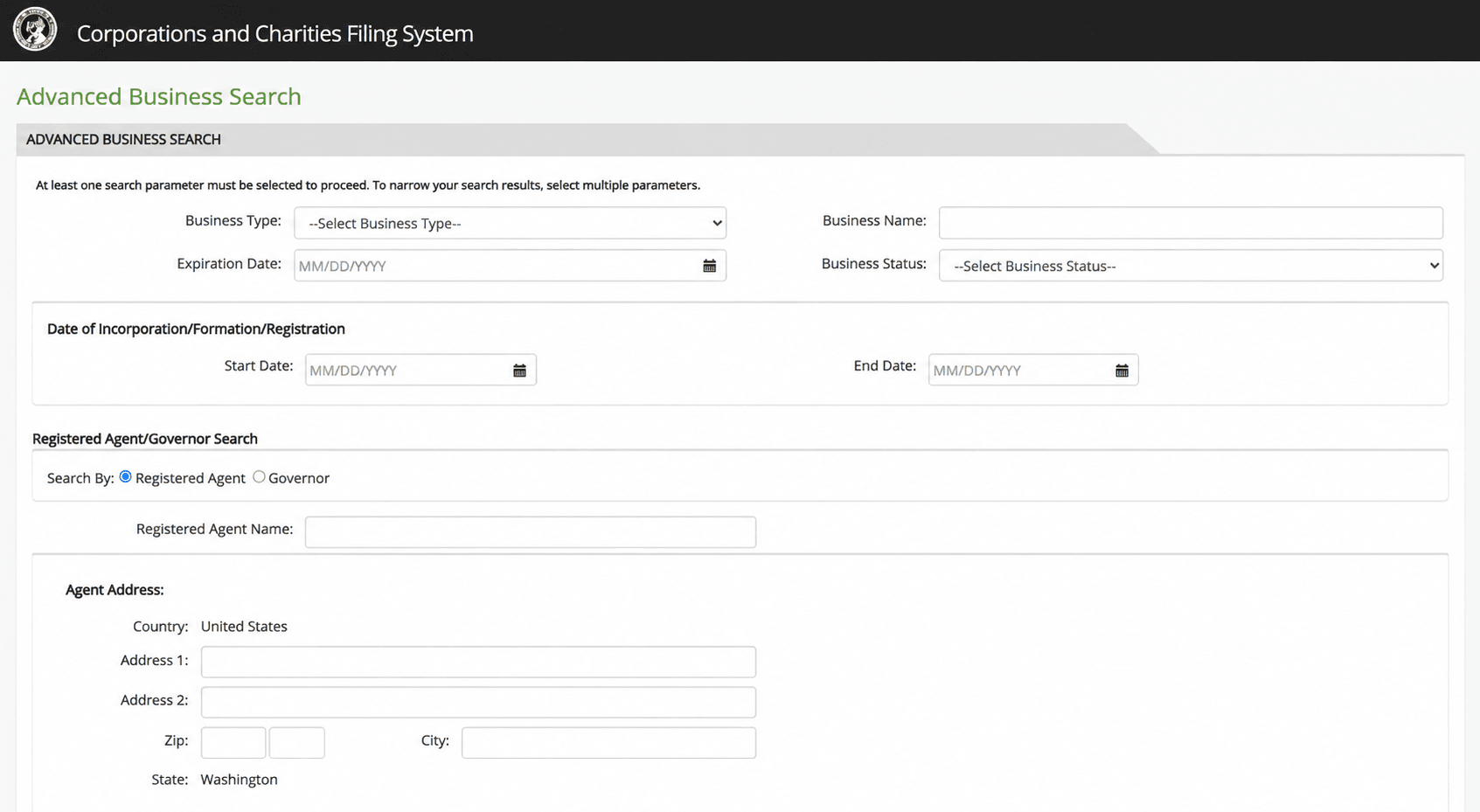
If you need more than a single name match, the Advanced Corporation Search lets you filter by business type, business status, expiration date, date of formation, and registered agent or governor name. [2] This is also the tool for a registered agent lookup, since it returns every entity tied to one agent at once.
Step 4. Open the Record and Read the Detail
Selecting a result opens the full record: entity type, UBI number, status, formation date, registered agent, and principal office address.
Step 5. Export Results if You Need a List
Both the standard and advanced searches can export results to a spreadsheet, useful for comparing several close matches side by side rather than opening each record one at a time. [2]
How To Read Your Washington Entity Search Results
Field | What It Tells You | Why It Matters |
Entity name | The exact registered legal name | It should match the name on any contract or invoice |
UBI number | Washington's unique nine-digit identifier | Ties the entity's record together across the Secretary of State, Department of Revenue, Employment Security Department, and Department of Labor & Industries [4] |
Status | Whether the entity is active, delinquent, or dissolved | The single most important field on the page |
Entity type | LLC, corporation, nonprofit, LP, or LLP | Sets which filings and naming rules apply |
Formation date | When it was registered in Washington | Also sets the entity's annual expiration month |
Registered agent | Who accepts legal service in Washington | A stale or resigned agent is a compliance signal |
Principal office address | Where the business says it operates | A mail drop or out-of-state address is worth a question |
What Washington Entity Statuses Mean
What You See | What It Means | What To Do |
Active | Registered and current on its annual report | Proceed with normal due diligence |
Delinquent | The annual report or fee is overdue | Ask when it will be cured before you rely on the entity |
Administratively Dissolved | The state dissolved it for continued non-compliance | It cannot conduct normal business until reinstated |
Withdrawn | A foreign entity ended its Washington registration | Confirm where it is currently registered instead |
Why a Washington Status Changes
Every Washington entity has an annual report due on the last day of the month it first formed, registered, or incorporated, and that anniversary date never moves. [2] Missing it moves an entity toward Delinquent status and eventually Administrative Dissolution. Swyft Filings handles Washington annual reports if you'd rather not track the date yourself.
How To Search for a Washington Nonprofit or Registered Charity
CCFS includes a separate Charities Search alongside the standard Corporation Search, and the two return different information. A nonprofit corporation shows up in both: the Corporation Search confirms it's legally registered as an entity, while the Charities Search confirms whether it's currently authorized to solicit donations in Washington and shows its most recent financial filing. [2]
This distinction matters before donating to or partnering with a Washington nonprofit. An organization can be an active corporation while its charitable registration has lapsed, which means it isn't currently authorized to solicit contributions even though it still legally exists.
How To Find a Registered Agent in Washington via Registered Agent Search
Every Washington entity is required to list a registered agent, the person or company authorized to accept legal documents on its behalf. Two common searches come up around this:
- Finding the registered agent for a specific company: Open that entity's record in CCFS. The registered agent's name and address are listed on the main detail page.
- Finding every company tied to one registered agent: Run the Advanced Corporation Search and filter by registered agent name instead of business name. This returns every entity that agent represents, which is the fastest way to check how many companies a commercial registered agent actually handles. [2]
A registered agent listing with a mail-drop address, or one that shows as resigned with no replacement filed, is worth a second look before you rely on that entity.
Why Is a Business Name Search Necessary Before Filing in Washington?
Washington reviews every new name against its existing records before accepting a filing. Skipping the search doesn't skip that review, it just means you find out at filing instead of before it. A rejected filing costs you the processing time and, in some cases, the filing fee itself.
Searching first also surfaces problems a name alone won't show: a name that's technically available but currently reserved by someone else, a name too close to an existing trademark on file in CCFS, or a registered agent conflict that signals a company worth investigating further before assuming a clean match.
Washington Business Search vs. Federal Trademark Search
Clearing Washington's business search protects the name at the state level only. It says nothing about federal trademark rights. Washington checks a proposed name against other Washington filings and state trademarks alone, so a name can be fully distinguishable in Washington and still infringe a mark that a business in another state registered years ago with the USPTO.
Run both searches if the brand matters beyond Washington's borders: CCFS for state-level distinguishability, and the USPTO trademark database for a name that could be used or defended nationwide. CCFS's own trademark search covers Washington state trademarks specifically, which is a third, separate layer from both entity names and federal marks.
What Happens if I Use a Business Name That Is Already Taken in Washington?
- The filing gets rejected. If the Secretary of State determines a name is not distinguishable from an existing entity or reservation, the formation document simply does not go through.
- You lose the filing fee and the time. Reservation and formation fees are non-refundable, so a rejected filing means paying again for a corrected one. [3]
- A trade name conflict can still surface later. Clearing CCFS says nothing about whether the same name is already registered as a trade name through the Department of Revenue.
- It creates no protection against a trademark claim. State-level clearance never defends against a company holding a federal trademark on a similar name.
How To Check if a Business Name Is Available in Washington
- Search the full proposed name in CCFS Corporation Search first, exactly as you plan to file it.
- Search again using only the single most distinctive word, dropping the entity designator.
- Search once more without punctuation, since Washington's comparison ignores it.
- Try both the singular and plural form of the name, since a mismatch there is a documented cause of missed results. [2]
- Search the federal trademark register separately, since Washington's search does not cover it.
A clear result is preliminary. The Secretary of State makes the final call only when it processes and approves the actual filing.
Still deciding what to call the business? The free Swyft Filings business name generator is a sensible first stop before you pay a reservation fee.
Washington Business Naming Rules and Restricted Words
Washington requires a name to be distinguishable from every other domestic entity that is not administratively dissolved, and from every foreign entity registered in the state. [5]
Variations that do not create distinguishability include changing the entity designator, such as "Corporation" to "Corp." or "Incorporated" to "Inc.," adding or dropping an article or conjunction like "the" or "and," and any difference in punctuation, capitalization, or special characters. [5]
Restricted Words
The following are prohibited in a Washington business name without separate authorization: [5]
- Bank, banking, banker, trust, and cooperative.
- Any combination of "industrial" and "loan."
- Any two or more of "building," "savings," "loan," "home," "association," and "society" used together.
- Any other word or phrase restricted by a separate Washington statute.
A clear search is not the same as approval. Availability is only settled once the Secretary of State processes and accepts the filing itself.
Washington State UBI Number Search for Business Verification
The UBI, or Unified Business Identifier, is a nine-digit number formatted like 603-123-456. It's assigned when a business first registers, and it ties that entity's record together across the Secretary of State, the Department of Revenue, the Employment Security Department, and the Department of Labor & Industries. [4]
Searching by UBI number instead of business name is the fastest way to confirm you have the right company, since it returns exactly one record with no ambiguity. It's especially useful when a business has changed its name, since the UBI stays constant even when the name on file doesn't.
How To Reserve a Business Name in Washington State for a New Startup
If you're not ready to form your entity yet, you can hold the name on its own first.
Detail | Information |
Filing | Name Reservation, RCW 23.95.310, filed with the Secretary of State [3] |
Fee | $30 for a for-profit entity type, $20 for a nonprofit. An additional $100 for expedited service |
Term | 180 days and cannot be renewed |
How to file | Mail or in person only. Online filing is not available for this specific form |
- Confirm the name is clear in CCFS first.
- Complete the Name Reservation form, which also lets you list up to two alternate names in case your first choice is already taken.
- Mail it with payment, or deliver it in person, to the Corporations & Charities Division.
- File your formation document within the 180-day hold. There is no renewal, so once it expires, the name is open again to anyone.
How To Register a Trade Name (DBA) in Washington
Washington calls a DBA a trade name, and this is the filing that catches people off guard: it does not go through the Secretary of State at all. Trade names are registered with the Department of Revenue's Business Licensing Service, as part of the same Business License Application that generates your UBI number. [4]
Your Business | Where the Trade Name Filing Goes |
Sole proprietor, LLC, or corporation | Department of Revenue, Business Licensing Service, through the Business License Application |
Entity formation itself | Secretary of State, through CCFS, a separate filing entirely |
File online through My DOR, or by mail to Business Licensing Service, PO Box 9034, Olympia, WA 98507-9034. The application itself carries a $50 processing fee for a brand-new business location, or $10 if you're adding a trade name to a business that already has a UBI number, plus $5 for each trade name registered on top of either processing fee. [6] Online applications are processed in about 10 business days; mailed applications can take up to six weeks. [4]
A trade name never creates a new legal entity. It does not change your tax status, your liability protection, or your ownership structure. It only authorizes the business to operate, sign contracts, and open a bank account under that name.
Swyft Filings can handle your Washington DBA registration alongside your entity formation.
Difference Between a Legal Business Name and a Trade Name in WA
Legal Business Name (Entity) | Trade Name (DBA) | |
What it creates | A legal entity, such as an LLC or corporation | A name an existing business can operate under |
Legal protection | Structural liability protection, for LLCs and corporations | None. It only authorizes use of a name |
Filed with | Secretary of State, through CCFS | Department of Revenue, Business Licensing Service |
Tied to | UBI number, assigned at registration | The same UBI number, since one identifier covers both |
A trade name never creates liability protection on its own. A sole proprietor operating under a Washington trade name is still personally liable for the business.
How To Look Up an Inactive or Historical Washington Business
If a search in CCFS comes up empty for a company you know once existed, the record may simply have aged out. Washington moves any entity that has been inactive for more than 10 years out of the live CCFS database and into the Washington State Digital Archives, a separate historical records system. [2]
This comes up most often for title research, old contract disputes, or confirming a company that dissolved years ago actually existed under the name on a document. CCFS is the right tool for anything active or dissolved within the last decade. Anything older belongs in the Digital Archives instead.
How To Verify a Washington Company Before You Deal With It
- Search the exact legal name printed on the contract or invoice, not the brand name on the sign.
- Confirm the status reads Active rather than Delinquent or Administratively Dissolved.
- Save the UBI number, the status, and the date you checked.
- Check the formation date against the years of experience the business claims.
- Read the registered agent and confirm the address is a real Washington street address.
- Run a registered agent search through Advanced Search to see how many other entities that agent represents.
Red Flags Worth a Second Look
- A company using LLC or Inc. in its name with no Washington record at all.
- A Delinquent or Administratively Dissolved status behind a business presenting itself as fully compliant.
- A UBI number that does not match the one printed on an invoice or contract.
- A registered agent address that is only a mail drop, or an agent who has resigned.
Let Us File Your Washington Business
Once your search confirms a name is clear, filing is the step that follows. Swyft Filings has helped more than 600,000 businesses get started since 2015. We handle Washington LLC formation, C Corp and nonprofit filings, registered agent service, DBA registration, annual registration filing, and foreign qualification, so no deadlines are left for you to track.
Bibliography
- Washington Secretary of State. Corporations & Charities Filing System (CCFS). Accessed August 13, 2026.
- Washington Secretary of State. Corporations & Charities Filing System Tools & Resources. Accessed August 13, 2026.
- Washington Secretary of State. Name Reservation Form, RCW 23.95.310. Accessed August 13, 2026.
- Washington Department of Revenue. New Business Information. Accessed August 13, 2026.
- Washington State Legislature. RCW 23.95.300, Permitted Names. Accessed August 13, 2026.
- Washington Department of Revenue. Variable Business License Processing Fees. Accessed August 13, 2026