
Learn how to run a free North Carolina Secretary of State business search, use all four search types, and understand why NC lets near-identical names coexist.
North Carolina is a "distinguishable upon the records" state, and that single phrase changes how its search behaves. In most states, a name close to yours blocks your filing. In North Carolina, two names can differ by a very small margin, and both can be accepted. That makes an exact-match search almost useless for clearing a name, and it means the company you are looking for may have three near-twins in the results. This guide covers how to search around that, how to read a North Carolina record, and much more.
Key Takeaways
There are four search types: company name, SOSID, company officials, and registered agents. [2]
The state tells you not to use Exact Match. NC recommends "starting with" or "contains all words," because near-identical names legally coexist here. [2]
DBAs are now searchable statewide via the Secretary of State database. [4]
NC assumed business names do not expire. Certificates filed after December 1, 2017 need no renewal. [4]
The status you want is Current-Active. Anything else means something needs fixing.
What the North Carolina Business Entity Search Covers
- Business corporations: Formed under N.C.G.S.
- Limited liability companies: Formed under Chapter 57D.
- Professional entities: PCs and PLLCs, which require licensing-board certification. Chapter 55B and 57D, Article 12
- Nonprofit corporations: Under Chapter 55A.
- Partnerships: LPs, LLPs, and LLLPs under Chapter 59.
- Foreign entities: Out-of-state companies holding a Certificate of Authority.
What North Carolina Business Entity Search Does Not Cover
- Sole proprietorships and general partnerships: They do not register as entities with the Secretary of State.
- Assumed business names: These live in a separate statewide database, covered further down. [4]
- S corporations as an entity type: An S corp is a federal tax election with the IRS, not a North Carolina structure. A company that "is an S corp" appears as a business corporation.
- EINs: Federal tax IDs come from the IRS and appear in no state database.
- LLC member names, in most cases: North Carolina lists managers and officers, but members are frequently absent from public filings.
How To Perform a North Carolina Business Entity Search Step-by-Step
Step 1. Open the Business Registration Search
Go to sosnc.gov, open Online Services, choose Business Registration, and click Search. [2] Basic searching is free and needs no login.
Use the state site. Several private domains host North Carolina business pages with heavy "start an LLC" prompts. They are not the Secretary of State.
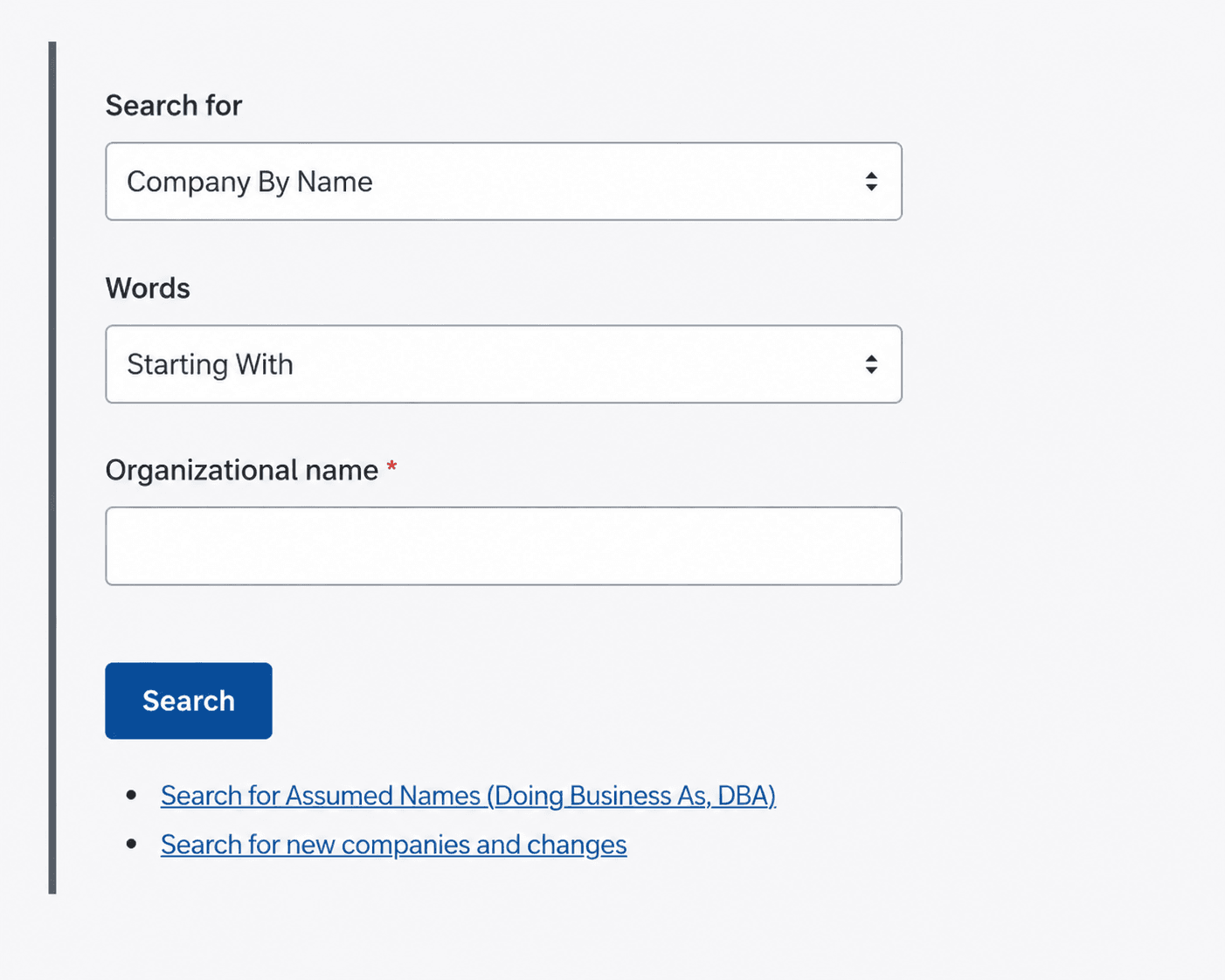
Step 2. Choose Which of the Four Search Types You Need
Search Type | What It Returns |
Company by name | Entities matching your name string, using one of four match options |
SOSID | One exact entity record, with no ambiguity |
Company officials | Officers, managers, and members on file, and the entities they are tied to |
Registered agents | Every entity linked to a named agent |
Company officials and registered agents are the two most people never use, and they are the ones that make this a due diligence tool rather than a name checker.
Step 3. Do Not Use Exact Match To Clear A Name
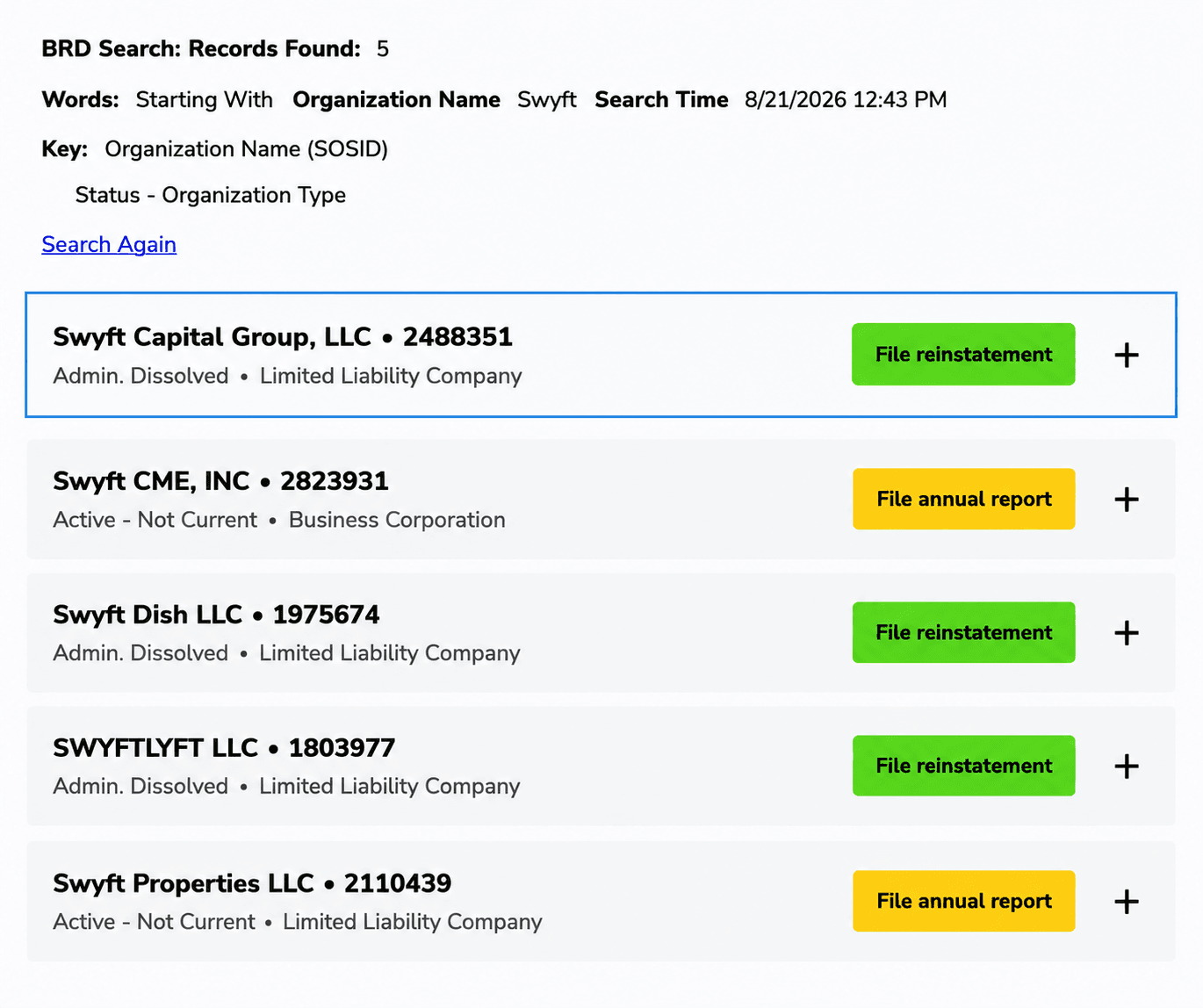
This is North Carolina's central quirk, and the state itself says so. The NC SOS search-tips guidance recommends "Name starting with" or "Name contains all words" over Exact Match, precisely because North Carolina is a distinguishable-upon-the-records state where similar names differ by tiny details. [2]
- Start with "Starting With" on the distinctive word, not the full name.
- Then run "All" to catch the same words in a different order.
- Then run "Any" to see the widest field.
- Save Exact Match for confirming a company you already know.
The same advice applies to official and agent searches, because names are entered inconsistently across filings. Searching "Robert Smith" may miss "Bob Smith" and "Smith, Robert."
Step 4. Use the SOSID When You Have One
The SOSID is the Secretary of State Identification Number, assigned to every registered entity. Search by SOSID to pull one exact record when names look alike, which in North Carolina is often.
Two things worth knowing. SOSIDs are sequential integers currently running 7 to 8 digits, not a fixed-length code, so do not assume a shorter number is wrong. And a SOSID is not an EIN and not a state tax number.
Step 5. Open The Record And Read The Filing History
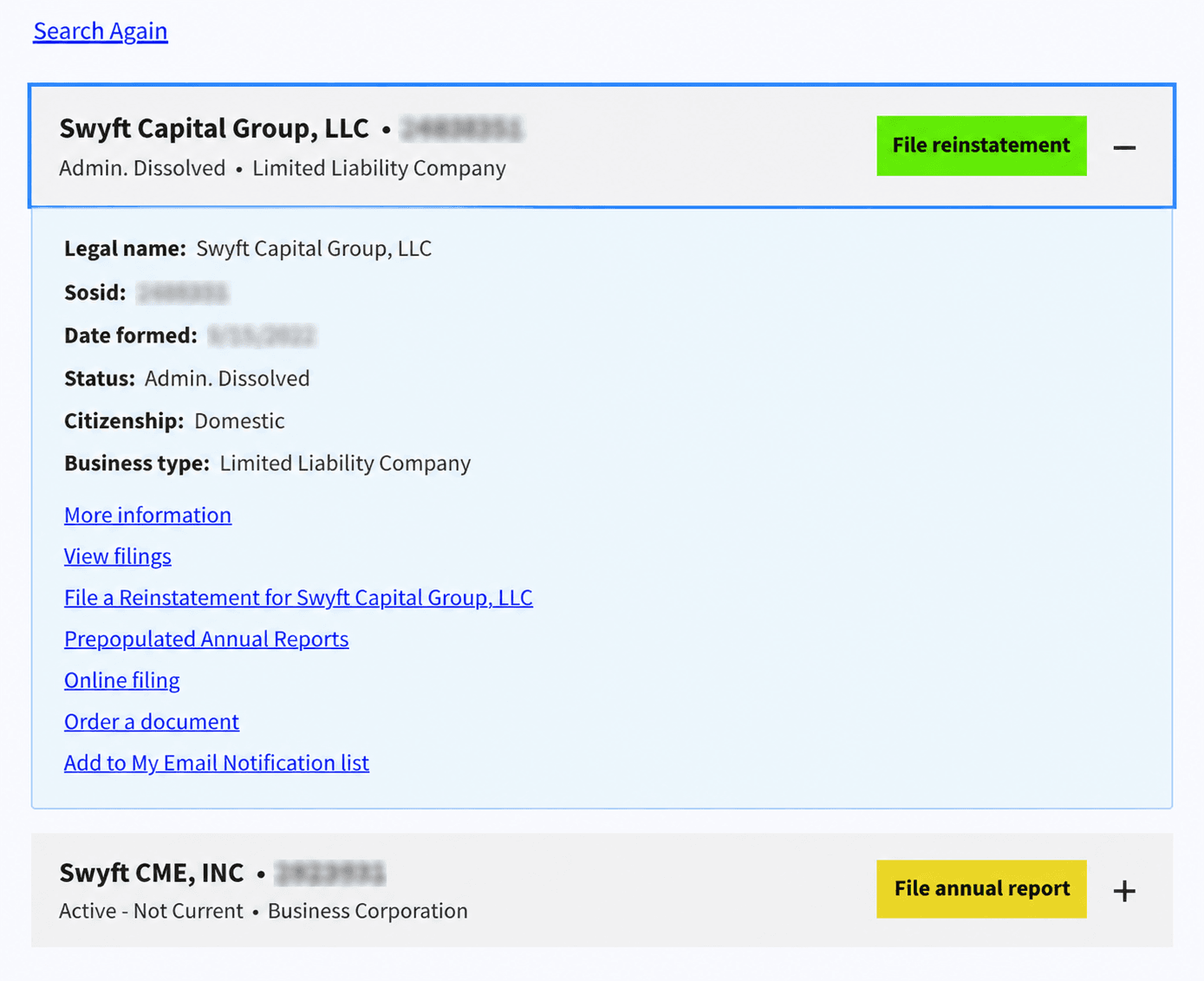
Click through from the results list for the full record, including the registered agent, addresses, officials, and the complete filing history with downloadable documents. [2]
How To Read Your North Carolina Entity Search Results
Field | What It Tells You | Why It Matters |
Legal name | The current registered name, plus former names if changed | Compare against the name on the contract or invoice |
SOSID | The unique state identifier | Returns one record every time. Save it with the date you checked |
Status | Whether the entity is compliant | The most important field, and NC has five values |
Entity type | Corporation, LLC, PC, PLLC, nonprofit, or partnership | Sets which statute and filings apply |
Date formed | When it registered in North Carolina | Check against the track record being claimed |
Citizenship | Domestic or foreign | Tells you where the company was actually formed |
Annual report due date | Printed on the record | Lets you see whether a filing is overdue at a glance |
Registered agent | Who accepts service of process | Must be a physical NC street address, never a PO box |
Officials | Officers, managers, and members on file | Compare with who you are dealing with |
Document filings | Articles, amendments, mergers, annual reports | Download the actual filing rather than trusting a summary |
The annual report due date on the record is more useful in North Carolina than in most states, because it is displayed directly. Compare it against today before you rely on anything else.
What Does North Carolina Business Entity Status Mean
North Carolina uses five labels, and each tells you exactly what went wrong.
Status | What It Means | What Needs To Happen |
Current-Active | Compliant on all required filings and fees | Nothing. This is good standing |
Active/Not Current | Registered but delinquent on a required filing | The overdue filing must be made |
PA Suspended | A licensing board suspended a professional entity under Chapter 55B | Resolve it with the licensing board, not the SOS |
Administratively Dissolved | The state dissolved a domestic entity for non-compliance | Application for Reinstatement, $100 plus overdue fees |
Revoked | A foreign entity's Certificate of Authority was withdrawn | Requalify with a new Certificate of Authority, $250 |
PA Suspended is often misread. It is not the Secretary of State's doing. A licensing board has suspended a professional corporation or PLLC, and only that board can lift it. If you are vetting a professional practice, that status is a much bigger signal than a late filing.
What Triggers Administrative Dissolution
North Carolina lists six statutory grounds under N.C.G.S. § 55-14-20. Two show up constantly:
- A delinquent annual report.
- No registered agent or registered office in North Carolina for 60 or more days.
A dissolved or revoked entity can lose limited liability protection and its ability to sue or be sued in North Carolina courts. That is why a status other than Current-Active is a stop-and-ask when you are checking a counterparty.
How To Check if a Business Name Is Available in North Carolina
North Carolina's standard is distinguishable from the records of the Secretary of State, under G.S. § 55D-21(b). [3]
That is a low bar compared with most states. Near-identical names can legally coexist. So your search is answering two different questions at once, and you should treat them separately:
- Will the state accept my filing? Often yes, even when a similar name exists.
- Should I use this name anyway? A near-twin in your market is a branding and trademark problem, whatever the state permits.
The sequence that works
- Run Starting With on the distinctive word in your name.
- Run All on your full name to catch reordered wording.
- Run Any to see the widest field of near-misses.
- Search the assumed business name database too, since a registered DBA may be trading under a similar brand.
- Search the federal trademark register, which the state search does not cover.
- Reserve the name if you are not filing immediately.
A clear result is preliminary. The Secretary of State makes the final call at filing.
Still deciding what to call the business? The free Swyft Filings business name generator is a sensible first stop.
North Carolina Naming Rules and Restricted Words
Entity Type | The Name Must Contain |
Limited liability company | "Limited liability company," "L.L.C.," or "LLC" |
Business corporation | "Corporation," "Incorporated," "Company," or "Limited," or Corp., Inc., Co., or Ltd. |
Professional LLC | "Professional Limited Liability Company," "P.L.L.C.," or "PLLC" |
Professional corporation | The designator required for the entity type under Chapter 55B |
Designator requirements sit in N.C.G.S. § 55D-20. [3]
Words that need legal authority:
These cannot be used without authority to do so:
- Realtor
- Trust
- Mutual
- Bank, Banker, Banking
Words that need proof you are qualified:
These require documentation showing you are legally qualified to provide the service:
- Architect, Architectural
- Certified Public Accountant
- Cooperative, Co-op
- Engineer, Engineering
- Insurance
- Pharmacy, Prescription Drug, Drug, Prescription, Rx, Apothecary
- Surveyor, Survey, Surveying
- Wholesale
Other limits:
A North Carolina name cannot suggest or state unlawful activity, cannot offend decency standards, and cannot imply an association with a state or federal government agency.
How To Reserve a North Carolina Business Name
Detail | Information |
Filing | Application to Reserve a Business Entity Name, filed with the NC SOS |
Fee | $30 under the statutory fee schedule. Confirm the current amount for your entity type |
How long the hold lasts | 120 days |
Transferable? | Yes. The holder can transfer it by filing a notice of transfer |
North Carolina has an unusual exception. Under G.S. § 55D-23(c), a business that acquires another company's goodwill can reserve the acquired name for 10 years. [3]
It is the longest name hold in the state system, and it exists so a buyer of a going concern can protect the brand they just paid for while they reorganize. Note the limit carefully: it applies to a name acquired with goodwill, not to any name you would like to sit on for a decade.
When you are ready, you can form your North Carolina LLC, or file as a C Corp or file as a Nonprofit.
North Carolina Assumed Business Name (DBA) Search
North Carolina overhauled its DBA system in December 2017, and most guidance online still describes the old rules. Here is what actually applies. [4]
DBA is Searchable Statewide:
Article 14A of Chapter 66 established a statewide, online, searchable database at the Secretary of State containing every assumed business name filing made on or after December 1, 2017. [4] [5]
That ended the old problem of assumed names hiding in individual county record rooms.
You File DBA at the County:
The certificate itself is still recorded with the Register of Deeds, not the Secretary of State. Under G.S. § 66-71.4(a), anyone doing business in North Carolina under an assumed name must file an assumed business name certificate with the register of deeds of the county where they are or will be doing business. [5]
One Filing Can Cover All 100 Counties:
The 2017 reform allows filers to designate multiple counties on a single filing. [4] If you do business in more than one county, filing is required in only one of them. Under the old system, you filed separately in each county.
The recording fee is typically $26, set by the county rather than the state, so it can vary slightly.
North Carolina DBA Does Not Expire:
Assumed business name certificates filed after December 1, 2017 do not expire and require no renewal. That is unusual, and it is a genuine advantage over states that make you re-file every five or ten years.
Three Things That Catch Filers Out:
- The 60-day update rule. You must update the information in your assumed business name filing within 60 days of it changing. [4]
- The transition deadline has passed. Pre-2017 filers had until December 1, 2022, to re-file and preserve their designation. Anyone who did not is no longer effectively registered.
- Entities must supply their SOSID. A corporation, LLC, or LP filing an assumed name must give its exact registered name and its SOSID on the certificate, which is another reason to look up your SOSID first.
An assumed business name is disclosure, not protection. It creates no exclusive rights, and it will not block someone else's entity filing the way a registered entity name does.
Swyft Filings can handle your North Carolina DBA registration, and for enforceable brand protection, we can help with federal trademark registration.
Check Your Domain and Handles Before You Commit
Because North Carolina permits near-identical names, clearing the register proves less here than in most states. It confirms the SOS will accept your filing. It does not confirm the name is yours to build a brand on.
Run three more checks in the same sitting:
- The domain. Check the exact match and a fallback or two.
- The social handles. Check the platforms you will actually use.
- The federal trademark register. A mark held by a company that never registered in North Carolina can still stop you, and the distinguishable-upon-the-records standard offers no defense.
Keep the shortlist alive until one name clears all four checks.
How To Verify a North Carolina Business Before You Deal With It
- Search the exact legal name from the contract or invoice, not the brand name.
- Save the SOSID, the status, and the date you checked.
- Confirm the status reads Current-Active, and read the specific label if it does not.
- Compare the annual report due date on the record against today.
- Verify the registered agent has a physical North Carolina street address.
- Run a registered agent search to see the agent's full client list.
- Run a company officials search on the principal to find their other companies.
- Open the document filings and read the most recent annual report.
- Order a Certificate of Existence if the transaction warrants certified proof.
Red Flags Worth A Second Look
- A company using LLC or Inc. in its name with no sosnc.gov record at all.
- Any status other than Current-Active behind a business presenting itself as fully operational.
- A newly formed entity replacing an older dissolved one with a near-identical name, which in contracting can be a reset to shed liabilities.
- A registered agent whose details do not match what the business told you.
- A principal whose name returns a trail of administratively dissolved companies.
How To Get a North Carolina Certificate of Existence
North Carolina's name for a certificate of good standing is the Certificate of Existence. Order it through the sosnc.gov portal for $15. It certifies the entity is validly formed and current on its filings, and it is what banks, lenders, and other states' foreign qualification filings ask for.
An entity that is not Current-Active will not be issued one until the underlying problem is resolved. Swyft Filings can obtain a Certificate of Good Standing on your behalf.
How to Search for Foreign Entities Registered in North Carolina
A company formed in another state must obtain a Certificate of Authority from the NC SOS before transacting business in North Carolina, and it then appears in the same search.
- Read the citizenship field to tell a domestic entity from a foreign one.
- Revoked means it lost authority, and requalification requires a new Certificate of Authority at $250.
- Cross-reference the home state. A foreign entity's North Carolina record shows only its NC registration, not its full history.
- No record is meaningful. An out-of-state company with an office or employees in North Carolina and no Certificate of Authority may not have qualified as required.
Let Us File Your North Carolina Business
Once your search confirms a name is clear across entities, assumed names, and the federal register, filing is the step that follows. Swyft Filings has helped more than 600,000 businesses get started since 2015. We handle North Carolina LLC formation, C Corp and nonprofit filings, registered agent service, DBA registration, and business name changes.
Bibliography
- North Carolina Secretary of State. North Carolina Secretary of State. Accessed on August 7, 2026.
- North Carolina Secretary of State. Business Registration Division. Accessed on August 7, 2026.
- North Carolina General Assembly. Chapter 55D, Article 3, Names. Accessed on August 7, 2026.
- North Carolina Secretary of State. Assumed Business Names. Accessed on August 7, 2026.
- North Carolina General Assembly. Chapter 66, Article 14A, Assumed Business Names. Accessed on August 7, 2026.