

Learn how to run a free Colorado Secretary of State business search, understand every field on the record it returns, and check whether a business name is available.
The Colorado Secretary of State keeps a free public record of every business registered in the state. Running the search is easy. Reading it correctly is where people go wrong.
Colorado has two separate search tools that look similar and do different jobs, a status system where an entity can be trading legally one week and locked out of court the next, and a rule that quietly releases a company name to the public 400 days after it goes delinquent. This guide walks you through the tools, then through the record itself, field by field.
Key Takeaways
- Colorado runs two searches, not one. The Business Database Search looks up companies. The Name Availability Search checks a new name. [1]
- Search by ID number when you have it. The state says ID searches are faster and give better results than name searches. [2]
- Good Standing is the only status that confirms compliance. Noncompliant and Delinquent both mean a missed periodic report. [4]
- Certificates and copies are free in Colorado. Certificates of good standing and filed documents download at no charge. [5]
- A record is not a character reference. The Secretary of State is a filing registry and does not certify that a business operates legally. [4]
Colorado Business Entity Search at a Glance
Detail | Information |
Official tool | Business Database Search, also called the Colorado Secretary of State business search, Colorado entity search, or CO SOS business entity search [2] |
Operated by | Colorado Secretary of State, Business and Licensing Division [1] |
Cost | Free, with no login or account required |
Search by | Business name, trade name, trademark, ID number, or document number [2] |
Advanced search by | Registered agent, reserved name holder, trade name registrant, or trademark registrant [2] |
Covers | LLCs, corporations, nonprofits, partnerships, registered trade names, and trademarks |
Does not cover | Sole proprietors without a trade name, and local business licenses |
Second tool | Name Availability Search, for checking a name before you file [3] |
Office | Colorado Secretary of State, 1700 Broadway, Suite 550, Denver, CO 80290, 303-894-2200 [1] |
Colorado Has Two Search Tools: Which One You Need
This is the first place people get stuck, because both tools sit on the same menu and neither name makes the difference obvious. [1]
Tool | What It Is For | What It Returns |
Business Database Search | Looking up a company that already exists | The full entity record: ID, status, dates, agent, addresses, and filing history [2] |
Name Availability Search | Testing a name you want to use before you file | An indication of whether the name appears available under Colorado’s rules [3] |
If you are checking a vendor, a partner, or a company you are about to pay, use the Business Database Search. If you are naming a new business, run both. The database search shows you the near misses, and the name search gives you the state’s read on availability.
What the Colorado Business Database Covers
What You Will Find
- Limited liability companies: Domestic and foreign LLCs.
- Corporations: For-profit, professional, and foreign corporations.
- Nonprofit corporations: Including those that later seek federal tax-exempt status.
- Partnerships: Limited partnerships, LLPs, and LLLPs registered with the state.
- Trade names and trademarks: Registered trade names and state trademarks are searchable in the same database. [2]
What is Not in The Database
- Sole proprietors without a trade name: They never register with the state, so they leave no record at all. File a trade name and the trade name becomes searchable. [4]
- General partnerships: The same applies unless they registered an LLP or a trade name.
- Owners and members: Colorado records the registered agent and addresses, not a verified ownership list.
- Local business licenses: Cities and counties issue those, and they are searched locally.
That last point about sole proprietors explains most empty searches. A real, tax-paying Colorado business can be entirely absent from this database because it never had to register. [4]
How To Perform a Colorado Business Entity Search Step-by-Step
Step 1. Open the Business Database Search
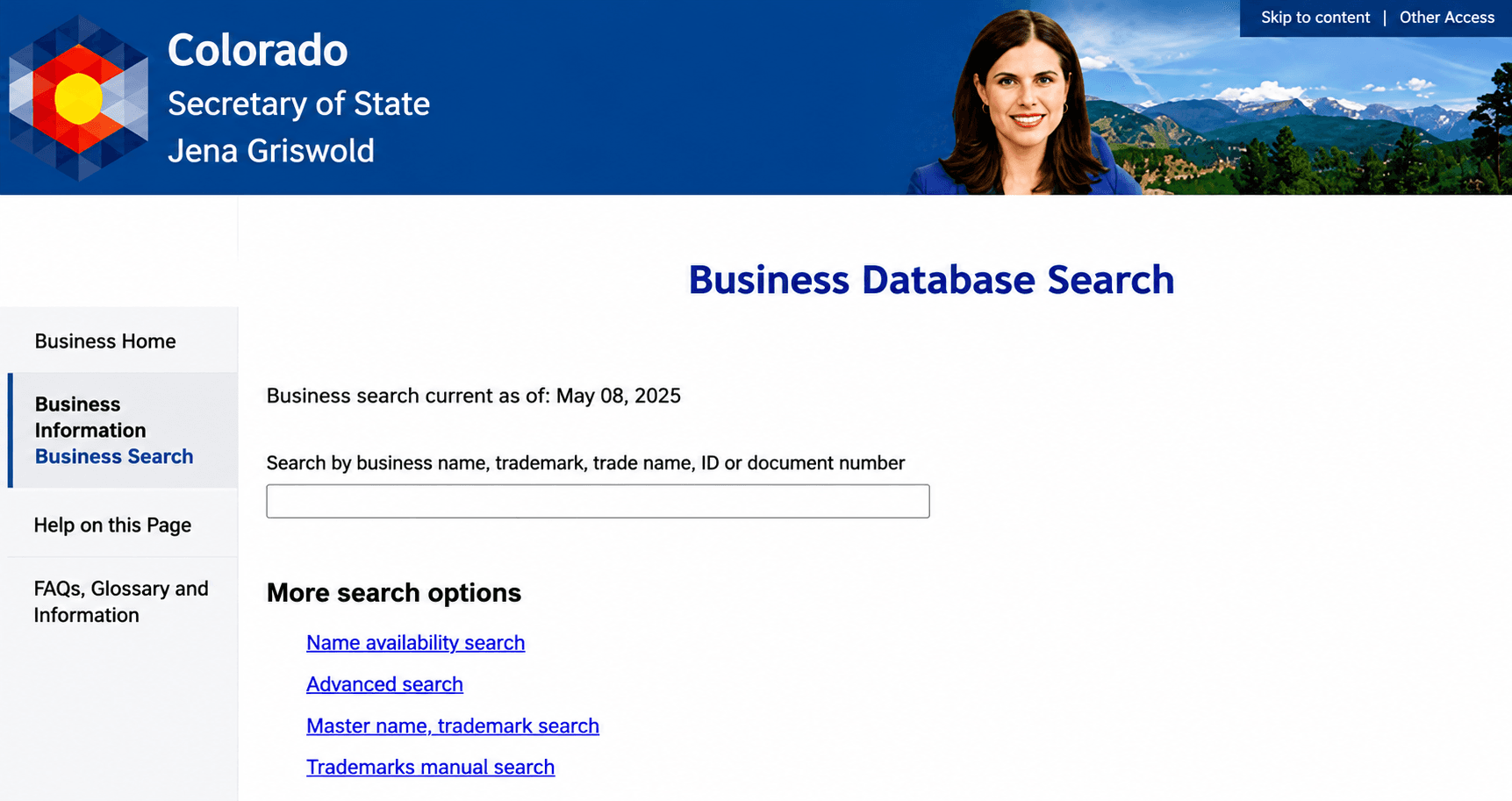
Go to the Colorado Secretary of State business database search. [2] No account, no login, no fee. The page also displays the date paper documents have been processed through, which tells you how current the records are.
Step 2. Decide What You Are Searching By
The basic search accepts more than a company name, and some of the alternatives are far more precise. [2]
Search By | When To Use It |
Business name | The default. Returns entity names, trade names, and trademarks together |
ID number | The fastest and most exact route when you have the 11-digit Colorado ID [2] |
Document number | When you are tracing a specific filing rather than a company |
Trade name | When the business trades under a DBA rather than its legal name |
Trademark | When you are clearing a brand rather than a company name |
Step 3. Use the Advanced Search to Narrow or Reverse a Lookup
The advanced search is where the useful due diligence lives. [2]
- Restrict the type: Search entity names, trade names, or trademarks separately instead of all three at once.
- Exact matches only: Useful once you have narrowed a long list of near misses.
- Filter by filing date: Set a date range to find entities formed in a given window.
- Search by registered agent: A reverse lookup that shows every entity one agent represents.
- Search by reserved name holder: To see who is holding a name you want.
- Search by trade name or trademark registrant: To find every name a person or company has claimed.
Step 4. Open the Entity Record
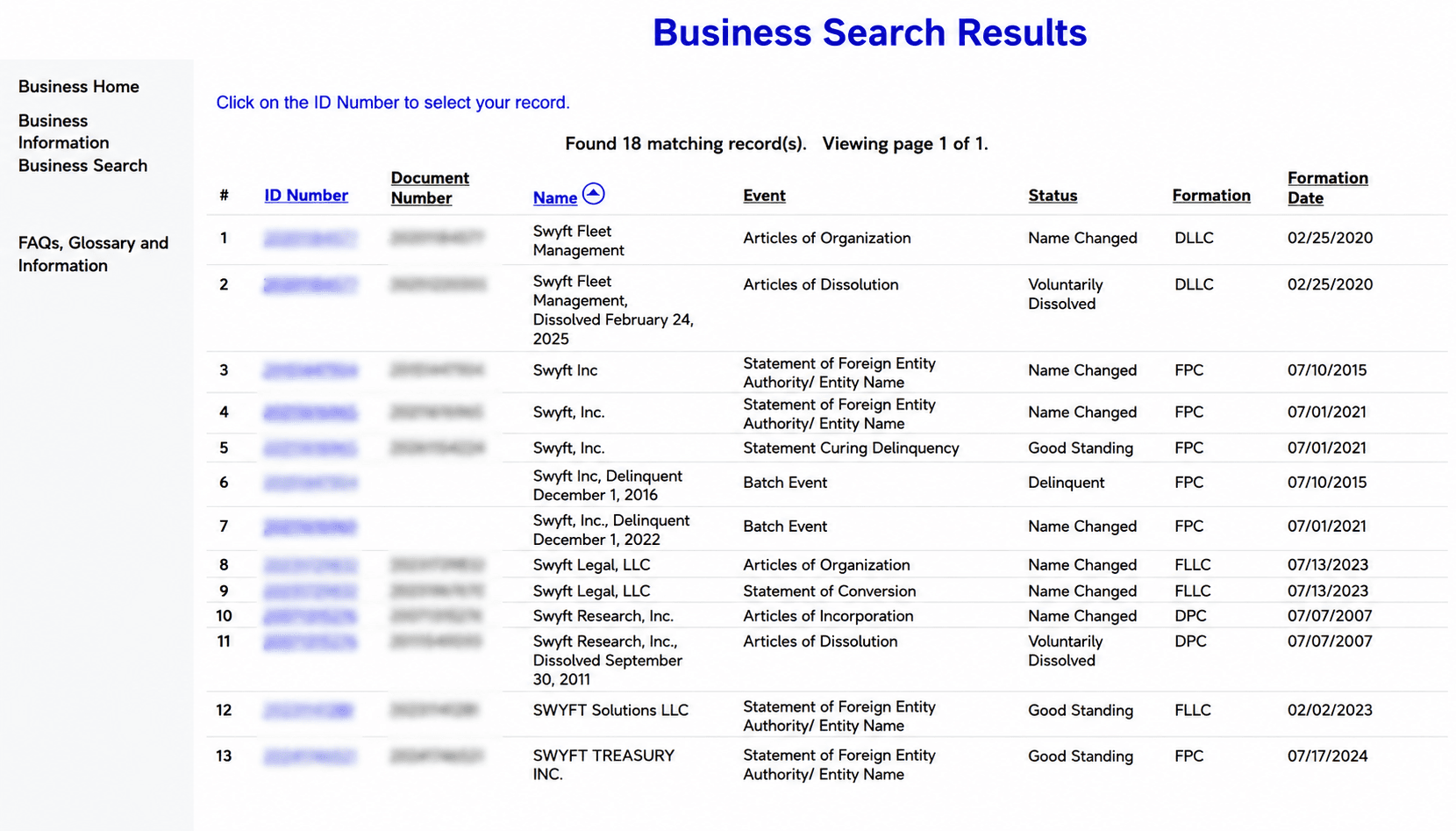
Click the Colorado ID number in the first column of the results to open the record. That page is the summary. Links beneath it take you to the entity’s filing history, its filed documents, and any trade names attached to it. [2]
Step 5. Open the Filing History Before You Draw Conclusions
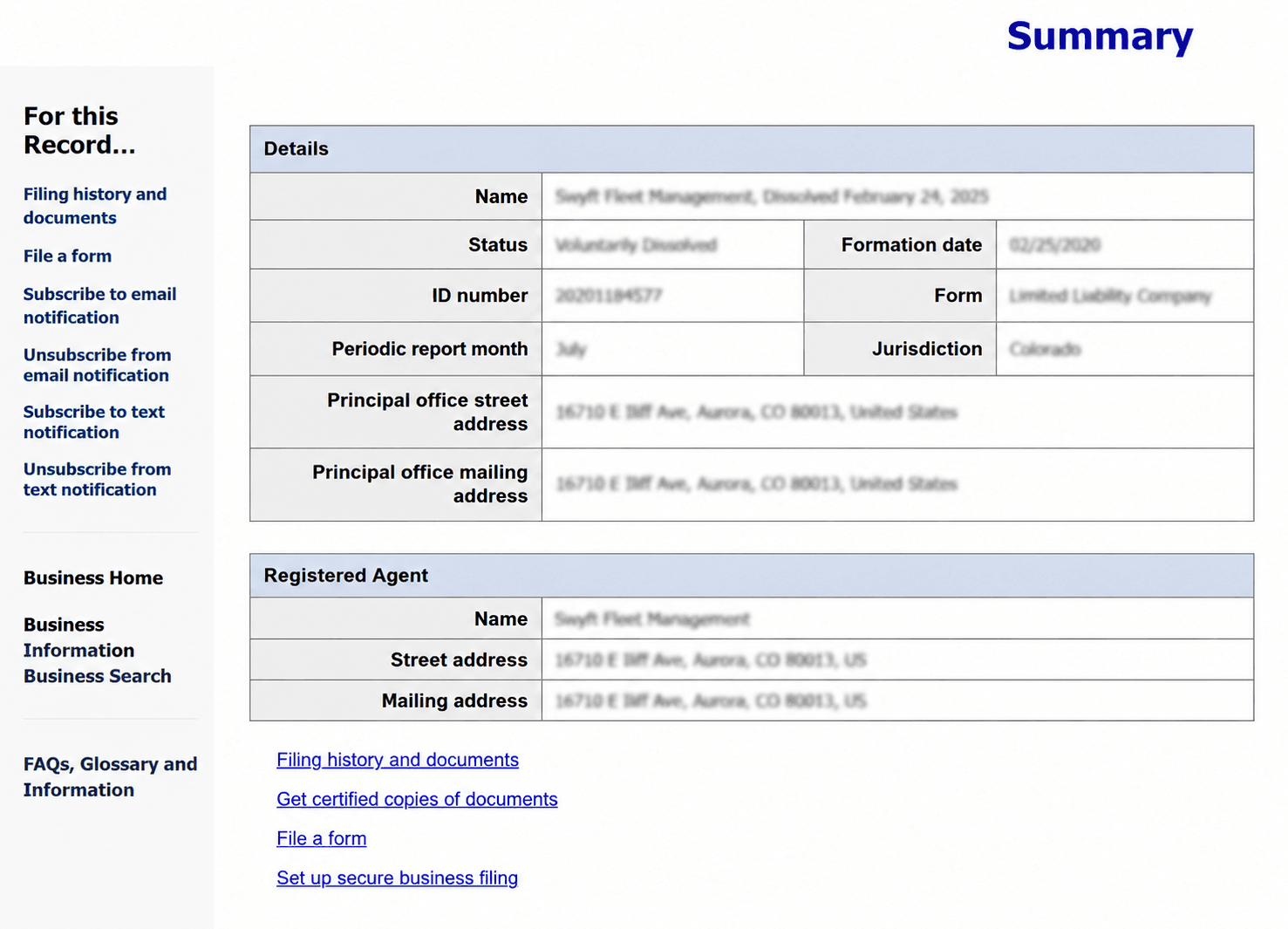
The summary tells you where a business stands today. The filing history tells you how it got there. Filed documents download as PDFs at no charge, so you can read the actual Articles of Organization rather than a summary of them. [5]
How To Read Your Colorado Entity Search Results
Every field on the record answers a different question. Here is what each one is actually telling you.
Field | What It Tells You | Why It Matters |
Entity name | The exact legal name on file | It should match the name on any contract or invoice |
Colorado ID number | The unique 11-digit state identifier | Use it for every future lookup; it never returns the wrong record |
Status | Whether the entity is current with the state | The single most important field on the page |
Form or entity type | LLC, corporation, nonprofit, or partnership | Sets what filings and rules apply |
Formation date | When it registered in Colorado | Check it against how long the business claims to have traded |
Jurisdiction | Colorado, or another state for a foreign entity | Tells you where the company actually lives |
Principal office address | The main business address on file | A mail drop or a residential address is worth noting |
Registered agent | Who accepts legal service, with a Colorado address | A missing or stale agent is a compliance signal |
Periodic report month | The month the annual report is due | Lets you work out whether a filing is overdue |
Trade names | Any DBAs attached to the entity | Explains a mismatch between the legal name and the brand |
Filing history and documents | Every filing, downloadable for free | Shows amendments, name changes, and gaps |
What Colorado Entity Statuses Mean
Colorado uses its own vocabulary, and the difference between two of these statuses is the difference between a working company and one that cannot sue to collect a debt.
Status | What It Means | What To Do |
Good Standing | Current on the periodic report and all filings | The only status that confirms compliance. Proceed with normal due diligence |
Noncompliant | The periodic report window closed without a filing | File the late report and pay the penalty before it worsens |
Delinquent | Still unfiled after the noncompliant window | A Statement Curing Delinquency is needed to restore good standing |
Administratively Dissolved | The state dissolved a long-delinquent entity | Reinstatement is a separate filing. Treat as a red flag on a counterparty |
Voluntarily Dissolved | The owners closed it themselves | Do not contract with it |
Withdrawn | A foreign entity ended its Colorado registration | Confirm where it is registered now |
Merged or Converted | It became part of, or turned into, another entity | Identify and vet the surviving entity instead |
Why a Colorado Status Changes
Colorado calls its annual filing a periodic report rather than an annual report, and the report month is printed on the entity record. Missing it is what moves an entity from Good Standing to Noncompliant and then to Delinquent. [7]
The 400-day rule that catches out name searchers:
Here is the detail worth remembering. A delinquent Colorado entity keeps exclusive rights to its name for a limited period after the delinquency date. Once that period passes, the word delinquent is appended to the entity name on the record and the original name becomes available for someone else to register.
So a name that looked permanently taken can free up without the company ever dissolving. If a close match in your search results is sitting at Delinquent, it is worth checking back rather than abandoning the name.
What a Colorado Search Does Not Prove
The Secretary of State is unusually direct about the limits of its own database. The office acts as a filing registry and does not have the authority to certify whether a business is operating legally. [4] A record proves a filing was accepted. It proves nothing about the business behind it.
- Not a license check: an entity record says nothing about whether the company holds the local or professional licenses its work requires.
- Not an EIN lookup: a federal Employer Identification Number comes from the IRS and is not published in any state database. For a vendor EIN, ask for a completed Form W-9.
- Not an ownership record: Colorado lists the registered agent and addresses, not a verified list of members or shareholders.
- Not proof of solvency: no financial data of any kind appears in the record.
- Not a trademark clearance: a name can clear Colorado entirely and still infringe a federal mark.
How To Check if a Business Name Is Available in Colorado
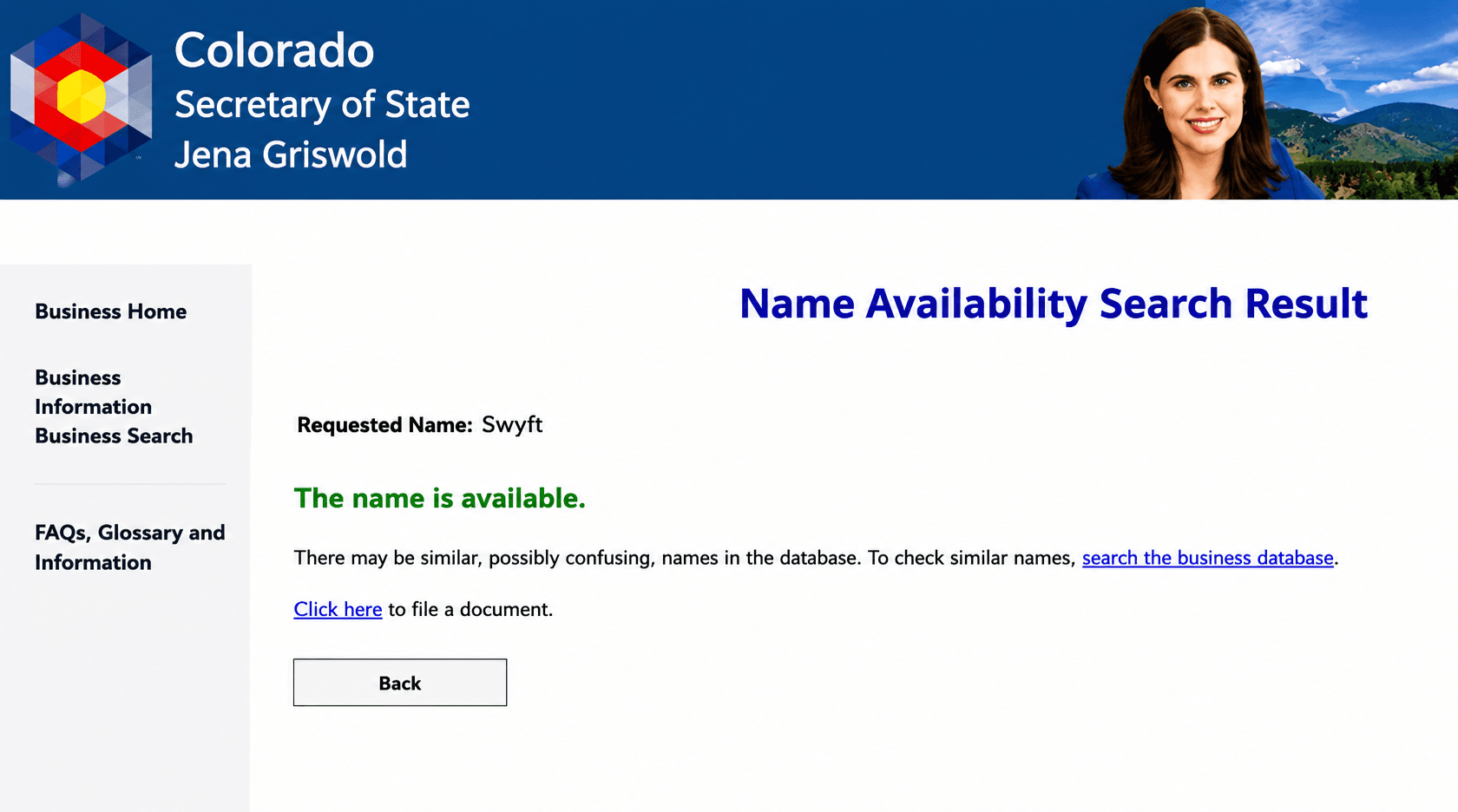
Use both tools in sequence. The database search shows you what already exists. The Name Availability Search gives you the state’s read on whether your name clears. [2] [3]
- Search the business database for your full name, and read every near miss it returns.
- Search again for the single most distinctive word in the name.
- Check whether any close match is a trade name or a trademark rather than an entity.
- Note the status of any close match, because a delinquent one may release its name.
- Run the Name Availability Search on the exact name you want. [3]
- Search the federal trademark register separately, since Colorado does not cover it.
Still deciding what to call the business? The free Swyft Filings business name generator is a useful starting point before you pay a reservation fee.
What Makes a Colorado Business Name Distinguishable
Colorado requires a new name to be distinguishable on the records of the Secretary of State from every other entity name, reserved name, trade name, and trademark already on file. The test looks past the cosmetic differences people usually rely on.
- The entity identifier: Swapping LLC for Inc. on an otherwise identical name.
- Articles: adding or removing "a," "an," or "the."
- Punctuation and symbols: Commas, hyphens, apostrophes, and ampersands.
- Spacing and capitalization: Two words versus one, or a change of case.
- Similar sounding words: A phonetic variation of a registered name.
- Singular versus plural: Adding an s to an existing name.
What Tends to Work Instead
- A genuinely different word: Not a respelling of the same one.
- Additional distinctive wording: That changes what a customer would understand the business to be.
- A different service descriptor: Where the rest of the name is shared.
Because Colorado tests against trade names and trademarks as well as entity names, a name can be blocked by something that is not a company at all. That is why the trade name search matters even if you are forming an LLC. [2]
Colorado LLC and Corporation Naming Requirements
Being distinguishable is only half the test. Your name also has to carry the right identifier for the entity type you are forming.
Entity Type | The Name Must Contain |
Limited liability company | "Limited Liability Company," "Ltd. Liability Company," "Limited Liability Co.," "Ltd. Liability Co.," "Limited," "LLC," "L.L.C.," or "Ltd." |
Corporation | "Corporation," "Incorporated," "Company," "Limited," or an abbreviation such as Corp., Inc., Co., or Ltd. |
Nonprofit corporation | A corporate identifier is permitted but not required |
Limited liability partnership | "Registered Limited Liability Partnership," "Limited Liability Partnership," "Ltd. Liability Partnership," "L.L.P.," "LLP," or "Limited" |
Limited partnership | "Limited Partnership," "Ltd. Liability Limited Partnership," "L.P.," or "LP" |
The identifier itself never distinguishes a name, so adding LLC to a name already held by a corporation will not clear it. Both rules apply at once: the right ending is required, and it counts for nothing in the availability test.
How To Reserve a Colorado Business Name
A reservation is optional, and worth it when you have cleared a name but are not ready to file. It stops anyone else registering the name while you get organized.
Detail | Information |
Filing | Statement of Reservation of Name, filed online [1] |
How long the hold lasts | 120 days |
Fee | $25.00 [5] |
Renewal | A Statement of Renewal of Reservation of Name, filed before the 120 days expire [5] |
Paper option | None. Colorado requires these filings to be made online [1] |
Who holds it | The reserved name holder is searchable in the advanced search [2] |
You do not need a reservation to form a business. If your documents are ready, filing the formation itself claims the name immediately.
Once the name is settled, you can form your Colorado LLC, or file as a C Corp or Nonprofit.
Colorado Trade Name (DBA) Search
Colorado calls a DBA a trade name, and it behaves differently depending on who files it. Your legal name is what appears on your Articles of Organization or Incorporation. A trade name is a separate filing recording a name you actually trade under. It creates no new legal entity, gives no liability protection, and grants no exclusive statewide rights to the name.
Who Has To File One
Any for-profit business trading under something other than its true entity name, and any individual trading under something other than their own legal first and last name, must file a Statement of Trade Name. There are separate forms for individuals, non-reporting entities, reporting entities, and out-of-state filers, so pick the one that matches your situation.
Filer | Term | Renewal |
Sole proprietor or general partnership | One year, expiring the first day after the anniversary month | Renew online in the three-month window before expiry |
LLC, corporation, or other reporting entity in good standing | Continues while the entity stays in good standing | No separate annual renewal |
Why It Matters For Your Search
- Trade names are searchable: They appear in the same business database, so search them as well as entity names. [2]
- They block entity names: A registered trade name counts when Colorado tests whether your entity name is distinguishable.
- A sole proprietor with a trade name is findable: One without a trade name is not in the database at all. [4]
- Not filing has consequences: Trading under an unregistered name in Colorado can affect your ability to enforce contracts and can carry a civil penalty.
Swyft Filings can handle your Colorado DBA registration, and for actual brand protection, you need federal trademark registration rather than a state filing.
Free Documents You Can Pull From a Colorado Search
Colorado is more generous here than most states, and it is worth knowing before you pay a third party for something the state gives away. [5]
- Certificate of Good Standing: Generated and downloaded free from the Secretary of State site once an entity is in good standing.
- Filed documents: Articles of Organization, amendments, and periodic reports download as PDFs at no charge from the filing history.
- Certified copies: Available free for documents under the page limit set by the Secretary of State.
- Certificate validation: A separate tool lets anyone confirm a certificate someone else has handed them is genuine. [1]
- Bulk business data: The Business Intelligence Center publishes Colorado business filing data for research and market analysis. [1]
If you would rather not deal with the portal, Swyft Filings can obtain a Certificate of Good Standing on your behalf.
Colorado Business Entity Search Costs
Searching is free, and so are most documents. These are the costs attached to searching, holding a name, and registering a trade name. [5] Confirm current amounts on the fee schedule before you pay, since Colorado revises it.
Service | Fee | Notes |
Business database search | Free | No account needed [2] |
Name availability search | Free | A separate tool from the database search [3] |
Advanced search by agent, holder, or registrant | Free | Reverse lookups on people and companies [2] |
Certificate of Good Standing | Free | Downloaded from the Secretary of State site [5] |
Filed documents and filing history | Free | PDF downloads from the entity record [5] |
Statement of Reservation of Name | $25.00 | Holds the name for 120 days [5] |
Statement of Renewal of Reservation of Name | $25.00 | Filed before the 120 days expire [5] |
Statement of Trade Name | $20.00 | Filed online, per trade name [5] |
How To Verify a Colorado Company Before You Deal With It
- Search the exact legal name from the contract or invoice, not the brand name.
- Confirm the status reads Good Standing, and nothing else.
- Check the formation date against the experience the business claims.
- Read the registered agent and confirm the address is a real Colorado street address.
- Run an advanced search on that agent to see how many entities they represent.
- Open the filing history and look for recent name changes or a gap in periodic reports.
- Check whether the name you were given is a legal name or a registered trade name. [2]
- Pull the free Certificate of Good Standing if the deal is significant. [5]
What Changed for Registered Agents in 2025
Colorado tightened its registered agent rules effective July 1, 2025, following House Bill 24-1137 and the recommendations of the state’s Fraudulent Business Filings Working Group. An individual agent must now have a Colorado primary residence or a usual place of business in the state, an entity agent must be in good standing, and the filer must enter the agent’s name and ID number exactly as they appear on their Colorado license or ID card. [6]
For anyone vetting a company, that is good news. Agent data filed after mid 2025 has been verified against identity documents, so a current agent record now carries more weight than it used to. [6]
Red Flags Worth a Second Look
- A company using LLC or Inc. in its name with no entity record at all.
- A Noncompliant or Delinquent status behind a business presenting itself as fully operational.
- A very recent formation date behind a claim of long experience.
- A legal name on the record that does not match the paperwork you were sent.
- A registered agent address that is a mailbox rather than a street address.
If you believe a filing on a Colorado record is fraudulent, the Secretary of State runs a formal complaint process for exactly that. [1]
Let Us File Your Colorado Business
Once your search confirms a name is clear, filing is the step that follows. Swyft Filings has helped more than 600,000 businesses since 2015. We handle Colorado LLC formation, C Corp and nonprofit filings, registered agent service, DBA registration, periodic report filing, and business name changes, so nothing slips between filings.
Bibliography
- Colorado Secretary of State. Business Organizations. Accessed on August 6, 2026.
- Colorado Secretary of State. Business Database Search. Accessed on August 6, 2026.
- Colorado Secretary of State. Name Availability Search. Accessed on August 6, 2026.
- Colorado Secretary of State. Business Organizations FAQs. Accessed on August 6, 2026.
- Colorado Secretary of State. Fee Schedule. Accessed on August 6, 2026.
- Colorado Secretary of State. Registered Agent Requirements Effective July 1, 2025. Accessed on August 6, 2026.
- Colorado Secretary of State. Periodic Report Filing Fee Increase, News Release. Accessed on August 6, 2026.