
A registered agent is an individual or entity officially appointed in your state of formation to receive legal notices, lawsuits, and government correspondence on behalf of your business.
Imagine you’ve finally booked that long-overdue vacation. Bags are packed, and flights are confirmed, but you can’t fully relax. Somewhere in the back of your mind, a thought lingers: What if something important arrives while I’m gone?
That is the quiet stress of acting as your own registered agent. One missed legal notice can trigger a lawsuit, a default judgment, a compliance fine, or worse.
But it doesn't have to be your burden.
A professional registered agent handles these responsibilities reliably every single business day. And despite what many assume, it won’t cost you a fortune. If you’re considering hiring a registered agent but feel hesitant, this guide will help you understand their role, the pros and cons, the costs of hiring, and more.
What Is a Registered Agent?
A registered agent is a person or entity officially designated to receive service of process, government notices, and legal correspondence on behalf of a business entity. Every U.S. state requires LLCs and corporations to maintain a registered agent as a condition of remaining in good standing.
The registered agent must have a physical street address in the state where the business is registered and must be available during standard business hours, Monday through Friday, 9am to 5pm, to accept hand-delivered documents. A P.O. box does not satisfy this requirement.
The role exists because courts and government agencies need a legally reliable point of contact for every registered business. When a lawsuit is filed, a tax notice is issued, or a compliance deadline approaches, those documents go to the registered agent first. It is then the agent's responsibility to forward them to the business promptly so that no deadline is missed.
Other names you may see for this role:
- Statutory agent (used in Ohio, Arizona, and a few other states)
- Resident agent (used in Maryland, Virginia, and others)
- Agent for service of process
No matter what it's called in your state, the role and the requirements are essentially the same.
Read What Is a Registered Agent for a detailed explanation!
What Does a Registered Agent Do?
1. Receive service of process:
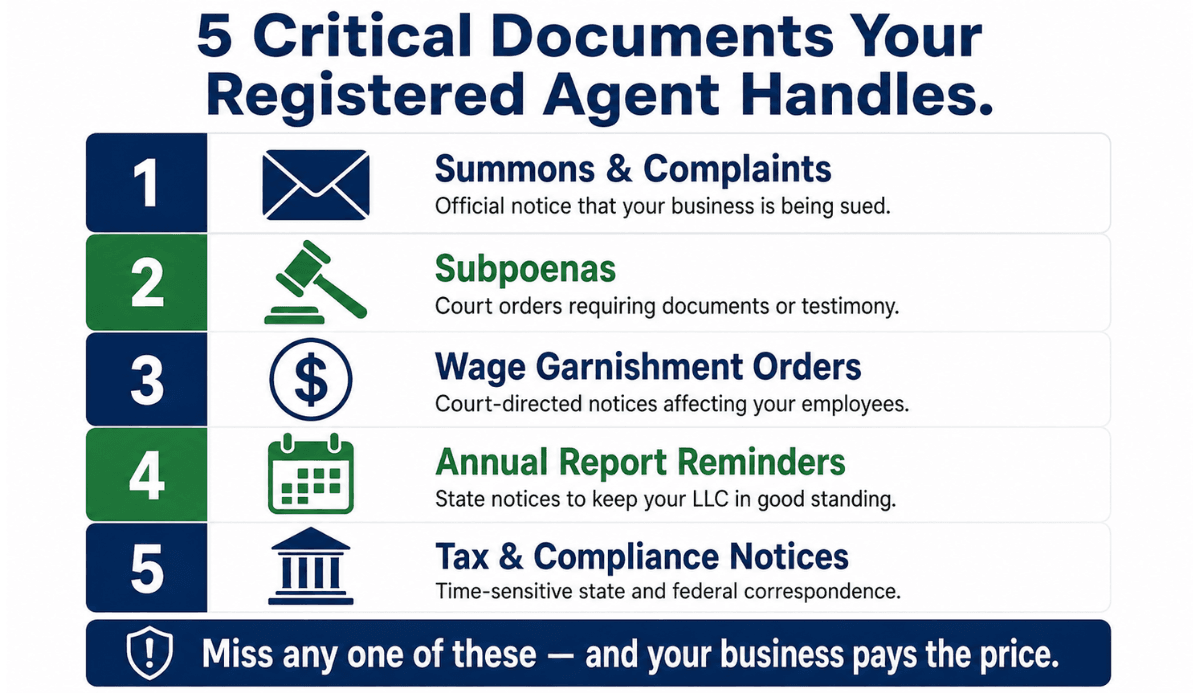
If someone files a lawsuit against your business, a process server or sheriff will deliver legal papers (called a "summons and complaint") to your registered agent. This is how the court officially notifies your company that a lawsuit has been filed. Your registered agent must accept those papers and get them to you right away.
2. Receive official government correspondence:
State agencies send time-sensitive documents to your registered agent's address. This includes annual report reminders, notices of delinquency, tax correspondence, and changes to state compliance requirements.
3. Forward everything to you on time:
A registered agent's job is not just to collect mail. It is to make sure you actually get it, quickly enough to respond before a deadline passes.
What Documents Does a Registered Agent Receive?
Your registered agent may receive any of the following:
- Summons and complaints: Official notice that a lawsuit has been filed against your business
- Subpoenas: Court orders requiring you to produce documents or testimony
- Wage garnishment orders: If one of your employees has their wages being legally garnished, the employer (you) gets notified here
- Charging orders: Court orders directing LLC distributions to a creditor
- Annual report reminders: Sent by the state so your business stays in good standing
- Tax notices: These are from state revenue or tax agencies
- State compliance notices: It includes notices of delinquency or administrative action
- Other regulatory notices: These are usually from state or federal agencies, depending on your industry
Every one of these documents is time-sensitive. Missing even one can have serious consequences for your business.
Why Do You Need a Registered Agent?
The government and courts need a reliable, consistent way to contact your business. Courts need to know that if they file a lawsuit against a corporation, there is a real human being at a real address who will accept the paperwork.
Here is why it matters for your business specifically:
- You may be sued at any time: Even a frivolous lawsuit requires a timely response. If you do not respond, the court can issue a default judgment against you, even if you would have won the case.
- State deadlines are unforgiving: Missing an annual report filing can cost you your good standing. Losing good standing means you may not be able to get a business loan, expand to other states, or even continue operating legally.
- You cannot always be at your desk: Many business owners have to travel a lot. They attend meetings. They work irregular hours. A registered agent is your reliable backstop for receiving documents when you are not available.
What Are the Legal Requirements to Be a Registered Agent?
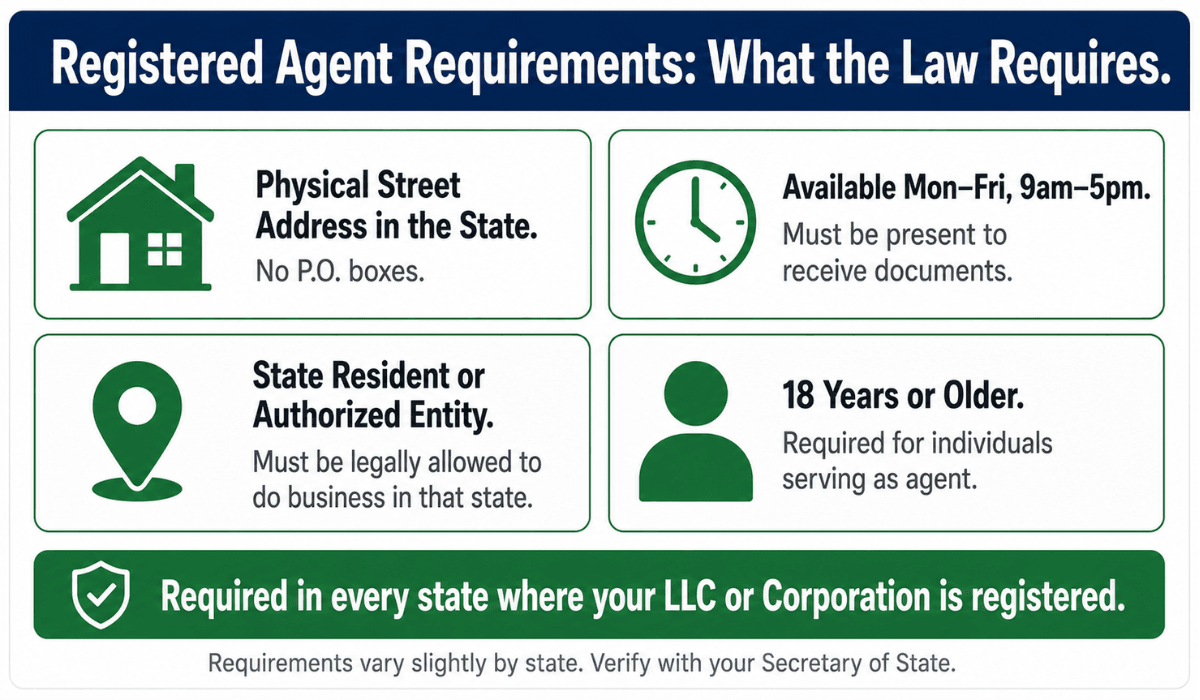
To serve as a registered agent, a person or business entity generally must:
- Have a physical street address in the state where the business is registered. P.O. boxes do not count.
- Be available during regular business hours, Monday through Friday, 9am to 5pm, to physically accept documents.
- Be a resident of the state (for an individual) or be legally authorized to conduct business in that state (for a company).
- Be at least 18 years old (for an individual).
Note: In most states, the LLC or corporation itself cannot serve as its own registered agent. A few states, like Delaware and Colorado, allow it, but this is the exception, not the rule.
Requirements vary slightly by state. Always verify the rules with your state's Secretary of State office before designating a registered agent.
Registered Agent vs. Statutory Agent vs. Resident Agent
These three terms all refer to the exact same role. The name simply changes depending on which state you are in:
Term | States That Use It | What It Emphasizes |
Registered Agent | Most states | The agent's name and address are officially "registered" with the state |
Resident Agent | Maryland, Virginia, others | The agent must be a resident of the state |
Statutory Agent | Ohio, Arizona, others | The requirement is created by state statute |
Agent for Service of Process | Some states | The agent's primary job: receiving legal papers |
If you are doing business in multiple states, you will likely see all of these terms. Do not let that confuse you. The job is the same everywhere.
Can I Be My Own Registered Agent?
Yes, you can, but that does not mean you should.
As a business owner, you are allowed to designate yourself as your own registered agent in most states, as long as you meet the requirements: you have a physical address in the state, you are 18 or older, and you will be available during business hours.
For a very small business with a fixed location and predictable schedule, self-appointment can save you the annual fee of a professional service.
However, before you go this route, read the next section carefully. There are real risks that catch many business owners off guard.
Read: 7 Reasons You Shouldn’t Be Your Own Registered Agent to know things in detail.
What are The Pros and Cons of Being Your Own Registered Agent
Pros
- It costs nothing extra: You do not pay an annual fee to a third party. For a brand-new business watching every dollar, this can feel like a smart move.
- You stay in direct control: Documents come straight to you. No middleman, no forwarding delay.
- It simplifies your setup: You use one address for everything. Less paperwork at formation.
Cons
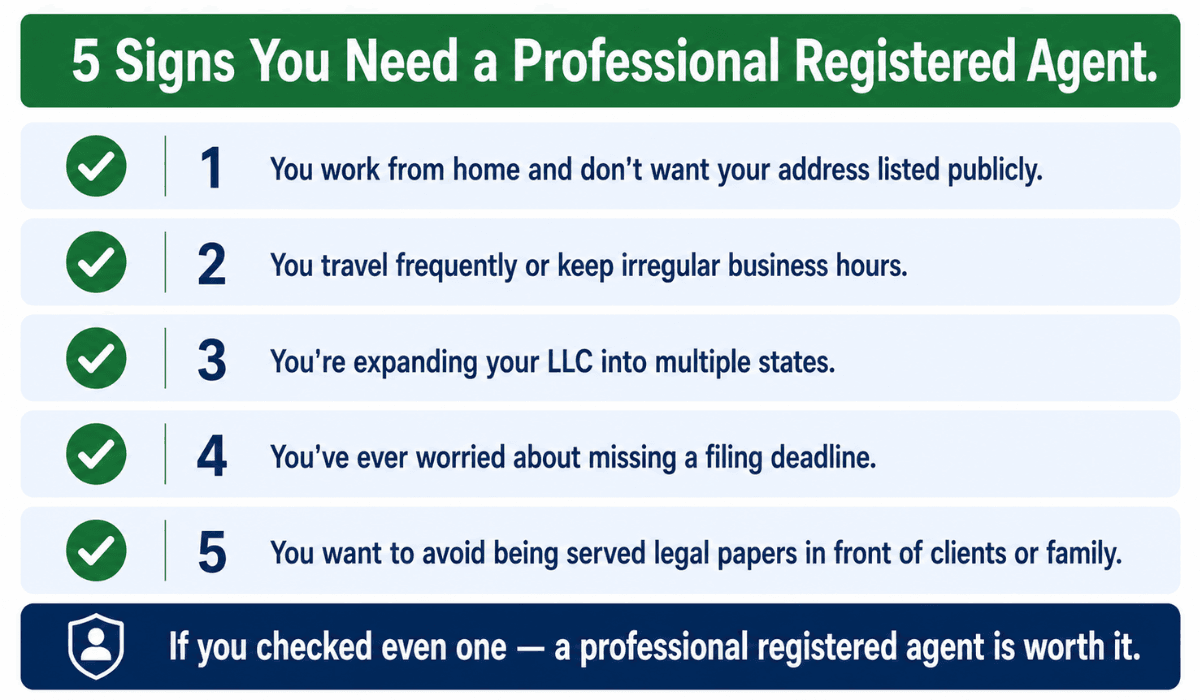
- Your home address becomes public record: If you use your home address as many solo founders and home-based business owners do, it goes on file with the Secretary of State. Anyone can look it up online. This includes not just junk mail solicitors, but also potential litigants, process servers, and anyone who wants to find out where you live.
- You must be physically present during business hours: Every weekday, someone must be at your registered address from 9 to 5. If you take a vacation, attend a conference, work from a coffee shop, or have a doctor's appointment, you may miss a critical delivery.
- Being served in person can be embarrassing: If a process server shows up at your home while your family is there, or walks into your office while a client is sitting across the desk, that experience is hard to walk back. It raises immediate questions about your company's stability.
- You could miss something and not realize it: If you move and forget to update your registered agent address with the state, important documents get sent to your old address. This is one of the most common ways businesses accidentally risk losing their good standing.
- You take on full legal responsibility: If a lawsuit notice arrives and sits on your desk for too long, there is no professional service to blame. Deadlines can be missed before you even realize the clock started.
Individual vs. Professional Registered Agent: Side-by-Side Comparison
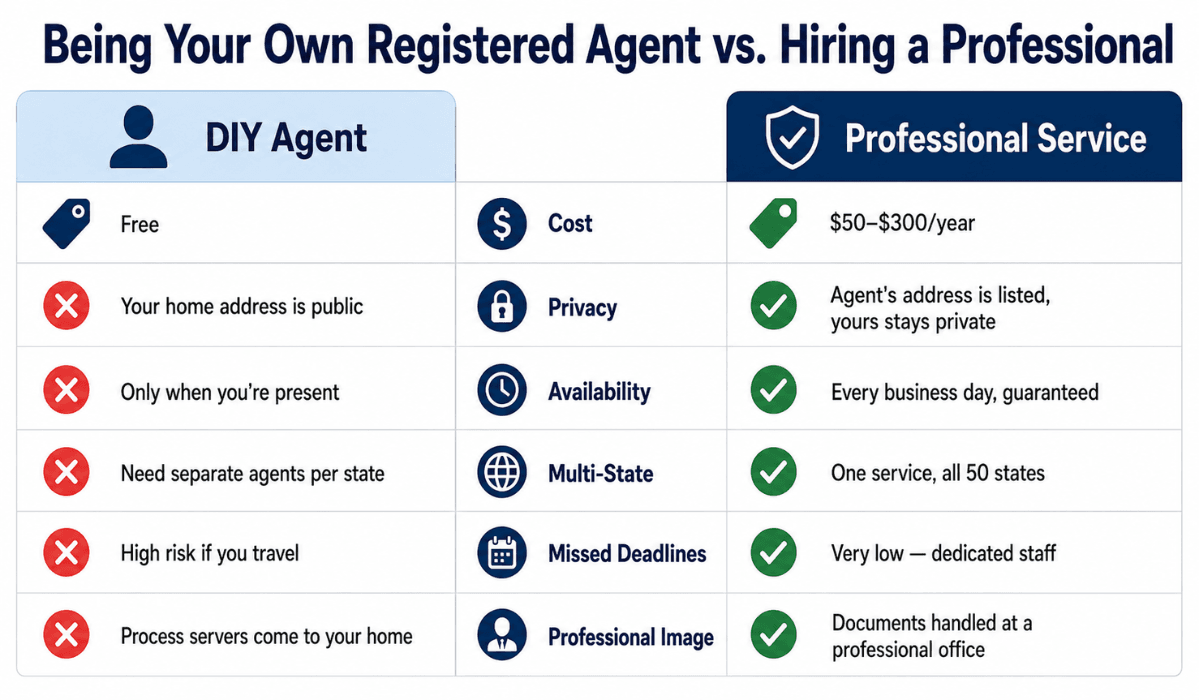
Factor | DIY (You or an Employee) | Professional Registered Agent |
Cost | Free | Around $50 a month |
Privacy | Your address is public record | The agent's address is listed for registration agent purposes, and yours stays private |
Availability | Only when you or your designee is present | Guaranteed, every business day |
Document handling | You manage it yourself | Professionally received and forwarded promptly |
Address changes | Must file with the state every time you move | Not needed — agent's address stays constant |
Compliance expertise | Your responsibility is to stay current | The agent monitors state law changes |
Multi-state coverage | Requires separate agents per state | One service covers all 50 states |
Professional image | Process servers come to your home or office | Documents received at a professional address |
Risk of missed deadlines | High if you travel or are unavailable | Very low, handled by dedicated staff |
How Does a Registered Agent Protect Your Privacy?
This is one of the most compelling reasons to hire a professional registered agent, especially if you run your business from home.
When you form an LLC or corporation, the state requires you to list a registered agent's address. That address becomes part of the public record. Anyone, including solicitors, competitors, and litigants, can search your state's Secretary of State database and find it within seconds.
If you list your home address, you are effectively publishing it to the entire public.
A professional registered agent service lists their address in the state records — not yours. Your personal home or business address stays off the public registry entirely. This means:
- Junk mail and solicitations go to the agent, not your home
- Process servers and sheriff deputies go to the agent's office, not yours
- Your family, neighbors, and clients never see a legal notice arrive at your door
For home-based business owners and founders who value privacy, this alone is often worth the annual fee.
What Happens If You Don't Have a Registered Agent?
Failing to maintain a registered agent is not just an administrative inconvenience. It can have cascading legal and financial consequences.
- Administrative dissolution: Your state can dissolve your LLC or corporation for failing to maintain a registered agent. Once dissolved, the business's legal protections disappear, including the limited liability shield that protects your personal assets from business debts.
- Default judgments: If you are sued and the plaintiff cannot serve your registered agent, the court may allow alternate service, such as through the Secretary of State or even publication in a newspaper. If you never receive actual notice, you miss your window to respond. The court can then enter a default judgment against you, meaning the plaintiff wins automatically, even if their case was weak.
- Loss of good standing: States send annual report notices to the registered agent address on file. If that address is outdated or vacant, you never get the notice. You miss the filing. Your business loses good standing. Losing good standing can block you from getting a business loan, expanding to other states, renewing licenses, or filing lawsuits in state court.
- Fines and penalties: Most states impose fines ranging from $50 to $500 or more for failing to maintain a registered agent or for late filings caused by missed notices. These fines compound over time.
- Personal liability. If your business is dissolved and you continue operating, owners and officers can become personally liable for debts incurred during the dissolution period.
Also Read: Registered Agent Requirements by State: 2026 Complete Guide!
How Much Does a Registered Agent Cost?
DIY cost: $0 per year (just your time and availability)
Professional registered agent service: Typically $50 and less per month, depending on the provider and services included.
Some states charge a small filing fee when you designate or change a registered agent, usually $5 to $50. If you use a lawyer or law firm as your registered agent, expect to pay significantly more, since you are billed at attorney rates.
Many registered agent services offer competitive annual pricing that includes document scanning, compliance alerts, and same-day forwarding of received documents.
How to Appoint a Registered Agent
The process is straightforward, and it happens at the very beginning of your business formation:
- Step 1: Choose who will serve as your registered agent, yourself, a trusted individual, or a professional service.
- Step 2: Confirm they meet your state's requirements (physical address, availability, legal authorization).
- Step 3: List their name and address on your Articles of Organization (for LLCs) or Articles of Incorporation (for corporations) when you file with the state.
- Step 4: In some states, the registered agent must sign a formal consent or acceptance of appointment form.
- Step 5: If you are registering to do business in additional states (foreign qualification), designate a registered agent in each of those states as well.
That's it. The registered agent is officially on the record once the state approves your filing.
Also read: Top 10 Ways to Choose the Right Registered Agent Service!
How to Change Your Registered Agent
Business needs change. You may outgrow your DIY setup, relocate, or simply want a more professional solution. Changing your registered agent is a routine process:
Step 1: Choose your new registered agent and confirm they consent to the appointment.
Step 2: File a Certificate of Change or Amendment with your state's Secretary of State office. Some states allow this online; others require a paper form.
Step 3: Pay the filing fee (typically $5 to $50, depending on the state).
Step 4: Notify your previous registered agent of the change in writing.
Step 5: Update your internal records to reflect the new agent's contact information.
Once the state processes your filing, the new registered agent's address replaces the old one in the public record.
To know about this in detail, read: How to Change a Registered Agent
Does a Registered Agent Have Any Power Over My Business?
No. A registered agent has no ownership stake, no management authority, and no ability to make decisions for your business.
Their role is strictly administrative: receive documents and forward them to you. They are a legal point of contact, nothing more.
Some business owners confuse the registered agent role with other roles like a business partner, officer, or manager. There is no overlap. Your registered agent cannot sign contracts, access your bank account, or speak on your behalf in any legal proceeding.
Is a Registered Agent the Same as the Owner?
Not necessarily. In many small businesses, the owner does designate themselves as the registered agent, but these are two separate roles.
The owner (or member, in an LLC) has equity in the business, makes decisions, and is responsible for operations.
The registered agent simply receives official documents during business hours and forwards them to the right person.
You can be both. But if you are also your own registered agent, you take on all of the responsibilities and risks described earlier in this article.
Ready to Protect Your Business and Your Privacy?
If you are forming an LLC or corporation, or if you are already operating and still serving as your own registered agent, now is a good time to reconsider.
A professional registered agent from Swyft Filings:
- Keeps your personal address off public state records
- Ensures you never miss a lawsuit notice or compliance deadline
- Covers all 50 states with one service
- Forwards documents to you the same day they are received
- Frees you up to run your business instead of worrying about the mailbox
Reach out to our business formation specialists for more details today!
Useful Links:
U.S. Small Business Administration. Register Your Business. Accessed May 22, 2026.
Disclaimer: This blog post is for general informational purposes only and does not constitute legal advice. For guidance specific to your situation, consult a licensed attorney in your state.
FAQs
State law requires it. Beyond that, a registered agent ensures you never miss a lawsuit notice, tax form, or compliance deadline, any of which can result in fines, default judgments, or loss of your business's legal standing.
Yes, as long as they meet your state's requirements: physical address in the state, availability during business hours, and legal authorization to conduct business there. Keep in mind that this places significant responsibility on your friend, including the risk of liability if they miss a critical document.
Your home address becomes public record. You must be physically present every business day. You may miss time-sensitive legal documents if you travel or relocate. Being served in front of clients or family can be professionally embarrassing. And if you miss a filing deadline because you did not receive a notice, your business may lose good standing or face administrative dissolution.
No. A lawyer can serve as your registered agent, but most registered agents are not lawyers. They are professional compliance services with trained staff dedicated to receiving and forwarding documents.
Yes. If your business is foreign-qualified to operate in multiple states, you must have a registered agent in each state where you are registered. A professional registered agent service with national coverage simplifies this significantly.
For home-based businesses, a registered agent is especially valuable because it keeps your personal home address out of the public record. Instead of your address appearing in state databases, the agent's professional address appears, protecting your privacy and your family from unexpected visits by process servers.
No. Most states require a registered agent to be a physical person (or authorized business entity) at a real street address who can receive hand-delivered documents in person. A virtual mailbox does not satisfy this requirement in most states.
Yes. State tax agencies and other government bodies send official correspondence to the registered agent address on file. This may include state income tax notices, sales tax correspondence, and other tax-related documents.