Key Takeaways
- Every state require you to file Articles of Organization, a Certificate of Formation, or a Certificate of Organization with the appropriate state agency to form an LLC.
- Filing forms, required fields to be filled, fees, and submission methods vary by state. Always check the official state instructions before submitting.
- After approval, you may need an EIN, operating agreement, business licenses, and compliance with ongoing state filing and tax requirements.
Articles of Organization are the state filing documents used to create an LLC. Learn what information to prepare, how to complete each section, and where to submit your filing.
To fill out Articles of Organization, you generally need to choose an available LLC name, provide your business address, appoint a registered agent, supply any required management information, complete applicable purpose and effective-date fields, sign the document, and submit it with the state filing fee.
Some states call this document a Certificate of Formation or Certificate of Organization. Although the names differ, each document serves the same basic purpose: establishing a limited liability company (LLC) under state law.
However, knowing which information to enter in each field can be confusing, especially if you are forming an LLC for the first time. This guide explains the filing process in seven steps, and shows a completed Florida example using fictional business information.
What Do You Need Before Filling Out Articles of Organization?
Before opening the filing form, gather the information your state requires. Preparing these details in advance can help you avoid incomplete entries, delays, and unnecessary corrections.
Information to Prepare | What You Need |
LLC Name | Your proposed complaint business name, including LLC or another accepted designator |
Business address | Principal business address and a separate mailing address, if applicable |
Registered agent | Agent’s legal name, qualifying in-state address and consent |
Management structure | Whether members or appointed managers will manage the LLC, if the state asks |
Management information | Names and addresses of the individuals or entities the form requires |
Organizer information | Details of the person or entity preparing and signing the filing |
Busines purpose | A description of the business activity, if required |
Effective date | The date the LLC should become legally effective, if an alternative is permitted |
Filing fee | A payment method accepted by the state |
Not every state asks for every item. For example, Delaware's standard LLC Certificate of Formation requires substantially less information than many other states' forms.
TIP: Before you begin with filing, find your state's official filing instructions and check whether you can submit online or must use a paper form.
7 Steps on How to Fill Out Articles of Organization Form
The following steps explain the information commonly requested in LLC formation filings. To make the process easier to understand, we'll use a fictional landscaping business called “Rivera Landscaping LLC”, located in Orlando, Florida. The example is based on Florida's official LLC formation instructions. Your state's form may use different field names or ask for additional information.
Step 1: Enter Your LLC Name
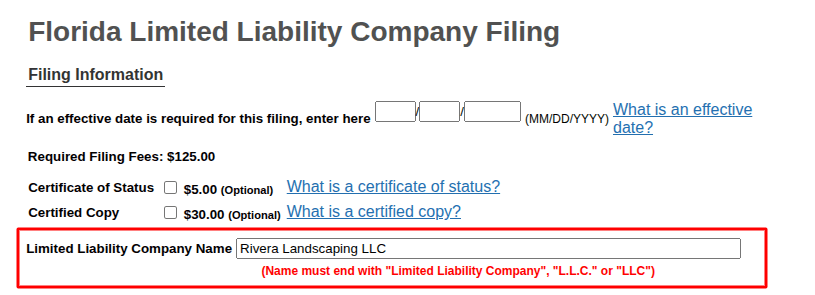
Start by entering the legal name you want to register for your LLC. Your business name generally must:
- Be distinguishable from other names already registered with the state.
- Include an accepted LLC designator, such as LLC, L.L.C., or Limited Liability Company.
- Avoid restricted or misleading terms unless applicable requirements are satisfied.
What to check: Confirm that the name is available under your state's naming rules. A preliminary name search does not guarantee approval, and state registration does not automatically establish trademark rights.
Florida-specific note: Florida requires the name to be distinguishable on the Department of State's records and to include an accepted designation. The Division of Corporations recommends searching its records before filing.
Example:
Form Field | Example Entity |
Limited Liability Company Name | Rivera Landscaping LLC |
The name includes the LLC designator and identifies the business.
Step 2: Provide Your Business Address
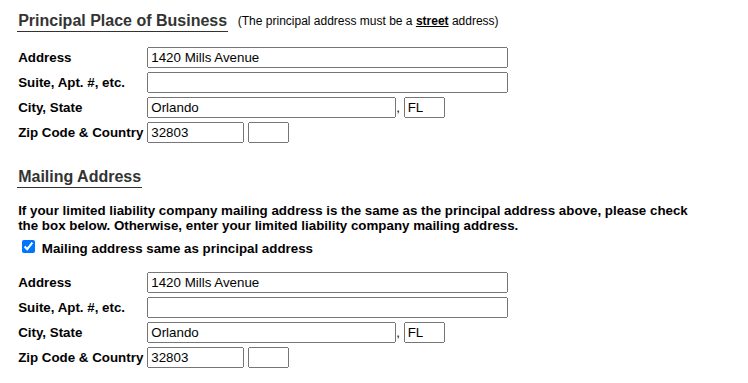
Next, enter the address requested by your state's formation document. Some forms distinguish between two addresses:
- Principal business address: The address of the LLC's principal office or business location.
- Mailing address: The address where the business receives correspondence, if different from its principal address.
The state may require a physical street address for certain fields. Whether a PO box or another address type is acceptable depends on the field and state.
What to check: Formation documents are generally public records. If you operate from home, consider the privacy implications before entering your residential address. Do not assume a registered agent's address can automatically be used as your principal business address; it must satisfy the requirements for that field.
What to check: Formation documents are generally public records. If you operate from home, consider the privacy implications before entering your residential address. Do not assume a registered agent's address can automatically be used as your principal business address; it must satisfy the requirements for that field.
Example:
Form field | Example entry |
Principal address | 1420 Mills Avenue |
City | Orlando |
State | Florida |
Zip code | 32803 |
Mailing address | Same as principal address |
In this example, Rivera Landscaping LLC uses the same location for its principal and mailing addresses. Florida's filing system allows applicants to indicate when the mailing address matches the principal address.
Step 3: Enter Your Registered Agent Information
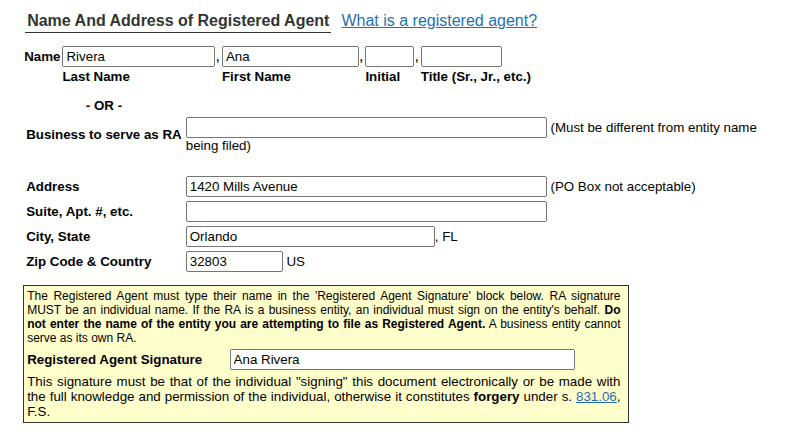
A registered agent is the person or eligible business entity designated to receive legal documents and official notices on behalf of the LLC. The agent generally must have a qualifying physical address in the state where the LLC is being formed.
You may be able to serve as your own registered agent if you meet your state's requirements. Alternatively, you can appoint an eligible individual or a registered agent service.
What to check: Make sure the registered agent has agreed to the appointment and can meet the state's requirements for receiving legal documents.
Example:
Form Field | Example Entry |
Registered agent name | Ana Rivera |
Street address | 1420 Mills Avenue |
City | Orlando |
State | Florida |
ZIP code | 32803 |
Registered agent acceptance | Ana Rivera |
Ana Rivera is the fictional owner of Rivera Landscaping LLC and agrees to serve as the company's registered agent. Florida requires the registered agent to sign the formation filing. In an online filing, the agent types their name to indicate acceptance. Do not enter another person's electronic signature without their permission.
Step 4: Select Your LLC Management Structure, If Required
An LLC can generally be managed by its members or by appointed managers.
- Member-managed LLC: The members, who are the owners of the LLC, manage its operations.
- Manager-managed LLC: One or more designated managers manage the company. A manager may be a member or, where permitted, someone who does not own the business.
For example, a single-owner landscaping company whose owner runs daily operations may choose a member-managed structure. A company with several investors who appoint a separate person to run operations may prefer manager management. However, not every state's formation document asks you to choose between these structures.
What to check: Follow the exact terminology on your state's form. For example, California requires applicants to identify the LLC's management structure, while Texas requests information about the LLC's governing authority.
Example:
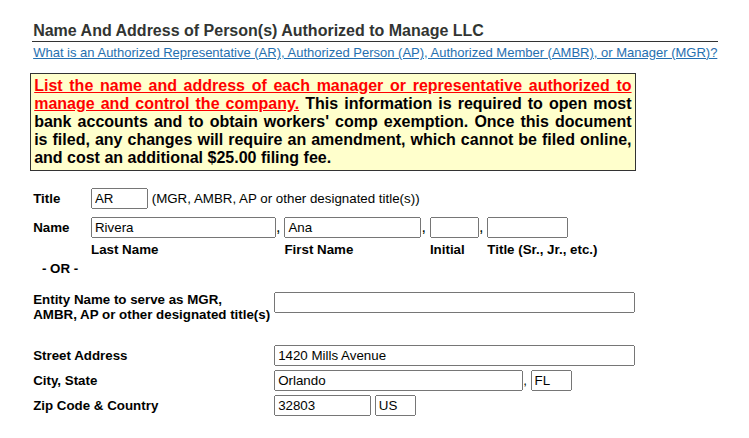
Florida's standard Articles of Organization provide optional fields for managers and authorized representatives.
Form field | Example entry |
Title | AR |
Name | Ana Rivera |
Street Address | 1420 Mills Avenue |
City | Orlando |
State | Florida |
ZIP code | 32803 |
In this example, Ana Rivera is listed as an authorized representative because she is authorized to execute and file records for the company.
Important Florida distinction: Florida's official filing instructions say not to list members in this optional management/authorized representative section. The instructions identify MGR for managers and AR for authorized representatives.
Step 5: Complete the Business Purpose, Duration, and Effective Date Fields
Some formation documents ask applicants to describe the LLC's purpose, specify its duration, or choose when its formation becomes effective.
Other states omit some of these fields.
a) Business Purpose
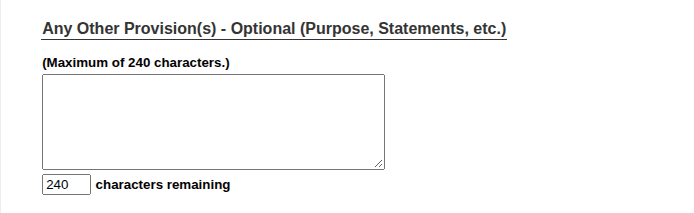
A business purpose explains the activities the LLC is formed to conduct. Some states permit a general lawful-purpose statement. Others prescribe specific wording or impose additional requirements for professional LLCs. For example, a general-purpose statement might describe the company as being organized to conduct any lawful business permitted for an LLC under the relevant state law.
Do not insert generic language where your state requires an exact statement or a specific professional purpose.
b) Duration
Duration describes how long the LLC is intended to exist. Many LLCs have perpetual duration, meaning they continue until dissolved or otherwise terminated under applicable law. If the form does not ask for duration, you generally do not need to invent an entry.
c) Effective Date
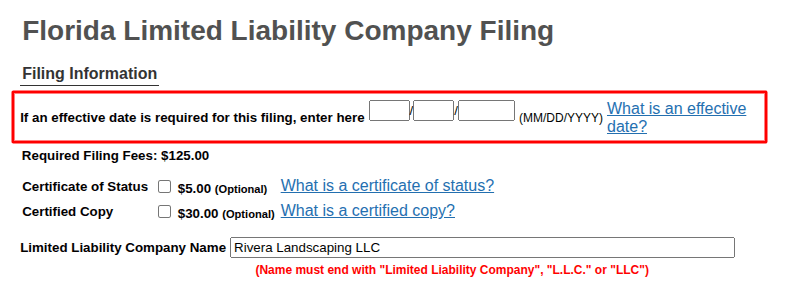
The effective date determines when the LLC's formation becomes legally effective. In many states, the LLC becomes effective when the state files or accepts the document, unless an acceptable alternative date or condition is specified.
Form Field | Example Entry |
Purpose | No entry required for this non-professional LLC |
Additional provisions | Left blank |
Duration | No separate field |
Effective date | Left blank |
Rivera Landscaping LLC does not request a delayed effective date. Its formation will become effective according to Florida's default filing rule. Florida allows certain alternate effective dates, including dates up to 90 days after the filing is received.
When Might a Delayed Effective Date be Useful?
Suppose you submit a Florida LLC filing in December but do not intend the business to begin operating until January. Florida's Division of Corporations explains that selecting an eligible January 1 effective date can postpone the LLC's first annual report requirement by a calendar year.
However, this also means the LLC's legal existence does not begin until that effective date. Consider business contracts, licensing, banking, and tax consequences before choosing a delayed date.
Step 6: Provide Organizer Information and Sign
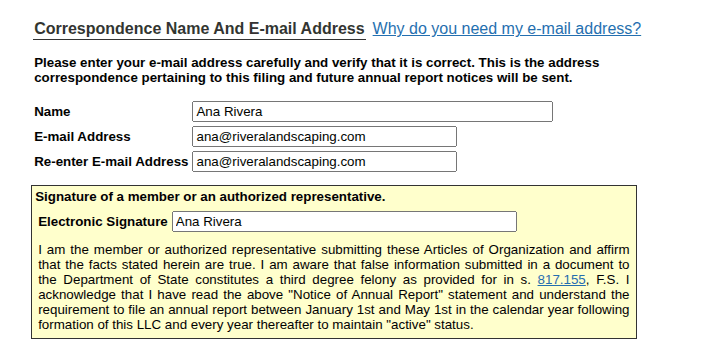
The organizer is the person or entity responsible for executing the formation document, although states use different terminology for the person authorized to sign. An organizer does not necessarily have to be an LLC owner.
For example, an owner, attorney, or business formation service may prepare and submit formation documents when permitted by state law. The person signing should review the filing carefully and confirm that they have authority to sign.
What to check: Verify the correspondence email before submitting. An incorrect email address could prevent you from receiving important filing information.
Read the declaration associated with the signature. Signing a state formation document can carry legal consequences if the information is knowingly false.
Form Field | Example Entry |
Correspondence name | Ana Rivera |
Email address | |
Authorized representative’s electronic signature | Ana Rivera |
The email address is fictional and used only to illustrate the form. Florida requires an authorized representative to sign the Articles of Organization. The state also requests a valid correspondence email for filing acknowledgments and future communications.
Step 7: Review, Submit, and Pay the Filing Fee
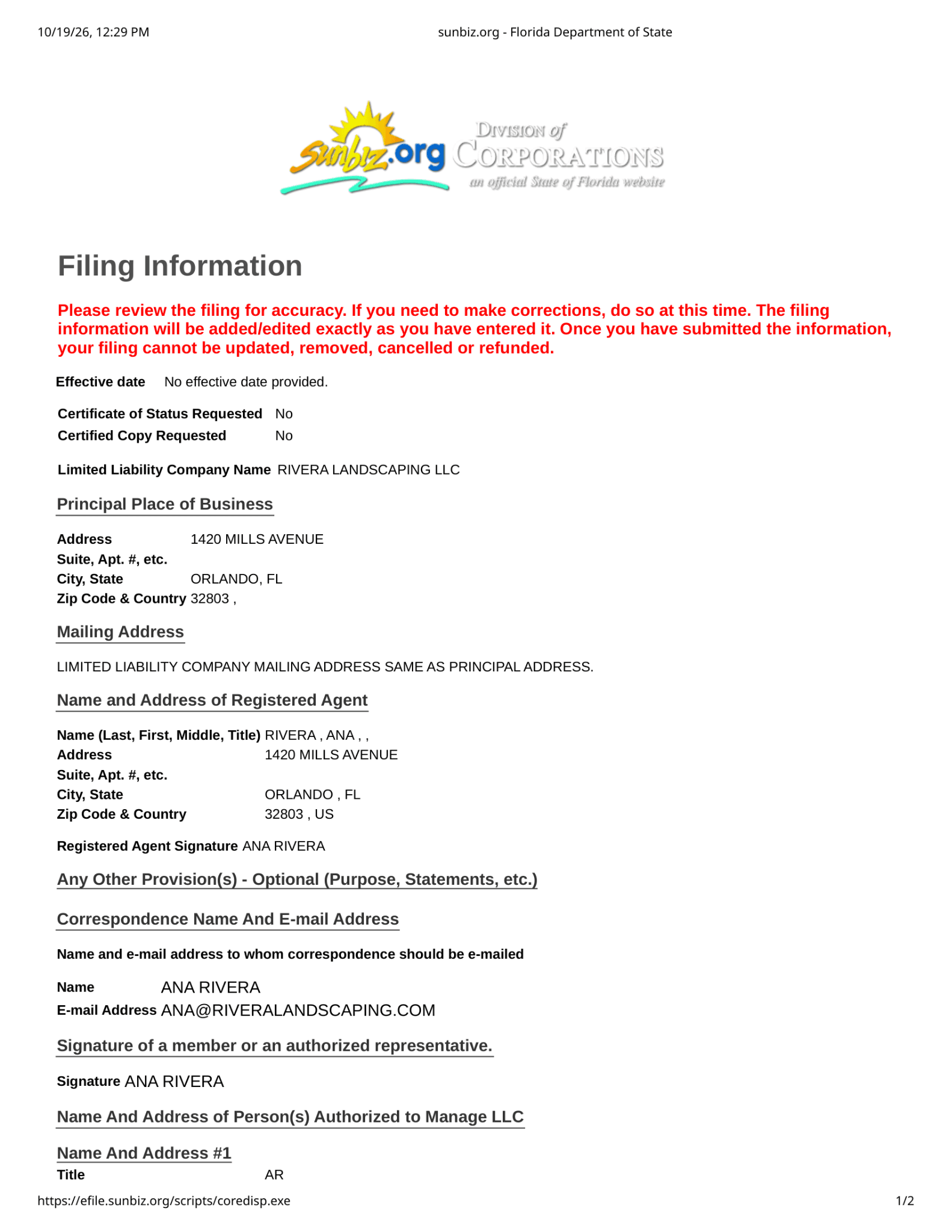

Before submitting your Articles of Organization or Certificate of Formation, review every required field.
Pay particular attention to:
- The exact LLC name and designator.
- The registered agent's name, address, and consent.
- The management or governing-person information required by your state.
- The effective date, if one is specified.
- The organizer's signature and correspondence details.
Then submit the filing through the state's authorized online portal or another accepted method.
Why Are Some Fields in the Articles of Organization Left Blank?
A blank field does not always mean the application is incomplete.
In this example:
- Additional provisions: Left blank because the fictional company has no additional provisions to include, and Florida does not require a general business-purpose statement for a standard non-professional LLC.
- Effective date: Left blank because the company does not request an alternate effective date.
- Optional certificate and certified copy: Not ordered because neither is required to establish the LLC.
Only leave a field blank when the state's instructions indicate that it is optional or otherwise unnecessary for your filing.
Find Articles of Organization Forms by State
Every U.S. state has its own LLC formation requirements. Depending on where you form your business, you may need to file Articles of Organization, a Certificate of Formation, or a Certificate of Organization. Here is a 50-state directory to find your state’s official business filing website.
State | Formation document |
Alabama | |
Alaska | Articles of Organization (online)/Articles of Organization (PDF) |
Arizona | |
Arkansas | |
California | |
Colorado | |
Connecticut | |
Delaware | |
Florida | |
Georgia | |
Hawaii | |
Idaho | |
Illinois | |
Indiana | |
Iowa | Iowa uses a Certificate of Organization to form an LLC, though the state doesn’t provide a mandatory fill-in-the-blank form for it. You must draft your own following the guidelines in Iowa Code § 489.201. |
Kansas | |
Kentucky | |
Louisiana | |
Maine | |
Maryland | |
Massachusetts | Certificate of Organization (online) / Certificate of Organization (PDF) |
Michigan | |
Minnesota | |
Mississippi | Business documents like Certificate of Formation may only be filed using the SOS’s online filing system. You need to set up a filing account. |
Missouri | |
Montana | |
Nebraska | |
Nevada | |
New Hampshire | |
New Jersey | |
New Mexico | |
New York | |
North Carolina | |
North Dakota | |
Ohio | |
Oklahoma | |
Oregon | |
Pennsylvania | |
Rhode Island | |
South Carolina | |
South Dakota | |
Tennessee | |
Texas | |
Utah | |
Vermont | |
Virginia | |
Washington | |
West Virginia | |
Wisconsin | |
Wyoming |
Conclusion
Filing Articles of Organization comes down to preparation. Gather your LLC name, business address, registered agent details, and management information before you open the form. Then follow your state’s official instructions, since field names, required details, and fees vary by state.
Review every entry before you submit. Most rejections and amendments stem from small errors in the LLC name, registered agent details, or the signature section.
If you would rather not handle the paperwork, or you do not have time to work through your state’s requirements, Swyft Filings can prepare and file the documents for you. Our basic LLC formation package covers the Articles of Organization filing for free; you only have to pay the required state fee.
FAQs
Requirements vary by state, including the document name, required information, filing fees, and post-formation obligations. For example, Texas uses a Certificate of Formation, California requires management structure information, and New York generally requires LLC publication after formation.
File with your state's Secretary of State or designated business filing agency, usually through its official online portal or by mail. For example, Florida uses Sunbiz, while Texas uses the Texas Secretary of State.
Yes. Most newly formed New York LLCs must publish a formation notice in two designated newspapers for six consecutive weeks and file a Certificate of Publication within 120 days of formation becoming effective. Failure to comply can suspend the LLC's authority to conduct business in New York.
Once your LLC is legally formed, save the approved documents, obtain an EIN if needed, prepare an operating agreement, open a business bank account, and check licensing and tax requirements. You must also comply with applicable ongoing state obligations.
Requirements depend on the state. California requires LLCs to maintain an operating agreement, while other states have different rules. Even when a written agreement is not mandatory, it can clarify ownership, management responsibilities, and profit distributions.
Common mistakes include using an unavailable LLC name, entering incorrect registered agent information, confusing members with managers or organizers, selecting the wrong effective date, and providing an inaccurate email address. Reviewing your state's instructions before submission can help prevent these errors.
The state may reject your filing or require a correction or amendment after approval. Depending on the state and type of error, additional forms and fees may apply. Verify all information before submitting.
You can prepare and submit LLC formation documents yourself through your state's official filing portal. If you'd prefer assistance with the paperwork, online LLC formation services like Swyft Filings can help prepare and submit the required documents. State filing fees still apply, and service charges may be additional.