
Key Takeaways
- Your home address becomes public once it's on LLC paperwork.
- Wyoming, New Mexico, Delaware, and Nevada lead in LLC privacy.
- Registered agents and virtual mailboxes keep addresses off public filings.
- Most LLC owners no longer face federal ownership reporting rules.
- Trusts and double LLC structures add deeper layers of privacy.
Keep your personal info off public databases. Know the essentials of LLC privacy, from registered agents and virtual mailboxes to Wyoming and New Mexico.
If you've filed an LLC, there's a good chance your home address is sitting in a public database right now. Anyone with a Secretary of State search bar and your business name can find it, including customers, competitors, and strangers online who have no real reason to know where you live.
For home-based business owners, e-commerce sellers, and content creators, that's not a small privacy gap. It's the difference between running a business and broadcasting your address to the internet. The good news is you have real options, starting with the state you choose and the structure behind your LLC.
Why Your Home Address on LLC Records Is a Real Risk
Filing your LLC with your home address turns a private detail into a permanent public record. Most state databases are free to search, and many show up in Google results within days. That's a real problem if you deal with upset customers, sell products online, or build a public brand under your own name.
Real estate investors face a similar issue. A tenant or contractor who traces a property record back to you can find your home address in a few clicks, and data broker sites make it worse by scraping public filings automatically.
This isn't about hiding from the law. It's about controlling who gets access to information you never agreed to share.
How to Avoid Using Your Home Address for Your LLC
You don't need to hide your business to protect your address. Two tools do most of the work:
- A registered agent
- a business mailing address that isn't your house
Once those are in place, your state paperwork never has to list where you actually live.
Registered Agent Services vs. a Virtual Mailbox for LLC Privacy
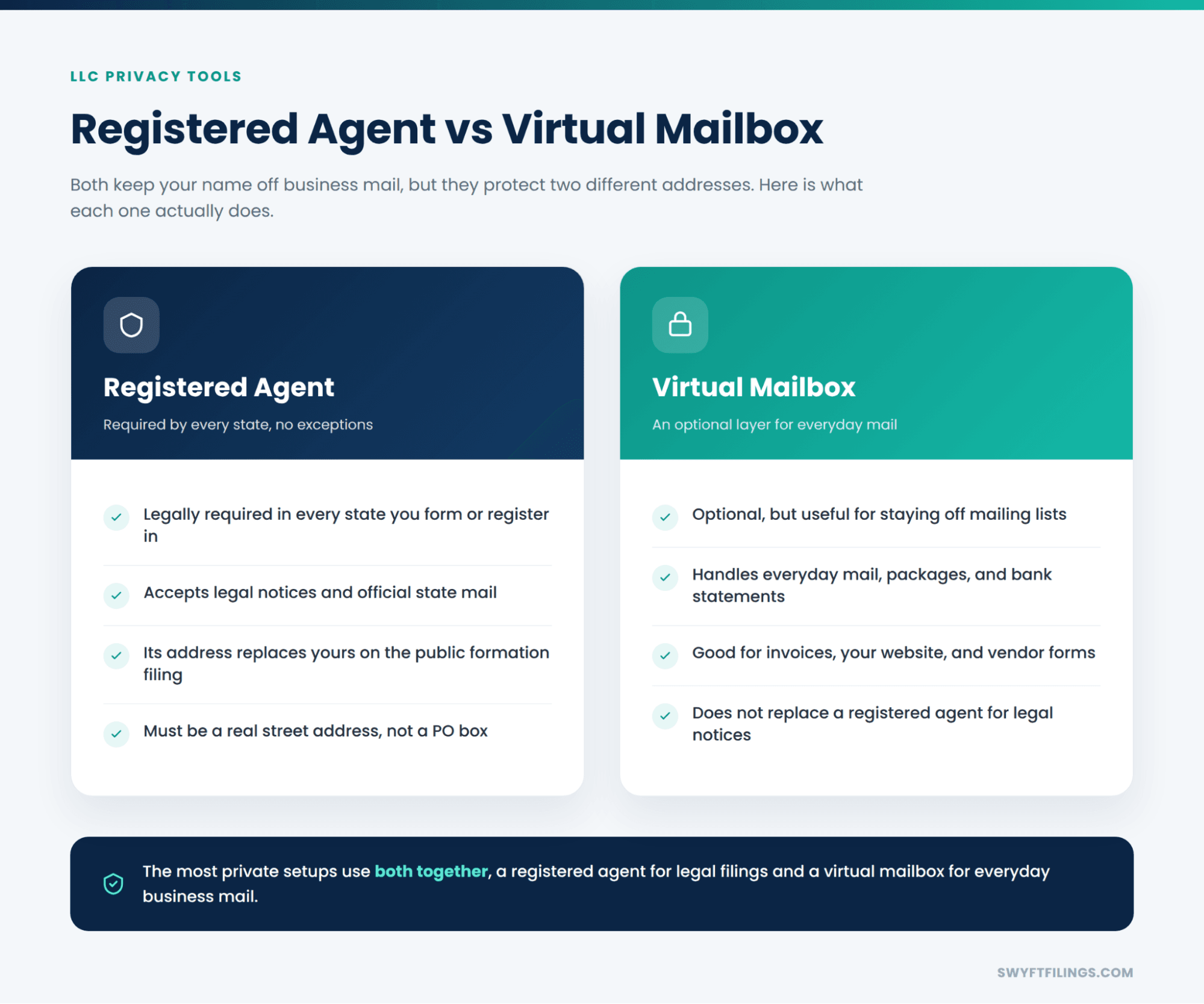
A registered agent accepts legal notices for your LLC and lists their address instead of yours on your formation documents. Every state requires one, and most require a real street address, not a PO box, for this role, based on guidance from state offices like the Washington Secretary of State.
A virtual mailbox solves a different problem. It gives your business an address for everyday mail and invoices, but it doesn't replace your registered agent for legal notices. Many owners use both, since scanned mail shows up in an online dashboard instead of your porch.
A registered agent protects your legal address, and a virtual mailbox protects your everyday one. Using both is the most complete way to start an LLC without your home ever appearing in the paperwork.
Can You Use a PO Box for Your LLC Address
For general mail, often yes. For your registered agent address, almost never, since states want a physical street address where legal documents can be delivered in person.
A PO box works well as your general business address on invoices or your website. Pair it with a proper registered agent for your official filings, and your home address won't appear on either one.
Anonymous LLC States Where Privacy Laws Work in Your Favor
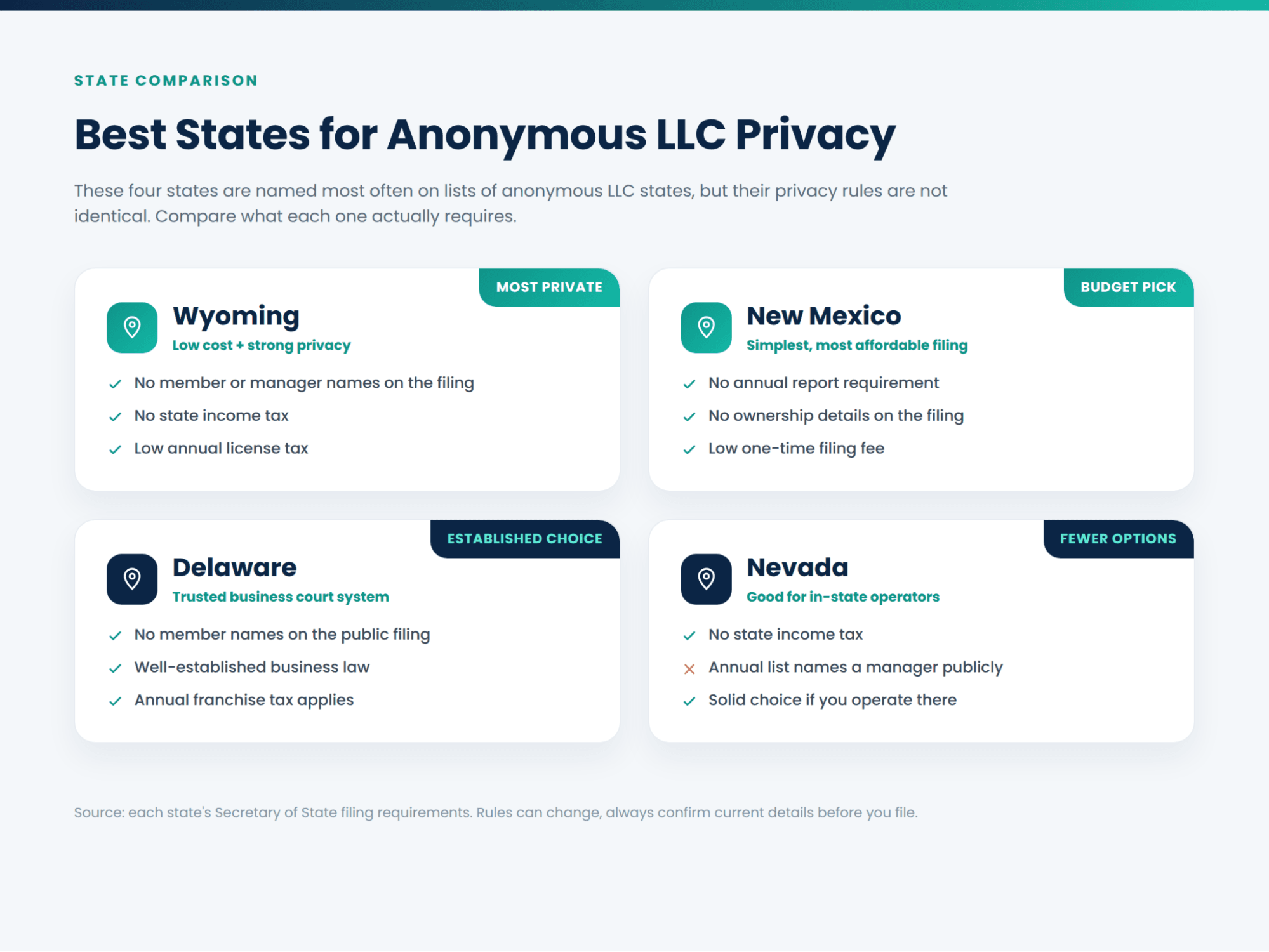
Some states ask for your name and address on public formation paperwork. Others don't ask at all. Of the states with anonymous LLC protections, New Mexico, Wyoming, Delaware, and Nevada show up on nearly every list of the best anonymous LLCs, since their formation documents don't require member or manager names.
New Mexico stands out for owners on a budget, since it's one of the few states with no annual report requirement and asks for no ownership details on its formation filing. Wyoming and Delaware take a similar approach, listing a registered agent's name on the public filing instead of the owner's. For most home-based owners, Wyoming is the best state for an anonymous LLC, thanks to its low fees and no state income tax.
Nevada asks for a bit more through its annual list, which is worth knowing before you assume every state on this list works the same way.
Wyoming LLC vs Nevada LLC Privacy Laws Compared
Wyoming keeps member and manager names off its formation documents and pairs that with no state income tax and low annual fees.
Nevada also skips state income tax, but its LLCs must file an annual list naming at least one manager, and that list becomes public record. That single filing is the main reason Nevada is considered less private than Wyoming, even though both get grouped together as anonymous LLC states.
For solo entrepreneurs, Wyoming usually wins on cost and privacy. Nevada still makes sense if you're already doing business there.
Advanced Privacy Strategies for Serious Anonymity
If you want a deeper layer of protection than a privacy-friendly state alone, two structures come up often among owners serious about staying off the public record.
Using a Living Trust as Your LLC Member
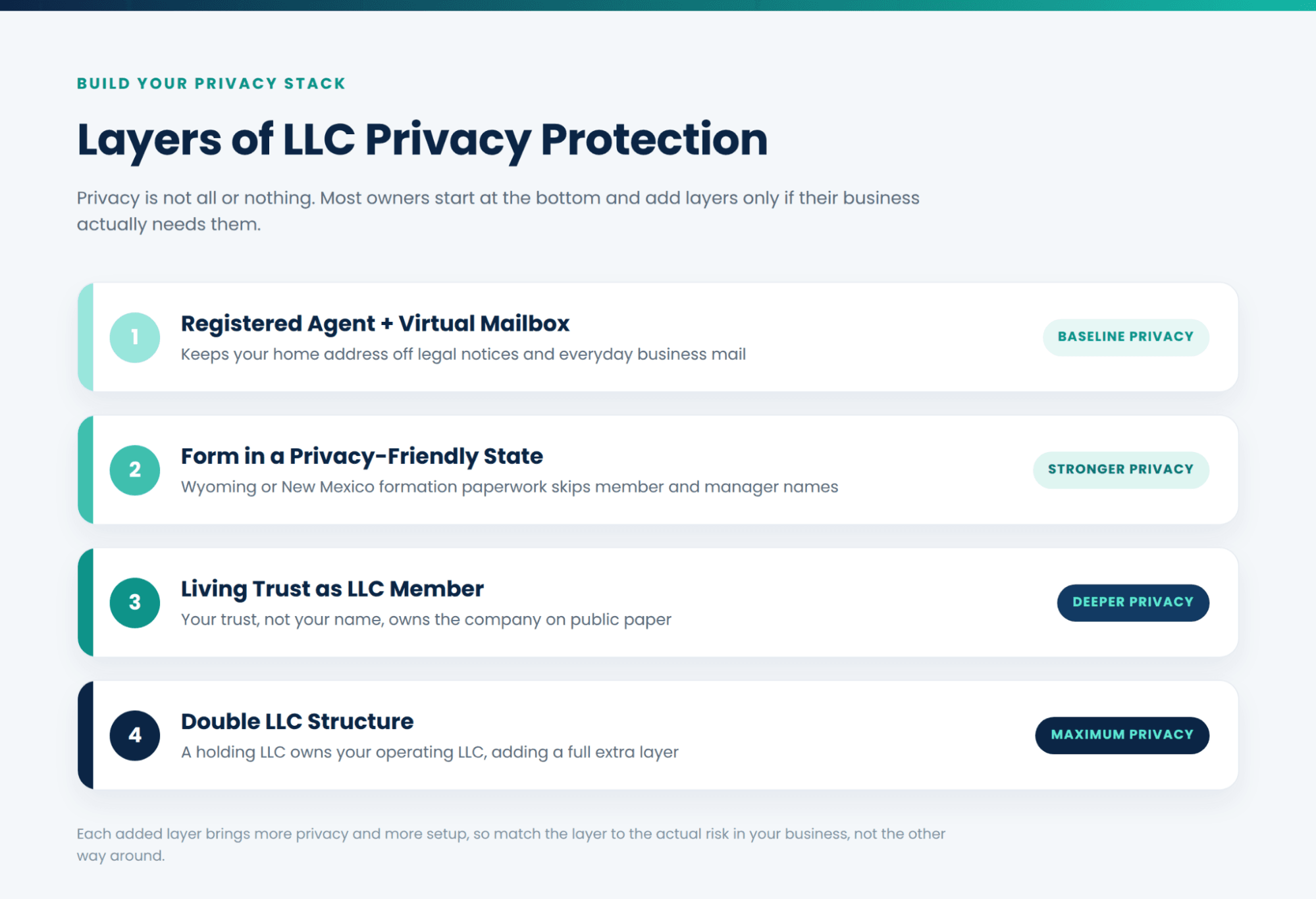
Instead of listing yourself as the LLC's member, you list your living trust. The trust, not your name, owns the company on paper, and your name only appears in the trust document, which is private and never filed with the state.
This works because most states ask who the LLC's member is, not who's behind the trust. Real estate investors use this often, pairing a trust-owned holding LLC with a separate LLC that runs the actual business. It takes a properly drafted operating agreement, so build this one with guidance rather than piecing it together alone.
The Double LLC Structure for Extra Privacy
A double LLC structure means one LLC owns another. The first LLC, formed in a private state like Wyoming, becomes the sole member of your second, operating LLC, the one that signs contracts and runs day to day.
Your name shows up only on the holding LLC's paperwork, filed in a state that doesn't require public ownership details. The operating LLC's filing lists the holding company as its member, not you. This adds real separation, but it also means double the filing fees and double the registered agent requirements, so weigh the cost against how much privacy you need.
LLC Privacy for Solo Entrepreneurs, Home-Based Owners, and Content Creators
Solo entrepreneurs often skip privacy planning because it sounds expensive. In reality, a registered agent paired with a privacy-friendly state costs about the same as forming an LLC anywhere else. The real cost shows up later, when an exposed address becomes a problem you can't undo.
Content creators and online influencers face a sharper version of this risk, since your business name is often your public brand. Registering a DBA for your brand name, combined with a registered agent for your legal filings, keeps your public identity separate from your personal address.
For home-based businesses on a tight budget, the most affordable path is a registered agent bundled into your LLC formation, rather than paying separately for a virtual office or a trust structure. It solves the biggest privacy gap first, and you can always add a trust or a second LLC later.
What the Corporate Transparency Act Means for LLC Owners Now
In 2026, federal regulators removed the ownership reporting rule for most U.S. companies under the Corporate Transparency Act. If you own a domestic LLC, you're no longer required to report ownership information to the federal government the way earlier rules once required.
This mainly affects foreign-owned entities operating in the U.S., which still carry separate reporting duties. It doesn't touch privacy at the state level, so your name can still be public on state paperwork even though the federal reporting rule is gone. The state-level steps in this guide still matter just as much as before.
Privacy isn't something you bolt onto an LLC after the fact. It's easiest to build in from the start, when you choose your state and your ownership structure together. Swyft Filings has helped 600,000+ businesses since 2015 get set up the right way, with registered agent support in every state.
Ready to form an anonymous LLC the right way?
FAQs
Yes, choosing a state that doesn't require ownership details on public filings is completely legal. You're still responsible for taxes under your real name with the IRS and your bank, since privacy laws only control what shows up in public state records.
Wyoming and New Mexico are usually the top picks, since neither requires member or manager names on the public filing and both keep ongoing costs low. Delaware works well too if you're already forming there for other reasons.
Yes, every state requires one no matter how private the LLC is. The registered agent's address replaces yours on the public record, which is what makes the anonymity possible.
Often, yes. You can usually update your registered agent, switch your business mailing address, or move ownership into a trust after formation, though the process depends on your state.
Not necessarily; a privacy-friendly state like Wyoming or New Mexico often costs about the same as filing in your home state. The bigger cost driver is which extra services, like a registered agent or virtual mailbox, you bundle in.
No, a registered agent must have a real street address in the state where your LLC is formed. A PO Box works fine for general mail, just not for that legal role.