Key Takeaways
- Texas Form 304 is required for LLCs formed outside Texas that need to register to do business in the state. The standard filing fee is $750.
- Filing more than 90 days after starting business in Texas may result in a $750 late fee for each calendar year or part of a year of delinquency.
- After registration, your LLC must maintain a Texas registered agent and office, report any changes, and meet applicable tax obligations.
A step-by-step guide to Texas Form 304 for foreign LLCs, covering every item on the application, the filing fee, the registered agent requirement, and what to do after the state approves it.
An LLC formed outside Texas may need to register with the state before conducting business there. This process is known as foreign qualification. To complete it, you must file Form 304, Application for Registration of a Foreign Limited Liability Company, with the Texas Secretary of State and pay the $750 filing fee.
Foreign qualification allows your out-of-state LLC to legally operate in Texas, but registration is only one part of your responsibilities. You may also need to meet state and local licensing requirements, maintain a registered agent, and file reports and tax returns. This guide walks you through the information and documents needed for Form 304, explains the filing fee and submission process, and outlines the compliance steps to take after approval.
What Do You Need Before Filling Out Texas Form 304?
Before filling out Form 304, gather the six items below. You'll need this information as you work through the application.
What You Need | Where It Comes From |
Your exact legal name | Your LLC formation document. Copy the name exactly |
Your jurisdiction and formation date | Your LLC formation document |
Your FEIN | The IRS. If you do not have a FEIN yet, note that on the form. |
A Texas registered agent who has agreed to serve | A Texas resident or a business authorized to serve as an agent in Texas. |
A Texas street address for that agent | Your registered agent. Mailbox and answering services do not qualify. |
Names and addresses of your governing persons | Your LLC records. You must list at least one person. |
Also, find out when your LLC began doing business in Texas, or when it plans to start. This date matters because an earlier start date may lead to a late filing fee. We'll explain that in Step 5.
You do not need to attach a certificate of good standing. Instead, Form 304 asks you to confirm that your LLC legally exists.
Fill Out Texas Form 304 Step-by-Step
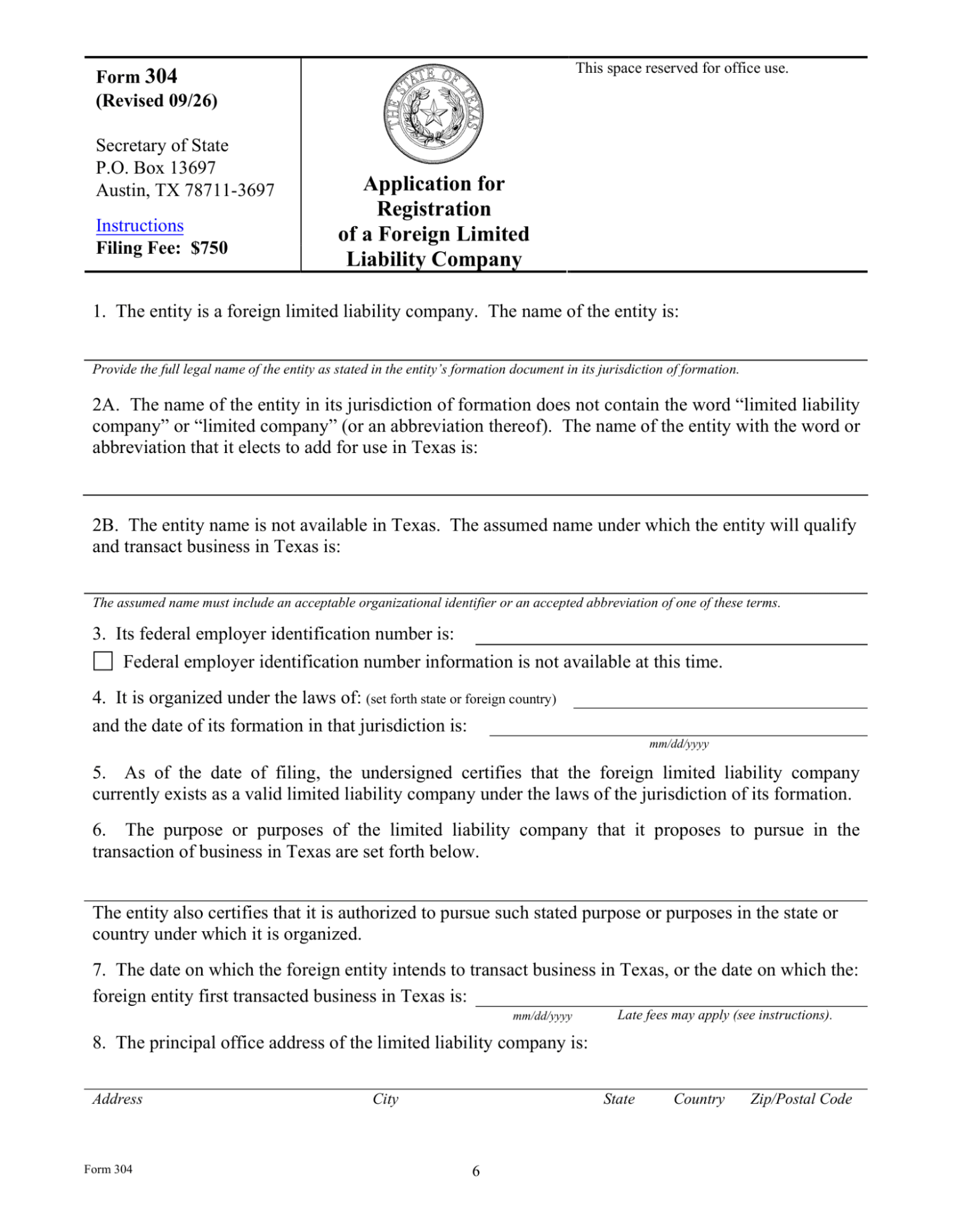
Here is the Texas 304 Form you can download from the official Texas Secretary of State website.
Step 1: Enter Your Entity Name and Type (Item 1)

Start with your LLC's full legal name. Copy it exactly from the document you filed to form the LLC. Keep the same spelling and punctuation, even if you use a shorter name on invoices.
Texas also has rules about which names it will accept. Under Chapter 5 of the Texas Business Organizations Code, your name must meet three requirements:
- It must include an accepted business-entity designation.
- It must not suggest that your LLC is authorized to conduct a business it cannot legally conduct.
- It must not be the same as, or too similar to, an existing Texas entity name, name reservation, or registration.
If your LLC's name does not meet these rules, Texas will reject the filing.
Not sure whether the name is available?
Start with a Texas business name search. You can also request a preliminary check from the Secretary of State by calling (512) 463-5555 or by email. However, this check is not a final approval. Texas makes the final decision when it reviews your filing. Avoid signing contracts or spending money based only on a preliminary answer.
Step 2: Add an Assumed Name if You Need One (Items 2A and 2B)
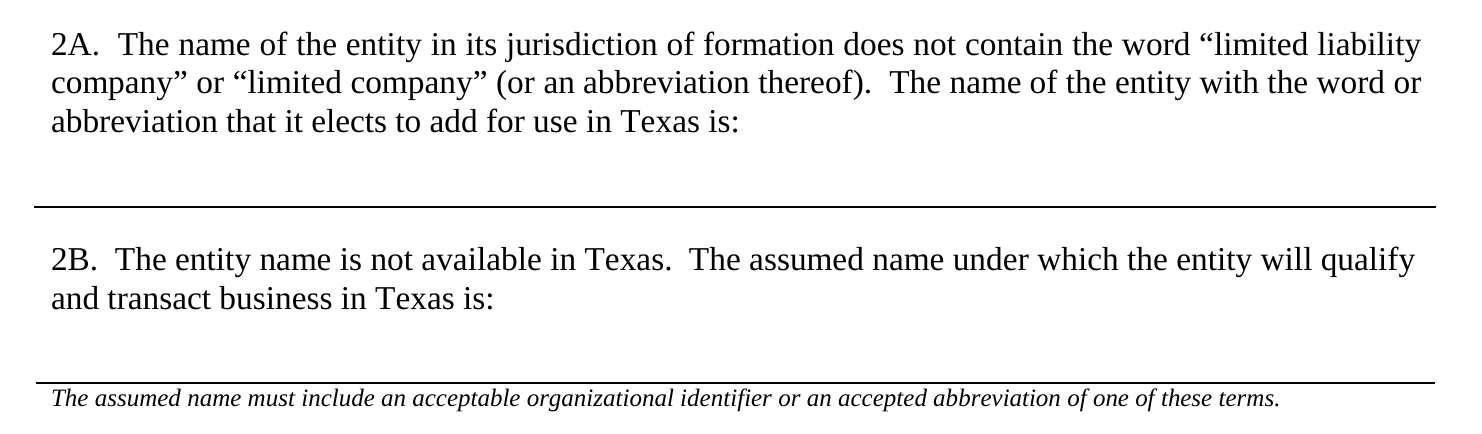
Next, check whether you need to use a different name in Texas. Most LLCs can leave Items 2A and 2B blank. Complete one of them only if the situation below applies.
Item 2A: Your Legal Name is Missing an LLC Designation
Some states allow LLC names without an ending such as "LLC" or "Limited Company." Texas requires one. Add an accepted designation to your legal name and enter the updated name in Item 2A. Texas accepts "limited liability company," "limited company," or an abbreviation of either.
Item 2B: Your Legal Name is Not Available in Texas
Choose an assumed name that meets the Chapter 5 naming rules and enter it in Item 2B. You must also file Form 503, the Texas assumed name certificate, with the Texas Secretary of State under Chapter 71 of the Texas Business and Commerce Code. The state version of Form 503 is different from the version accepted by county clerks.
Step 3: Enter Your FEIN (Item 3)

In Item 3, enter your nine-digit federal employer identification number (FEIN) from the IRS. Use this format: 12-3456789.
If you have not received a FEIN, indicate that on the form instead of leaving the field blank. If you have one, include it. The number helps the Texas Comptroller set up your tax account.
Step 4: State Your Home Jurisdiction and Purpose (Items 4, 5 and 6)
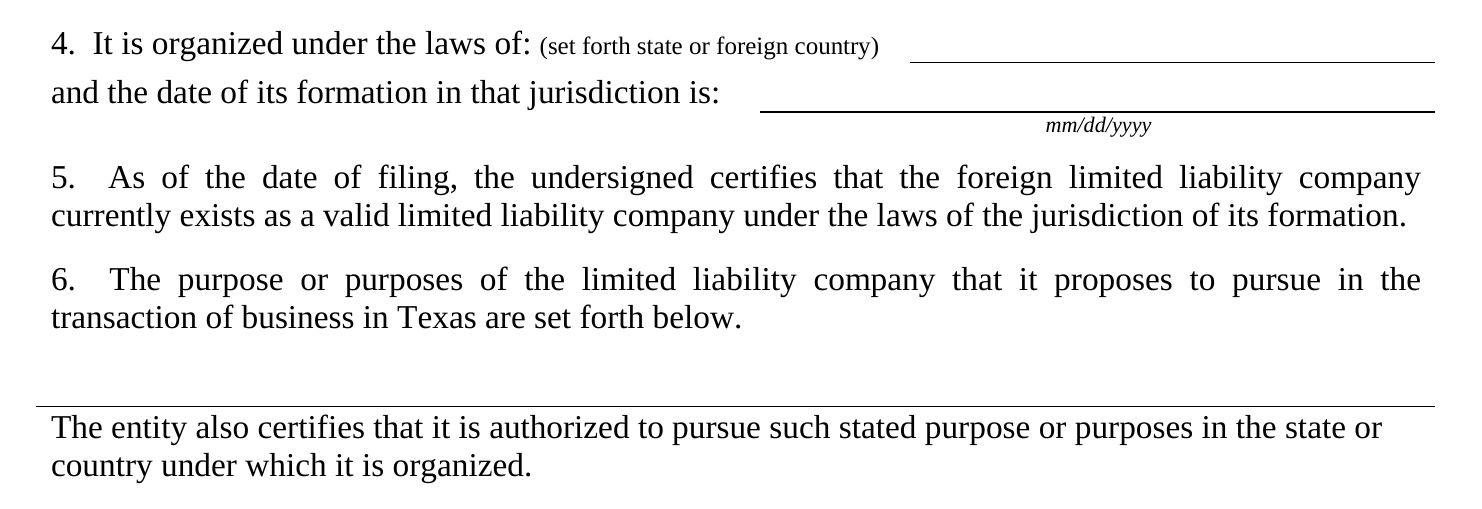
Now enter where your LLC was formed and what it plans to do in Texas. Form 304 covers this information in Items 4, 5, and 6.
Item 4: State or Country of Formation
Enter where you formed the LLC and the date it was formed. Follow the date format shown on the form.
Item 5: Confirmation That Your LLC Exists
By completing this item, you confirm that your LLC legally exists under the laws of the state or country where it was formed. You make this confirmation yourself. You do not need to attach a certificate from that jurisdiction.
Item 6: Business Purpose
Describe the business activities your LLC plans to carry out in Texas. Many filers use the phrase "any lawful business or activity under the law of this state," which Texas accepts. You must also confirm that your LLC is allowed to carry out those activities in its home jurisdiction.
Step 5: Give Your Texas Start Date (Item 7)

Next, enter the date your LLC first did business in Texas, or the date it expects to start. This goes in Item 7.
Check this date carefully because it may affect your filing cost. If your LLC began transacting business in Texas more than 90 days before you submit Form 304, a late fee applies. The fee is $750 for each year, or part of a year, that the LLC operated without registering. Even part of a calendar year counts as a full year.
Do not simply enter the date you formed your LLC or decided to expand. The key date is when your Texas activities first counted as "transacting business" under Chapter 9. If your LLC has already been active in Texas and you are unsure which date applies, speak with an attorney before filing.
Step 6: Enter Your Principal Office Address (Item 8)

Item 8 asks for your LLC's principal office address. Enter the street or mailing address of its main office, even if that office is outside Texas. This is different from the registered office address you'll provide in Step 7.
Step 7: Name Your Registered Agent and Office (Items 9 and 10)
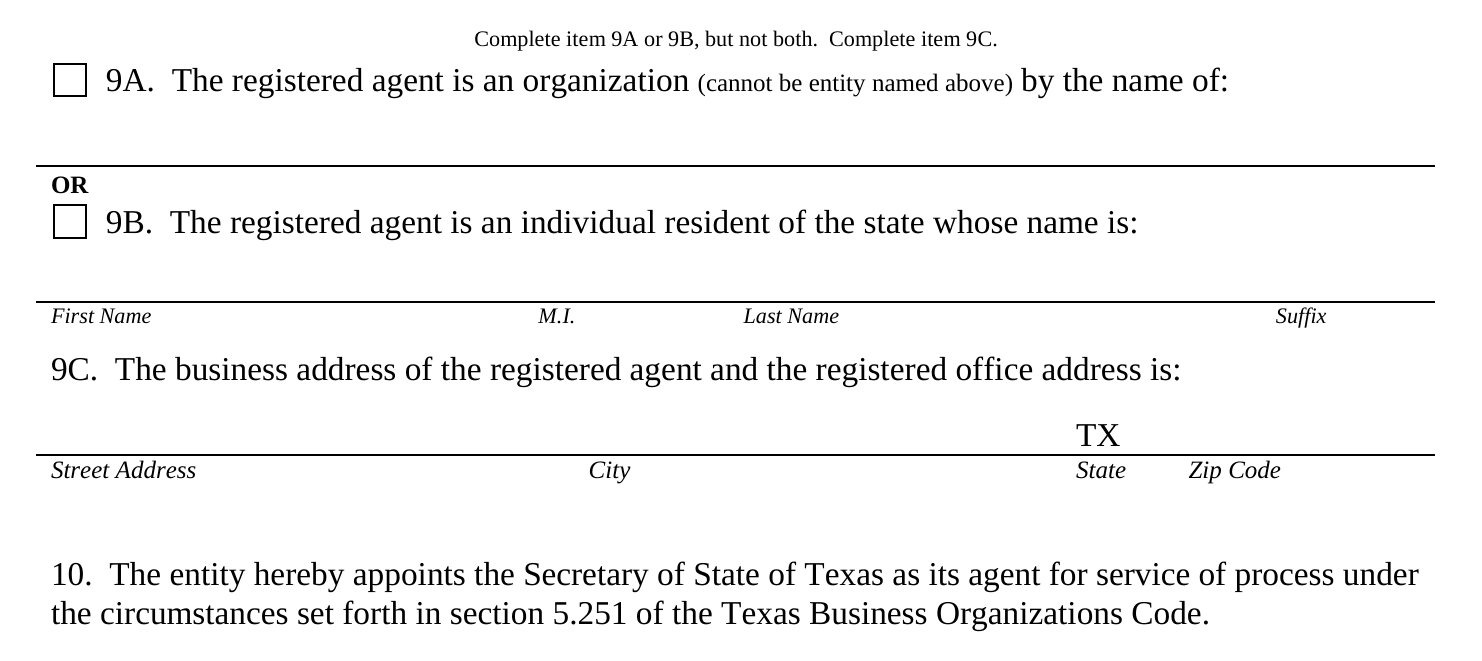
Next, choose your Texas registered agent in Item 9. You can select one of two options:
- Option A: An organization. It must be a Texas entity or an out-of-state entity that is already registered to do business in Texas.
- Option B: An individual who lives in Texas.
Your LLC cannot be its own registered agent, so do not enter the LLC's name here.
Before you name a registered agent, make sure that person or organization has agreed to serve. The agreement must be in writing or electronic form. You do not include it with Form 304, but you must have it. Naming an agent without consent can create liability under sections 4.007 and 4.008 of the Texas Business Organizations Code.
Registered office address: Enter a Texas street address where someone can deliver legal papers to the agent during normal business hours. The address does not need to be your LLC's business location. However, it cannot be only a mailbox service or telephone answering service.
Item 10: No additional information is needed. When you sign Form 304, your LLC agrees that the Secretary of State may receive legal documents on its behalf in the situations described in section 5.251.
Step 8: List Your Governing Persons (Item 11)
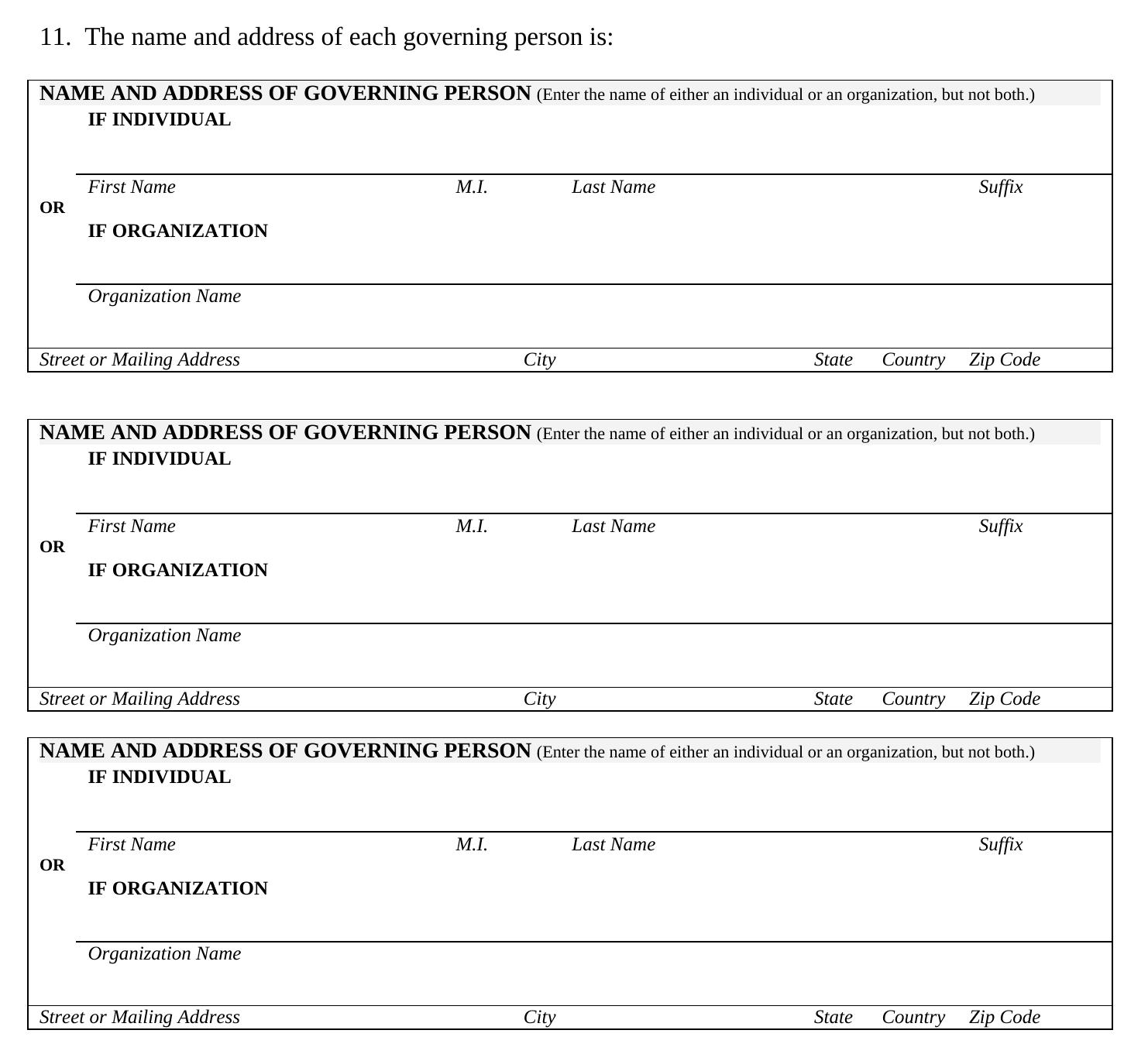
In Item 11, list the people or organizations that manage and direct your LLC. These are called its governing persons. You must list at least one and include an address for each.
To avoid mistakes, follow these name and address rules:
- Leave out titles such as Mr., Mrs., and Ms.
- Use the suffix field only for Jr., Sr., III, and similar family suffixes. Do not add job titles or degrees such as M.D. or Ph.D.
- Enter only one person or organization in each entry. Do not combine both in one entry.
- Include an address for every governing person.
Remember that the information on Form 304 becomes public. If someone listed on the form wants to avoid sharing a home address, they can use a business address or post office box instead.
Step 9: Pick an Effectiveness Option
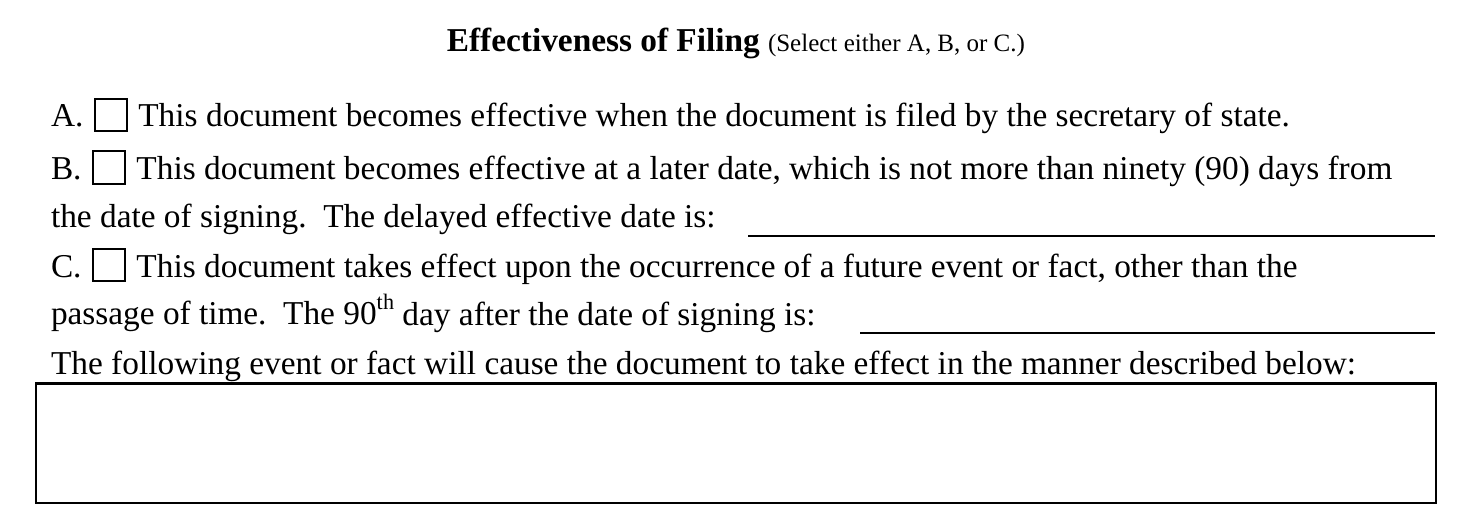
After entering your LLC's details, decide when the registration should take effect. You will see three options near the end of the form. Most filers choose Option A, which takes effect when the Secretary of State files the form.
Option | When It Takes Effect | What Else It Requires |
A | When the Secretary of State files it | Nothing |
B | A date you choose, up to 90 days after you sign | The chosen date |
C | When a future event or fact occurs | A description of how that event causes it to take effect, the date of the 90th day after signing, and a follow-up statement filed within 90 days |
If you chose Option B or C, Texas will record both the filing date and the future effective date. The state’s record will also show the registration as in existence.
Be especially careful with Option C. It requires a follow-up statement within 90 days. If you miss that deadline, the registration will not take effect. Choose this option only if you can track and meet the deadline.
Step 10: Sign the Application
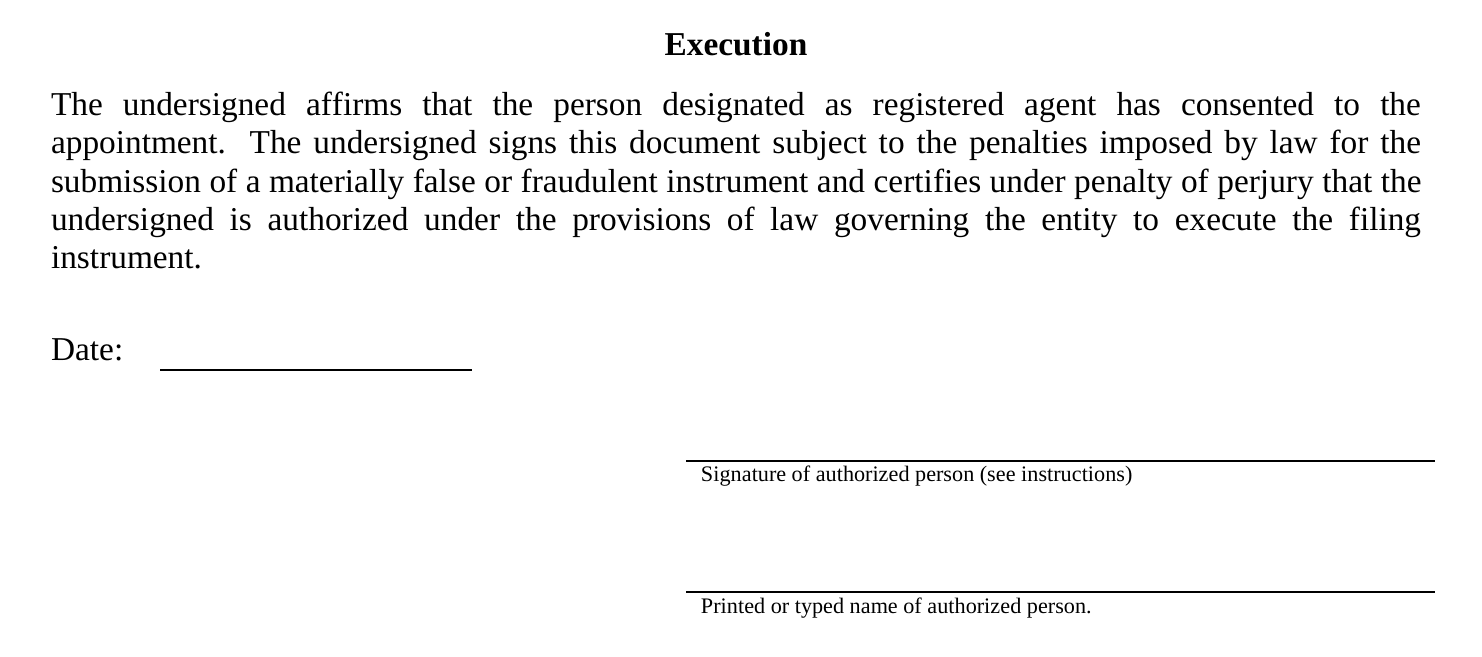
Once the form is complete, an authorized person must sign it. For most LLCs, this is a governing person or managerial official who has authority to sign filings for the business.
You do not need to have the signature notarized.
Before signing, read the statements above the signature line. If a managerial official has appointed the registered agent, signing also confirms that the agent agreed to serve.
Make sure every statement in the filing is accurate. Under section 4.008, knowingly signing or directing a materially false filing is an offense. It can be a Class A misdemeanor or, if done with intent to harm or defraud, a state jail felony.
Step 11: Work Out What You Owe
Charge | Amount |
Filing Fee | $750 |
Late Filing Fee | $750 for each year or part of a year of delinquency |
In addition to the $750 filing fee, you may owe a late filing fee if your LLC started doing business in Texas more than 90 days before filing. Texas counts each calendar year, even a partial one. For example, an LLC that started in November 2024 and files in January 2026 may owe fees for three calendar years.
A credit card payment also has a convenience fee. To avoid that charge, pay by ACH, check, or money order.
Step 12: Submit the Form
- Online: File through SOSPortal. This is generally the faster option. The portal guides you through the required fields. You can pay by ACH or credit card. The person who submits the form receives proof of filing by email.
- By mail: Send the completed form to P.O. Box 13697, Austin, TX 78711-3697. Include a check or money order. Texas will mail back the filing confirmation.
- In person: Deliver the form to 400 W. 15th St., Austin, TX 78701. Payment and filing confirmation work the same way as a mailed submission.
Before submitting, remove the following items. Including them may cause Texas to reject the filing:
- The instruction pages
- Duplicate copies of the document
- Personal identifying information
Conclusion
After approval, keep an active registered agent and registered office address in Texas. You need both for as long as your LLC remains registered in the state.
If your agent or registered office changes, change your registered agent with the Secretary of State. Do not allow either one to lapse. Otherwise, Texas may revoke the registration.
Registration is only one part of operating in Texas. Check with the Texas Comptroller of Public Accounts about franchise tax requirements. You should also check with the IRS about federal filings and your FEIN.
FAQs
Texas Form 304 is used to register a limited liability company (LLC) formed outside Texas to do business in the state. It allows a foreign LLC to apply for registration with the Texas Secretary of State.
LLCs formed in another U.S. state or country generally need to file Form 304 if their activities require registration in Texas. For example, a Delaware LLC expanding its business operations into Texas may need to submit this form.
The standard filing fee for Texas Form 304 is $750. Additional charges may apply if your LLC registers late or pays by credit card. Credit card payments may include an additional convenience fee.
Yes. If your LLC has not received its Federal Employer Identification Number (FEIN), you can indicate that the number is unavailable in Item 3. However, you should include your FEIN if you have one.
Yes. You must appoint an eligible registered agent with a physical street address in Texas. The agent must agree to serve before you submit the application. Your LLC cannot act as its own registered agent.
If your LLC began doing business in Texas more than 90 days before filing, late fees may apply. Texas charges $750 for each calendar year, or part of a year, that the LLC operated without registering.
If your LLC's legal name is unavailable in Texas, you must choose an assumed name that meets the state's naming requirements. Enter the name in Item 2B of Form 304, and file a separate assumed-name certificate using Form 503.
Yes. You can file Form 304 online through the Texas Secretary of State's SOSPortal. The portal guides you through the required information and accepts ACH or credit card payments. You can also submit the form by mail or in person.