

Form your LLC for $0 by doing the paperwork yourself! You only pay your state's mandatory filing fee. Learn how to skip the extra costs and save money today.
Creating an LLC for free means either doing it yourself or using a $0 service to help prepare your paperwork. You still pay your state's filing fee, which ranges from about $40 to $500 depending on where you form. The good news is most of the other steps, like getting an EIN or writing an operating agreement, can be done for free if you know where to look.
Key Takeaways
A “free LLC” usually means no service fee, not no cost at all.
Most states require a filing fee to approve your Articles of Organization.
You can file your LLC yourself through your state’s official website.
You can get an EIN directly from the IRS for free.
An operating agreement template works fine for a simple LLC.
You may be able to act as your own registered agent.
Free LLC services may include upsells for EINs, registered agents, operating agreements, and compliance.
The cheapest option is not always the best if you need privacy, support, or help staying compliant.
LLC Formation: What's Actually Free?
Some parts of forming an LLC are genuinely free. Others are required no matter which path you choose.
LLC Cost
Required?
Can You Avoid It?
Free Alternative
State filing fee
Yes
No, in nearly every state
None. This goes directly to your state.
LLC name search
Yes
N/A, already free
Use your state's business name database
Registered agent
Yes
Sometimes
Act as your own registered agent if your state allows it
Articles of Organization filing
Yes
No
File it yourself online
Operating agreement
Recommended, not always required
Yes
Use a free template
EIN
Recommended for most LLCs
No cost either way
Apply for free directly through the IRS
Business bank account
Recommended
No
Many banks offer free business checking
Annual report or franchise tax
Often yes, depends on the state
No
None; this is a state requirement
What Are The Steps To Create An LLC For Free Online
Creating an LLC follows a similar process across all states, but specific requirements vary by location. For example
- Most states route filings through the Secretary of State, but Maryland processes them through the SDAT (State Department of Assessments and Taxation).
- New York requires you to publish a notice of your articles of organization in two newspapers for 6 consecutive weeks.
- California requires most LLCs to file a Statement of Information within 90 days of formation and then every 2 years.
Apart from these differences, the core steps to form an LLC are largely the same in every state. Most states require you to choose a unique name, appoint a registered agent, file Articles of Organization, and pay a state filing fee.
Step 1: Choose The State Where You'll Form Your LLC
Before any paperwork starts, you need to decide where you want to form your limited liability company. Most people form an LLC in their home state. Others choose a different state to take advantage of lower formation costs or better tax rules.
If you register in one state and operate from another state, you will need to hire a registered agent in the state of formation and get familiar with that state's tax rules. Your home state can still tax your income since that's where you actually work. That said, paying taxes in the state where you formed your LLC often qualifies you for a tax credit, so it's not always double taxation.
Delaware is one of the most popular states for forming businesses in the country. Big companies and first-time founders alike choose it for its flexible laws, business-friendly courts, and strong privacy protections. So let's use Delaware as our example and walk through the entire process, step-by-step, with screenshots from the actual official website.
To get started, go to your browser and search: "Create an LLC in Delaware"
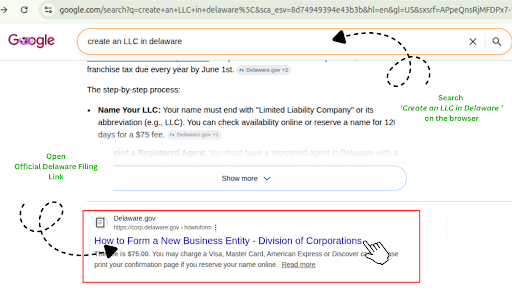
When Google search results appear, click the Delaware.gov link that says "How to Form a New Business Entity"
Step 2: Select The Name Of Your LLC
You can name your LLC whatever you want. It can be your own name, a brand name, or something descriptive.
Here are the basic naming rules to keep in mind:
- Choose a unique name. Your name cannot be the same as or too similar to an existing Delaware entity.
- Add a designator. Your name must end with "LLC," "L.L.C.," or "Limited Liability Company."
- Avoid restricted words. Words like "bank," "trust," or "insurance" require extra approval and documentation.
To check, you search the state's official name database. It holds every registered business name and flags any conflicts before you file.
Before you search the state database, you can use the Swyft Filings Business Name Generator to brainstorm unique name ideas with the help of an AI-powered tool. It's free, and it helps you land on a name that fits your brand before you run the official availability check.
How To Check Your Business Name Availability
Once you have a name in mind, here's how to check if it's available in Delaware:
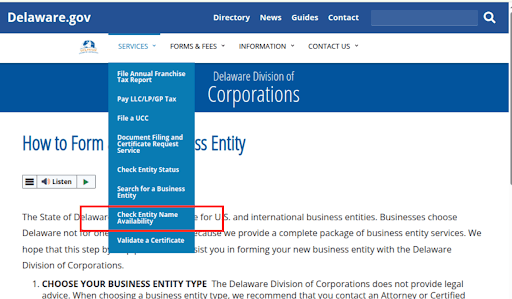
Go to Services on Delaware.gov. A dropdown will appear. Select "Check Entity Name Availability."
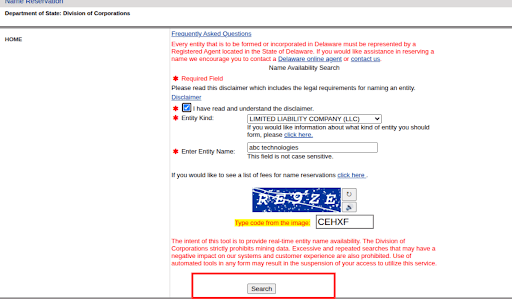
This form will appear. For Entity Kind, select Limited Liability Company. Enter the name you have chosen. Complete the CAPTCHA and click Search.
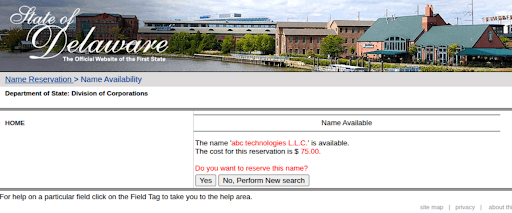
A result page will appear. If the name is free, it will say the name is available. You will also see that the current cost to reserve the name is $75. If you want to hold that name for the next few days (generally 120 days for most states), you can click Yes. If you are ready to file right away, you can skip the business name reservation and go straight to filing.
Step 3: Name Your Registered Agent
Every U.S. state requires you to appoint a registered agent for your LLC. A registered agent is a person or business that receives legal documents on your behalf, things like lawsuits, government notices, and official state mail.
You have a few options:
- Be your own registered agent
- Appoint a trusted friend or family member
- Hire a professional registered agent service
The key requirement is that your registered agent must have a physical street address in Delaware and must be available there during all normal business hours. Legal documents are hand-delivered, not mailed, so a P.O. box does not qualify. If you live outside Delaware, you will need to hire a registered agent service.
Step 4: Set Up Your eCorp Account
Delaware processes LLC filings through an online portal called eCorp Business Services. You need to create a free eCorp account before submitting your Certificate of Formation.
To get there, go back to the Delaware Division of Corporations homepage and click Services in the top menu. From the dropdown, select Document Filing and Certificate Request Service.
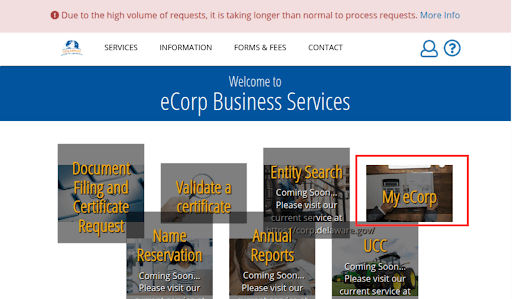
This takes you to the eCorp homepage. Click on My eCorp to create your account.
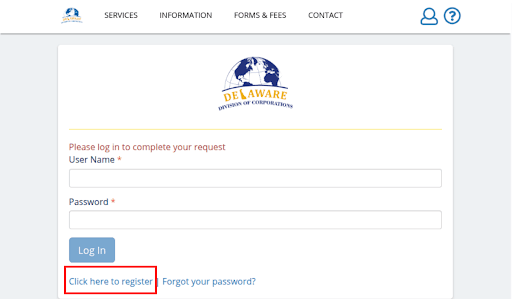
On the registration page, select Individual as your account type. Fill in your first name, last name, address, email, and phone number. Create a username and password. Write your ID and password down somewhere safe; you will need these to check your filing status later.
Once your account is set up, you will see your name in the top right corner. If you don't see it, log in.
Step 5: Download And Fill Out The Certificate Of Formation
In Delaware, the document that officially creates your LLC is called the Certificate of Formation. Other states call it the Articles of Organization, but it's the same thing. You download this form for free from the state website, fill it out, sign it, and upload it online.
Here's how to find it:
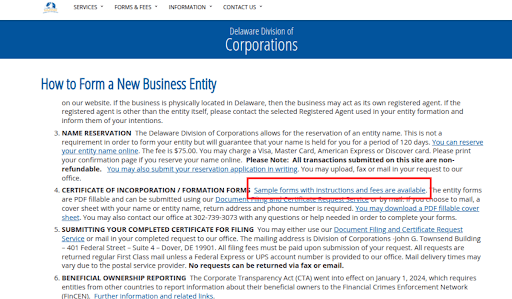
Click on Information in the top menu. From the dropdown, select the first option: How to Form a New Business Entity.
On that page, scroll to number four. It covers the Certificate of Formation. Click the link that says Sample forms with instructions and fees are available.
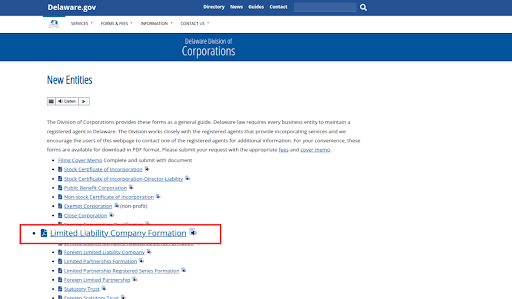
On the next page, scroll down and click on Limited Liability Company Formation to download the fillable Certificate of Formation PDF.
The form itself is short. It has two sections to fill out:
- Section 1: Write your LLC name exactly as you want it registered.
- Section 2: Enter your registered agent's full street address, city, ZIP code, and their name.
At the bottom, sign the form and print your name below the signature line. You can print the form and sign it by hand, or sign it digitally using a tool like iLovePDF or Adobe Acrobat. Either way works.
⚠️ Important Note: Every state has a slightly different online portal and filing process. In this guide, we are using Delaware as our primary example. If you are forming your LLC in another state (such as Texas, California, or Florida), you likely won't need to download and upload a PDF; the entire process will be completed directly through an online form on their website.
File Your Certificate Of Formation
You are about to officially submit your LLC to the state.
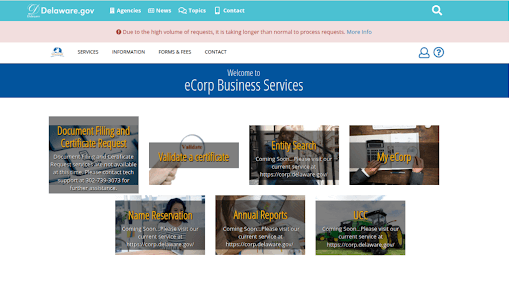
Go to the Document Filing and Certification Request section; you will see a form to fill out before uploading your PDF. Here's what to select:
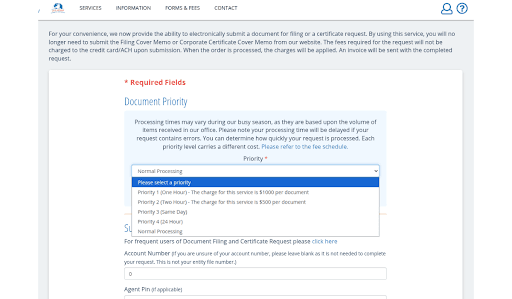
- Processing priority: Delaware gives you several options. If you want your LLC approved within 24 hours, select the 24-hour expedite option. It costs an extra $50 on top of the standard $110 filing fee. If you're not in a rush, select normal processing, which takes about 2 to 3 weeks but has no expedite fee.
- Submitter information: Since you're logged in, your account details will already show up here.
- Document type: Type or select "Certificate of Formation."
- Company name: Enter your LLC name exactly as it appears on your form.
- File number and reservation number: These are optional fields. If you did not reserve your name earlier, leave the sections blank.
- Method of return: Select Regular Mail to avoid extra delivery fees. Your approved documents will be sent to the address on your account.
After filling out the form, upload your signed Certificate of Formation PDF. Then click Continue to go to checkout.
At checkout, select a payment method. Most people pay by credit card. Your card will not be charged right away. Delaware charges you only once your filing enters active processing. You may see a small temporary hold on your card to confirm it's valid, but the full payment comes later.
Once submitted, log back into your eCorp account and click on Filing to check your status. Your application will show as Pending first, then move to processing. You will be able to see all your submission details from there.
Step 6: Create A Free Operating Agreement
An operating agreement is an internal document that outlines how your LLC will be run. Delaware does not require you to file it with the state, but every LLC should have one.
It covers things like:
- Who owns the LLC, and what percentage does each member hold
- How profits and losses are distributed
- How decisions get made
- What happens if a member leaves or the LLC needs to be dissolved
For a single-member LLC, you can create a free operating agreement using an AI tool or a free template online. If your LLC has multiple members or a more complex ownership structure, a custom agreement helps prevent conflicts down the road.
Step 7: Get A Free EIN From The IRS
An EIN (Employer Identification Number) is your LLC's federal tax ID. Think of it as a Social Security Number for your business. You need it to open a business bank account, hire employees, and file your taxes.
You can fill out the paperwork for an EIN via the IRS website at no charge. The process is done entirely online, and you get your number immediately after completing the application. [1]
For the exact steps and the right page to go to on the IRS website, read our guide on how to apply for an EIN.
Step 8: Open A Business Bank Account
Once your LLC is approved and you have your EIN, open a dedicated business bank account. This is one of the most practical steps you can take to protect yourself.
Keeping your business and personal finances separate maintains the liability wall between you and your LLC. If you mix the two, a court can use that as a reason to hold you personally responsible for business debts, which defeats the whole point of having an LLC.
Most banks will require your Certificate of Formation and your EIN to open the account. Some also ask for your operating agreement. For a full breakdown of the process, read the Swyft Filings guide on opening a business bank account.
Step 9: Track Annual Reports, Taxes, And Licenses
Forming your LLC is a one-time step, but staying in good standing requires ongoing attention. Here's what to keep track of in Delaware:
- Annual Franchise Tax: Delaware LLCs owe a flat $300 franchise tax every year. The deadline is June 1. Missing it triggers a $200 late penalty plus monthly interest.
- Business Licenses: Most Delaware businesses need a state business license from the Division of Revenue before they start operating.
- Federal Taxes: Depending on how your LLC is taxed, you may owe quarterly estimated federal taxes throughout the year.
Set a reminder for these deadlines at the start of every year so nothing slips.
One last thing worth saying: even after this full walkthrough, do your own research based on your specific business. Delaware works great for a lot of business types, but it may not be the right fit for yours. Research your business's needs first, then pick the state that fits.
Also Read: Common LLC Mistakes and How To Avoid Them
What Is The Minimum Cost To Form And Maintain An LLC In Each State
State | Domestic LLC Filing Fee | Foreign LLC filing cost | Annual/Biennial Report Fee |
$150 | $50 minimum (annually) | ||
$350 | $100 (biennial report filing) | ||
$150 | $0 | ||
$270 | $50 | ||
$70 | $800 (every year) + $20 (every 2 years) | ||
$100 | $25 (annual report filing) | ||
$120 | $80 (annual report filing) | ||
$200 | $300 (annual report filing) | ||
$125 | $138.75 (annual report filing) | ||
$225 online ($5 processing) or $235 by mail | $50 (annual report filing) | ||
$50 | $15 (annual report filing) | ||
$100 | $0 (information report required yearly) | ||
$150 | $75 (annual report filing) | ||
$95 | $105 | $32 (biennial) | |
$100 | $30 (biennial report filing) | ||
$165 | $50 (annual report filing) | ||
$90 | $15 (annual report filing) | ||
$150 | $300 (annual report filing) | ||
$250 | $85 (annual report filing) | ||
$100 | $300 (annual report filing) | ||
$500 | $500 (annual report filing) | ||
$50 | $25 (annual report filing) | ||
$205 | $0 (Information report needs to be filed annually) | ||
$250 | $0 | ||
$250 | $0 ( no fee and information report) | ||
$70 | $20 | ||
$100 | $13 (biennial report filing) | ||
$425 | $350 (annual report filing) | ||
$102 | $100 (annual report filing) | ||
$125 | $75 (annual report filing) | ||
$100 | $0 (no fee and information report) | ||
$250 | $9 (biennial report filing) | ||
$250 | $200 (annual report filing) | ||
$135 | $50 (annual report filing) | ||
$99 | $0 (no fee and information report) | ||
$300 | $25 (annual report filing) | ||
$275 | $2 (annual report filing) | ||
$250 | $7 (annual report filing) | ||
$150 | $50 (annual report filing) | ||
$110 | $0 (no fee and information report) | ||
$150 | $55 (annual report filing) | ||
$300 | $300 (annual report filing) | ||
$750 | $18 (annual report filing) | ||
$59 | $18 (annual report filing) | ||
$155 | $45 (annual report filing) | ||
$100 | $50 | ||
$180 | $60 (annual report filing) | ||
$220 | $300 (biennial report filing) | ||
$150 | $25 (annual report filing) | ||
$100 | $25 (annual report filing) | ||
$150 | $60 minimum (annual report filing) |
Are There Any Hidden Costs For LLC Formation
Yes. Depending on how you file your LLC, there might be a hidden fee that you might skip at first.
What Are The Mandatory LLC Fees
There are a few fees mandated by the state. No matter how you file, you will always owe these:
- State Filing Fees: This goes 100% to your state government to register your Articles of Organization.
- Annual Reports and Franchise Taxes: Most states require you to file an annual report, pay a franchise tax, or both to keep your LLC active. The amount and frequency vary by state.
- Mandatory Publication Fees: A few states (like New York and Arizona) legally require you to publish a notice of your new LLC in local newspapers, which carries a local publishing cost.
- Expedited Filing Fees: Though optional, states charge a premium to move your filing to the front of the line. You can skip this cost entirely by choosing normal processing instead.
Other Fees That Might Apply During LLC Formation
A few additional fees are optional, and you'll typically only encounter them if you use a formation service.
- Registered Agent Renewal Fees
This is one of the hidden costs people often overlook when they're just getting started. A registered agent must be present at their listed address during all business hours, which is why many owners choose a professional registered agent service rather than handling it themselves. The catch is that this isn't a one-time cost. Most services charge on a recurring basis, whether quarterly or annually, so it's worth factoring into your long-term budget before you commit to a provider.
- EIN Filing Fees
Applying for an EIN directly through the IRS is always free. A filing company, however, will typically charge a fee to handle the paperwork for you. Many people choose to pay for this convenience because a professional service can help avoid errors and speed up the process.
- Operating Agreement Fees
A free template is usually enough for a simple, single-member LLC. But as your business grows or becomes more complex, a template may not hold up. A professionally drafted operating agreement might be more useful for LLCs with member disputes, multiple owners, or more complex profit-sharing arrangements. This typically comes with a small, one-time fee.
- Business License Fees
You may need city, county, or state-specific licenses based on your location or business needs. These are separate from your LLC formation filing. Many formation services will research and identify these requirements for you for a small fee, though you can also do this research yourself if you have the time.
- Foreign Qualification Fees
If you form your LLC in one state but conduct business in another, you may need to register as a foreign LLC in that additional state, which comes with its own filing fee. Expanding your business into other states may also require you to pay a separate formation fee in each one.
Are Free LLC Service Packages Really $0 + State Fees
Some companies offer free LLC formation packages. These usually mean the company does not charge a basic service fee to prepare your paperwork. You still pay the state filing fee.
These packages can be helpful if you want guidance, but they are not always completely free.
Common add-ons may include:
- Registered agent service
- EIN filing
- Operating agreement
- Compliance reminders
- Expedited processing
- Business license research
- Tax consultation
- Website or domain services
- Business bank account offers
This does not mean free LLC services are bad. They can save time and reduce confusion. The key is to read the package details carefully and avoid paying for extras you can handle yourself.
For example, you may not need to pay for EIN filing if you are comfortable applying directly through the IRS. You may not need a paid operating agreement if you have a simple single-member LLC and a free template works for you.
If you are comparing paid and free filing options, see our guide on Swyft Filings vs LegalZoom.
Conclusion
This is not really about what is free. It is about what you can do yourself and what you would rather hand off. A $0 + state fee package can take the paperwork off your plate while you stay in control of the bigger decisions. If you only need a registered agent or an operating agreement, that is a fine place to start, too. Whatever path you choose, knowing the real costs upfront helps you move forward with confidence.
A free, DIY approach works well for simple, single-member LLCs with no employees and straightforward ownership. It may not be the best fit if you have multiple business partners, plan to raise outside funding, operate in an industry with complex licensing, or simply do not have time to manage the paperwork yourself.
Sources
Internal Revenue Service. EIN Assistant. Accessed June 2026.