
Initial Setup
Compliance
Changes & Filings
Resolve
Protect & Legal
Learn
Excellent
7,984 reviews

In Wisconsin, you form your LLC by filing Form 502, the Articles of Organization, with the Department of Financial Institutions. You can file online through the QuickStart LLC portal or by mail. You need your business name, registered agent details, and principal office address to complete the filing. Once your LLC is approved, you can apply for an EIN and register for Wisconsin state taxes. From there, keep your LLC in good standing by filing your annual report every year.
Swyft Filings handles the paperwork and state filings in all 50 states. Select our basic package to start an LLC in Wisconsin for free. We also offer professional registered agent service, which can help you keep your home address from being used as your registered office address on public filings. Our online dashboard securely stores a copy of your paperwork and keeps it accessible at all times.
Your Wisconsin LLC's name goes on your Articles of Organization, your operating agreement, and other business documents, so it's worth getting it right before you file. Wisconsin requires your LLC name to be distinguishable from other entity names on file with the Department of Financial Institutions (DFI).
Wisconsin Naming Guidelines and Requirements:
Search the Wisconsin Department of Financial Institutions' Corporate Registration Information System (CRIS) to see names already in use before filing your LLC formation documents. The DFI also provides a separate Name Availability Search to help identify potential conflicts with existing entity names.
You can also call Corporations Bureau at 608-261-7577 to request a name search, but verbal search results are tentative and can change as new names are registered.
A search does not guarantee that your name will be accepted. The DFI states that you should not assume a name is available until your formation filing has been reviewed and accepted as "FILED."
Yes. You can file a Name Reservation Application with the DFI and pay a $15 fee to hold your name for 120 days, online or by mail.
Name reservation is optional. It can be useful if you need more time to arrange financing, sign contracts, or prepare your business before officially forming your LLC. If you're ready to file your Articles of Organization, you can skip name reservation. Your LLC name will be reviewed as part of the formation filing, and the name takes effect if your filing is approved.
Forming your Wisconsin LLC does not require a federal trademark, and the two protections work differently. Registering your LLC name with the Wisconsin Department of Financial Institutions does not give you nationwide trademark rights or prevent businesses in other states from using a similar name or logo. A federal trademark can provide broader protection for your brand name, logo, or slogan across the United States.
You may want to consider a federal trademark earlier if you sell online, plan to expand into other states, or are building a brand you want to protect nationwide. Our Trademark Registration service can help you file with the U.S. Patent and Trademark Office when you are ready.
Not necessarily. Your LLC can operate under its legal name without registering a fictitious name. You'd generally need a DBA, called a fictitious name in Wisconsin, if you want your LLC to operate under a different name.
A fictitious name does not create a separate legal entity. It allows your existing LLC to conduct business under an additional name. If you want to use a different name for your business, you can file a DBA, also known as a fictitious name. Read our complete guide on filing a DBA in Wisconsin if you are interested.
Every Wisconsin LLC must designate and continuously maintain a registered agent in Wisconsin. The registered agent can be an individual or an existing entity that is a resident of Wisconsin. The agent may be an officer or employee of the LLC or someone outside the business, such as an attorney.
The registered agent's business office serves as the LLC's registered office. You should keep the registered agent, registered office, and agent's email address information up to date with the Wisconsin Department of Financial Institutions (DFI).
Your registered agent receives official communications on your LLC's behalf, including service of process, annual report forms, and tax forms. Failing to receive or act on important documents can have significant consequences.
The registered agent's information is included in your LLC filing and is available through the state's business records. If you prefer not to handle these responsibilities yourself, you can consider our registered agent services.
Yes. You can serve as your own registered agent if you meet Wisconsin's requirements. You must be a Wisconsin resident and have a physical business office in the state that serves as the LLC's registered office. You can also appoint another eligible individual or an existing entity to serve as your registered agent.
If you act as your own registered agent, keep your registered agent and registered office information current with the DFI. You will be responsible for receiving and acting on official documents sent to your LLC.
You can update your registered agent, the agent’s email address, or your registered office address either when filing your annual report or by submitting a separate Statement of Change or Amendment.
Here is how you will receive confirmation of your filing:
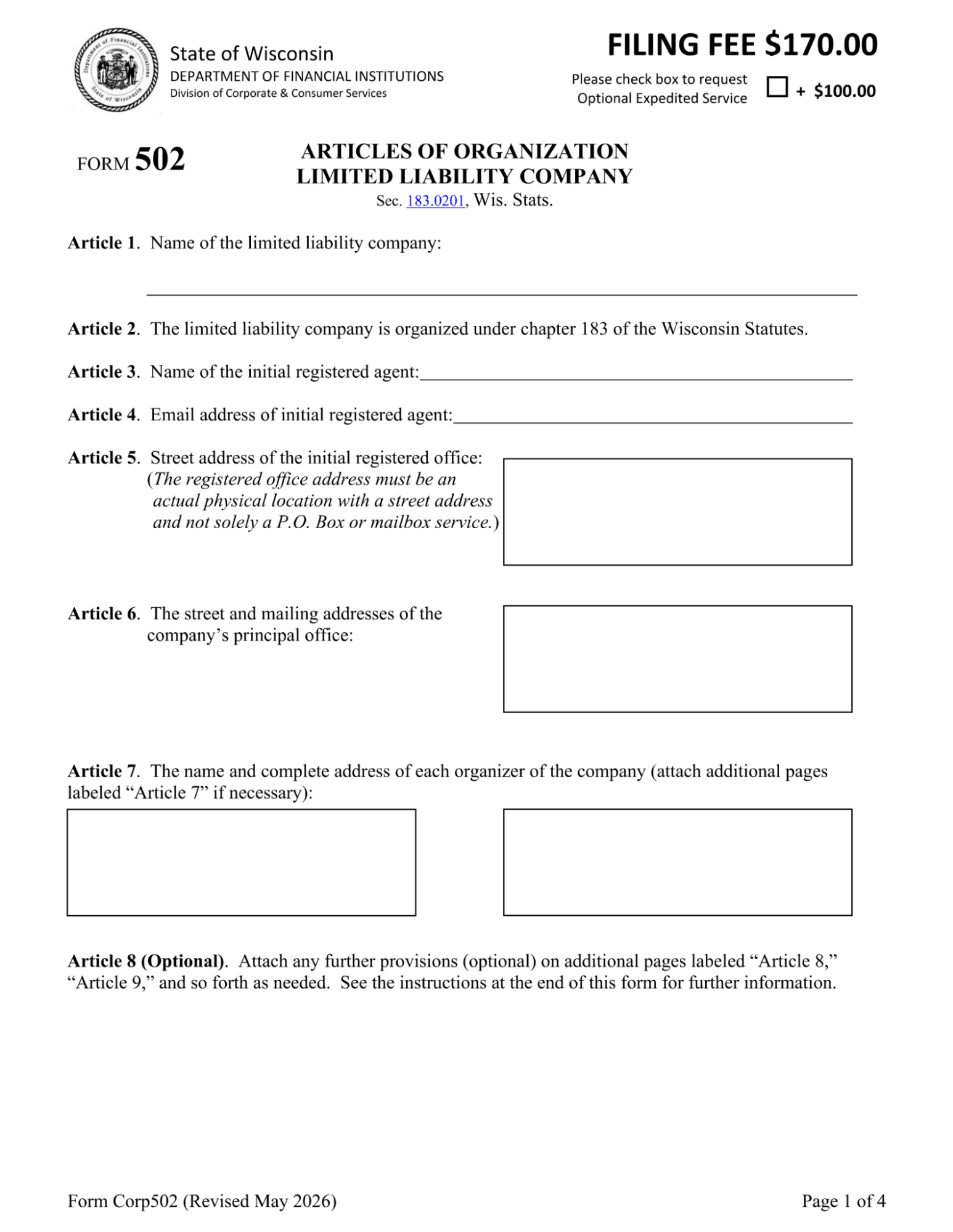
To officially create your LLC, you can either file online or file Form 502 (Articles of Organization) with the Wisconsin Department of Financial Institutions.
The filing fee is $130 online or $170 by mail. The filing fee is non-refundable.
Online filings are generally approved immediately, making it the fastest option. Here is the detailed process:
How to File an LLC in Wisconsin via the QuickStart LLC Portal
For standard mail filings, send Form 502 and a check for $170 (payable to the Department of Financial Institutions) to:
If sent by express or priority U.S. mail, use this address instead (a PO Box can't receive express/priority mail):
Student entrepreneurs who meet eligibility requirements (at least 18, enrolled in a Wisconsin postsecondary institution, public/private/tribal high school, or home-based program) may qualify for a fee waiver. The waiver only applies to paper filings using Form 502. Online filings always require the $130 fee.
An LLC formed in another state files a Registration Statement (Foreign LLC) instead of Articles of Organization. This helps you to register as a foreign LLC.
You can specify your management structure when you file your Articles of Organization, though Wisconsin makes it optional on the form. A member-managed LLC is run day to day by its owners, which suits most small businesses where all members stay involved. A manager-managed LLC puts one or more designated managers in charge, and those managers don't have to be members. This fits better when some owners are passive investors.
If you don't specify a management structure in your Articles, Wisconsin's default rules under Chapter 183 govern. Your operating agreement is where most management details are defined regardless.
An operating agreement isn't part of your Articles of Organization, but it's important to have one to set clear rules for how your business runs. Wisconsin's default LLC rules apply to anything you leave out, and those rules might not match what you and your co-owners actually want.
You can write your operating agreement using clear, simple language. If you need something built specifically for your state and situation, Swyft Filings walks you through a short questionnaire and generates a customized operating agreement for you. Either way, make sure every member signs it, and keep a copy somewhere safe.
Main terms to add in a Wisconsin LLC operating agreement:
Swyft Filings offers a free operating agreement template to start from, and we can also build a custom one around how your business actually runs if you would rather not draft it yourself. Our Wisconsin operating agreement guide walks through the full process in more detail.
Our Swyft Filings Wisconsin operating agreement walks through the full process in more detail.
You may need an Employer Identification Number (EIN) to open a business bank account, hire employees, or meet certain federal tax requirements. Applying for an EIN is free and typically takes 15 to 20 minutes on the IRS website. The application requires:
If you cannot obtain an SSN or ITIN, you may need to apply for an EIN using Form SS-4 rather than the IRS online application.
Wisconsin requires every LLC to file an annual report with the Department of Financial Institutions to stay in good standing. The fee is $25 online ($40 by mail, which includes a $15 paper surcharge). Your annual report is due by the end of the calendar quarter in which your LLC was originally formed, starting the year after formation.
Here's how it works. Wisconsin uses a quarterly system based on your formation month:
If your LLC was formed in January, February, or March, your annual report is due by March 31. If formed in April, May, or June, it's due by June 30. If formed in July, August, or September, it's due by September 30. If formed in October, November, or December, it's due by December 31.
For example, if you formed your Wisconsin LLC on August 15, 2026, your first annual report would be due by September 30, 2027.
Wisconsin does not charge a monetary late fee, but your LLC is immediately marked delinquent after the quarter closes. If your LLC fails to file its annual reports for several years, the Wisconsin Department of Financial Institutions (DFI) can administratively dissolve it. Before dissolution, DFI sends notices and gives the business an opportunity to correct its status by filing the missing annual report. Reinstatement after dissolution costs $100 plus $25 per missed report.
Wisconsin doesn't issue one general statewide business license, so there's no single license every LLC needs. Instead, your requirements depend on your industry and location. Certain types of businesses need a license through the Wisconsin Department of Revenue, and some professions require a state-level occupational or professional license through their licensing board.
Many cities and counties also require a local business license or zoning permit before you can operate. If you sell taxable goods or services, you'll need to register with the Department of Revenue for a seller's permit. Check with your local city or county clerk's office to confirm what applies to your specific business.
Read our guide on how to get a business license in Wisconsin for more information.
To open your business bank account, bring your EIN confirmation letter, your approved Articles of Organization, and a government-issued photo ID. Most banks will also ask for your operating agreement to confirm who's authorized to manage the account, so have it signed beforehand. Compare a few Wisconsin banks or credit unions on monthly fees, minimum balance requirements, and free transaction limits before you apply.
Read our guide on how to open a business bank account for more information.
Wisconsin is one of the more straightforward states for LLC formation costs. Here's what to budget for:
| Item | Cost |
|---|---|
| Articles of Organization (online) | $130 |
| Articles of Organization (by mail) | $170 |
| Name reservation (optional, 120 days) | $15 |
| Expedited service for mail filings (optional) | $25 |
| Annual report (online) | $25/year, due by end of formation quarter |
| Annual report (by mail) | $40/year |
| EIN | Free through the IRS |
| Registered agent (if hired) | Varies |
| Operating agreement drafting (if custom) | Varies |
Wisconsin doesn't charge LLCs a franchise tax or a separate entity-level income tax. Your only mandatory ongoing state cost is the $25 annual report fee, due by the end of the calendar quarter in which your LLC was originally formed.
Starting an LLC in Wisconsin yourself is possible, but it requires time, research, and follow-up. Here's how forming a Wisconsin LLC on your own compares with using Swyft Filings:
| Item | DIY | Swyft Filings |
|---|---|---|
| Wisconsin LLC Operating Agreement | Draft your own agreement from scratch or use a free operating agreement template | A customized LLC Operating Agreement is included |
| Wisconsin Registered Agent | Handle the registered agent requirements yourself | Professional registered agent service is available |
| Attorney Access | Hire an attorney separately if you need legal guidance | Personalized guidance from a business attorney is available |
| Domain Name + Website | Build, purchase, and manage your own website and domain | Done-for-you website and domain included through partner UENI |
| Wisconsin Business License Research | Research licenses and permits yourself | Business License Research is available as an add-on |
| Wisconsin DBA Filing | Handle the assumed name filing yourself | DBA filing service is available as an add-on |
| Document Vault | Manage and store your business documents yourself | Secure online portal with 24/7 document access |
| Wisconsin Compliance Management | Track state deadlines yourself | Compliance support is available through ComplianceGuard |
| Tax Consultation | Find and hire a tax professional separately | Free 30-minute tax consultation included through partner 1-800Accountant |
| Support | No dedicated formation support | Lifetime customer support is available |
Since 2015, Swyft Filings has helped over 600,000+ owners with business formation and compliance management. Our business formation specialists manually review your application for accuracy. Take the first step toward starting your Wisconsin LLC with confidence. Skip the guesswork and let Swyft Filings handle your paperwork.
$0 + State Filing Fees
*Disclaimer: This guide provides general information about forming an LLC in Wisconsin and is not a substitute for legal, tax, or financial advice.*
LLC rules, fees, and processing times vary by state. Select a state below to check its specific costs and filing requirements.