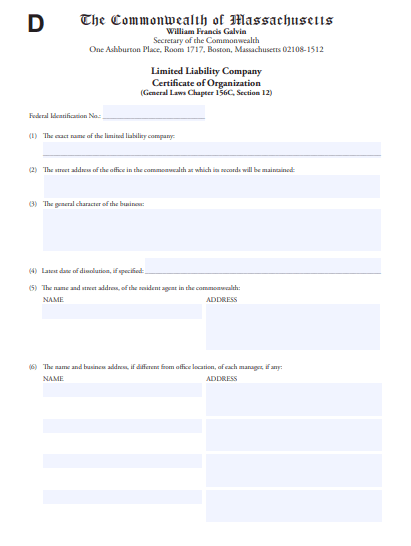
Form a Massachusetts LLC by filing a Certificate of Organization with the Secretary of the Commonwealth's Corporations Division. Use our basic LLC filing service to form a free Massachusetts LLC, where we prepare and file your Certificate of Organization with the state. You only pay the $500 state fee. Choose one of our premium packages to include a resident agent, an operating agreement, a DBA, EIN, and other Massachusetts LLC services.
What Are the Requirements for Starting an LLC in Massachusetts?
Requirement
What You Need
Name
Unique and distinguishable from other entities, ending in "Limited Liability Company," "LLC," or "L.L.C."
Resident Agent
A person or company with a physical Massachusetts street address
Filing Document
Certificate of Organization, filed with the Secretary of the Commonwealth Corporations Division
Filing Fee
$500
Ongoing Filing
Annual Report, due on the anniversary of your LLC's formation, $500
How to Form a Massachusetts LLC in 5 Steps
Massachusetts handles LLC filings through the Secretary of the Commonwealth's Corporations Division. You need your business name, resident agent details, and principal office address to file your Certificate of Organization. Once the Corporations Division approves your LLC, you get an EIN and put together your internal paperwork. Then you apply for the necessary licenses and permits for your LLC and open a business bank account if needed. After that, one annual filing on your formation anniversary keeps your LLC in good standing.
Swyft Filings handles the paperwork and state filings in all 50 states. Select our basic package to start an LLC for free in Massachusetts. We also offer professional resident agent services, so your personal address does not end up on a public filing.
Step 1: Pick a Name for Your Massachusetts LLC
Your LLC name goes everywhere. It is on your Certificate of Organization, your website, your marketing, and every social media handle you set up. That means it needs to be easy to read and easy to remember. If you still haven’t decided on a name, use our free business name generator tool to get creative business name ideas.
The challenge is that it also needs to be unique. No other business should already have a trademark or legal right to use that name. Check it against the Massachusetts Business Entity Search. This is the state's official name-check tool, and it shows whether a business with that name, or something close to it, already exists.
Keep in mind this search only shows entities that have actually filed with the state. It will not catch a name someone else is holding under a 60-day reservation but has not formed yet. It is a small gap, but worth knowing about before you get attached to a name.
While you are deciding on a name, check it against Massachusetts's naming rules:
Massachusetts requires the name to be distinguishable from any business already on file with the Corporations Division, even if it is not identical.
Your name also needs an approved ending, such as "Limited Liability Company," "L.L.C.," "LLC," "LC," or "L.C."
Skip anything that suggests your business is a government agency or regulatory body.
Yes. If you found an available name but are not ready to file your Certificate of Organization, file an Application for Reservation of Name with the Secretary of the Commonwealth along with a $30 fee. This holds the name for 60 days. Massachusetts does not accept this form online or by fax, so you need to mail it or hand-deliver it to One Ashburton Place, Room 1717, Boston, MA 02108-1512. If you need more time, you can extend the reservation for another 60 days by filing again and paying another $30.
Only if you plan to operate under a name different from the one on your Certificate of Organization. Massachusetts calls this a Business Certificate rather than a DBA, and it works differently than in most states. Instead of filing with the state, you file a DBA in Massachusetts directly with the city or town clerk in every municipality where your LLC has a physical location. The fee is set by each city or town, so it typically runs somewhere between $40 and $65, and the certificate stays valid for four years before you need to renew it. Filing methods depend on the clerk's office, so check with your specific town or city for whether mail, in-person, or online filing is available. Read our complete guide on how to file a DBA in Massachusetts for the full process.
You should select and secure your domain name after your filing is approved. Your domain name serves as the foundation for your website, professional email addresses, social media handles, and marketing materials. When choosing a domain, ensure it is short and easy to spell, and is available across major social platforms. Securing your matching .com domain early locks in your brand identity online and prevents domain squatters from claiming it.
Forming your LLC only protects your business name within Massachusetts; it doesn't stop someone in another state from using the same name or logo. Filing a trademark gives you exclusive rights to your brand name, logo, or slogan nationwide, and legal grounds to stop others from copying it. This matters more once you start selling online, expanding to other states, or building a brand people recognize. Without one, a competitor could adopt a similar name, making it harder for customers to find the real you.
Massachusetts law requires every LLC to name a resident agent on its Certificate of Organization. This is the person or company that accepts legal notices, lawsuits, and official state mail on your LLC's behalf.
Your resident agent needs a physical Massachusetts street address. A P.O. box does not satisfy this requirement. They also need to be available at that address during regular business hours so they can accept documents the moment they arrive.
Yes, as long as you have a physical Massachusetts street address and can be there during normal business hours to accept documents in person. Many LLC owners in Massachusetts start this way to save money. The tradeoff is that your name and resident address become part of the public record the moment your LLC is approved.
Yes. A parent, another family member, or a friend can serve as your resident agent, as long as they meet the same requirements as anyone else: a physical Massachusetts street address and availability during regular business hours to accept documents. There is no rule against using someone you know personally, but think about whether they can reliably be at that address every business day before you list them on your filing.
Your home or office address becomes part of the public record, where anyone, including someone filing a lawsuit against you, can look it up. You also have to be available at that address during business hours every single day, which means no stepping out for a meeting, a vacation, or a sick day without risking a missed delivery. A professional resident agent service keeps your personal address off the public filing and forwards anything important to you the same day it arrives.
Your LLC falls out of compliance with Massachusetts law. Any legal notices, lawsuits, and state mail sent to your registered agent address will have nowhere to land. It means you could miss something as serious as being served in a lawsuit without ever knowing it happened. If you don’t name your registered agent, the state will flag your LLC as delinquent or inactive and may eventually administratively dissolve it.
Step 3: File Your Massachusetts Certificate of Organization
The Certificate of Organization is the document that officially creates your LLC with the Secretary of the Commonwealth. The state filing fee is $500. Paying online or by fax adds a $20 charge, which the Corporations Division treats as a credit card and eCheck processing fee. Paying by check through mail or in person avoids that extra $20 entirely.
You can file online through the Corporations Online Filing System, by mail, by fax, or in person at the Corporations Division office. To complete the form, gather the following:
Your LLC's exact name with a legal designator
The street address of your principal office
Your resident agent's name, street address, and signature
The names and street addresses of your LLC's managers, if it has any
A general character of business statement, describing what your LLC does in a sentence or two
Your LLC's effective date, if you want it different from the filing date (optional)
A latest date of dissolution, if your LLC is not meant to run indefinitely (optional)
The name of anyone authorized to purchase real property on the LLC's behalf, if applicable (optional)
Any additional matters you want included in the filing (optional)
The signature of the person authorized to submit the filing
Mail or hand-deliver paper filings to the
Secretary of the Commonwealth Corporations Division,
One Ashburton Place, Room 1717,
Boston, MA 02108-1512.
Processing time depends on the filing method and how backed up the Corporations Division is at the time. Fax filings are the only method with a stated turnaround, typically one to two business days. Online and mail filings do not have a published guarantee, so timing shifts with the state's current workload. When you file through Swyft Filings, we prepare and submit your paperwork fast on our end, but the state's own review time is outside our control and depends entirely on their workload at the time you file.
If your LLC is already formed in another state and you want to do business in Massachusetts too, you file an Application for Registration as a foreign LLC instead of a new Certificate of Organization. The fee is $500, the same as a domestic filing. You need to include a Certificate of Good Standing from your home state, dated within 90 days of your Massachusetts filing. Our foreign LLC registration service can handle this filing for you.
An LLC is a business structure you form at the state level. An S Corp is not a structure at all; it is a federal tax election that an LLC or a corporation can choose to apply for. By default, a Massachusetts LLC is taxed as a pass-through entity, and its profits are also subject to self-employment tax. Electing S Corp status lets owners split their income between a salary and a distribution, which can lower the self-employment tax owed on the distribution portion.
In a member-managed LLC, the owners, called members, run the day-to-day business themselves and make decisions directly. In a manager-managed LLC, the members step back and appoint one or more managers, who may or may not be members themselves, to handle daily operations and decisions. Massachusetts's Certificate of Organization asks you to specify which structure you are using, and if you choose manager-managed, you need to list each manager's name and address on the public filing.
You need a PLLC instead of a standard LLC if you are a licensed professional offering a service that requires state licensure in Massachusetts, such as law, medicine, accounting, architecture, engineering, chiropractic care, or psychology. These licensed professionals may need to use a professional entity, such as a Professional Limited Liability Company (PLLC), depending on the profession and applicable licensing rules. If your business does not involve a licensed profession, a standard LLC is generally the right structure.
Step 4: Create an LLC Operating Agreement
Draft your operating agreement using clear, plain language covering how your LLC will run day-to-day. Once every member signs it, it becomes a legally binding contract among the members, and it can help establish the rights and responsibilities of the members and provide a reference if a dispute arises.
Use our free operating agreement template to get started, or let Swyft Filings build a custom agreement around your business for $99. That service walks you through a short questionnaire about your ownership structure and management style, then puts together a complete agreement based on your answers so you are not starting from a blank page. Learn more about our operating agreement service.
Your LLC's legal name, principal address, and whether it will run as member-managed or manager-managed
Each member's name, address, ownership percentage, and initial capital contribution
How profits and losses get split among members
Voting rules for major decisions, like taking on debt or bringing in a new member
Operating agreement amendment procedures
What happens if a member wants to leave, sell their share, or passes away
Your LLC's tax treatment and who has the authority to change it later
The process for winding down and dissolving the LLC, and how remaining assets get distributed
Massachusetts does not require you to file one with the state, so no LLC is legally blocked from forming without one. That said, banks often ask to see one before opening a business account, and it helps prove your LLC is a separate legal entity from you personally if a dispute or lawsuit ever comes up. Skipping it means Massachusetts's default LLC rules decide things like how profits get split, and those defaults might not match what you and your members actually want.
Yes. You can write it yourself in simple language covering ownership, management, and what happens if a member leaves, or use Swyft's guided questionnaire to build one around your specific business. To avoid loopholes and face complex situations or member disputes tomorrow, it can help to have someone experienced review it before every member signs.
Writing your own costs nothing beyond your time. If you would rather not draft it from scratch, Swyft Filings builds a custom operating agreement for $99. That price covers a short questionnaire about your ownership and management structure, then a complete agreement built around your answers, ready for every member to sign.
Leaving out what happens if a member wants to leave, sell their share, or passes away
Not spelling out a clear voting threshold for major decisions, which leads to disputes later
Copying a generic template without adjusting it for how your specific LLC actually operates
Failing to have every member sign it, which can create uncertainty about whether all members agreed to its terms
Never updating it after ownership percentages or management structure change
Step 5: Get an EIN
Apply directly on the IRS website. The IRS does not charge a fee for an EIN, and most applicants get their number within minutes. The application requires the following details:
SSN or ITIN of the responsible party
Business name or any DBA names
Mailing address
Entity details
Reason for applying
If the responsible party does not have an SSN or ITIN, you can apply by mailing or faxing Form SS-4 instead.
Once you have your EIN and your approved Certificate of Organization, open a dedicated business bank account. Keeping business and personal money separate is part of what protects your personal liability shield. If you choose one of Swyft Filings' paid packages, your EIN filing is included and handled for you as part of the formation process.
What Are the Post-Formation Requirements for a Massachusetts LLC
File Your Massachusetts Annual Report
Massachusetts LLCs file an annual report with the Corporations Division every year on the anniversary date of when your LLC was formed, not on a fixed calendar date like most other states use. The fee is $500, the same as your original filing fee, making Massachusetts one of the more expensive states to keep an LLC current in. Paying online or by fax adds the same $20 processing charge that applies to your original filing.
No, you cannot skip it. Massachusetts requires every registered LLC to file an annual report and pay the $500 state fee every year, even if your business had zero earnings, zero activity, or no bank account. Failing to file on time puts your LLC out of good standing and leads to administrative dissolution by the state.
Open a Business Account for Your LLC in Massachusetts
To open your account, bring your EIN confirmation letter, your approved Certificate of Organization, and a government-issued photo ID. Most banks will also ask for your operating agreement to confirm who's authorized to manage the account, so have it signed before your appointment. Compare a few Massachusetts banks or credit unions on monthly fees, minimum balance requirements, and free transaction limits, then apply in person or online. For a full walkthrough of the process, check out this guide to opening a business bank account.
Apply for a Business License in Massachusetts
Massachusetts has no general statewide business license, so start with your city or town clerk's office to confirm any local permits your business needs. If you sell taxable goods or services, register for a sales tax permit with the Massachusetts Department of Revenue. Regulated professions, like construction, cosmetology, healthcare, or childcare, need a license from the relevant state board through the Division of Professional Licensure before you can operate. Use Swyft's business license research service if you'd rather have your specific requirements identified for you.
How Much Does an LLC Cost in Massachusetts?
Item
Cost
Certificate of Organization filing fee
$500
Online or fax processing charge
$20
Name reservation (60 days)
$30
Business Certificate / DBA (4 years, varies by town)
$40 to $65
Foreign LLC registration
$500
Annual Report (every year, on your formation anniversary)
$500
Massachusetts has both the highest LLC formation fee and the highest annual report fee of any state, at $500 each. These figures come from the state's own fee schedule set by the legislature. They are not tied to the amount of paperwork involved or any extra service you receive, so there is no way to reduce them by filing a certain way, beyond avoiding the small $20 online or fax processing charge.
DIY vs. Swyft Filings: Massachusetts LLC Formation Differences
Starting an LLC in Massachusetts yourself is possible, but it requires time, research, and follow-up. Here’s how forming a Massachusetts LLC on your own compares with using Swyft Filings:
Free 30-minute tax consultation included through partner 1-800Accountant
Support
No dedicated formation support
Lifetime customer support is available
Let Swyft Filings Handle Your LLC Paperwork
Since 2015, Swyft Filings has helped over 600,000+ owners with business formation and compliance management. Our business formation specialists manually review your application for accuracy. We are known as one of the fastest LLC formation services in the U.S. Take the first step toward building your LLC with confidence. Skip the guesswork and let Swyft Filings handle your paperwork!
*Disclaimer: This guide provides general information about forming an LLC in Massachusetts and is not a substitute for legal, tax, or financial advice.*
Check LLC Formation Guides for Other States
LLC rules, fees, and processing times vary by state. Select a state below to check its specific costs and filing requirements.
The biggest downside of starting an LLC is cost. Between the $500 formation fee and the $500 annual report, Massachusetts is one of the more expensive states to form and keep an LLC current in. That said, the advantages, mainly the personal liability protection and the flexible management structure, outweigh that cost for business owners, especially once the business is generating steady revenue.
Generally no. Forming an LLC separates your personal assets from your business, so your home and savings usually stay protected if your business faces a lawsuit or an unpaid debt. That protection depends on keeping your finances separate and staying current on your paperwork, like your annual report.
The most common mistakes are picking a name too close to an existing business, mixing personal and business bank accounts, and skipping the operating agreement entirely. Missing your annual report deadline is another one that catches Massachusetts owners off guard, since it falls on your LLC's formation anniversary instead of a fixed date everyone can remember.
It depends on what benefits you are looking for. A sole proprietorship is cheaper and simpler to run, but it leaves your personal assets exposed if the business gets sued. A corporation offers similar liability protection to an LLC but comes with more formal requirements, like a board of directors and shareholder meetings. Many first-time owners register an LLC because it offers liability protection without those extra formalities.
There is no set income threshold where an LLC suddenly makes sense, since the real value is liability protection, not a tax break tied to revenue. Given how much Massachusetts charges to set up an LLC, some owners wait until they are taking on real contracts, clients, or risk before making the switch from a sole proprietorship.
Yes, for many small businesses. It gives you personal liability protection without the formal requirements of a corporation, and the pass-through tax treatment keeps your tax filing simpler than a corporate structure would.
A sole proprietorship costs nothing to start, but it leaves your personal assets exposed to your business's debts and lawsuits. Filing an LLC costs $500 in Massachusetts and $500 a year to maintain in Massachusetts, but it creates a legal separation between your personal assets and your business that a sole proprietorship cannot offer.
Yes. Select the Basic LLC package with Swyft Filings, and we prepare and file your Certificate of Organization for you. You only pay the mandatory $500 Massachusetts state fee.
The free package covers everything you need to legally file your LLC (state fee still applies). Upgrading makes sense if you also want a resident agent, an operating agreement, a DBA, or your EIN handled for you at the same time, instead of managing each one separately.