
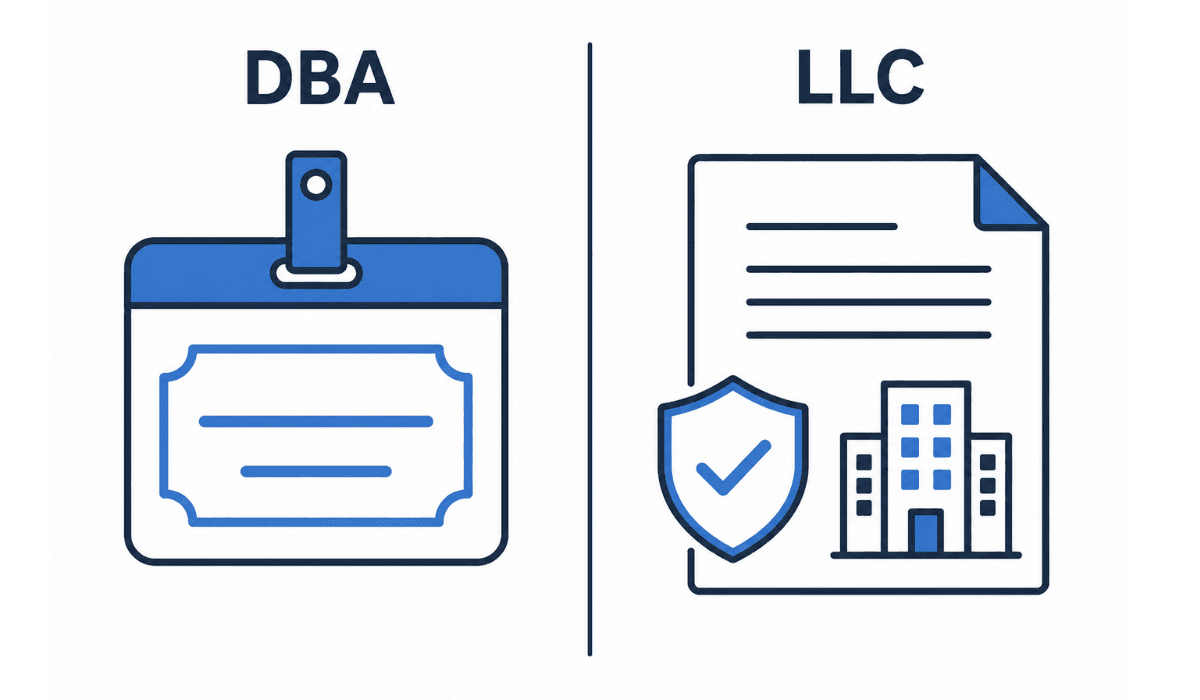
A DBA lets you use a different business name, and an LLC can help separate your personal assets from business debts or lawsuits. Read more to know which one your business needs.
Choosing between a DBA and an LLC affects how your business name works, how much paperwork you handle, and how much personal risk you may carry.
The main difference between a DBA and an LLC is that a DBA is a registered business name, while an LLC is a legal business structure.
The right choice depends on your business risk, budget, branding plans, and long-term goals. Some owners only need a DBA. Others should form an LLC first, then add a DBA under that LLC.
DBA vs. LLC: Quick Comparison
Feature | DBA | LLC |
Full meaning | Doing Business As | Limited Liability Company |
What it is | A registered business name | A legal business structure |
Legal entity | No | Yes |
Liability protection | No personal asset protection by itself | Helps protect personal assets in many cases |
Tax treatment | Does not change your tax classification | Depends on owner count and IRS elections |
Best for | Branding, trade names, low-risk name use | Liability protection, formal structure, growth |
Cost | Often lower | Usually higher |
Ongoing rules | Renewal may be required | Annual reports, state fees, registered agent, or taxes may apply |
Can they work together? | Yes, an LLC can use a DBA | Yes, an LLC can register one or more DBAs |
What Is a DBA in Business?
A DBA means "doing business as." It is also called a fictitious name, assumed name, or trade name in some states.
A DBA lets a person or business operate under a name that is different from its legal name.
For example:
- Maria Lopez wants to sell baked goods as Sweet Maple Bakery instead of using her personal name.
- Red Velvet Ventures LLC wants to launch a second brand called Red Velvet Studio.
- A sole proprietor wants a business bank account under a brand name instead of a personal name.
A DBA is helpful for branding, but it does not create a separate company. It also does not create personal liability protection. If you are a sole proprietor using a DBA, you are still the legal owner of the business.
That means business debts, claims, or lawsuits may still connect to you personally.
Also Read: How To Register a DBA Name
What If You Are Already Operating Under a DBA and Something Goes Wrong?
This is one of the most common situations business owners face, and one of the most stressful.
If you are currently running a business as a sole proprietor under a DBA and a customer files a claim, a vendor disputes a payment, or a supplier demands repayment, your DBA offers no legal wall between that problem and your personal finances.
Your home, personal savings, and other personal assets may all be exposed.
This does not mean the situation is unrecoverable. Many business owners in this position form an LLC while still operating, transfer contracts and accounts to the new entity, and move forward with the liability protection in place.
What it does mean is that waiting to form an LLC "until the business gets bigger" is a risk calculation, not a safe default. The time to put the structure in place is before a problem arises, not after.
If you are already operating without an LLC and want to understand your options, speaking with a business attorney in your state is the clearest next step.
What Is an LLC?
An LLC, or Limited Liability Company, is a business structure created under state law. The IRS defines an LLC as a business structure allowed by state statute, and LLC owners are called members.
An LLC is different from a DBA because it creates a formal legal entity. That entity can own property, open bank accounts, sign contracts, and operate under its legal name.
The U.S. Small Business Administration says LLCs can protect personal assets in most instances if the LLC faces bankruptcy or lawsuits. This can include your home, vehicle, and personal savings.
An LLC is often a better fit for businesses that:
- Sell products
- Work with clients or contracts
- Hire workers
- Have business debt
- Operate online stores
- Provide services with liability risk
- Want a more formal structure
An LLC is not a complete shield against every problem. Owners still need to keep business and personal finances separate, follow state rules, sign contracts correctly, and avoid personal guarantees when possible.
Also Read: How To Start An LLC Online
What Is the Difference Between a DBA and an LLC?
A DBA is a name. An LLC is a business entity. That difference affects liability, taxes, banking, paperwork, and growth.
Legal Structure
A DBA does not create a new business structure. It only tells the public that a person or company is using another business name.
An LLC creates a separate legal structure under state law. This gives the business its own legal identity.
Liability Protection
A DBA alone does not protect your personal assets. If you run a sole proprietorship under a DBA and the business is sued, your personal assets may still be at risk.
An LLC can help separate personal assets from business liabilities. This is one of the main reasons business owners choose an LLC over a DBA.
Business Name and Branding
A DBA helps you use a public-facing name. An LLC name is the legal name of your business entity. A business can use both. For example, Sunrise Retail LLC may register a DBA called Sunrise Baby Boutique.
Cost and Maintenance
A DBA is often cheaper to register and easier to maintain. Costs vary by city, county, and state.
An LLC usually costs more because it may require a formation filing fee, a registered agent, an annual report, state tax, or other ongoing compliance steps.
What Are the Pros and Cons of a DBA
DBA Pros | DBA Cons |
|
|
A DBA can work well for low-risk businesses that mainly need a public name. However, it neither gives liability protection nor prevents other people from using the same business name.
The Texas Secretary of State says an assumed name certificate does not prevent another party from filing the same assumed name or using that name to form a new entity. That means a DBA filing is not the same as broad name protection. [1]
What Are the Pros and Cons of an LLC
LLC Pros | LLC Cons |
|
|
An LLC can be a strong choice for owners who want to build a business that is separate from them personally. But it can also be expensive to maintain an LLC.
For example, the California Franchise Tax Board says every LLC doing business or organized in California must pay an annual tax of $800, even if it is not conducting business, until the LLC is canceled. [2]
DBA vs. LLC Taxes: What Actually Changes?
Many business owners ask if a DBA has tax benefits. A DBA itself does not create tax deductions or change how your business is taxed. Tax write-offs depend on your business expenses and tax classification, not the name you use.
For example:
- A sole proprietor with a DBA may still report business income on their personal tax return.
- A single-member LLC may be treated as disregarded as separate from its owner for federal income tax purposes unless it elects corporate taxation.
- A multi-member LLC is generally treated as a partnership for federal income tax purposes unless it elects corporate taxation.
- An LLC may elect corporate tax treatment if it qualifies and files the proper IRS forms.
A DBA can appear on invoices, bank accounts, and customer-facing materials. It does not decide your tax structure.
An LLC gives more tax flexibility, but tax savings are not automatic. Talk with a tax professional before choosing an entity, mainly for tax reasons.
Which Is Cheaper, DBA or LLC?
A DBA is usually cheaper than forming an LLC, but costs vary significantly by location.
DBA costs may include: | LLC costs may include: |
|
|
State LLC formation fees vary significantly. According to the World Population Review, filing fees range from $50 in Kentucky to $520 in Massachusetts, making state selection a real cost factor for new business owners. [3]
A DBA can be a lower-cost way to use a brand name. An LLC can cost more, but it may provide liability protection and a stronger legal structure.
The lowest-cost option is not always the best option. A business with product risk, customer contracts, debt, employees, or partners may benefit from an LLC even if the setup costs more. [4]
Also Read: LLC Costs by State Comparison (2026)
Do You Need a DBA for an LLC?
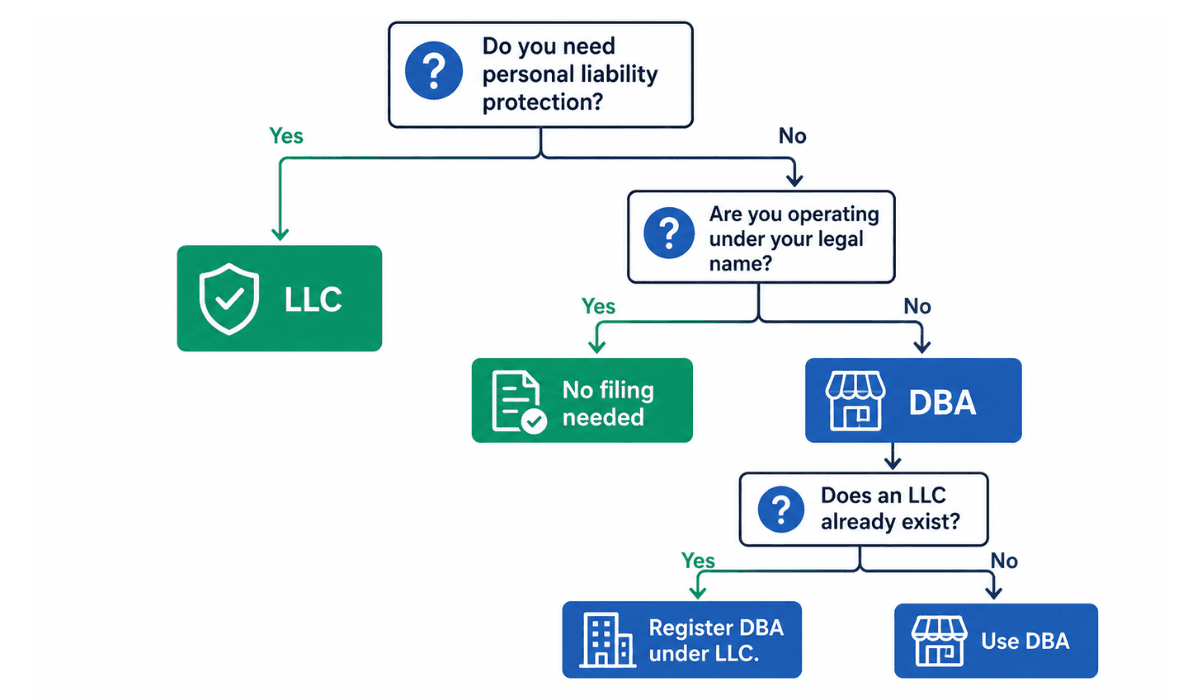
No, an LLC does not automatically need a DBA. You only need a DBA for your LLC if the LLC wants to operate under a name different from its legal name.
Example: Legal LLC name is Blue Oak Ventures LLC. DBA name is Blue Oak Bakery. The LLC can use its legal name without a DBA. A DBA becomes useful when the business wants a shorter name, a separate brand, or a different public-facing identity.
Can an LLC Have Multiple DBAs?
Yes, an LLC can often have multiple DBAs if state and local rules allow it. This can help one LLC operate different brands without forming a separate LLC for each brand.
Examples:
- An LLC owns a cleaning brand and a carpet-care brand.
- An LLC runs two online stores.
- An LLC uses different DBAs for different cities.
- An LLC tests a new service line before creating another entity.
This can be efficient, but it does not separate liability between brands the same way separate entities might. If one DBA creates a legal problem, the underlying LLC may still be involved.
What Comes First, LLC or DBA?
The best order depends on your goal.
- Choose the LLC first if you want liability protection, a formal structure, or a business entity that can own the DBA.
- Choose the DBA first only if you are a low-risk sole proprietor testing a simple brand name, and you understand that you will not get liability protection from the DBA.
A common path:
- Form the LLC.
- Get an EIN if needed. [5]
- Open the business bank account.
- Register a DBA under the LLC if the business will use a different public name.
This path can help keep the legal structure and brand name organized from the start.
Should I Choose a DBA or LLC?
Choose a DBA if: | Choose an LLC if: | Choose both if: |
|
|
|
State-Based and Problem-Based Scenarios
Scenario 1:
A Texas web designer named Jasmine wants to operate as Bright Pixel Studio instead of using her personal name. If she stays a sole proprietor, Texas may require her to file an assumed name certificate at the county level.
If Jasmine forms Bright Pixel Studio LLC, Texas treats the LLC as a filing entity. Texas says LLCs file assumed name certificates with the Secretary of State, not the county clerk.
For Jasmine, the choice depends on risk and goals. A DBA may be enough if she only wants a brand name. An LLC may be better if she signs client contracts, wants liability protection, or plans to grow.
Scenario 2:
A California seller wants to launch a candle brand called Golden Jar Goods. A DBA may help her sell under that brand name. That may work if she is testing the idea at a small scale.
The business also sells physical products. Product-based businesses can carry liability risk. An LLC may be worth considering because it can help separate personal and business liabilities.
The owner should also understand California's LLC costs. California says every LLC doing business or organized in the state must pay an $800 annual tax until the LLC is canceled. That cost matters when comparing a DBA vs. LLC.
Scenario 3:
Evergreen Home Services LLC already provides house cleaning. The owner wants to launch a carpet-cleaning brand called Fresh Floor Pros.
The owner may not need a second LLC right away. Evergreen Home Services LLC may be able to register Fresh Floor Pros as a DBA under the existing LLC.
This lets the company market a new service under a separate name while keeping one legal entity. The owner should still check whether one LLC is the right structure for liability, taxes, insurance, and bookkeeping.
Can You Change a DBA to an LLC?
A DBA does not usually "convert" into an LLC because a DBA is not a legal entity. It is a name.
A common process looks like this:
- Form a new LLC with the state.
- Decide whether the LLC's legal name will match the brand name.
- Register the old DBA under the LLC if needed.
- Update bank accounts, contracts, tax accounts, licenses, and invoices.
- Stop using or abandon the old DBA if it is no longer needed.
Example: Old setup is Jordan Lee doing business as North River Design. The new setup is North River Design LLC. Optional DBA: North River Design LLC DBA River Studio.
Check name availability before forming the LLC. A DBA filing does not always reserve or protect the name for entity formation.
Conclusion:
Choosing a DBA or LLC isn't just about branding; it’s about protection. While a DBA offers naming flexibility, only an LLC provides the legal firewall needed to safeguard your personal assets. Don’t leave your future to chance; pick the structure that secures your growth.
Whether you need a simple name registration or an LLC structure, Swyft Filings handles the paperwork so you can handle the business. Get started with us today!
Sources
- Texas Secretary of State. Name Filings FAQs. Accessed on May 29, 2026
- California Franchise Tax Board. Limited liability company. Accessed on May 29, 2026
- World Population Review. LLC Cost by State 2026. Accessed on May 29, 2026
- U.S. Small Business Administration, Choose a business structure. Accessed on May 29, 2026
- IRS. Get an employer identification number. Accessed on May 29, 2026
- IRS. S corporations. Accessed on May 29, 2026